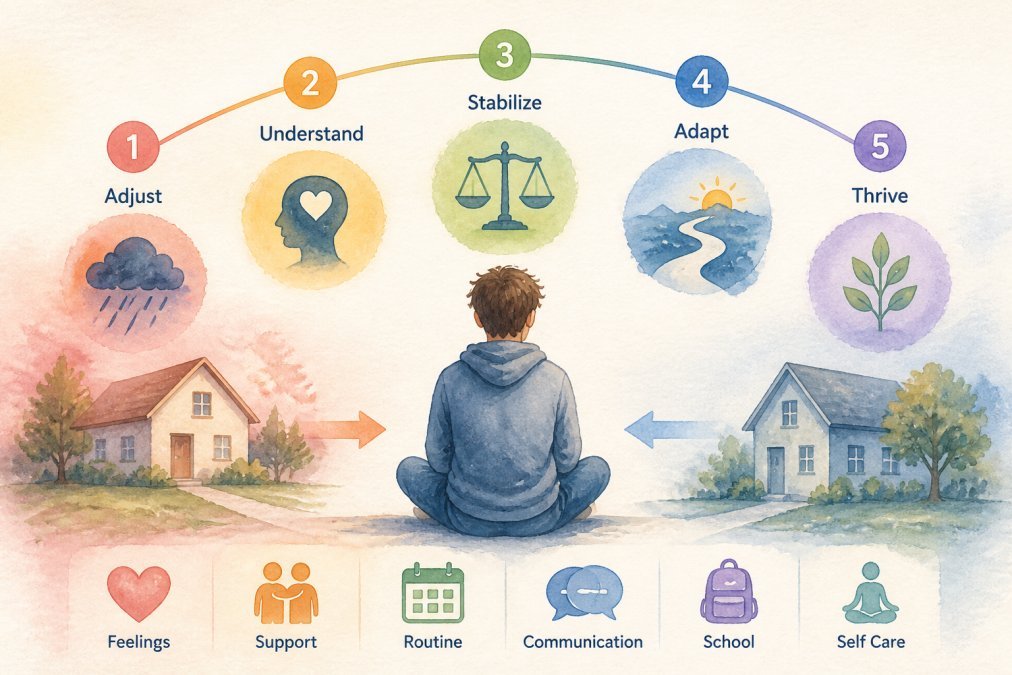
- Why the Co-Parenting Transition Is the Most Fragile Phase
- Pitfall #1: Moving Too Fast
- Pitfall #2: Expecting Trust to Reappear Instantly
- Pitfall #3: Using Kids as Indicators of Success
- Pitfall #4: Confusing Positive Communication With Readiness
- Pitfall #5: Not Preparing the Children Properly
- Pitfall #6: Letting Old Triggers Return
- Pitfall #7: Believing Co-Parenting Means Emotional Closeness
- Pitfall #8: Ignoring the Need to Paus
- FAQ: Co-Parenting Transition Pitfalls
Why the Co-Parenting Transition Is the Most Fragile Phase
Moving from parallel parenting into collaborative co-parenting is not a simple “upgrade” ; it’s one of the most emotionally delicate phases of separated parenting.
You’re shifting from:
- distance → coordination
- structured boundaries → shared decision-making
- emotional protection → emotional exposure
- minimal communication → active teamwork
And because the wounds of infidelity are often still present, even small misunderstandings can trigger big reactions.
This post is based on your “Common Pitfalls During the Transition” article Common_Pitfalls_During_the_Tran…. These are the mistakes parents fall into without realizing it — and how to avoid them to keep your child safe and stable.
Pitfall #1: Moving Too Fast
Most transitions fail because parents rush.
When cooperation seems possible again, parents sometimes jump straight to:
- joint decision-making
- flexible schedules
- frequent communication
- casual in-person conversations
- “let’s try more shared routines”
But moving too fast overwhelms children AND reignites conflict between parents.
How to avoid it:
Use a three-step pace:
Step 1 — Micro-changes: One small aligned routine or shared update at a time.
Step 2 — Limited collaboration: Agree on a single shared rule (bedtime, homework, screens).
Step 3 — Gradual teamwork: Only after 6–12 weeks of stability.
Slow = safe. Fast = friction.

Pitfall #2: Expecting Trust to Reappear Instantly
Infidelity destroys trust — in your partner, in the relationship, and even in the stability of the parenting dynamic.
Many transitions collapse because one parent expects:
- fast forgiveness
- immediate openness
- warm communication
- emotional closeness
- effortless cooperation
But trust in co-parenting is earned through consistent behavior, not hopeful intentions.
How to avoid it:
Focus on:
- predictable routines
- calm responses
- written communication
- showing up on time
- respecting boundaries
- emotional regulation
Trust returns through stability, not speed.
Pitfall #3: Using Kids as Indicators of Success
Parents often interpret:
- “The kids seem happy”
- “They were excited today”
- “They said it feels better now”
as a sign that the transition is working.
But children frequently mask stress to avoid upsetting parents. They may seem “fine” while becoming:
- anxious
- confused
- avoidant
- over-responsible
- emotionally overwhelmed
How to avoid it:
Look at behavior, not words.
Signs the transition is too fast:
- sleep disruption
- irritability
- regression
- tummy aches
- school problems
- tearfulness
- withdrawal
If these appear, slow down or pause.
Pitfall #4: Confusing Positive Communication
With Readiness
Sometimes the communication starts to feel a little easier:
- polite texts
- calmer tone
- neutral exchanges
- a moment of friendliness
Parents assume:
“Maybe we’re ready to collaborate again!”
But early post-infidelity communication is fragile. One misunderstanding can create setbacks.
How to avoid it:
Look for consistency, not sparks of goodwill.
Ask:
- Has communication been calm for 6+ weeks?
- Do we handle disagreements well?
- Are boundaries respected?
- Do minor issues stay minor?
If yes, THEN consider collaboration.
Pitfall #5: Not Preparing the Children Properly
Parents sometimes:
- tell kids too early
- skip the preparation step
- use confusing explanations
- create false hope (“We’re getting along better!”)
- pressure kids to respond positively
- show their own emotional excitement
This destabilizes children.
How to avoid it:
Follow a child-centered script:
“We’re trying a new way of working together to make things calmer and smoother for you. You don’t need to worry. We will handle all the grown-up parts.”
Children need reassurance, not emotional weight.
Pitfall #6: Letting Old Triggers Return
Even after months of progress, old patterns can reappear:
- defensiveness
- guilt
- jealousy
- resentment
- fear
- suspicion
- stress
- old hurts resurfacing
This doesn’t mean you’re failing — it means you’re human.
How to avoid it:
When you become triggered:
- pause communication
- switch to written messages
- regulate before responding
- revisit boundaries
- slow the transition
- communicate only when calm
Self-regulation is key.
Pitfall #7: Believing Co-Parenting Means Emotional Closeness
Some parents interpret “co-parenting” as:
- being friends
- having warm conversations
- doing shared events
- complimenting each other
- rebuilding emotional intimacy
These are lovely — but not required and sometimes harmful in early transition.
How to avoid it:
Focus on functional closeness, not emotional closeness.
Co-parenting is:
- respectful
- calm
- predictable
- child-centered
- low-conflict
It is not a relationship reunion.
Pitfall #8: Ignoring the Need to Paus
Transition doesn’t have to be linear.
If conflict returns:
- pause
- reset
- reduce communication
- return temporarily to parallel parenting
- revisit the plan
- stabilize
- try again later
This is not failure — it’s responsiveness.
FAQ: Co-Parenting Transition Pitfalls