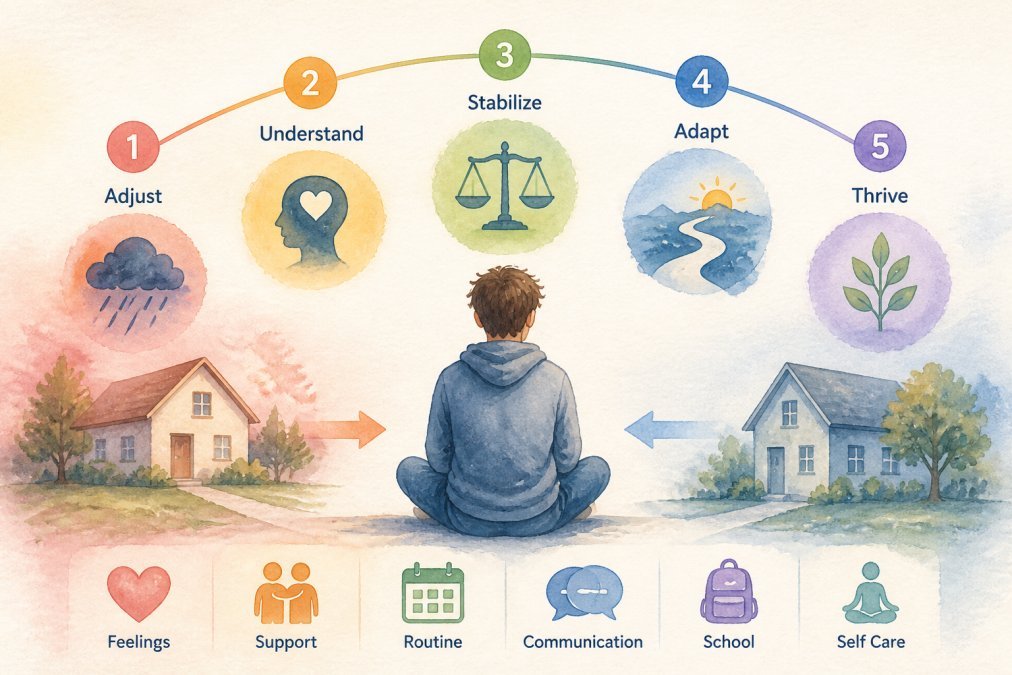
- The Transition Doesn’t Start With a Schedule, It Starts With Emotional Safety
- 1. Start Preparing Emotionally Before You Prepare Logistically
- 2. Prepare Yourself Before Talking to Your Child
- 3. Keep Explanations Simple, Neutral, and Developmentally Correct
- 4. Give Children Enough Time to Process (But Not Too Much)
- 5. Anchor the Conversation With Predictability
- 6. Introduce the Change in Small Emotional Pieces
- 7. Normalize Every Emotional Response
- 8. Adjust Your Parenting Style Temporarily
- 9. Limit Exposure to Co-Parent Conflict
- 10. Give Your Child a Simple, Predictable “Transition Ritual”
- The Most Important Thing You Can Say
- FAQ: Preparing Kids for Parenting Changes
The Transition Doesn’t Start With a Schedule,
It Starts With Emotional Safety
Too many parents assume that when a parenting plan changes, they simply need to:
- explain it
- update the schedule
- tell the child what’s next
But the truth is:
Children don’t react to the plan, they react to how their nervous system feels BEFORE the plan begins.
Emotional preparation is the single biggest factor in whether a child adapts smoothly or struggles intensely.
Let’s break down exactly how to prepare your child for upcoming parenting changes, gently, securely, and developmentally.
1. Start Preparing Emotionally Before
You Prepare Logistically
Parents tend to:
- finalize schedules
- coordinate routines
- inform lawyers
- update calendars
But they delay preparing the child.
This creates emotional shock.
According to the Child Mind Institute, children cope best when transitions include emotional preparation before logistical changes occur (childmind.org).
✔ What to do first:
- stabilize your emotional tone
- regulate your stress
- make your home feel calm
- reduce obvious tension
- observe your child’s current stress level
The child must feel safe, regulated, and grounded before changes are introduced.
2. Prepare Yourself Before Talking to Your Child
Your child’s emotional reaction is shaped by your nervous system.
If you feel:
- angry
- anxious
- triggered
- overwhelmed
- confused
– your child will feel it instantly.
✔ Before speaking to your child:
- practice the script out loud
- anticipate hard questions
- breathe deeply
- decide what you will (and won’t) share
- anchor yourself in calm, neutral facial expression
- remember: Your tone is the message.
The American Psychological Association (APA) notes that children’s stress decreases when parents present changes with emotional neutrality and confidence (apa.org).
3. Keep Explanations Simple, Neutral, and Developmentally Correct
Children don’t need:
- details
- adult explanations
- blame
- emotional stories
- reasons
- moral judgments
They need:
- clarity
- safety
- predictability
- reassurance
✔ Effective explanation formula:
- What is changing (simple)
- Why the grown-ups decided it (neutral)
- What stays the same (reassuring)
- How the child will still be safe and loved
Example:
“Mom and Dad are changing the way we take care of you so things feel calm and predictable. You didn’t do anything wrong. You will still see both of us, and you are safe.”
Short. Neutral. Reassuring.
4. Give Children Enough Time to Process
(But Not Too Much)
Too sudden = anxiety spike
Too early = rumination, confusion, fear
✔ Ideal timing:
3–7 days before the change for younger children
1–2 weeks before the change for older children and teens
This range gives them time to adjust while preventing catastrophic thinking.
5. Anchor the Conversation With Predictability
Children cope with emotional uncertainty through rhythm.
During the transition week, make everything in your home:
- more structured
- more predictable
- more stable
- more calm
- more consistent
What children hear: “Things are changing.”
What they feel: “But the world is still safe.”
Consistency is medicine.
6. Introduce the Change in Small Emotional Pieces
Your conversation should not be one big announcement.
Break the transition into micro-preparations:
✔ Step 1: Emotional safety
“We’re here. You’re safe.”
✔ Step 2: Simple explanation
“There will be a small change.”
✔ Step 3: What stays the same
“You will still be with both parents.”
✔ Step 4: Predictable schedule
“This is what it will look like.”
✔ Step 5: Validation
“It makes sense if you have big feelings.”
✔ Step 6: Assurance
“We will handle all the adult parts.”
This prevents overwhelm.
7. Normalize Every Emotional Response
Children may react with:
- anger
- sadness
- confusion
- silence
- curiosity
- clinginess
- withdrawal
- indifference
Every reaction is normal.
Use phrases like:
“It’s okay to feel that.”
“Your feelings make sense.”
“You don’t have to hide how you feel.”
“Nothing you feel will upset me.”
Children heal when feelings are accepted, not corrected.

8. Adjust Your Parenting Style Temporarily
During the transition:
✔ Increase emotional availability
Sit closer, listen more, initiate connection.
✔ Reduce discipline intensity
Focus on teaching, not correcting.
✔ Strengthen predictability
Bedtime, meals, transitions → stay the same.
✔ Provide more reassurance
Repeat safety messages, especially before bed.
These adjustments signal to your child: “You’re not going through this alone.”
9. Limit Exposure to Co-Parent Conflict
Kids don’t need to:
- feel the tension
- hear disagreements
- see negative micro-expressions
- listen to frustrated phone calls
- witness emotional reactivity
Conflict during transitions is the #1 predictor of child distress.
Protect your child’s nervous system by:
✔ keeping exchanges extremely brief
✔ staying neutral and calm
✔ never discussing logistics in front of your child
✔ using written communication
10. Give Your Child a Simple, Predictable “Transition Ritual”
Rituals build security.
Examples:
- “Transition snack”
- Reading the same book
- Five-minute cuddle
- Bedtime message (“Safe, loved, tomorrow is a new day.”)
- Light walk together
- “Three good things” reflection
Small rituals = big emotional safety.
The Most Important Thing You Can Say
No matter the child’s age:
“This is not your fault. You are safe. We love you. You do not have to fix anything.”
This single message acts as emotional glue during instability.
FAQ: Preparing Kids for Parenting Changes