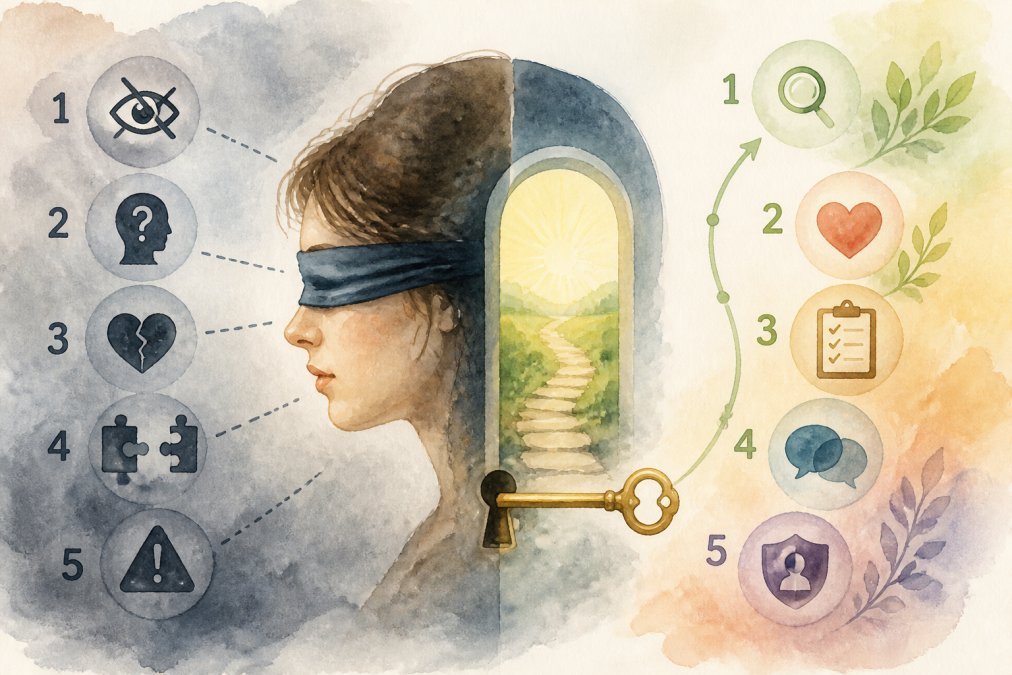
- How to choose books to read after being cheated on
- The first 0–6 months: crisis, shock, and intrusive thoughts
- Months 6–12: clarity, boundaries, and deciding what happens next
- After one year: rebuilding identity, trust in self, and long-term transformation
- Practical workbooks: when reading isn’t enough
- A few cautions that protect your healing
- What to read based on the question you can’t stop asking
You don’t need a “fix your relationship” book right now. Not in the first hours, days, or even weeks after discovering infidelity—when your body is running on adrenaline, your mind is replaying scenes you didn’t consent to imagine, and every choice feels permanent.
What you need first is stabilization: language for what’s happening to you, simple tools to get through the next surge, and a structure that helps you decide what to do next without being pressured into forgiveness or separation before you’re ready.
The right books can help—but only if you choose them for your stage of recovery, not for the version of you you were before the betrayal.
How to choose books to read after being cheated on
A book that feels “too intense” isn’t necessarily wrong; it may just be early. Likewise, a gentle, reassuring book can be a lifeline in month one and feel inadequate in month six.
A helpful way to choose is to match reading to three needs:
- nervous system regulation (because betrayal often lands like trauma),
- meaning-making (so you’re not stuck in obsessive analysis), and
- decision support (so you’re not trying to rebuild trust without boundaries, or leave without grief support).
You’ll also want to notice the author’s stance. Some books assume reconciliation is the goal. Others treat separation as the only self-respecting option. Many people need something more emotionally responsible: a steady guide that supports clarity before commitment.
The first 0–6 months: crisis, shock,
and intrusive thoughts
In this phase, your job isn’t to “be strong.” Your job is to get through the day without losing yourself. Books that normalize trauma responses and teach grounding skills tend to be most useful here.
1) The Body Keeps the Score (Bessel van der Kolk)
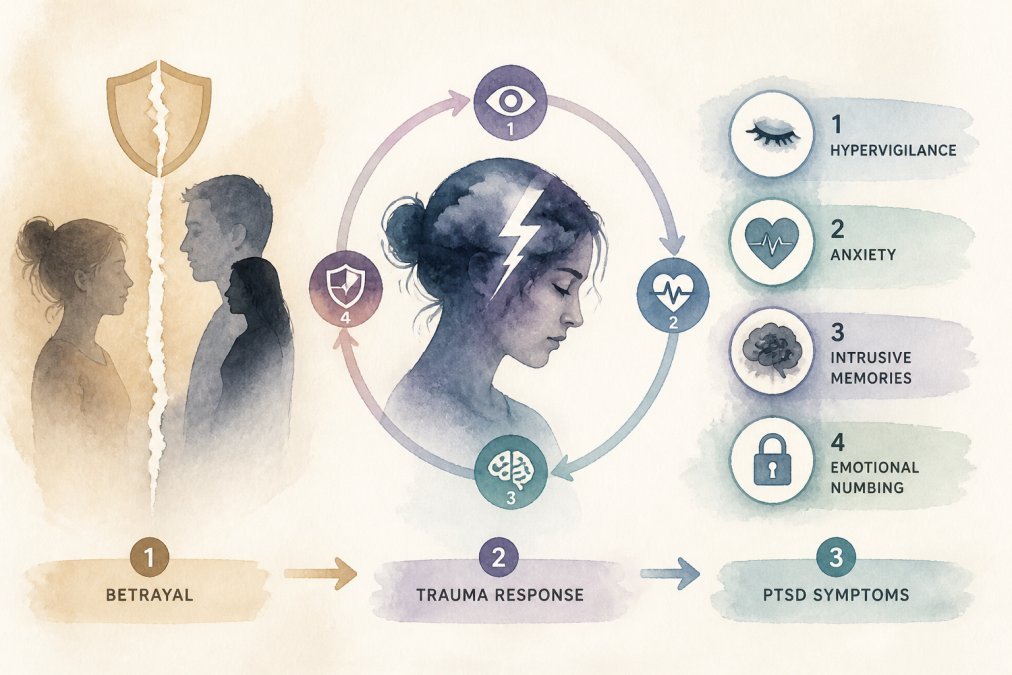
This is not an infidelity book, and it’s not light reading. But for many betrayed partners, it’s the first time someone explains why the body reacts as if there’s ongoing danger—sleep disruption, hypervigilance, nausea, numbness, and sudden panic.
Trade-off: if you’re newly destabilized, parts of it can feel heavy. Read in small doses and pair it with practical grounding—eat, hydrate, and don’t read it at midnight when you’re already spinning.
2) Not “Just Friends” (Shirley P. Glass)
This is one of the most referenced books in affair recovery for a reason: it offers clear language for how boundaries erode, how secrecy reshapes reality, and how trust is damaged and repaired.
It can be particularly clarifying if your partner insists “nothing happened” because it was “only texting,” “only emotional,” or “only once.” You’ll find frameworks that help you evaluate behavior, not excuses.
3) Cheating in a Nutshell (Wayne and Tamara Mitchell)
If you’re asking, “Why can’t I just get over it?” this book answers that question with blunt honesty about betrayal’s psychological impacts. Many readers feel deeply validated—especially those who have been told they’re “dwelling” or “punishing.”
Trade-off: its tone can feel uncompromising. If you’re trying to reconcile and you need a book that supports both accountability and repair, you may want to balance it with a reconciliation-focused resource.
Months 6–12: clarity, boundaries,
and deciding what happens next
Once the initial shock softens (not disappears), the questions change. You may still have triggers, but you also start noticing patterns: avoidance, defensiveness, minimization, trickle-truth, or genuine accountability.
This is where books that support boundary-setting, attachment repair, and values-based decision-making become more useful than “what is an affair?” primers.
4) Hold Me Tight (Dr. Sue Johnson)
Infidelity often exposes attachment injuries: fear of abandonment, fear of not being enough, fear of depending on someone unsafe. This book is grounded in Emotionally Focused Therapy (EFT) and helps couples understand their conflict cycles and move toward safer connection.
It depends: this is most helpful when the unfaithful partner is willing to engage in repair, not just “move on.” If you’re still getting blame-shifting or secrecy, it may feel premature.
5) Set Boundaries, Find Peace (Nedra Glover Tawwab)
After betrayal, many people confuse boundaries with ultimatums, or confuse “being understanding” with self-abandonment. This book helps you name what you will and won’t accept—and how to communicate it without overexplaining.
This matters whether you stay or leave. Boundaries aren’t a relationship tactic; they’re a nervous system safety plan.
6) Attached (Amir Levine and Rachel Heller)
Attachment theory isn’t an excuse for cheating, but it can explain why betrayal hits some people like a total identity collapse, and why some couples get locked in pursuer–distancer dynamics after discovery.
Trade-off: it can be tempting to use attachment labels as diagnoses (“he’s avoidant, so he can’t change”). Use it as a lens for patterns and needs—not as a verdict.
After one year: rebuilding identity, trust in self, and long-term transformation
At this point, many betrayed partners are tired of being “the person this happened to.” Whether you reconciled, separated, or are still unsure, the work becomes less about the affair and more about your life: self-trust, meaning, sexuality, and the kind of partnership you want going forward.
7) The Gifts of Imperfection (Brené Brown)
Shame is one of the quiet aftershocks of betrayal. Even when you logically know you didn’t cause it, your body may still carry “I wasn’t enough.” This book gently challenges the performance-and-perfection mindset and helps you build worthiness from the inside.
8) Rising Strong (Brené Brown)
If you keep replaying conversations, rewriting the story, or second-guessing your decisions, this one supports the messy middle: how to process reality without collapsing into self-blame or fantasy.
It’s especially useful if you’re rebuilding after separation, or if reconciliation has forced you to grieve the relationship you thought you had.
9) The State of Affairs (Esther Perel)
This is a nuanced, sometimes provocative look at infidelity’s meanings in modern relationships. Some readers feel understood; others feel it risks over-explaining the unfaithful partner.
It depends: if you’re in early trauma and craving accountability language, this may not be the first pick. If you’re later in recovery and trying to make sense of the “why” without excusing harm, it can be valuable.
Practical workbooks: when reading isn’t enough
At a certain point, insight stops being soothing if it doesn’t translate into action. That’s where structured exercises—journaling prompts, boundary scripts, disclosure questions, and trigger plans—become more effective than another chapter of theory.
10) The Betrayal Bind (Michelle Mays)
This book is often recommended for betrayal trauma because it names the push–pull of loving someone who hurt you, the obsessive loops, and the physiology of threat bonded attachment.
If you feel “crazy,” conflicted, or stuck checking devices and rereading messages, it offers a compassionate map—and practical ways to work with your nervous system rather than against it.
11) A stage-based infidelity recovery workbook
If you’re looking for books to read after being cheated on that don’t just validate pain but actually guide next steps, prioritize resources that are explicitly stage-based (crisis → clarity → rebuild → transform) and specific about different affair dynamics.
One option aligned with that approach is the After the Affair series and companion workbook at https://Aftertheaffair.uk, which uses a structured timeline and a “types of infidelity” framework to match strategies to what actually happened—because recovering from a long-term emotional affair is not the same as recovering from serial cheating or an exit affair.
A few cautions that protect your healing
Some books—often unintentionally—push betrayed partners into emotional labor that isn’t theirs. If a resource emphasizes “your part” before it addresses honesty, repair, and accountability, it can deepen self-blame.
Also be wary of books that treat “closure” as a conversation you earn by performing calmness. In betrayal, closure is usually a practice: getting enough truth to make an informed decision, then building a life that doesn’t require the full story to feel stable.
Finally, don’t underestimate pace. Reading too much too fast can become another form of hypervigilance—trying to think your way out of pain. Sometimes the most healing choice is to read one chapter, then take a walk, eat real food, and let your body learn that the emergency is not every minute.
What to read based on the question you can’t stop asking
If your mind is stuck on “Was it really an affair?” start with Not “Just Friends”.
If you’re stuck on “Why am I falling apart?” start with The Body Keeps the Score or The Betrayal Bind.
If you’re stuck on “Should I stay or go?” choose something that strengthens boundaries and clarity (Set Boundaries, Find Peace), then add a relationship repair lens (Hold Me Tight) only if there’s real accountability.
If you’re stuck on “Who am I now?” pick something oriented toward identity and resilience (The Gifts of Imperfection or Rising Strong).
The book that helps most is the one that meets your exact moment—not the one that promises a fast reset. Let your reading be a stabilizing companion: a few pages that bring you back to yourself, one steady step at a time.