Infidelity Recovery Workbook
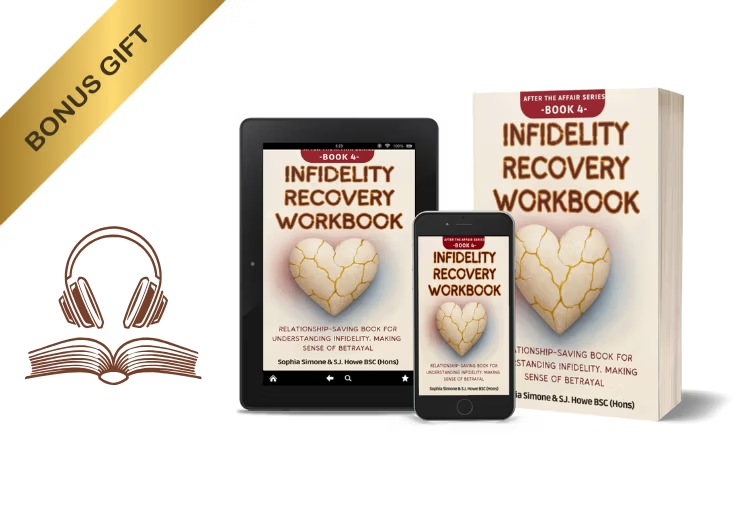
Reading about healing is important. But transformation happens when you actively engage with the work. This comprehensive workbook turns insight into action.
Your healing deserves more than passive reading
The Infidelity Recovery Workbook provides practical exercises, guided journaling prompts, self-assessment tools, and worksheets for every stage of recovery. Use it alongside Books 1-3 or as a standalone resource to deepen your healing journey.
Frequently Asked Questions
How is the infidelity recovery workbook different from the other books in the series?
While Books 1-3 provide information, guidance, and strategies, the workbook is entirely focused on application. It includes therapeutic exercises, guided journaling prompts, self-reflection questions, progress tracking tools, and practical worksheets. The workbook transforms passive reading into active healing work, helping you process your emotions, track your progress, and implement the strategies from the main books in concrete ways.
Do I need to read Books 1-3 before using the workbook?
No, the workbook can be used as a standalone resource. Each exercise includes enough context to be valuable on its own. However, using the workbook alongside Books 1-3 provides the deepest benefit. The books give you the framework and understanding, while the infidelity recovery workbook helps you apply it to your specific situation. Many readers use the workbook concurrently with the main books, completing relevant exercises as they read each chapter.
What types of exercises are included in the workbook?
The infidelity recovery workbook includes diverse exercises for different aspects of healing: guided journaling for processing emotions, self-assessment tools for tracking progress, communication worksheets for difficult conversations, decision-making frameworks for major choices, values clarification exercises, boundary-setting templates, trigger identification and management tools, self-care planning worksheets, goal-setting exercises, and gratitude and meaning-making prompts. Each exercise is designed to be practical and immediately applicable.
Can I use infidelity recovery workbook with my partner or is it just for individual work?
The workbook includes both individual and couples exercises. Some sections are specifically designed for solo reflection and processing, while others include partner exercises for rebuilding communication, trust, and intimacy together. The workbook clearly labels which exercises are for individual use and which can be done with your partner. Many couples find that doing individual exercises separately and then sharing insights creates powerful conversations.
How do I know which exercises to do and when?
The workbook is organized by recovery stage (early crisis, stabilization, decision-making, rebuilding, thriving) so you can focus on exercises relevant to where you are in your journey. Each section includes guidance on when that exercise is most helpful. You don’t have to complete exercises in order: use the table of contents to find what you need when you need it. Some exercises you’ll return to multiple times as you progress.
How do I know which exercises to do and when?
The workbook is organized by recovery stage (early crisis, stabilization, decision-making, rebuilding, thriving) so you can focus on exercises relevant to where you are in your journey. Each section includes guidance on when that exercise is most helpful. You don’t have to complete exercises in order—use the table of contents to find what you need when you need it. Some exercises you’ll return to multiple times as you progress.
What if writing about my feelings is too painful?
The infidelity recovery workbook acknowledges that some exercises may be emotionally challenging. Each section includes guidance on pacing yourself, taking breaks when needed, and knowing when to seek professional support. You’re encouraged to work at your own pace—there’s no requirement to complete everything, and it’s okay to skip exercises that feel too overwhelming and return to them later. The workbook also includes grounding exercises to use when emotions become too intense.
Can I use the workbook if I’m in therapy?
Absolutely! Many therapists encourage clients to use workbooks between sessions to deepen therapeutic work. The exercises can provide valuable material to discuss in therapy, help you track progress, and give you concrete tools to practice between sessions. Some therapists even assign specific exercises as “homework.” The workbook complements professional therapy—it doesn’t replace it. If you’re working with a therapist, consider sharing the workbook with them so they can guide you toward the most relevant exercises.
How long does it take to complete the infidelity recovery workbook?
There’s no set timeline—the workbook is designed to be used throughout your healing journey, which can span months or years. Some people work through it systematically over several months, while others use it as an ongoing resource, returning to relevant exercises as new challenges arise. The goal isn’t to “finish” the workbook quickly, but to use it as a tool for deepening your healing at whatever pace feels right for you.
What if my partner won’t do the couples exercises with me?
The workbook includes guidance for this common scenario. Many exercises can be adapted for individual use even if they’re designed for couples. You can still benefit from clarifying your own thoughts, feelings, and needs even if your partner isn’t ready to engage. The workbook also addresses how to communicate about your desire to work on the relationship together and what it means if your partner consistently refuses to participate in recovery work.
Can I use the workbook if I decided to leave the relationship?
Yes! While some exercises are specifically for couples rebuilding together, many sections are valuable regardless of relationship status. The infidelity recovery workbook includes exercises for: processing grief about the relationship ending, rebuilding self-esteem, clarifying your values and vision for the future, setting boundaries, healing from trauma, and creating a fulfilling life on your own. The healing work is important whether you stayed or left.
How do I track my progress through recovery?
The infidelity recovery workbook includes specific progress-tracking tools including: baseline assessments to complete early in recovery, periodic check-ins to measure healing markers, mood and trigger tracking logs, and milestone celebrations. These tools help you recognize progress that might otherwise be invisible, especially during difficult periods when it feels like you’re not moving forward. Seeing concrete evidence of your growth can be incredibly encouraging.
What makes this infidelity recovery workbook different from other infidelity recovery resources?
This workbook is specifically designed to complement the 7 Types of Infidelity framework from the After the Affair series. It includes type-specific exercises that address the unique challenges of each affair type, ensuring your healing work is tailored to your situation rather than generic. The workbook also integrates trauma-informed approaches, recognizing that betrayal is a traumatic experience that requires specialized healing strategies. Finally, it’s comprehensive—covering every stage from crisis to thriving.
Get the Complete Infidelity Recovery Series
Each book builds on the previous one, creating a comprehensive recovery system that supports you through every stage of healing.