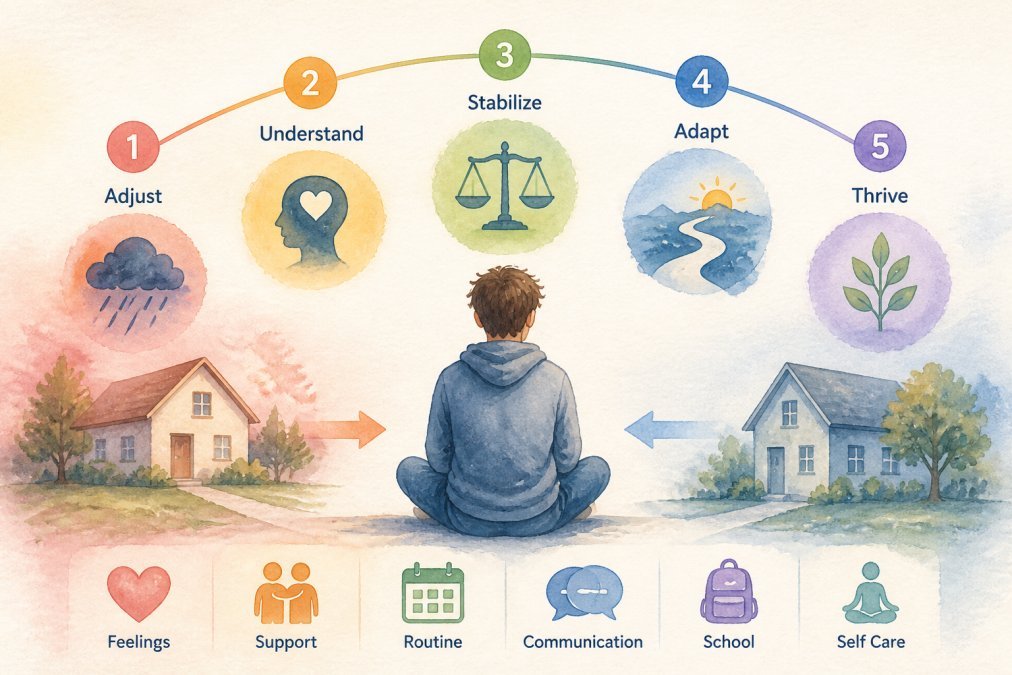
- Infidelity Doesn’t Determine a Child’s Future,But Parental Response Does
- 1. Rebuilding Begins With Emotional Safety
- 2. Routine Is the First Form of Healing
- 3. Children Rebuild Trust Through Parental Behavior, Not Words
- 4. Resilience Grows When Children Feel Heard (Without Being Overloaded)
- 5. Kids Need Permission to Love Both Parents
- 6. Secure Attachment Is Rebuilt Through “Micro-Moments”
- 7. Emotional Regulation Skills Change Everything
- 8. Resilience Grows When Conflict Stays Away From Children
- 9. Parallel Parenting Can Improve Resilience
- 10. Professional Support Accelerates Healing (When Needed)
- What Resilience Looks Like in Children
- FAQ: Building Resilience in Kids After Infidelity
Infidelity Doesn’t Determine a Child’s Future,
But Parental Response Does
Infidelity is a rupture in the family system.
But it is not automatically a childhood trauma. What matters is what happens after the rupture.
Children become resilient when the environment around them becomes stable, warm, and predictable, even if the parents are no longer together
This article breaks down exactly HOW children rebuild resilience and what parents can do to guide that healing.
1. Rebuilding Begins With Emotional Safety
Resilience requires a regulated nervous system — and a child can only regulate when the home environment is:
- calm
- predictable
- emotionally warm
- safe from conflict
The National Child Traumatic Stress Network (NCTSN) notes that a child’s most important protective factor is the presence of at least one calm, attuned caregiver (nctsn.org).
Children heal best when they feel:
- “My home is safe.”
- “My parent is steady.”
- “I don’t have to fix anything.”
- “The grown-ups will take care of the grown-up problems.”
Your emotional tone becomes their emotional thermostat.
2. Routine Is the First Form of Healing
Kids feel stable when life is predictable.
During and after infidelity, routines often break:
- bedtime gets inconsistent
- school mornings become chaotic
- parents become distracted
- transitions become tense
- emotional tone becomes unpredictable
To rebuild resilience, routines must become the “anchors” again:
- same bedtime each night
- consistent morning rhythms
- predictable mealtimes
- clear transition timing
- weekly rituals
Routine sends a message to the child’s nervous system: “Life is stable again.”
3. Children Rebuild Trust Through
Parental Behavior, Not Words
Kids don’t care about promises.
They care about:
- showing up on time
- consistency
- calm tone
- reliability
- predictability in transitions
- respect between homes
- reliable emotional presence
The American Psychological Association (APA) says that children rebuild trust when caregivers behave consistently over time, not when they offer explanations (apa.org).
Trust is not taught.
Trust is felt through patterns.
4. Resilience Grows When Children Feel Heard (Without Being Overloaded)
Children need space to talk, but they should not be burdened with adult information.
Healthy emotional conversations look like:
“How’s your heart today?”
“What was the hardest part of the week?”
“Are you feeling confused about anything lately?”
“No matter what happened between the adults, you are safe.”
Avoid:
- blame
- details
- anger
- emotional unloading
- guilt-based conversations
Kids heal when their feelings are welcome, not when they’re responsible for YOURS.
5. Kids Need Permission to Love Both Parents
Resilience grows when children feel free to have:
- two safe homes
- two loving relationships
- no loyalty conflicts
Infidelity often breeds emotional tension.
Kids sense it immediately.
They need to hear:
“You are allowed to love both of us.”
“Nothing happening between us changes how we feel about you.”
“You never have to choose.”
This neutralizes loyalty conflicts, one of the biggest barriers to resilience.
6. Secure Attachment Is Rebuilt Through
“Micro-Moments”
Healing moments are often tiny:
- brushing hair
- reading together
- sitting beside your child during homework
- small jokes
- shared rituals
- bedtime check-ins
- asking “Are you okay?”
- hugging without rushing
Micro-moments build securely attached children, not big emotional conversations.
7. Emotional Regulation Skills Change Everything
Children who struggle after infidelity often can’t regulate their emotions because their environment became unpredictable.
Teach them:
- naming emotions (“That feels like frustration.”)
- breathing techniques
- grounding exercises
- “pause and choose” skills
- drawing their feelings
- using a “calm-down space”
Not by lecturing, but by modeling.
Kids learn emotional regulation through your body, not your words.
8. Resilience Grows When Conflict Stays
Away From Children
Even quiet tension harms kids.
Hurt parents often slip into:
- sighing during transitions
- subtle comments
- eye rolls
- tight tone of voice
- sarcastic messages
- emotional withdrawal
Children read micro-expressions like experts.
Protect resilience by committing to:
✔ neutral tone
✔ short transitions
✔ no arguing
✔ no criticizing other parent
✔ no emotional displays at hand-offs
Conflict is the #1 enemy of resilience.

9. Parallel Parenting Can Improve Resilience
Many parents believe they must co-parent immediately for their child to thrive.
Not true.
- fewer emotional triggers
- predictable structure
- lower conflict exposure
- calmer transitions
- more emotional safety
Kids become more resilient when parents stop trying to force cooperation during the raw emotional stage.
Later, co-parenting becomes easier, because the child’s foundation is stable.
10. Professional Support Accelerates Healing (When Needed)
Children may benefit from:
- play therapy
- child counseling
- family support services
- school counselor check-ins
Especially if they show:
- regression
- withdrawal
- somatic symptoms
- defiance
- intense anxiety
- sleep changes
- school decline
Therapy is not a sign of failure, it’s support for a child experiencing emotional disruption.
What Resilience Looks Like in Children
Over time, children show resilience through:
- calmer emotions
- stable sleep
- improved school performance
- healthy independence
- honest communication
- secure connection with both parents
- fewer regressions
- better mood stability
- more confidence
This is the future you are building, every predictable routine, every calm moment, every neutral transition matters.
FAQ: Building Resilience in Kids After Infidelity