- What “betrayal trauma” actually means after cheating
- Betrayal trauma symptoms after cheating (what it can look like)
- Why these symptoms happen (and why you can’t “logic” them away)
- The first weeks: what helps most when you’re in crisis
- Months 1–12: how symptoms change (and what to watch for)
- Infidelity type matters more than most people think
- A closing thought you can borrow on hard days
You might be making dinner, answering an email, or driving to work—and suddenly your body reacts like there’s an emergency. Heart racing. Hands shaking. A rush of nausea or heat in your face. Then the images start: what they did, what they lied about, what you didn’t know. If this is your life after discovering cheating, you’re not “being dramatic.” You’re describing betrayal trauma.
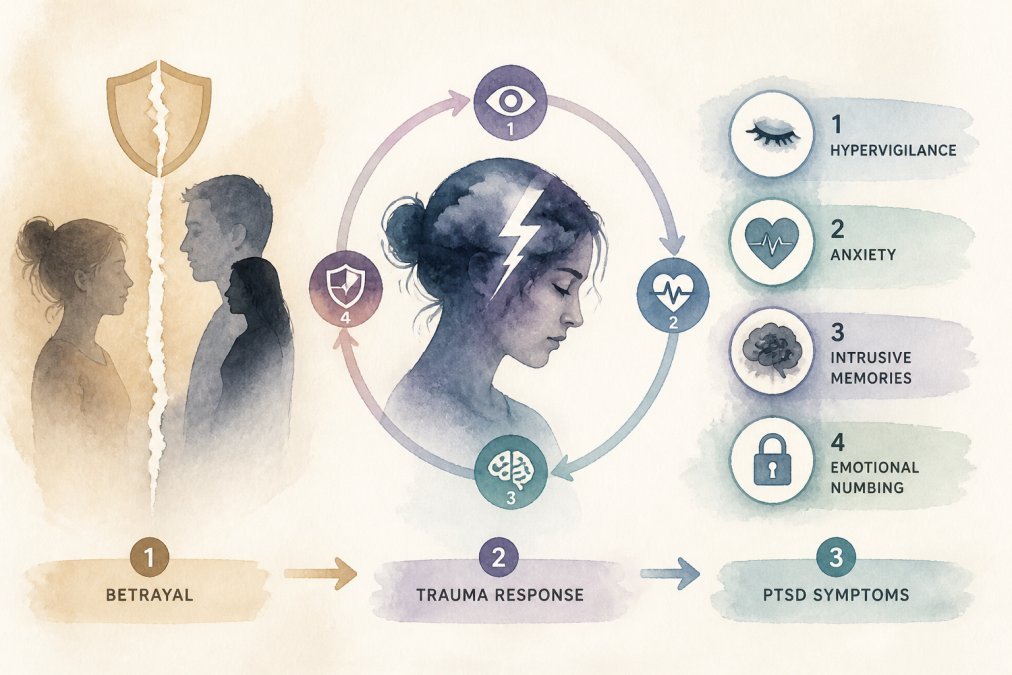
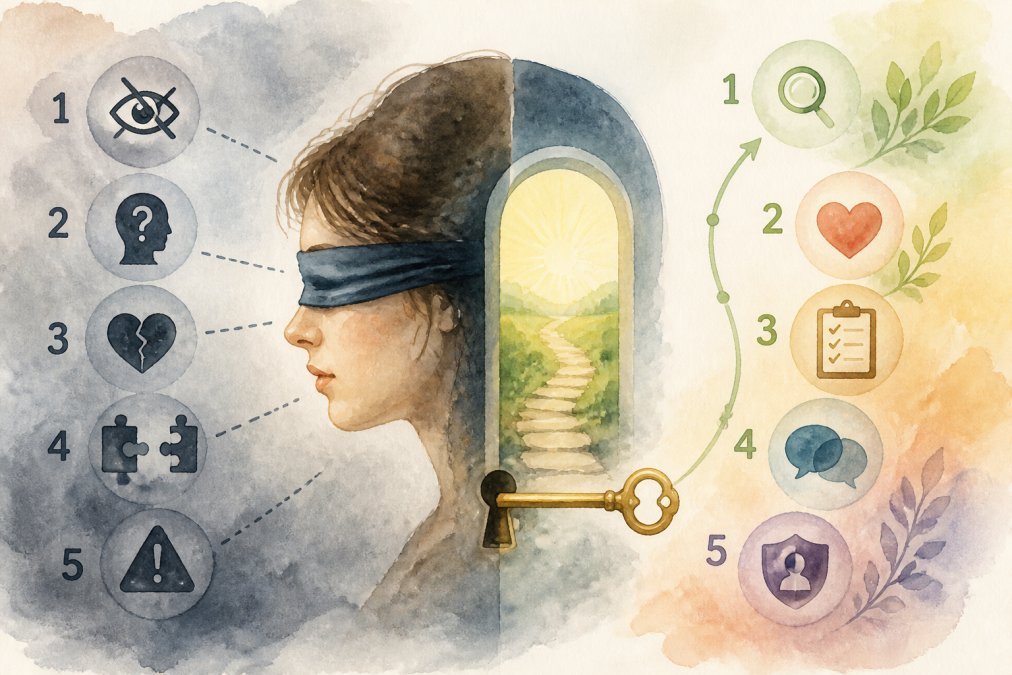
Betrayal trauma is what can happen when the person you relied on for emotional safety becomes the source of threat. It’s not only grief and heartbreak (though it includes those). It’s also a nervous-system injury: your mind and body trying to protect you after trust was broken in the place you expected refuge.
What “betrayal trauma” actually means after cheating
When infidelity is discovered, your brain scrambles to answer one urgent question: Am I safe? That’s true whether the affair was physical, emotional, online, opportunistic, or part of a serial pattern. The details matter, but the impact often lands in the same place—your sense of reality gets shaken.
Many people describe it as living in two timelines at once: the relationship you thought you had, and the one that was happening behind your back. That split is disorienting, and your body treats disorientation as danger.
Here’s the key nuance: betrayal trauma symptoms after cheating don’t always track neatly with “how bad it was” in the way outsiders might judge it. A “short” affair can still cause severe trauma if there was extensive gaslighting. An online affair can be traumatic if it involved repeated deception and emotional intimacy. And a single incident can land differently depending on your history, attachment style, and whether your partner takes full responsibility afterward.
Betrayal trauma symptoms after cheating (what it can look like)
Symptoms tend to cluster in a few predictable areas. You may have many of these, or only a handful. You may feel them intensely for weeks, then get hit again months later when something reminds you.
1) Intrusive thoughts and “mind movies”
This is one of the most distressing betrayal trauma symptoms after cheating: unwanted mental images, obsessive replaying of conversations, and compulsive questioning. Your brain is trying to build a coherent story so it can prevent the threat from happening again.
You might find yourself scanning for missing pieces—dates, locations, messages, money spent—because uncertainty feels intolerable. This isn’t weakness. It’s a nervous system trying to restore predictability.
2) Hypervigilance and constant monitoring
Hypervigilance can look like checking phones, watching location apps, rereading texts, monitoring tone of voice, or analyzing small changes in routine. It can also show up internally: you can’t relax, can’t focus, can’t stop listening for danger.
The painful trade-off is that hypervigilance can provide short-term relief (“I caught something”), but it usually increases anxiety over time. It becomes a loop: anxiety leads to checking, checking leads to temporary calm, then the calm fades and anxiety spikes again.
3) Nervous system symptoms: panic, nausea, sleep disruption
Betrayal trauma is often felt in the body before it’s understood in the mind. You may experience panic attacks, a clenched jaw, headaches, stomach pain, appetite changes, or a heavy fatigue that doesn’t match your activity level.
Sleep is frequently affected. Some people can’t fall asleep because their thoughts race. Others wake at 3 a.m. with adrenaline, as if the discovery is happening all over again.
4) Emotional whiplash: rage, grief, numbness, tenderness
It’s common to swing between feelings that seem to contradict each other—wanting comfort from the person who hurt you, then feeling repulsed; being determined to leave, then terrified of losing the relationship.
This emotional whiplash can be confusing, especially if you’re trying to make a big decision quickly. In early recovery, intense swings don’t necessarily tell you what you “really want.” They often reflect a system in shock.
5) Changes in self-concept: shame, self-blame, identity loss
Cheating often injures identity. You might think:
- “How did I not see this?”
- “What’s wrong with me?”
- “Was any of it real?”
Even when you logically know the betrayal wasn’t your fault, shame can stick to the body. Some people become preoccupied with comparing themselves to the affair partner. Others feel a deeper existential hit: “If I was wrong about my partner, what else am I wrong about?”

6) Difficulty trusting your own reality
If your partner lied repeatedly or minimized what happened, you may develop a specific kind of trauma response: doubting your perceptions. You might second-guess your memory, your instincts, even your right to ask questions.
This is especially common when discovery involved gaslighting (“You’re crazy,” “That never happened,” “You’re overreacting”). The result is not only heartbreak; it’s a destabilized internal compass.
7) Sexual impact: avoidance, compulsive reassurance-seeking, triggers
Some people can’t tolerate touch for a while. Others seek sex as a way to “reclaim” the relationship or calm the panic. Neither reaction is automatically healthy or unhealthy—it depends on whether the sexual contact is truly consensual and stabilizing, or whether it leaves you feeling worse afterward.
Triggers are common: specific acts, phrases, locations, or even ordinary things like a certain perfume can bring on nausea or intrusive images.
8) Social withdrawal and privacy fears
Betrayal can make you feel exposed. You may not want to tell anyone, or you may want to tell everyone and then regret it. Many people isolate because they don’t want advice, judgment, or pressure to stay/leave.
There’s also a practical layer: if children, finances, shared friends, or workplace dynamics are involved, privacy can feel essential for stability.
Why these symptoms happen (and why you can’t “logic” them away)
After cheating, your attachment system is activated. Attachment isn’t just emotional closeness—it’s your built-in survival wiring for who you rely on. When that bond becomes unsafe, your body responds with alarm.
Your threat system also activates because the betrayal creates uncertainty, and uncertainty is one of the hardest states for the brain to tolerate. That’s why you may crave details even when the details hurt. Your brain is trying to reduce ambiguity.
This is also why well-meaning advice like “just don’t think about it” tends to backfire. Intrusive thoughts aren’t a choice. They lessen when safety and clarity increase—internally (regulation skills) and externally (truth, transparency, consistent repair).
The first weeks: what helps most when you’re in crisis
Early on, your goal isn’t to forgive, rebuild trust, or decide the fate of the relationship. Your goal is stabilization.
Start with the body. Small, repeatable regulation practices matter more than big insights right now: steady meals, hydration, walking, basic sleep routines, grounding exercises, and limiting late-night investigation spirals that spike cortisol and wreck rest.
Next, reduce ongoing injury. If the affair contact is continuing, if there is trickle-truth, or if your partner is blaming you, symptoms usually intensify. You don’t need to make lifelong decisions in week one, but you do need clear immediate boundaries that protect you from further harm.
Finally, contain information. Many betrayed partners feel compelled to ask questions constantly. Some questions are necessary for safety and decision-making; others are attempts to soothe anxiety that will never be satisfied by more detail. It often helps to set a time-limited “questions window” and keep a running list, so your whole day isn’t consumed.
Months 1–12: how symptoms change (and what to watch for)
For many people, symptoms soften in waves rather than disappearing. You might function well for a stretch and then crash after an anniversary date, a certain song, or a new disclosure.
If you’re reconciling, progress depends less on grand promises and more on patterns: consistent transparency, empathy without defensiveness, and an ongoing willingness from the unfaithful partner to repair—especially when you’re triggered.
If you’re separating, symptoms can still spike even when you know leaving is right. Grief and relief often coexist. Your nervous system may take time to register that the immediate threat is over, especially if co-parenting or ongoing contact continues.
It may be time to bring in professional support if you’re not sleeping for weeks, you’re having persistent panic, you’re unable to work, you’re using substances to cope, or you’re having thoughts of self-harm. Trauma-informed therapy (individual or couples, depending on your path) can help you rebuild internal safety while you decide what external safety needs to look like.
Infidelity type matters more than most people think
Not all cheating creates the same recovery tasks. An opportunistic one-time incident has different repair requirements than serial infidelity. An emotional affair often creates a unique kind of grief because the intimacy was redirected. Online infidelity can include compulsive behaviors that require specific containment.
When you match strategy to the pattern, rather than relying on generic advice, you reduce the “why am I still feeling this?” confusion. That’s one reason the proprietary “7 Types of Infidelity” framework used in the After the Affair resources can be clarifying for people who feel stuck: it helps you stop applying the wrong solution to the wrong problem.
If you want a structured, stage-based path from crisis through rebuilding (or separating with dignity), you can find the book series and companion tools at Aftertheaffair.uk.
A closing thought you can borrow on hard days
When your body flares with betrayal trauma symptoms after cheating, try replacing “I’m falling apart” with “My system is trying to protect me.” You don’t have to rush your healing to prove anything. You just have to take the next steady step that increases safety—inside you, and around you.