TL;DR:
- Betrayal damages self-esteem by causing self-blame, shame, and identity loss.
- Recovery involves acknowledging pain, challenging negative thoughts, and building self-compassion.
- Lasting self-worth is achieved through ongoing growth, connection, and choosing to treat oneself with care.
Betrayal by a partner doesn’t just break trust. It breaks the story you had about yourself. Suddenly you’re questioning your worth, your judgment, and whether you were ever enough. That internal collapse is one of the most painful parts of infidelity, and it’s far more common than you might realize. Research consistently shows that self-esteem drops sharply after betrayal, especially when you start absorbing blame that was never yours to carry. This guide walks you through exactly how to rebuild your sense of self, step by step, using practical strategies grounded in real recovery work.
Table of Contents
- Understanding the impact of betrayal on self-esteem
- Preparing to heal: Setting the stage for recovery
- Step-by-step guide: Rebuilding self-esteem after betrayal
- Verifying progress and sustaining growth
- A deeper truth about self-esteem after betrayal
- Resources to support your path to healing
- Frequently asked questions
Key Takeaways
| Point | Details |
|---|---|
| Betrayal impacts identity | Emotional betrayal often shakes your sense of self and confidence. |
| Preparation aids healing | Setting up support and resources is a crucial first step to recovery. |
| Stepwise recovery works | Taking small, consistent actions leads to meaningful self-esteem growth. |
| Progress is measurable | With regular reflection, you can track improvements in self-worth over time. |
Understanding the impact of betrayal on self-esteem
Self-esteem is your internal sense of value. It’s the quiet voice that says you are worthy of love, respect, and good things. Betrayal attacks that voice directly. When someone you trusted chooses to deceive you, your brain scrambles to make sense of it. And the most available explanation, even if it’s wrong, is that something must be wrong with you.
This is where the psychological damage begins. The relationship healing process is complicated because betrayal doesn’t just hurt your feelings. It rewires how you see yourself in relation to others.
How betrayal typically affects self-esteem:
- Self-blame: You replay conversations, looking for what you did wrong
- Shame: You feel embarrassed, as if the affair reflects your inadequacy
- Withdrawal: You pull back from friends, afraid of judgment or pity
- Loss of identity: You no longer know who you are outside of the relationship
- Distrust: You stop trusting your own instincts and perceptions
Gender plays a role in how these reactions unfold. Women often internalize blame leading to greater self-esteem drops, while men tend to externalize through anger or withdrawal, which can slow their recovery in different ways. Neither response is wrong. Both are understandable reactions to a devastating experience.
“The wound of betrayal is not just relational. It is deeply personal. It tells you a lie about your worth, and the work of recovery is learning to reject that lie.”
| Reaction type | Common behaviors | Effect on self-esteem |
|---|---|---|
| Internalizing | Self-blame, rumination, crying | Sharp, immediate drop |
| Externalizing | Anger, avoidance, risk-taking | Gradual erosion over time |
| Mixed response | Fluctuating emotions, confusion | Unpredictable, harder to track |
The good news is that these responses, as painful as they are, can be redirected. Understanding personal growth after betrayal starts with recognizing that your reaction is normal, not a sign of weakness. It’s a sign that you loved and trusted deeply.
Preparing to heal: Setting the stage for recovery
Healing isn’t a switch you flip. It’s a process that requires some preparation before the real work begins. One of the most important things to accept is that your readiness is personal. You don’t have to be ready on anyone else’s timeline.
That said, certain foundations make recovery significantly more effective. Think of this phase as building the scaffolding before you restore the building.
What you need before you begin rebuilding:
- At least one trusted person you can speak to honestly, without fear of judgment
- Basic self-care habits in place, including sleep, food, and some physical movement
- A journal or notebook for tracking thoughts, patterns, and progress
- Access to structured resources for rebuilding self-esteem after cheating, whether books, guides, or therapy
- A willingness to feel uncomfortable, because healing requires sitting with difficult emotions
Therapy is worth mentioning specifically here. It’s not a sign of weakness. It’s one of the most effective tools available. Emotion-focused coping strategies like seeking social support are directly linked to post-traumatic growth, meaning the support you gather now shapes how well you recover.
If formal therapy isn’t accessible right now, structured self-help resources and peer support can fill part of that gap. Explore options for coping after infidelity that match where you are financially and emotionally.
Creating a safe space for vulnerability is also essential. This means choosing environments and people where you don’t have to perform strength. You’re allowed to not be okay.
Pro Tip: Don’t wait until you feel motivated to start. Motivation follows action, not the other way around. Pick one small thing you can do today, even if it’s just writing three sentences in a journal.
Step-by-step guide: Rebuilding self-esteem after betrayal
With your foundations in place, you can begin the active work of rebuilding. These steps aren’t linear. You may revisit earlier ones as you move forward, and that’s completely normal.
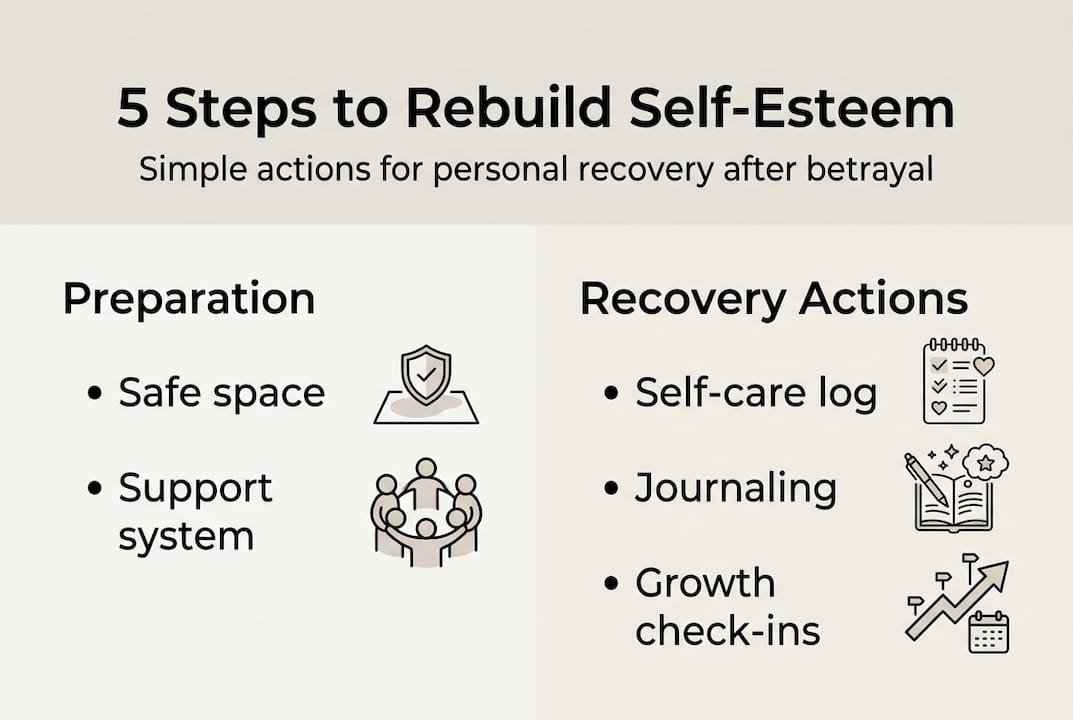
- Acknowledge your pain without judgment. Before you can move forward, you have to stop pushing the pain away. Name what happened. Name how it made you feel. Suppressing it delays healing.
- Challenge self-critical thoughts. When the voice says “I wasn’t enough,” ask for evidence. Most of the time, there isn’t any. Infidelity reflects the choices of the person who cheated, not your worth.
- Reconnect with your values and strengths. Write down five things you value about yourself that have nothing to do with this relationship. This is harder than it sounds, and it matters enormously.
- Seek connection, not isolation. Isolation feels protective but accelerates the damage. Reach out to one person today. Connection is medicine.
- Build daily self-esteem rituals. Small daily actions, like affirmations, physical movement, or acts of self-kindness, compound over time into genuine shifts in how you see yourself.
Research shows that growth-oriented coping predicts better outcomes after betrayal, while rumination, replaying the same painful thoughts repeatedly, can stall recovery. The goal isn’t to stop thinking about what happened. It’s to shift from passive suffering to active processing.
You can find a detailed breakdown of the betrayal recovery steps and learn more about processing emotional trauma as you move through each phase.
| Coping approach | What it looks like | Outcome |
|---|---|---|
| Emotion-focused | Journaling, therapy, social support | Linked to post-traumatic growth |
| Avoidance-focused | Numbing, distraction, isolation | Short-term relief, long-term stagnation |
| Growth-oriented | Reframing, values work, new purpose | Best long-term self-esteem outcomes |
Pro Tip: At the end of each week, write down one way you showed up for yourself. Over time, this log becomes powerful evidence that you are, in fact, healing.
Verifying progress and sustaining growth
After working through each step, here’s how you can measure your growth and keep your momentum. Progress after betrayal is rarely a straight line. You’ll have good weeks and hard weeks. Knowing what to look for helps you stay grounded when things feel uncertain.
Signs your self-esteem is rebuilding:
- You catch self-critical thoughts faster and challenge them more easily
- You feel moments of genuine pleasure or lightness, even briefly
- You’re making decisions based on your own needs, not fear
- You’re more willing to connect with others without hiding your experience
- You feel occasional optimism about your future
Setbacks are not failures. They are part of the process. A difficult anniversary, a triggering conversation, or a bad night doesn’t erase the progress you’ve made. What matters is what you do after the setback.
Research confirms that post-traumatic growth is possible after betrayal, particularly when people use adaptive strategies rather than avoidance. Studies suggest that roughly 70% of individuals who engage in targeted self-esteem work report meaningful recovery of their sense of self-worth over time.
To sustain your growth, build in regular check-ins with yourself. A weekly reflection, a monthly review of your journal, or a standing appointment with a therapist all serve as anchors. Practices like mindfulness for healing can also help you stay present rather than getting pulled back into the past.
If you’re not sure whether professional support is right for you, learning about the benefits of therapy after infidelity can help you make a more informed decision. Support groups, online communities, and structured programs are also valid options.
Resilience isn’t about never hurting again. It’s about trusting that you can handle the hurt and keep moving forward anyway.
A deeper truth about self-esteem after betrayal
Most guides on this topic give you a checklist and send you on your way. And checklists are useful. But they miss something important.
True self-esteem recovery after betrayal isn’t just about feeling better. It’s about becoming someone new. Not because you were broken, but because the experience, as awful as it was, has the potential to strip away things you were carrying that were never really yours. Borrowed definitions of worth. Relationships built on fear of abandonment. A self-concept that depended too heavily on someone else’s approval.
The people we’ve seen make the deepest recoveries aren’t the ones who returned to who they were before. They’re the ones who used the experience to understand personal growth after betrayal at an identity level. Some became advocates. Some changed careers. Some finally started living by their own values instead of performing for others.
Quick fixes fade. Lasting self-worth is built slowly, through repeated choices to treat yourself as someone worth caring for. That’s the work no checklist can do for you.
Resources to support your path to healing
If you’re ready to expand your toolkit for lasting healing, these resources can help you take the next steps. The work of rebuilding self-esteem after betrayal is deeply personal, but you don’t have to figure it all out alone.
At aftertheaffair.uk, we’ve built structured, compassionate resources specifically for people at every stage of this journey. Start with the infidelity recovery checklist for a clear, step-by-step framework you can begin using today. When you’re ready to look further ahead, explore our relationship growth resources for guidance on what long-term healing can look like. Our full healing resource library covers everything from coping strategies to identity work, all grounded in real recovery experience.
Frequently asked questions
How long does it take to rebuild self-esteem after betrayal?
Recovery timelines vary widely depending on your coping style and support system, but most people find that meaningful progress takes several months to a year of consistent, active effort.
Does talking to a therapist help self-esteem after betrayal?
Yes. Emotion-focused support, including therapy, is directly linked to post-traumatic growth, giving you a structured space to challenge harmful beliefs and build healthier patterns.
What are signs that my self-esteem is improving?
You’ll notice less frequent self-criticism, more moments of self-compassion, greater confidence in your own decisions, and a growing willingness to connect with others rather than hide.
Can self-esteem be rebuilt without forgiving the betrayer?
Absolutely. Self-esteem recovery is an internal process focused on your relationship with yourself. Forgiveness may help some people, but your growth is not dependent on the choices or remorse of the person who hurt you.
Recommended
- How to Cope After Infidelity – After the Affair Series
- Relationship Healing Process – After the Affair Series
- Relationship Growth After Infidelity – After the Affair Series
- 7 Key Benefits of Therapy – After the Affair Series
- Rebuilding trust after cheating: a 2026 Canadian guide