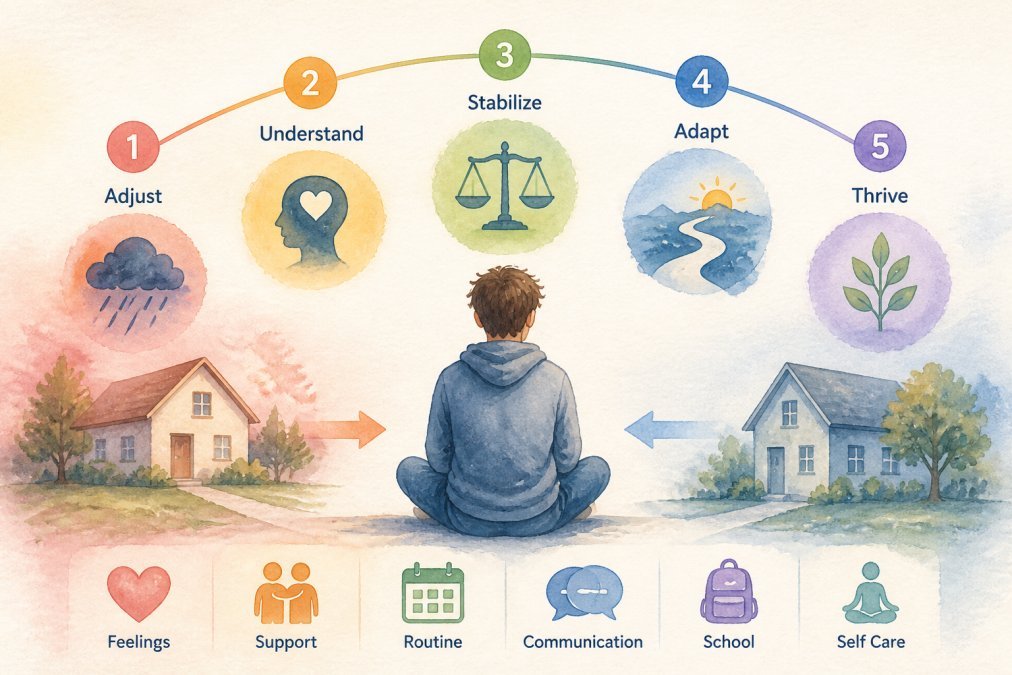
- Stage 1: Impact and stabilization (days to weeks)
- Stage 2: Truth-seeking and containment (weeks to months)
- Stage 3: Meaning-making and nervous system repair (months 2 to 6)
- Stage 4: Decision and rebuilding (months 6 to 12)
- Stage 5: Trust calibration and intimacy repair (around one year)
- Stage 6: Integration and identity rebuilding (12 months and beyond)
- Why healing isn’t linear (and what to do when you backslide)
Right after you find out, time doesn’t behave normally. Hours stretch. Your body runs hot and cold. Your brain keeps replaying details you never asked to know. People around you may want you to “decide what you’re doing” – stay, leave, forgive, confront – but betrayal trauma tends to move in stages, not in a straight line.
When we talk about the stages of healing after an affair, we’re not talking about a neat checklist or a promise that you’ll feel better by a specific date. We’re talking about predictable phases your nervous system and your relationship system move through. Knowing the stage you’re in helps you choose the right next step instead of trying to solve the entire future while you’re still in shock.
Stage 1: Impact and stabilization (days to weeks)
The first stage is about immediate safety – emotional safety, physical safety, and practical stability. Your system is responding as if a major threat has occurred, because to your attachment bond, it has. Sleep disruption, appetite changes, panic symptoms, obsessive scanning, and sudden numbness can all show up here.
This is also the stage where many people accidentally harm themselves by demanding perfect clarity. You might feel pressure to answer big questions: “Do I stay?” “Was any of it real?” “How could I miss this?” The truth is that the early window is not built for high-quality decision-making. It’s built for triage.
If you are the betrayed partner, stabilization usually means tightening the basics: sleeping whenever you can, eating something with protein, getting support from one or two safe people, and limiting the kind of information that spikes you into spirals. If you are the unfaithful partner and you want reconciliation, stabilization means stopping all contact with the affair partner, being transparent enough to reduce re-traumatization, and focusing on calming actions rather than persuasive speeches.
One important nuance: the type of infidelity changes what “stabilize” requires. A one-time opportunistic encounter creates a different threat profile than an ongoing emotional affair, and both differ from serial patterns or an exit affair where the relationship was already being replaced. Early stabilization should match the reality of what happened.
Stage 2: Truth-seeking and containment (weeks to months)
After the initial shock, the mind often goes looking for a complete story. People call it “needing details,” but more often it’s your brain trying to build a coherent map so it can predict danger and prevent it from happening again.
This is where couples can get stuck. Too little truth creates ongoing instability and intrusive images. Too much unstructured truth, delivered in late-night confession dumps or trickle-truth fragments, can create repeated trauma hits that make healing slower.
Containment is the skill of putting boundaries around truth-seeking so it serves recovery rather than feeding pain. In practice, that can look like agreeing on when you’ll talk about the affair, how long those conversations will last, and what the purpose is (clarity and accountability, not punishment). If you’re in therapy, this stage is often where a counselor helps you organize disclosure and questions so they’re trauma-informed.
It depends on the situation how much detail is helpful. Some betrayed partners need a basic timeline and key facts to stop catastrophic guessing. Others get flooded by explicit detail and heal better with broader honesty and clear boundaries. The right amount of information is the amount that reduces ongoing fear without creating new mental movies you can’t unsee.
Stage 3: Meaning-making and nervous system repair (months 2 to 6)
Once the basics are stabilized and the story is more coherent, the pain often shifts. It may feel less like acute panic and more like grief, anger, disgust, or a heavy sadness that comes in waves. This stage is where many people start asking deeper questions: “What did this mean about me?” “Was I not enough?” “Is love even safe?”
Those questions are understandable, but they’re also where shame and self-blame can sneak in. An affair can be connected to relationship issues without being caused by the betrayed partner’s inadequacy. Healing requires separating responsibility (the choice to betray) from context (the state of the relationship, the unfaithful partner’s coping style, entitlement, conflict avoidance, addiction, or attachment injuries).
For couples attempting reconciliation, meaning-making includes two parallel tracks. One track is the unfaithful partner learning to understand their own drivers without minimizing the impact. The other is the betrayed partner rebuilding a stable sense of reality and self-trust.
Nervous system repair matters here because many “relationship problems” in this window are actually trauma symptoms. If your heart races when their phone buzzes, that’s not pettiness. If you go numb during intimacy, that’s not failure. You’re responding to threat cues. Gentle, repeated experiences of safety – consistent transparency, predictable routines, repair after conflict, and respectful pacing – help your body learn that the present is different from the moment of discovery.

Stage 4: Decision and rebuilding (months 6 to 12)
By this stage, most people have a clearer sense of what they’re dealing with: the nature of the affair, the patterns that enabled it, and whether the unfaithful partner is capable of sustained repair. This is where “What happened?” gradually gives way to “What happens next?”
If you are reconciling, rebuilding is not a return to the old relationship. It’s the construction of a new one with stronger agreements. That can include explicit boundaries about friendships, social media, travel, alcohol, pornography, or secrecy. It can also include a more mature approach to conflict and emotional needs.
If you are separating, rebuilding focuses on dignity and stability. That means legal and financial clarity, co-parenting structures if needed, and emotional boundaries that prevent the affair story from continuing to dominate your life. Separation can be a healing path, not a failure, especially in cases of serial infidelity, ongoing deception, coercive dynamics, or refusal to end contact.
A key trade-off in this stage: pushing for normalcy can backfire. Many couples try to “put it behind us” at month four or five, then feel blindsided when triggers spike again later. Rebuilding works better when it includes planned check-ins, patience with setbacks, and measurable behaviors that rebuild trust over time.
Stage 5: Trust calibration and intimacy repair (around one year)
After roughly a year, many people notice they can function again, but something still feels tender. This is where trust needs calibration. Not blind trust, not constant suspicion – accurate trust.
Accurate trust is built from evidence. Does your partner do what they say they’ll do? Do they tell the truth when it’s uncomfortable? Do they repair quickly after a misstep, or do they turn it into your problem? The betrayed partner’s nervous system is often scanning for patterns, and the goal is to use that scanning as data rather than as a life sentence.
Intimacy repair belongs here too. Intimacy is not just sex. It’s emotional closeness, mutual regard, and the sense that your inner world is safe with someone. Some couples need to slow down sexually to avoid reenacting trauma. Others need structured ways to reintroduce touch and desire without pressure. Either way, it helps to treat intimacy as a shared project rather than a performance.
If you stayed together, you may also start grieving the relationship you thought you had. That grief can coexist with renewed love. If you left, you may grieve the future you imagined while also feeling relief. Both can be true.
Stage 6: Integration and identity rebuilding (12 months and beyond)
Integration is when the affair becomes part of your history, not the center of your identity. It doesn’t mean you “shouldn’t care.” It means your life expands again. Your mind stops looping as often. You can think about the future without the constant urge to re-litigate the past.
For many betrayed partners, this stage includes rebuilding self-trust. Self-trust is not “I will never be hurt again.” It’s “If I’m hurt again, I will see it sooner, I will respond sooner, and I will protect myself with clear boundaries.”
For couples, integration looks like a relationship that is honest about what happened without being run by it. Some couples build a stronger marriage than they had before. Others realize that the betrayal revealed a mismatch in values or capacity for accountability. Healing supports either outcome when the process is respectful and reality-based.
This is also the stage where people often revisit meaning in a healthier way. Not “Why did this happen to me?” but “What kind of person do I want to be after what happened?” That question can lead to a deeper voice, clearer boundaries, and a more grounded sense of self.
Why healing isn’t linear (and what to do when you backslide)
Even when you understand the stages of healing after an affair, you’ll still have days that feel like day one. An anniversary date, a song, a hotel ad, a random smell – triggers can collapse time.
Backsliding does not mean you’re failing. It usually means you hit an unprocessed pocket of grief or a new layer of meaning. The practical move is to return to the task of the stage you’re in. If you’re triggered, you stabilize. If you’re confused, you contain and clarify. If you’re rebuilding, you focus on behaviors and boundaries.
If you want a structured, stage-based pathway that also accounts for different types of affairs, Aftertheaffair.uk organizes recovery resources around what to focus on in the first six months, months 6 to 12, and beyond, with exercises designed for each phase.
Healing after betrayal is not about becoming unbothered. It’s about becoming steady – the kind of steady that lets you tell the truth to yourself, make clean decisions, and build a life that feels like yours again, whichever direction you choose.