- Why defensiveness hits so hard after infidelity
- Supporting betrayed partner without defensiveness starts with what you do inside
- The three moves that calm conflict without avoiding accountability
- What defensiveness looks like in real conversations (and what to do instead)
- Timing matters: not every moment is a good moment
- When your partner repeats the same questions
- “It depends”: different affair types, different triggers
- The phrases that usually help (and the ones that backfire)
- Boundaries without defensiveness
- A closing thought you can carry into the next hard conversation
The question usually shows up right after discovery, when everything is raw: your partner is crying, shaking, asking the same question again, and you can feel your throat tighten because you already answered it. Or you hear, “How could you do this to me?” and your brain races to explain context, stress, loneliness, alcohol, feeling ignored. You might even be trying to be helpful – and still they look at you like you are dodging.
If you are the partner who betrayed, learning how to stay present without defensiveness is not about winning a conversation. It is about becoming emotionally safe enough that the betrayed partner’s nervous system can begin to stand down. That is the doorway to any later work on rebuilding, accountability, or even deciding whether the relationship continues.
Why defensiveness hits so hard after infidelity
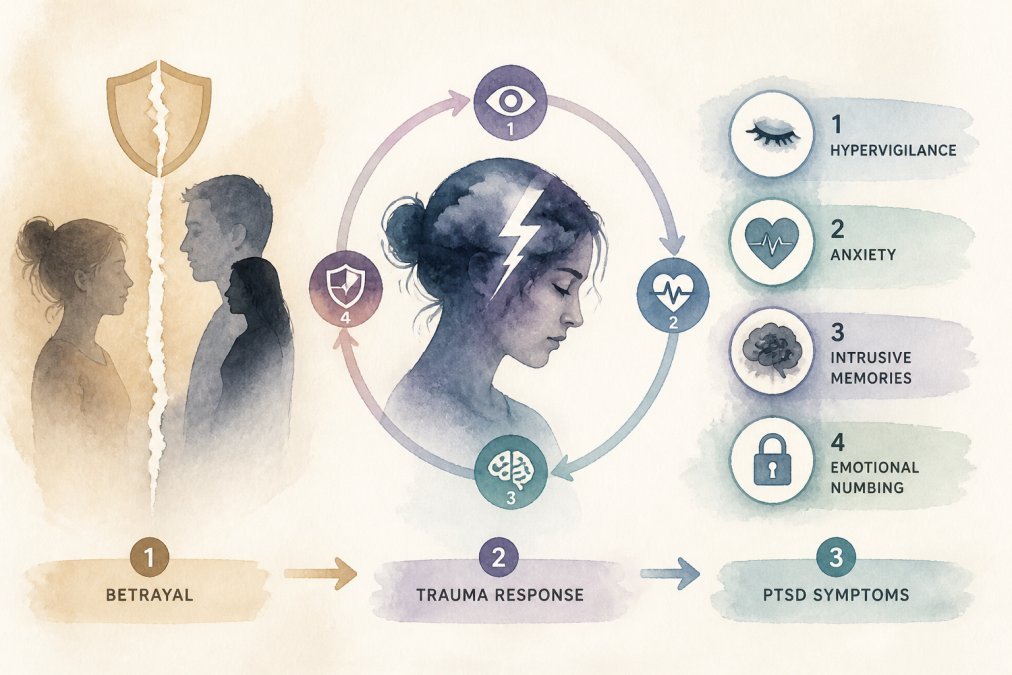
After betrayal, many partners experience symptoms that look a lot like acute stress: intrusive images, hypervigilance, sleep disruption, sudden anger, numbness, compulsive questioning. It is not “being dramatic.” It is a brain and body trying to regain safety after a relational trauma.
Defensiveness lands as danger in that context. Even if you are simply clarifying details, your tone or pacing can signal, “I care more about protecting myself than protecting you.” The betrayed partner then escalates to get certainty, and you escalate to get relief. That loop can become your new daily life.
The trade-off is real: you do deserve to be spoken to with basic respect. But early recovery is not the time to demand “fair fights” as a condition of showing up. You can set boundaries around abuse while still accepting that their intensity is often a trauma response, not a strategy to punish you.
Supporting betrayed partner without defensiveness starts with what you do inside
Most people try to fix defensiveness at the level of words. The deeper work is regulating your own threat response first.
Defensiveness is usually one of three things: shame (“I am a monster”), fear (“I am about to lose everything”), or control (“If I explain it right, this can go away”). If you can name which one is driving you in the moment, you can respond differently.
Try a quick internal script before you speak: “This is about safety, not court. I can tolerate discomfort for two minutes.” Slow your breath. Unclench your jaw. Put your feet flat on the floor. These tiny body cues matter because if your nervous system is braced, your partner will feel it – even if your words are polished.
Also, decide ahead of time what outcome you are aiming for. In the early stages, the goal is not to be understood. The goal is to help your partner feel less alone with what happened.
The three moves that calm conflict without avoiding accountability
You do not need perfect language. You need a reliable sequence.
1) Validate the impact before you explain anything
Validation is not agreeing with every interpretation. It is acknowledging the reality of their pain.
This tends to land well:
“I can hear how panicked you feel. I did this, and it makes sense that you do not feel safe.”
This tends to inflame:
“I get that you’re upset, but I’m telling you the truth.”
Notice the difference. The first one names the impact and your ownership. The second one centers your defense.
If you want a simple formula, use: feeling + meaning + ownership. “You look terrified. This shattered your trust. I did that.”
2) Answer the question they are asking, not the question you wish they asked
After an affair, betrayed partners often ask questions in a way that sounds accusatory: “Did you even love me?” “Was she better?” “How many times?” Underneath, the real question is often: “Am I safe? Am I replaceable? Is my reality real?”
You can respond on both levels.
For example:
- “Did you love me?” can be met with: “I understand why you would doubt everything. I chose something selfish and I hurt you. I do love you, and I also betrayed you. Both are true, and I’m committed to showing you with actions.”
- “Why didn’t you just leave?” can be met with: “Because I wanted comfort without consequences. I avoided hard conversations. That was cowardly, and you deserved honesty.”
Answering cleanly is supportive because it reduces the sense that they must interrogate you to get a straight line.

3) Offer repair, not persuasion
Persuasion sounds like “Trust me.” Repair sounds like “Here is what I am doing so trust can become possible again.”
Repair is specific: transparency with devices, ending all contact, therapy, written timelines, STD testing, location sharing, telling the truth even when it makes you look worse. You do not have to offer every measure forever, but early on, clarity is kindness.
If you catch yourself building a legal defense, pause and shift to repair: “I want to answer this fully. If I start explaining, will it help you feel safer, or do you need me to simply own it right now?”
What defensiveness looks like in real conversations (and what to do instead)
Defensiveness is not only yelling. It can be subtle.
It can sound like minimizing: “It was just texting.” Or rationalizing: “We were basically roommates.” Or splitting hairs: “I never said ‘I love you,’ so it wasn’t emotional.” Or turning the tables: “You’re not perfect either.”
If you notice any of those, use a direct reset. Something like: “You’re right – I’m getting defensive. I’m going to try again.” Then restate the core truth in one sentence.
A good one-sentence anchor is: “I betrayed you, and I’m here to answer and repair.”
That sentence is not magic. The consistency is what changes things over weeks and months.
Timing matters: not every moment is a good moment
A common fear is: “If I don’t answer right now, they’ll think I’m hiding something.” Sometimes that is true. Other times, your partner is in a level of activation where no answer will land.
You can ask for a pause without abandoning them. The key is to stay connected and set a clear return time.
Try: “I want to do this carefully and truthfully. I’m starting to feel flooded and I don’t want to say something defensive. Can we take 20 minutes, and I will come back and keep talking?”
Then actually come back. Reliability is part of repair.
It also helps to agree on “container” conversations: a set time each day or a few times a week for affair questions, with flexibility for genuine spikes. This reduces the sense that betrayal has colonized every minute of life, while still prioritizing your partner’s need for information.
When your partner repeats the same questions
Repetition is one of the hardest parts. It can feel like nothing you say counts.
But repetition is often how trauma tries to integrate reality. The betrayed partner is checking for consistency, watching your face, listening for shifts, scanning for deception. If you respond with irritation, it confirms their worst fear.
A supportive approach sounds like: “You’ve asked this before, and I understand why. My answer is the same. I’m not angry that you need to hear it again.”
If you worry you will snap, write a brief, consistent statement you can read or paraphrase. This is not robotic. It is stabilizing.
“It depends”: different affair types, different triggers
Not all infidelity hits the same way. In our work, we often see that the betrayed partner’s questions and triggers map to the type of affair.
With an emotional affair, the defensiveness trap is often “It wasn’t physical, so it’s not that bad.” The betrayed partner is usually grieving intimacy theft, secrecy, and humiliation. Your best support is to name the emotional intimacy you diverted and why it was wrong.
With online infidelity, the defensiveness trap is “It wasn’t real.” For many betrayed partners, the realness is measured by secrecy, sexual energy, money spent, and the feeling of being replaced.
With serial or opportunistic affairs, the betrayed partner often needs a stronger pattern-based explanation: What is your cycle, what are your boundaries now, and what accountability will prevent recurrence? Here, vague reassurance can feel insulting.
With an exit affair, conversations can be more complex because the relationship may genuinely be ending. Supporting without defensiveness may mean tolerating their grief and rage without using it as an excuse to “prove” they are the problem.
If you want a structured, stage-based pathway that also accounts for different affair patterns, Aftertheaffair.uk organizes recovery around both timeline and type, so you are not guessing what matters most in month one versus month nine.
The phrases that usually help (and the ones that backfire)
You do not need to talk like a therapist. You need to talk like someone who can hold the weight of what happened.
Helpful phrases tend to include ownership and empathy: “I understand why that image is stuck in your mind.” “You didn’t deserve this.” “I’m sorry I made you doubt your reality.” “I will answer without blaming you.”
Backfiring phrases tend to rush healing or recruit forgiveness: “Can we move on?” “I said I’m sorry.” “You’re choosing to stay angry.” “If you keep bringing it up, we’ll never heal.” Even if there is a future moment for those topics, early recovery is not it.
If you are unsure what to say, choose the simplest truthful sentence: “I did this. I’m sorry. I’m here.” Then stop talking and let them respond.
Boundaries without defensiveness
Some betrayed partners do become verbally aggressive. Your job is not to absorb unlimited harm to prove remorse.
The difference is in delivery. A defensive boundary sounds like: “If you keep yelling, I’m done.” A supportive boundary sounds like: “I want to stay in this conversation, and I won’t be spoken to with insults. I’m going to step into the other room for ten minutes. I will come back at 7:20 and continue.”
That boundary protects dignity without threatening abandonment.
A closing thought you can carry into the next hard conversation
If you can remember one thing, let it be this: your betrayed partner is not asking you to be perfect. They are asking you to be emotionally safe while they live inside a reality you created. When you feel defensiveness rising, treat it as a signal to slow down, tell the truth plainly, and choose repair over self-protection. Safety is built in moments like that – not dramatic promises, but steady presence when it would be easier to argue your way out.