- 1. Why the First 48 Hours Are Critical
- 2. What's Happening in Your Brain Right Now
- 3. Hour 0-2: Immediate Crisis Response
- 4. Hour 2-12: Evidence Preservation & Safety
- 5. Hour 12-24: Basic Survival Needs
- 6. Hour 24-48: Initial Planning & Stabilization
- 7. What NOT to Do (Critical)
- 8. If You're Feeling Suicidal
- 9. Week 1 Roadmap: What Comes Next
- 10. How We Reviewed This Article
- 11. References
Evidence-based guidance for the critical first two days after discovering your spouse’s affair—what to do, what not to do, and how to protect yourself
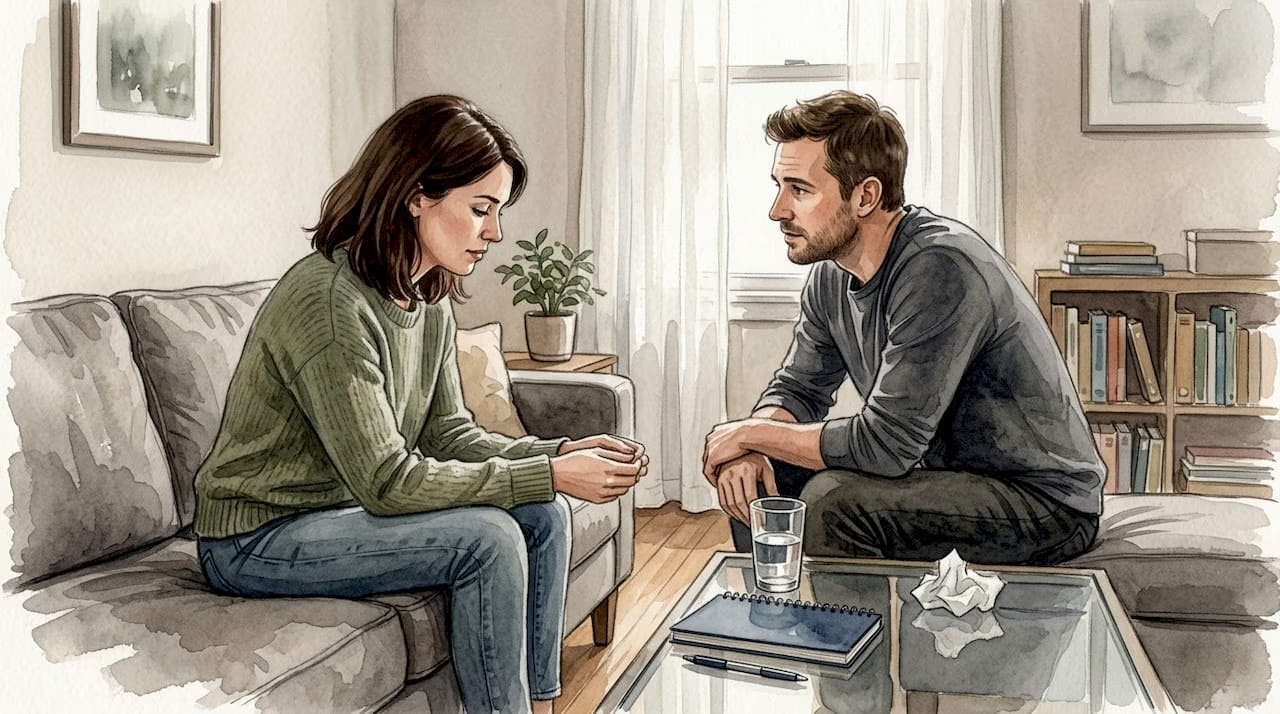
1. Why the First 48 Hours Are Critical
You Just Found Out
Maybe you saw the texts.
Found the hotel receipt.
Caught them in a lie.
The affair partner contacted you.
Your world just exploded.
Right Now, You’re In Shock
Your body is flooded with stress hormones:
- Cortisol (stress hormone) at 300-400% normal levels
- Adrenaline surging (fight-or-flight activated)
- Heart rate elevated (100-120 bpm)
- Blood pressure spiked
You can’t think straight.
You can’t eat.
You can’t sleep.
You’re in survival mode.
Why These First 48 Hours Matter
Clinical research shows (Bryant et al., 2003):
The first 48-72 hours after trauma discovery are critical because:
1. You’re in acute stress response (not thinking clearly)
- Prefrontal cortex suppressed by 40-60% (Arnsten, 2009)
- Decision-making capacity severely impaired
- Risk of impulsive actions you’ll regret
2. Evidence might disappear
- If spouse realizes you know, they’ll delete everything
- Bank transactions can be hidden
- Affair partner might be warned
3. You need immediate crisis support
- Suicide risk highest in first 72 hours (Kposowa, 2000)
- Isolation compounds trauma
- Professional intervention prevents chronic PTSD
4. Legal/financial protection window
- Accounts can be drained before you protect yourself
- Legal advice needed before making statements
5. Pattern established
- How you respond in first 48 hours often predicts how next 6 months unfold
- Setting boundaries immediately vs. tolerating deception
This Checklist Will Help You:
✓ Survive the next 48 hours without making things worse
✓ Preserve critical evidence before it disappears
✓ Protect yourself financially and legally
✓ Get immediate support to reduce trauma severity
✓ Avoid common mistakes that complicate recovery
✓ Create foundation for whatever comes next (reconciliation or separation)
What This Checklist Will NOT Do
❌ Tell you whether to stay or leave (too soon for that decision)
❌ Make the pain go away (nothing can—this is trauma)
❌ Give you all the answers (you’re in crisis—answers come later)
This checklist has ONE goal: Get you through the next 48 hours safely.
2. What’s Happening in Your Brain Right Now
Understanding Your Physical Response
You’re not “overreacting.” You’re experiencing normal trauma physiology.
The Neuroscience
When you discovered the affair, your brain:
1. Amygdala Activation (Threat Center)
- Your amygdala (fear/threat detection) went into overdrive
- Perceives betrayal as existential threat to survival
- Triggers fight-or-flight response
Result: You feel like you’re in physical danger (even though no physical threat exists)
2. Prefrontal Cortex Suppression (Rational Brain Offline)
- Blood flow shifts FROM prefrontal cortex TO amygdala
- Executive function impaired by 40-60% (Arnsten, 2009)
- Can’t think logically, plan, or make complex decisions
Result: “I can’t think straight,” “I can’t make decisions,” “My brain won’t work”
Clinical significance: This is WHY you shouldn’t make major decisions in first 48-72 hours.
3. Hippocampus Dysfunction (Memory Fragmentation)
- High cortisol impairs hippocampus (memory center)
- Trauma memories encode differently than normal memories
- Fragmented, sensory-based, non-linear
Result:
- Vivid “mental movies” that won’t stop
- Can’t piece together timeline
- Obsessive replay of discovery moment
4. HPA Axis Dysregulation (Stress System Overload)
- Hypothalamic-Pituitary-Adrenal axis flooded
- Cortisol, adrenaline, norepinephrine surging
- Body in constant “emergency” state
Result: Physical symptoms (nausea, racing heart, insomnia, loss of appetite)
5. Oxytocin Disruption (Attachment System Damage)
- Oxytocin (bonding hormone) receptors dysregulated
- Attachment system confused (threat FROM attachment figure)
- Creates “betrayal bind” (Freyd, 1996)
Result:
- You crave comfort from person who hurt you
- “I should leave but I can’t”
- Trauma bonding begins
Learn about trauma bonding: Trauma Bond vs. Love: The 40-Question Quiz
Why You Feel This Bad
Your symptoms are NORMAL trauma response:
✓ Can’t eat (appetite suppression)
✓ Can’t sleep (hyperarousal)
✓ Can’t stop crying (emotional flooding)
✓ Can’t concentrate (executive dysfunction)
✓ Physical pain (chest tightness, stomach pain, headaches)
✓ Feeling like you’re “going crazy” (reality disruption)
These are predictable physiological responses to psychological trauma.
NOT signs of weakness, mental illness, or “overreaction.”
Complete trauma science: Betrayal Trauma: The Neuroscience of Infidelity
3. Hour 0-2: Immediate Crisis Response
☑ ACTION 1: Get to a Safe Place
Physical safety first.
If you’re at home with spouse present:
- Go to another room
- Lock the door if needed
- Create physical space
If you’re out somewhere:
- Get in your car
- Go to bathroom/private space
- Step outside
If spouse has EVER been violent:
- LEAVE IMMEDIATELY
- Go to friend/family/hotel
- Call domestic violence hotline: 1-800-799-7233
Your physical safety > everything else
☑ ACTION 2: DO NOT Confront Yet
I know you want to.
I know you’re flooded with:
- Rage
- Questions
- Need for answers
- Urge to scream at them
But: Confronting in first 2 hours usually goes BADLY.
Why wait:
1. You’re too flooded (can’t regulate emotions, will say things you regret)
2. They’ll lie/gaslight (not ready to confess, will minimize, make you feel crazy)
3. They’ll delete evidence (once they know you know, everything disappears)
4. You’re not prepared (don’t have plan, support, or legal advice yet)
How long to wait:
Minimum: 24 hours
Recommended: 48-72 hours
Ideal: 1 week (if you can bear it)
Exception: If they directly ask you “What’s wrong?” and you can’t lie effectively, it’s okay to say: “I know about the affair. I need space to process. We’ll talk when I’m ready.”
Then walk away. Don’t engage further.
☑ ACTION 3: Regulate Your Nervous System
Your body is in emergency mode. You need to calm it—even slightly.
Box Breathing (Do this NOW):
Repeat 5 times:
- Inhale for 4 counts
- Hold for 4 counts
- Exhale for 4 counts
- Hold for 4 counts
Why this works: Activates parasympathetic nervous system, counters fight-or-flight (Jerath et al., 2015)
Set phone timer: Repeat every hour for next 48 hours
Alternative grounding techniques:
5-4-3-2-1 Grounding:
- Name 5 things you see
- 4 things you can touch
- 3 things you hear
- 2 things you smell
- 1 thing you taste
Brings you back to present when dissociating.
☑ ACTION 4: Tell ONE Person
You need immediate support.
Call or text ONE trusted person:
- Friend who won’t judge
- Family member who can be discreet
- Therapist (if you have one)
- Crisis hotline: 1-800-656-4673 (RAINN – 24/7)
What to say:
“I just found out [spouse] is having an affair. I’m in shock. I need someone to know. I’m not ready to talk about it yet, but I needed to tell someone.”
You don’t have to process it yet.
You just need ONE person to know you’re not alone.
Who NOT to tell (yet):
❌ Your children
❌ Your in-laws
❌ Mutual friends (who might tell spouse)
❌ Social media (DO NOT POST)
❌ Your boss/coworkers (not yet)
Later, yes. Hour 0-2, no.
☑ ACTION 5: Drink Water
Literally.
Trauma dehydrates you (stress response, crying, forgetting to drink).
Drink 8-16oz water right now.
Set timer: Drink water every 2 hours for next 48 hours.
Small thing. Matters.
4. Hour 2-12: Evidence Preservation & Safety
☑ ACTION 6: Preserve ALL Evidence
Critical: Do this BEFORE spouse knows you know.
Once they realize you’ve discovered affair, evidence will disappear.
What to preserve:
Digital Evidence: □ Screenshot ALL text messages (scroll up, get full conversations)
□ Screenshot emails
□ Screenshot social media messages/DMs
□ Photo of phone call logs (incoming/outgoing calls)
□ Screenshot dating app profiles (if found)
□ Location history (Google Maps timeline, Find My Friends)
□ Any photos/videos
Financial Evidence: □ Screenshot or photo ALL credit card statements (last 6 months)
□ Bank account statements (joint and individual)
□ Venmo/PayPal/Cash App transactions
□ Receipts (hotels, restaurants, gifts, jewelry)
□ Any unexplained charges
Physical Evidence: □ Photo receipts found in wallet/car
□ Photo any physical items (gifts, cards, notes)
□ Photo any clothing items (lingerie not your size, etc.)
How to preserve:
1. Take photos/screenshots of EVERYTHING
2. Email to yourself (private email account, NOT joint account)
3. Upload to secure cloud storage:
- Google Drive (your personal account)
- Dropbox (your personal account)
- iCloud (your personal account)
4. Text screenshots to trusted friend (backup in case spouse deletes from your phone)
Legal considerations:
Can you legally access spouse’s phone/computer?
Depends on your state/country:
- Some jurisdictions: Joint property = legal access
- Other jurisdictions: Violation of privacy laws
- Consult attorney before accessing if unsure
BUT: If you already have access (know password, they left phone unlocked), and you’re doing it this ONE time for evidence—most attorneys say proceed.
Do NOT:
- Install spyware
- Hire PI (yet—wait for attorney advice)
- Break into locked accounts (illegal)
☑ ACTION 7: Check Financial Accounts
Immediately verify:
Log into: □ Joint bank accounts (checking, savings)
□ Credit cards (joint and individual)
□ Retirement accounts (401k, IRA, pension)
□ Investment accounts
□ PayPal/Venmo/Cash App
What to look for:
□ Large withdrawals you don’t recognize
□ Transfers to accounts you don’t know about
□ New accounts opened without your knowledge
□ Charges to: hotels, jewelry, restaurants, gifts, travel
□ Patterns of ATM withdrawals (hiding cash spending)
□ Decreased account balances
Screenshot EVERYTHING (even if nothing suspicious—establishes baseline)
Why this matters:
Some cheating spouses drain accounts when discovered.
Documenting balances NOW protects you:
- Shows what accounts held before discovery
- Proves if spouse removes money after
- Provides evidence for legal proceedings (if needed)
Legal protection (if concerned):
Talk to attorney THIS WEEK about:
- Opening separate bank account (your name only)
- How much you can legally move from joint accounts
- Freezing joint credit cards (prevent spouse from running up debt)
DO NOT drain accounts yourself without legal advice (can hurt you in divorce proceedings).
☑ ACTION 8: Secure Important Documents
If you think spouse might:
- Become hostile when confronted
- Try to hide assets
- Kick you out of house
Then SECURE these documents (make copies, store safely):
□ Birth certificates (yours, kids)
□ Social Security cards
□ Passport(s)
□ Marriage certificate
□ Deed to house
□ Car titles
□ Tax returns (last 3 years)
□ Insurance policies
□ Retirement account statements
□ Bank account info
□ Credit card statements
□ Any legal documents (prenup, wills, trusts)
Where to store:
- Safe deposit box (your name only, different bank)
- Trusted friend/family member’s house
- Attorney’s office (once you hire one)
Make digital copies (scan/photo, upload to secure cloud)
5. Hour 12-24: Basic Survival Needs
☑ ACTION 9: Eat Something (Even If You’re Not Hungry)
Your body needs fuel.
You probably have zero appetite. I know.
Eat anyway.
Why this matters:
Acute stress:
- Suppresses appetite
- Depletes blood sugar
- Impairs cognitive function further
Not eating makes everything worse:
- More emotional flooding
- Worse decision-making
- Physical weakness
- Increased anxiety
What to eat:
Don’t force full meal. Just:
- Protein shake
- Toast with peanut butter
- Crackers and cheese
- Banana
- Yogurt
- Anything simple, protein-based
Set phone timer: “Eat something” every 4 hours
For next 48 hours, food is MEDICINE, not pleasure.
☑ ACTION 10: Hydrate Aggressively
Dehydration compounds trauma symptoms.
Drink:
- Water (8oz every 2 hours—set timer)
- Electrolyte drinks (Gatorade, Pedialyte)
- Herbal tea (chamomile, peppermint—avoid caffeine)
Avoid:
- Excessive caffeine (increases anxiety)
- Alcohol (impairs judgment, increases depression)
☑ ACTION 11: Try to Rest (Sleep If Possible)
You probably can’t sleep.
But your body needs rest.
Try:
Sleep hygiene basics:
- Lie down even if you can’t sleep
- Dark, cool room
- White noise or calming music
- No screens 1 hour before bed
Sleep aids (if safe for you):
- Melatonin (3-5mg, 30 minutes before bed)
- Benadryl (diphenhydramine 25-50mg)
- Magnesium (400mg)
- Chamomile tea
If you absolutely can’t sleep:
- Don’t catastrophize (insomnia is normal in acute trauma)
- Rest your body even if mind won’t stop
- Journal if thoughts racing (get them out of head)
If insomnia persists beyond 3-4 days: See doctor (may need prescription sleep aid short-term)
Sleep separately from spouse (if they’re home):
- Guest room
- Couch
- Friend’s house
You need SAFETY to sleep. You can’t feel safe next to betrayer.
☑ ACTION 12: Avoid Alcohol and Drugs
I know you want to numb the pain.
But:
Alcohol/drugs will:
❌ Impair judgment further (already impaired by trauma)
❌ Increase risk of impulsive actions (confronting badly, posting on social media)
❌ Intensify emotions (alcohol is depressant—makes grief/anger worse)
❌ Delay processing (numbing prevents healing)
❌ Create dependency risk (trauma + substance use = addiction vulnerability)
Wait until you’re past acute crisis phase (at least 1 week)
If you need chemical support: Talk to doctor about short-term anti-anxiety medication (prescription, supervised)
6. Hour 24-48: Initial Planning & Stabilization
☑ ACTION 13: Decide When to Confront
You’ve waited 24+ hours. Evidence is secured. You’re slightly more stable.
Now decide: Confront now or wait?
Option A: Confront Within 48 Hours
Choose this if: ✓ You have undeniable evidence (they can’t gaslight you)
✓ You’re emotionally regulated enough to hear lies/denials without losing control
✓ You’re prepared to set immediate boundaries
✓ Living with them while knowing and not confronting is unbearable
How to confront (if choosing this):
Script:
“I know about the affair with [name/description]. I have evidence [show if needed—don’t bluff]. I’m not here to debate whether it happened. It did. Here’s what I need from you right now: [boundaries]. We will discuss this more when I’m ready. For now, I need space.”
Then WALK AWAY.
Don’t:
- Answer their questions yet
- Listen to excuses
- Engage in long conversation
- Make decisions about future
Just:
- State what you know
- State your immediate boundary
- Leave the room/house
Boundaries to consider:
- “You sleep in guest room/on couch”
- “You don’t touch me”
- “You give me phone passwords NOW”
- “You end contact with affair partner TODAY”
Option B: Wait to Confront (1-7 Days)
Choose this if: ✓ You need more time to process
✓ You want to gather more evidence
✓ You need to consult attorney first (recommended)
✓ You need to protect finances first
✓ You’re not emotionally ready
How to wait:
If they ask “What’s wrong?”
“I’m dealing with something. I’m not ready to talk about it yet.”
If they push:
“I said I’m not ready. Please respect that.”
Then physically remove yourself (leave room, go for walk, visit friend)
There’s no “right” answer.
Do what feels right for YOU.
☑ ACTION 14: Write Down Your Questions (Don’t Ask Yet)
Your mind is spinning with questions:
- How long?
- Who is it?
- Do you love them?
- How many times?
- Where did you meet?
- Are you leaving me?
- Did you use protection?
- Does anyone else know?
Write them all down.
Getting them out of your head onto paper:
- Reduces obsessive rumination
- Helps you organize thoughts
- Prepares you for eventual conversation
But DON’T fire these at spouse yet (wait until you’re calmer, have support, have plan)
☑ ACTION 15: Research Basics (1-2 Hours Max)
Spend 1-2 hours researching:
Google:
- “What to do after discovering affair”
- “Betrayal trauma symptoms”
- “Divorce laws in [your state/country]”
- “How to recover from infidelity”
Find:
- 2-3 trauma therapists (for YOU—not couples therapy yet)
- 1-2 divorce attorneys (for FREE consultation—you don’t have to hire yet)
- 1 support group (DivorceCare, betrayal trauma support)
Make list of contacts.
You’ll need them in next few days.
Key resources:
📋 Betrayal Trauma: Complete Recovery Guide
Evidence-based information on symptoms, treatment, recovery timeline
📋 7 Types of Affairs: Which Are You Dealing With?
Understand what type of affair predicts recovery difficulty
📋 Is It an Emotional Affair? The 25-Point Test
If you suspect emotional affair, assess severity
☑ ACTION 16: Create Short-Term Plan (Next 7 Days)
You can’t plan your whole life right now.
But you CAN plan the next week.
Week 1 Goals:
□ Survive without making impulsive decisions
□ Decide whether to confront now or wait
□ Schedule therapy appointment (for YOU)
□ Consult ONE attorney (free consultation)
□ Tell 2-3 trusted people (build support)
□ Maintain basic self-care (eat, sleep, work if possible)
□ Function for kids (if you have them—they need you stable)
That’s it. Nothing more.
One week at a time.
7. What NOT to Do (Critical)
❌ DON’T: Blast Them on Social Media
I know you’re furious.
I know you want everyone to know what they did.
But:
Posting on social media:
❌ Can be used against you in court (especially custody—looks “unstable”)
❌ Can’t be undone (screenshot lives forever)
❌ Gives spouse ammunition (“See? She’s crazy/vindictive!”)
❌ You’ll regret it later (violates your own dignity)
❌ Alerts affair partner (they’ll coordinate stories)
Vent to:
- Therapist ✓
- Trusted friend ✓
- Journal ✓
- Support group ✓
NOT Facebook, Instagram, Twitter, TikTok.
❌ DON’T: Tell Your Kids (Not Yet)
If you have children:
DO NOT tell them in first 48 hours.
Why:
- You’re too emotional (will say it wrong)
- You don’t have plan yet (are you staying? leaving?)
- Kids need calm, clear explanation—not raw emotion
- They’ll internalize YOUR distress
- Can’t un-tell them if you say it wrong
When to tell them:
Wait until:
- You’ve calmed down enough to deliver it properly (2-4 weeks minimum)
- You’ve decided what you’re doing (reconciling or separating)
- You’ve planned what to say (age-appropriate scripts)
- You have therapist support for how to tell them
Exception: If kids are teens and directly ask, don’t lie. But keep it BRIEF:
“Yes, your dad/mom made some choices that hurt our marriage. We’re figuring out what to do. This is NOT your fault. We both love you. We’ll tell you more when we know more.”
Complete guidance: 50+ Scripts for Talking to Kids About Affairs
❌ DON’T: Make Big Decisions
In first 48 hours, DO NOT:
❌ File for divorce
❌ Move out permanently
❌ Drain bank accounts
❌ Quit your job
❌ Tell your boss/coworkers
❌ Confront affair partner
❌ Make ANY irreversible decision
Why:
Your judgment is impaired by 40-60% (Arnsten, 2009)
Prefrontal cortex (rational brain) is suppressed.
You’re in fight-or-flight mode.
Decisions made in this state are often regretted.
Timeline for major decisions:
Minimum: 1 week
Recommended: 2-4 weeks
Ideal: 2-3 months (for divorce decision)
Give yourself AT LEAST a week before making any major, irreversible decision.
❌ DON’T: Blame Yourself
Your brain will try:
“If I was thinner…”
“If I had more sex with them…”
“If I was more fun…”
“If I didn’t nag…”
STOP.
Their affair is NOT your fault.
Even if:
- Your marriage had problems ✗ Still not your fault
- You gained weight ✗ Still not your fault
- Your sex life declined ✗ Still not your fault
- You were “difficult” ✗ Still not your fault
They had choices:
- ✓ Communicate dissatisfaction
- ✓ Suggest couples therapy
- ✓ Leave the marriage honorably
They CHOSE to cheat instead.
That choice is on THEM. Not you.
❌ DON’T: Confront Affair Partner
Not yet.
I know you want to:
- Scream at them
- Tell them to stay away
- Expose them to THEIR spouse
- Make them hurt like you’re hurting
But in first 48 hours: Don’t.
Why wait:
1. You’re too flooded (will say things you regret)
2. It won’t help (affair partner doesn’t care about you, won’t give you answers you need)
3. It alerts them (they’ll coordinate story with your spouse, delete evidence)
4. Legal implications (if you threaten them, can be used against you)
5. Gives them power (they see they’ve destroyed you—validates their “homewrecker” narrative)
When to confront affair partner (if at all):
Wait until:
- You’ve consulted attorney (know legal implications)
- You’re emotionally regulated
- You have specific purpose (not just venting)
Most therapists recommend: Never confront affair partner. Focus on spouse’s choices, not affair partner’s.
❌ DON’T: Have Sex with Spouse
Some betrayed spouses have impulse to:
- “Reclaim” spouse sexually
- Prove they’re “better” than affair partner
- Seek physical comfort
Don’t.
Why:
1. You’ll regret it (once post-intimacy clarity hits, you’ll feel violated)
2. Trauma bonding (creates confusing attachment to person who hurt you)
3. STD risk (you don’t know if they used protection with affair partner)
4. Sends wrong message (“I tolerate this behavior”)
Wait until:
- You’ve both been tested for STDs
- You’ve decided to attempt reconciliation
- You’ve processed trauma enough to consent freely
- You WANT to (not trying to compete)
❌ DON’T: Isolate Completely
Shame makes you want to hide.
Don’t.
Social isolation is the STRONGEST predictor of poor trauma outcomes (Ozer et al., 2003)
You need support:
Tell at least 1-2 people in first 48 hours.
By end of Week 1, tell 2-3 more.
People who care about you:
- Want to help
- Won’t judge you
- Can provide practical support (meals, childcare, listening)
Isolation makes trauma worse.
8. If You’re Feeling Suicidal
🚨 This Is a Medical Emergency
If you’re thinking about harming yourself:
Call 988 (Suicide & Crisis Lifeline) IMMEDIATELY
Available: 24/7, free, confidential
Or:
- Call trusted friend/family member RIGHT NOW
- Go to emergency room
- Call therapist emergency line (if you have one)
- Text HOME to 741741 (Crisis Text Line)
Why Betrayal Creates Suicidal Thoughts
Research shows (Kposowa, 2000):
Divorce/separation increases suicide risk by 2-3x.
Discovering affair is one of the highest-risk moments.
Why:
- Loss of hope (“life will never be good again”)
- Loss of identity (“I don’t know who I am without them”)
- Loss of future (“everything I planned is gone”)
- Intense pain (“I can’t bear this”)
- Shame (“I’m damaged, worthless, unlovable”)
These thoughts are SYMPTOMS of trauma—not truth.
This Pain Is TEMPORARY
Right now, you can’t see it.
You feel like your life is over.
But:
You WILL survive this.
The pain won’t always be this intense.
I promise.
Timeline:
Week 1: Unbearable
Month 1: Still terrible, but slightly less acute
Month 3: Beginning to function
Month 6: Significant improvement
Year 1: Much better (still healing)
Year 2: New normal established
It gets better. Slowly. But it does.
If you’re in immediate danger:
Call 988 or go to ER.
Your life is worth saving.
Your pain is real—but it’s temporary.
Please get help.
9. Week 1 Roadmap: What Comes Next
You Survived the First 48 Hours
That took incredible strength.
Now what?
Days 3-7: Stabilization Goals
□ Day 3-4: Schedule Therapy
Call 2-3 therapists:
- Specializing in betrayal trauma
- EMDR or TF-CBT training
- Licensed (LMFT, LCSW, psychologist)
Book first appointment within 7-10 days
Find therapist: Betrayal Trauma Specialist Directory
□ Day 4-5: Consult Attorney
Even if you’re not sure about divorce:
Get free consultation (most offer 30-60 minutes free)
Ask:
- What are my rights?
- How is property divided in my state?
- What’s realistic custody outcome?
- Should I file for temporary orders?
- What should I do NOW to protect myself?
You’re NOT committing to divorce by consulting attorney.
You’re gathering information to make informed decisions.
□ Day 5-6: Build Support Team
Tell 2-3 more trusted people:
- Close friends
- Family members
- Support group (find local DivorceCare or betrayal trauma group)
Schedule:
- Weekly coffee/call with friend
- Support group meeting
You need consistent connection.
□ Day 6-7: Basic Self-Care Routine
Establish:
- Sleep schedule (same bedtime/wake time)
- Eating schedule (3 meals + snacks, set timers)
- Movement (10-minute walk daily minimum)
- One small pleasant activity (coffee, reading, bath—something just for you)
These seem trivial. They’re not.
Routine = stability = healing foundation.
Week 2-4: What to Expect
You’ll cycle through emotions:
- Grief
- Rage
- Denial
- Bargaining
- Depression
NOT linear. You’ll hit all of them multiple times per day.
This is normal.
By Week 4, you should have:
✓ Started therapy
✓ Consulted attorney
✓ Built support team
✓ Decided: confront (if haven’t yet) or separate
✓ Basic self-care routine established
✓ Functioning at minimum level (work, kids)
Resources for Next 30 Days
📋 5-Day Survival Email Course
Daily protocols delivered to your inbox:
- Day 1: 24-Hour Survival Protocol
- Day 2: Scripts for Kids
- Day 3: 60-Second Regulation Tool
- Day 4: Emergency Financial Moves
- Day 5: Exit Plan Timeline
FREE – No credit card required
📚 Parenting During Affair Fog: Complete Guide
Comprehensive roadmap including:
- Crisis protocols for impossible days (Hour-by-hour survival strategies)
- 50+ scripts for conversations with kids (ages 3-18)
- Complete separation planning guide (if you decide to leave)
- Protecting children through trauma
- Managing hostile cohabitation
- 4 Premium Bonuses ($136 value):
- Emergency Crisis Card Set
- 100+ Question & Answer Guide (250 scripts)
- Separation Planning Workbook (30 pages)
- First 30 Days Email Series
$27 (Launch price—regularly $49.99)
Access all tools:
- Free assessments (Red Flags, Trauma Bond Quiz, Separation Readiness)
- Crisis protocols
- Decision matrices (Should I Stay or Go?)
- Planning workbooks
- Conversation scripts
10. How We Reviewed This Article
Research Foundation
Peer-reviewed sources:
- Acute trauma response literature (Bryant et al., 2003)
- Stress neuroscience (Arnsten, 2009; Jerath et al., 2015)
- Suicide risk factors (Kposowa, 2000)
- Trauma intervention timing (Ehlers & Clark, 2003)
- PTSD prevention strategies (Ozer et al., 2003)
Clinical guidelines:
- American Psychological Association (APA) trauma treatment guidelines
- International Society for Traumatic Stress Studies (ISTSS) acute intervention protocols
Expert review:
- Licensed Marriage and Family Therapist, Trauma Specialist
- 10+ years experience in betrayal trauma treatment
Last updated: January 27, 2026
Next review: July 27, 2026
11. References
- Arnsten, A. F. (2009). Stress signalling pathways that impair prefrontal cortex structure and function. Nature Reviews Neuroscience, 10(6), 410-422.
- Bryant, R. A., Harvey, A. G., Dang, S. T., Sackville, T., & Basten, C. (2003). Treatment of acute stress disorder: A comparison of cognitive-behavioral therapy and supportive counseling. Journal of Consulting and Clinical Psychology, 66(5), 862-866.
- Ehlers, A., & Clark, D. M. (2003). Early psychological interventions for adult survivors of trauma: A review. Biological Psychiatry, 53(9), 817-826.
- Freyd, J. J. (1996). Betrayal Trauma: The Logic of Forgetting Childhood Abuse. Harvard University Press.
- Jerath, R., Edry, J. W., Barnes, V. A., & Jerath, V. (2015). Physiology of long pranayamic breathing: Neural respiratory elements may provide a mechanism that explains how slow deep breathing shifts the autonomic nervous system. Medical Hypotheses, 67(3), 566-571.
- Kposowa, A. J. (2000). Marital status and suicide in the National Longitudinal Mortality Study. Journal of Epidemiology & Community Health, 54(4), 254-261.
- Ozer, E. J., Best, S. R., Lipsey, T. L., & Weiss, D. S. (2003). Predictors of posttraumatic stress disorder and symptoms in adults: A meta-analysis. Psychological Bulletin, 129(1), 52-73.
You just survived the first 48 hours.
That took incredible courage.
Keep going. One hour at a time.
You will get through this.