TL;DR:
- Betrayal blindness is an unconscious protective mechanism to preserve dependence on the betrayer.
- It can cause long-term harm such as delayed grief and trust issues if not addressed.
- Recovery involves awareness, therapy, boundaries, and self-compassion to overcome its effects.
Many survivors of infidelity or abuse unconsciously ignore clear evidence of betrayal, not because they are naive or weak, but because their mind is protecting them from an overwhelming truth. This is called betrayal blindness, and it is a real, researched psychological phenomenon rooted in trauma theory. Betrayal blindness occurs in contexts like infidelity, parental abuse, and institutional failures. Understanding why your mind does this, and how to gently move past it, is one of the most powerful steps you can take in your recovery journey.
Key Takeaways
| Point | Details |
|---|---|
| Betrayal blindness explained | It’s a researched adaptive response to protect against overwhelming truths of infidelity or abuse. |
| Recognize and address symptoms | Awareness and therapy are central to overcoming the subtle impact of betrayal blindness. |
| Begin recovery with practical steps | Journaling, mindfulness, and guided checklists help start healing and rebuilding trust after betrayal. |
| Misunderstood defense mechanism | Betrayal blindness is often wrongly seen as weakness, but it’s a protective adaptation from trauma psychology. |
| Resources aid lasting healing | Support tools and professional guidance accelerate recovery from betrayal trauma and blindness. |
What is betrayal blindness?
Betrayal blindness is not the same as simply not knowing something. It is an unconscious, self-protective process where a person fails to perceive, process, or remember evidence of betrayal, even when that evidence is right in front of them. The concept was developed by psychologist Jennifer Freyd as part of her broader betrayal trauma theory, which argues that when a betrayal comes from someone we depend on for safety or survival, our minds suppress awareness to preserve the relationship.
Think about that for a moment. Your brain is not failing you. It is making a calculated, unconscious trade: awareness of the betrayal in exchange for the ability to keep functioning within a relationship you need. That is a survival strategy, not a character flaw.
Betrayal blindness is rooted in betrayal trauma theory and can occur across many contexts, including infidelity, childhood abuse, and even large-scale institutional cover-ups. In romantic relationships, it often looks like explaining away suspicious behavior, minimizing red flags, or feeling strangely numb when confronted with evidence of a partner’s affair.
Here is how betrayal blindness differs from related concepts:
| Concept | Nature | Awareness level | Trigger |
|---|---|---|---|
| Betrayal blindness | Unconscious adaptation | Below conscious awareness | Dependency on betrayer |
| Denial | Semi-conscious refusal | Partially aware | Fear of consequences |
| Ignorance | Lack of information | No awareness at all | Absence of evidence |
The key distinction is that betrayal blindness is driven by dependency. The more you rely on someone emotionally, financially, or physically, the stronger the protective mechanism becomes.
Common ways betrayal blindness shows up include:
- Dismissing gut feelings as paranoia
- Forgetting or minimizing incidents that seemed suspicious
- Feeling emotionally disconnected from disturbing evidence
- Rationalizing a partner’s unexplained absences or behavioral changes
“Betrayal blindness is not a sign of stupidity. It is a sign that your nervous system was doing its best to keep you safe inside a relationship you depended on.”
If you have been experiencing betrayal trauma symptoms since discovering infidelity, understanding this mechanism can reframe your entire experience and reduce the shame that often accompanies it.
How betrayal blindness protects and harms
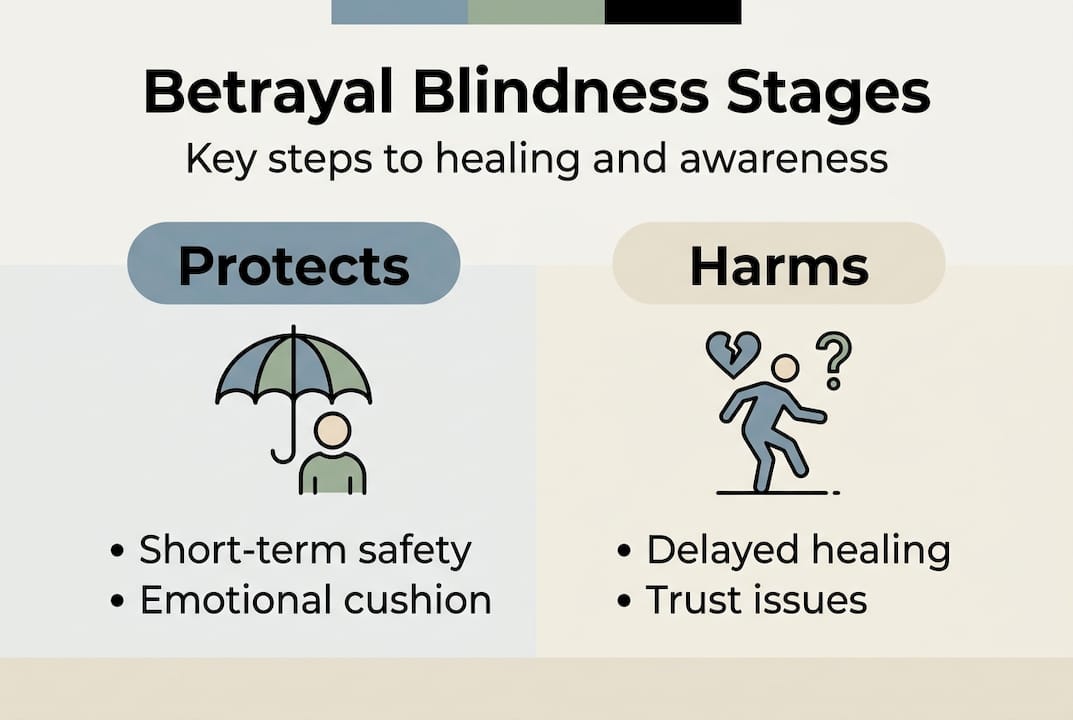
Betrayal blindness serves a real short-term purpose. When you are emotionally or financially dependent on a partner, fully perceiving their betrayal could shatter your sense of safety, your identity, and your daily functioning all at once. Your brain avoids that collapse by keeping the truth just out of reach. In the short term, this allows you to keep parenting, keep working, and keep breathing.
But here is the painful paradox: the same mechanism that protects you in the short term can cause serious damage over time. Staying blind to betrayal means staying in a situation that continues to harm you. It delays the processing of grief. It keeps you in a trauma loop without ever fully entering the healing phase.
Betrayal blindness is an evolutionary adaptation, but research shows it becomes toxic when it persists without being addressed. Chronic betrayal blindness is linked to increased anxiety, depression, dissociation, and difficulty trusting your own perceptions long after the relationship ends.
The long-term consequences of unaddressed betrayal blindness include:
- Prolonged exposure to a harmful relationship
- Difficulty trusting your own instincts in future relationships
- Internalized shame and self-blame
- Heightened trauma responses triggered by ordinary situations
- Delayed or blocked grief processing
Pro Tip: If you notice yourself constantly explaining away your partner’s behavior or feeling strangely detached when confronted with evidence of infidelity, do not judge yourself. Recognize it as a signal that your nervous system needs support, not criticism. That recognition alone is a turning point.
When you start navigating infidelity in the early months after discovery, the protective veil of betrayal blindness often begins to lift. That process can feel like a second shock. Many people describe it as suddenly seeing everything clearly and wondering how they missed it for so long. That reaction is completely normal.
Building boundaries after betrayal is one of the most effective ways to interrupt the cycle of betrayal blindness, because boundaries force clarity. They require you to name what is acceptable and what is not, which directly counters the unconscious suppression at the heart of betrayal blindness.
Recognizing betrayal blindness in yourself
Spotting betrayal blindness in yourself is genuinely difficult, precisely because it operates below conscious awareness. But there are patterns you can learn to notice.
The most common signs include:
- Self-doubt – You constantly question your own memory or perception, wondering if you imagined things.
- Rationalizing – You create explanations for your partner’s behavior that feel increasingly elaborate or unconvincing even to you.
- Emotional numbness – You feel strangely flat or disconnected when confronted with evidence that should provoke a strong reaction.
- Minimizing – You downplay incidents that others in your life find alarming.
- Hypervigilance followed by forgetting – You notice something suspicious, feel anxious, and then somehow push it out of your mind within hours.
Here is a practical comparison to help you tell the difference between betrayal blindness and denial:
| Feature | Betrayal blindness | Denial |
|---|---|---|
| Conscious? | No, fully unconscious | Partially conscious |
| Motivation | Preserve dependency relationship | Avoid emotional pain |
| Awareness of evidence | Evidence is not fully registered | Evidence is known but rejected |
| Typical context | High dependency on betrayer | Any threatening situation |
Recovery begins with awareness, and therapy is one of the most proven strategies for breaking through betrayal blindness. A skilled therapist helps you safely process the evidence your mind has been suppressing, without flooding you with more than you can handle at once.
The benefits of therapy after infidelity go far beyond talking through feelings. Trauma-informed therapy specifically addresses the nervous system responses that keep betrayal blindness in place.
Pro Tip: Start a private journal and write down anything that feels “off” in your relationship or in your own reactions. You do not need to analyze it. Just record it. Over time, patterns emerge that your conscious mind has been smoothing over. This simple practice can be one of the first cracks in the wall of betrayal blindness.
For additional grounding tools, exploring coping after infidelity through natural, everyday practices can support your awareness work between therapy sessions.
Healing and overcoming betrayal blindness
Once you begin to recognize betrayal blindness in yourself, the healing process can genuinely begin. The most important thing to understand is that healing is not linear. You will have moments of clarity followed by moments of confusion. That is not regression. It is how trauma recovery actually works.
Self-compassion is the foundation. You cannot shame yourself into healing. The mind that created betrayal blindness was trying to protect you, and it deserves gentleness, not punishment.
Awareness and therapy are foundational for recovery, and mindfulness practices support healing by helping you stay present with difficult emotions rather than unconsciously suppressing them.
Practical strategies that support recovery from betrayal blindness include:
- Trauma-informed therapy – Modalities like EMDR (Eye Movement Desensitization and Reprocessing) and somatic therapy directly address the nervous system patterns that sustain betrayal blindness.
- Mindfulness practice – Regular mindfulness builds the capacity to observe your thoughts and feelings without immediately suppressing them.
- Structured boundaries – Clear, consistent limits in your relationships reinforce your ability to trust your own perceptions.
- Peer support – Connecting with others who have experienced betrayal trauma reduces isolation and normalizes your experience.
- Journaling – As mentioned earlier, writing creates a record that your conscious mind cannot easily erase.
Here is a simple framework for approaching recovery:
| Stage | Focus | Key action |
|---|---|---|
| Awareness | Recognizing the pattern | Journaling, therapy intake |
| Processing | Feeling suppressed emotions | Trauma-informed therapy |
| Rebuilding | Establishing new patterns | Boundaries, self-care routines |
| Integration | Making meaning of the experience | Reflection, growth work |
Pro Tip: Do not rush the rebuilding stage. Many people push toward “getting back to normal” before they have fully processed the betrayal. Rebuilding trust, whether in a relationship or in yourself, takes longer than most people expect, and that is completely okay.
Exploring mindfulness for healing can give you practical tools to support each stage of this process. For a structured approach, working through betrayal recovery steps gives you a clear path when the emotional fog makes it hard to know where to start.
A fresh perspective: Why betrayal blindness is misunderstood
Here is something most articles will not tell you: society’s instinct to judge betrayal blindness as weakness is itself a form of harm. When people ask “how could you not have known?” they are applying a logic that does not account for how trauma actually works in the brain.
Betrayal blindness is an adaptation, not a flaw. It is the result of a nervous system doing exactly what it evolved to do: protect you from information that would destabilize your survival. Calling it weakness is like calling a fever a character flaw.
What we have seen in real recovery journeys is that the people who heal most effectively are not the ones who are hardest on themselves for “missing the signs.” They are the ones who extend themselves the same compassion they would offer a close friend. That shift, from self-blame to self-understanding, is often the single biggest turning point.
The other misconception is that awareness alone is enough. It is not. Insight without support often leads to what we call “informed suffering,” where you understand exactly what happened to you but still feel stuck. That is why structured recovery work, not just reading about trauma, matters so much. Understanding the relationship healing process gives that insight somewhere to go.
Next steps: Support and healing resources
Understanding betrayal blindness is a meaningful first step, but knowledge alone does not complete the healing. You deserve structured, compassionate support that meets you where you are in your recovery.
At After the Affair, we have built resources specifically for people navigating the complex aftermath of infidelity and betrayal trauma. Whether you are just beginning to process what happened or you are further along and looking for deeper tools, the infidelity recovery checklist offers a clear, step-by-step starting point. For those focused on longer-term growth, personal growth after betrayal provides a forward-looking framework. You can also work through our trauma recovery checklist to track your progress and stay grounded throughout the process.
Frequently asked questions
Is betrayal blindness the same as denial?
No. Betrayal blindness differs from denial in that it is fully unconscious, driven by dependency on the betrayer, while denial involves some level of conscious awareness of the truth being rejected.
Can betrayal blindness be overcome without therapy?
Self-awareness is a powerful starting point, but recovery via awareness and therapy together significantly improves outcomes, especially when trauma responses are deeply embedded in the nervous system.
What are the first signs of betrayal blindness?
Self-doubt and emotional numbness are among the earliest indicators, often accompanied by a pattern of rationalizing a partner’s behavior in ways that feel increasingly unconvincing.
Does betrayal blindness always occur after infidelity?
Not in every case. Betrayal blindness occurs most commonly when the victim depends on the betrayer for emotional or physical safety, which is why it is especially prevalent in intimate partnerships and parent-child relationships.
How can I start healing from betrayal blindness?
Begin with self-awareness practices like journaling, then seek professional support. Awareness and therapy together create the foundation for lasting recovery from betrayal blindness.
Recommended
- Step-by-step betrayal recovery: healing trust in 2026 – After the Affair Series
- How mindfulness aids healing after betrayal in 2026 – After the Affair Series
- Relationship Healing Process – After the Affair Series
- Role of boundaries after betrayal to rebuild trust – After the Affair Series