If your partner is avoiding responsibility, making empty promises, dismissing your boundaries, or staying in contact with the person who caused the betrayal, those are not minor concerns. They are the clearest signs that reconciliation is not genuinely on the table, regardless of what they say.
Recognizing these red flags early protects you from investing more of yourself into a process that only one of you is actually committed to. Here is what to watch for:
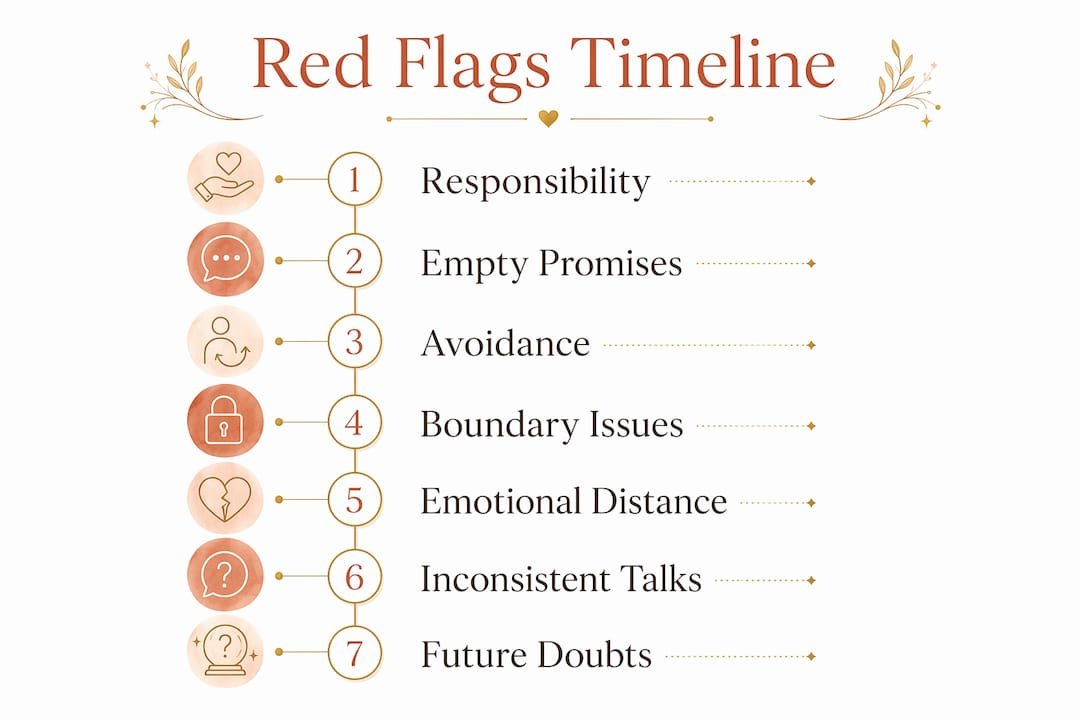
- Refusing to take responsibility. Blame-shifting, minimizing, or framing their behavior as your fault signals that nothing has fundamentally changed.
- Empty promises without behavioral change. Apologies that are not followed by consistent, observable action are manipulation, not repair.
- Avoidance of counseling or therapy. A partner who refuses professional support is signaling they are unwilling to do the deeper work reconciliation actually requires.
- Disrespect for your boundaries. Treating your limits as unreasonable or punitive rather than honoring them is a direct indicator of insincerity.
- Emotional distancing or inconsistent affection. Warmth that appears only during conflict or when they fear losing you is not genuine connection.
- Inconsistent communication. Reaching out only when lonely or anxious, then going quiet, is a pattern that reveals self-interest over real commitment.
- Refusal to discuss the relationship’s future. A partner serious about rebuilding will speak in shared-future terms and make concrete plans. Vagueness is avoidance.
- Ongoing contact with a third party. Continued contact with someone connected to a prior betrayal is one of the most direct signs that commitment to reconciliation is not real.
- Ignoring your expressed needs. Consistently dismissing what you say you need signals a lack of respect that undermines any reconciliation effort.
- Repeated conflicts with no progress. The same arguments cycling without resolution show that no real change is happening beneath the surface.
- Rushing you toward a decision. Pressure to move fast is often a way to prevent you from noticing that nothing has actually changed.
What are the red flags your partner isn’t serious about reconciliation?
1. Refusing to take full responsibility
A partner who deflects, minimizes, or reframes their behavior as your fault has not done the internal work that genuine reconciliation requires. Watch for phrases like “I only did that because you…” or “You’re too sensitive about this.” These are not apologies. They are a continuation of the same dynamic that caused the rupture in the first place.
Sincere apologies focus on the harm done to you, not on the difficulty the other person experienced in causing it. A “victim-apology,” where your partner frames their behavior as something that happened to them, is a reliable sign that accountability is not actually present.
2. Empty promises without behavioral change
Grand declarations of change that are not followed by consistent, observable action are one of the most common red flags in relationships. Real change takes steady effort over time, not just a short period of improved texting habits. If your partner is spending more energy convincing you they have changed than actually demonstrating it, that gap tells you something.
Apologies without accountability or behavior change function as manipulation, not genuine repair. The test is simple: what is different now, specifically and observably, compared to some time ago?
3. Avoidance of counseling or therapy
Refusing to engage with professional support is a significant warning sign, particularly after infidelity or serious conflict. Therapy is not a punishment. It is the structured environment where the kind of deep behavioral change reconciliation demands actually happens. A partner who dismisses it as unnecessary or excessive is telling you they are not willing to invest at that level.
This avoidance often pairs with a preference for “just moving forward” without examining what went wrong. Moving forward without understanding what broke is how couples end up in the same place six months later.
4. Disrespect for your boundaries
Partners serious about reconciliation honor your boundaries without treating them as punishment or unreasonable demands. When your partner pushes back against a limit you have set, argues that you are being controlling, or simply ignores the boundary after agreeing to it, that is not a small thing. Boundary violations during reconciliation are one of the clearest behavioral signals that the relationship is not being treated as a priority.
Healthy boundaries post-affair are not walls. They are the conditions under which safety can be rebuilt. A partner who resists them is resisting the process itself.
5. Emotional distancing or inconsistent affection
Signs of emotional unavailability are often subtle at first. Your partner may be warm and engaged during a crisis, then pull back once the immediate threat of losing you passes. This pattern, sometimes called “crisis-only” behavior, reveals that their engagement is driven by fear of loss rather than genuine desire to reconnect.
Therapists describe this as feeling like you’re knocking on a door that’s not opening. You share something painful, and instead of comfort or curiosity, you get a deflection or a subject change. Over time, that absence of emotional response becomes its own answer.
6. Inconsistent communication patterns
Reaching out only when lonely, anxious, or afraid you are moving on is not the same as consistent effort. A partner who texts intensely for a few days and then goes quiet for a week is not demonstrating the steady, low-pressure engagement that genuine reconciliation requires. The pattern matters more than any individual message.
Ignoring or dismissing your expressed needs consistently signals a lack of respect that no amount of good weeks can offset. Watch the pattern across months, not the best moments within a single week.
7. Reluctance to discuss the relationship’s future
A partner committed to rebuilding will speak in shared-future language. They will make plans, include you in decisions, and talk concretely about what the relationship looks like going forward. Vagueness about the future, or outright refusal to discuss it, is avoidance dressed up as patience.
This reluctance often signals that your partner has not decided whether they actually want to be in the relationship. Asking you to wait indefinitely while they “figure things out” is not reconciliation. It is keeping options open.
8. Ongoing contact with a third party
If your partner maintains contact with the person connected to a prior betrayal, that is not a gray area. Continued involvement with a third party related to past issues is one of the most direct signs that commitment to the relationship is not genuine. Transparency and a clean break from that contact are baseline requirements, not negotiable extras.
A partner who argues that the contact is harmless, or who hides it rather than disclosing it, is prioritizing that relationship over yours.
9. Ignoring your expressed needs
Reconciliation requires both people to actively listen and respond to what the other says they need. A partner who consistently dismisses your concerns, changes the subject when you raise them, or agrees in the moment and then forgets entirely is not engaged in the process. This pattern of dismissing your hurt is a sign that your emotional experience is not being treated as real or relevant.
The difference between a partner who is trying and one who is not often shows up here. Trying looks like asking follow-up questions, remembering what you said last week, and adjusting behavior accordingly.
10. Repeated conflicts without progress
Every couple has recurring arguments. The question is whether those arguments are moving anywhere. If the same fight keeps happening with the same outcome and no new understanding on either side, that cycle is evidence that the underlying issue is not being addressed. Conflict without resolution is not just frustrating. It is a structural sign that the relationship is not changing.
A partner serious about reconciliation will notice the pattern and bring it to a counselor, propose a new approach, or at minimum acknowledge that something is stuck. Pretending the cycle does not exist is its own red flag.
11. Rushing you toward a decision
Pressure to commit quickly to reconciliation is often a strategy to prevent you from seeing clearly. If your partner dismisses your doubts as fear of commitment or being “too sensitive,” they are not taking your concerns seriously. A partner who has genuinely changed will respect your need for time and evidence, because they understand why that need exists.
Rushing is frequently a sign that your partner fears what you will notice if you slow down.
Why boundaries and accountability are the foundation of real reconciliation
Boundaries and accountability are not optional features of a healthy reconciliation process. They are the structure that makes it possible. Without them, what looks like reconciliation is usually just proximity.
What genuine accountability looks like in practice:
- Naming the specific harm caused, without being prompted
- Proposing concrete behavioral changes with a timeline, not vague intentions
- Following through consistently, not just in the first few weeks
- Disclosing relevant information proactively rather than waiting to be asked
- Tolerating your pain and anger without becoming defensive or shutting down
What boundary respect looks like:
- Honoring agreed limits without arguing about their fairness
- Not requiring you to justify or re-explain a boundary you have already set
- Stopping a flagged behavior the first time, not the fifth
- Treating your need for space or time as legitimate, not as rejection
Signs of boundary violation to watch for:
- Reframing your limits as controlling or punitive
- Agreeing to a boundary and then quietly ignoring it
- Using guilt or emotional pressure to get you to drop a limit
- Treating boundary conversations as attacks rather than communication
Pro Tip: Watch behavior over an extended period before drawing conclusions. A partner who is genuinely changing will show quiet, consistent progress. One who is not will revert to old patterns as soon as the immediate pressure eases.
Boundary disrespect during reconciliation correlates strongly with failed outcomes in mental health practice. When a partner cannot honor the conditions you have set for feeling safe, the relationship cannot rebuild on a stable foundation. The role of boundaries in post-betrayal healing is not about control. It is about creating the conditions where trust can actually grow.
Accountability, by contrast, is not a single apology. It is a sustained posture of ownership over time. A partner who apologizes once and then expects the relationship to normalize has confused a moment of remorse with the ongoing work of repair. Research on personal growth and emotional authenticity in relationships consistently shows that genuine change requires repeated, observable behavioral shifts, not declarations of intent.

What recent psychology research tells us about sincere reconciliation
The psychological research on reconciliation from 2025 and 2026 points to several patterns that distinguish genuine effort from performance.
Attachment anxiety and the motivation to reconcile
Attachment anxiety drives some partners to seek reconciliation not out of genuine commitment but out of fear of being alone. Research published in the Journal of Social and Personal Relationships found that rekindling is predicted by attachment anxiety, described as a negative self-view and heightened sensitivity to relationship threats. Partners motivated primarily by that anxiety tend to produce lower-quality rekindled relationships, because the underlying driver is self-relief rather than relational repair.
This matters practically. A partner who pursues you intensely when they feel you pulling away, then becomes distant once you re-engage, is likely operating from attachment anxiety rather than real commitment. The pursuit is about managing their own distress, not about building something better with you.
Love-bombing as a red flag, not a green one
Love-bombing, an intense early surge of affection, grand gestures, and constant contact, is frequently misread as evidence of serious intent. Therapists consistently identify it as a warning sign. True reconciliation involves consistent, quiet progress over time, not flashy gestures or constant talk about change. When the intensity is unsustainable, and it always is, the withdrawal that follows can feel like abandonment, which creates a cycle of anxiety and dependency rather than genuine healing.
Crisis-only engagement
Partners who are attentive only during crises but emotionally absent otherwise lack true commitment to reconciliation. This pattern is one of the clearest behavioral signatures of insincerity. If your partner engages deeply when they fear losing you and then retreats once stability returns, their investment is in managing the threat, not in building the relationship.
Defensive stonewalling as a diagnostic signal
Defensive stonewalling and dismissing your hurt are signs a partner is not serious about reconciliation. A partner who can sit with your pain, ask questions about it, and remain present without becoming defensive is demonstrating the emotional capacity that repair requires. One who shuts down, deflects, or turns the conversation back to their own feelings when you express hurt is showing you the ceiling on their current capacity.
The difference between genuine accountability and defensive posturing
Genuine accountability looks like a partner who names what they did, acknowledges the specific impact on you, and changes their behavior without needing to be reminded. Defensive posturing looks like a partner who apologizes in broad terms, adds qualifications (“but you have to understand that I was under a lot of pressure”), and then monitors whether you have “gotten over it” yet. The second posture is not accountability. It is image management.
For a structured way to assess whether your partner is demonstrating real accountability, Aftertheaffair’s Partner Accountability Conversation Guide offers a practical framework grounded in clinical experience with infidelity recovery.
Aftertheaffair: structured support for what you’re navigating
Recognizing these red flags is one thing. Knowing what to do with that recognition is another, and that second step is where most people get stuck.
Aftertheaffair was built specifically for this gap. The resources at aftertheaffair.uk go beyond general relationship advice to address the specific, layered experience of betrayal and its aftermath, including how to assess whether genuine reconciliation is happening or whether you are being managed. The 7-step infidelity recovery checklist gives you a concrete, evidence-informed framework for evaluating where you actually are in the process, not where your partner says you should be. Whether you are trying to decide whether to stay, working through the early stages of rebuilding, or trying to understand why something still feels wrong, Aftertheaffair’s books and resources meet you at that exact stage. Start with the checklist and let the evidence guide the next step.
FAQ
What are the top red flags in a relationship after betrayal?
The clearest red flags are refusal to take responsibility, empty promises without behavioral change, disrespect for boundaries, emotional distancing, and ongoing contact with a third party connected to the betrayal. Any one of these signals that genuine reconciliation is not happening.
What is a silent red flag in a relationship?
A silent red flag is a pattern of absence rather than action: emotional unavailability, consistently ignoring your expressed needs, or withdrawing after conflict without resolution. These are easy to miss because nothing dramatic happens, but the cumulative effect is the same as more visible warning signs.
What are three signs a relationship won’t last after reconciliation?
Repeated conflicts with no progress, a partner who engages only during crises and withdraws once stability returns, and relational quality that often declines with each reconciliation attempt are three reliable indicators that the relationship is not on a stable trajectory.
Does he want to reconcile, or does he just want things to go back to normal?
The distinction shows up in behavior, not words. A partner who wants genuine reconciliation will tolerate your pain, honor your boundaries, and make observable changes. A partner who just wants things to go back to normal will push for speed, resist accountability, and become frustrated when you do not “move on” fast enough.
What is the 7-7-7 rule for couples?
The 7-7-7 rule is not a formally established clinical framework in relationship psychology. Definitions vary across self-help contexts, but the underlying principle most versions share is that consistent, repeated effort over time matters more than any single conversation or gesture. That principle aligns with what the research on genuine reconciliation consistently shows.
Key Takeaways
A partner who is not serious about reconciliation will show it through consistent behavior patterns, not isolated moments. Watch the pattern across weeks, not the best day of the month.
| Point | Details |
|---|---|
| Accountability over apology | A sincere partner names the specific harm and changes behavior; a vague apology with no follow-through is manipulation. |
| Boundaries signal sincerity | Partners serious about reconciliation honor your limits without arguing their fairness or quietly ignoring them. |
| Attachment anxiety distorts motivation | Some partners pursue reconciliation to relieve their own distress, not to build a healthier relationship, producing lower-quality outcomes. |
| Crisis-only engagement is a pattern | A partner who is attentive only when they fear losing you lacks the consistent commitment genuine reconciliation requires. |
| Aftertheaffair offers structured guidance | The 7-step infidelity recovery checklist at Aftertheaffair gives you a concrete framework for assessing where you actually are in the process. |
Recommended
- Is Your Spouse in Affair Fog? 40 Red Flags Assessment – After the Affair Series
- Is Your Partner a Serial Cheater? Signs and Next Steps
- Behavioral Red Flags in Kids – After the Affair Series
- Is Your Spouse in Affair Fog? The 25-Point Reality Check – After the Affair Series