Table of Contents
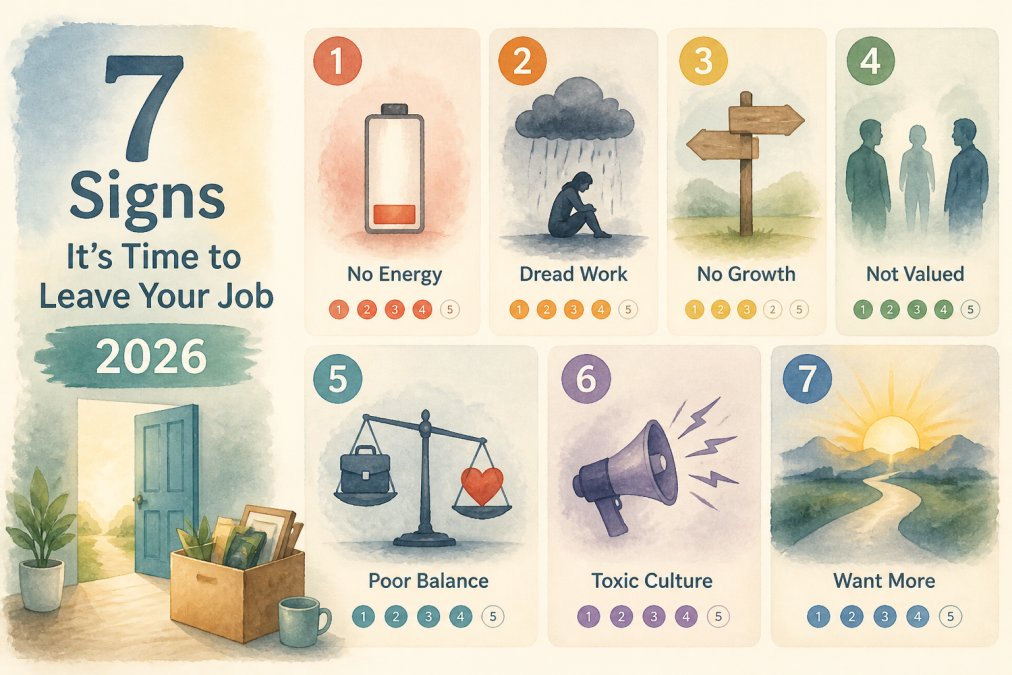
- 1. Your Physical and Mental Health Is Deteriorating
- 2. Signs of a Toxic Workplace Are Affecting Your Performance
- 3. You’re Experiencing Career Stagnation, Not a Rough Patch
- 4. Professional Growth and Development Have Stopped
- 5. Your Gut Instinct Says It’s Time to Move On
- The Stay or Go Decision Matrix: How to Know for Certain
- How to Resign From a Job Professionally and Build Your Exit Strategy
- Financial Runway Planning Before You Leave
Last Updated: August 15, 2026
Knowing when it’s time to leave your job is one of the most difficult career decisions you’ll face. Many people stay far longer than they should, hoping things will improve or fearing the unknown. The cost of staying in the wrong role often exceeds the risk of leaving.
This guide examines the clearest indicators that a job transition is necessary. We’ll walk you through the signs, help you distinguish between a rough patch and genuine career misalignment, and provide frameworks to decide whether to stay or go.
Quick Assessment: Are You Ready to Leave?
Before diving deeper, ask yourself these questions:
- Does your physical or mental health show signs of deterioration since you started this role?
- Do you dread Mondays or feel persistent dread about work?
- Are you using alcohol, sleep, or other coping mechanisms more than before?
- Has your professional growth stalled for 12+ months?
- Does your gut instinct consistently tell you this isn’t the right fit?
If you answered yes to three or more, the signs it’s time to leave are likely present.
1. Your Physical and Mental Health Is Deteriorating
The first and most urgent sign it’s time to leave is when your job damages your health. This isn’t normal work stress, it’s sustained, measurable decline in how you feel physically and mentally.
Physical symptoms appear first: persistent headaches, stomach problems, sleep disruption, constant fatigue, muscle tension, or jaw clenching. Chronic workplace stress triggers real physiological responses. Your body is signaling that the environment is unsustainable.
Mental health deterioration follows: anxiety bleeds into personal time, depression, irritability, emotional numbness, difficulty concentrating, and reduced patience with loved ones. The critical distinction is that temporary stress from a difficult project is normal; sustained, worsening health decline over months is not.
Pushing through doesn’t work. Chronic stress compounds, weakening your immune system and deteriorating your mental health further. The longer you stay, the longer recovery takes after you leave.
If you’re experiencing suicidal thoughts, severe depression, or substance use as a coping mechanism, seek professional help immediately. Contact the 988 Suicide and Crisis Lifeline or reach out to a mental health professional before considering any job transition.
2. Signs of a Toxic Workplace Are Affecting Your Performance
A toxic work environment includes inconsistent or punitive management, lack of psychological safety, chronic disrespect, unclear expectations, and reward systems that incentivize bad behavior. In such environments, you manage office politics instead of focusing on your role, second-guess decisions because feedback is unpredictable, and avoid speaking up because candor is punished.
The performance impact is measurable: your output drops, quality suffers, you miss deadlines. This isn’t because you’ve become less capable, your cognitive and emotional resources are consumed by managing toxic dynamics instead of doing actual work.
This creates a vicious cycle. Performance decline becomes visible to management, triggering criticism that increases anxiety and further damages performance. You internalize blame, believing you’re failing, when the real problem is the environment.
One of the clearest signs it’s time to leave is recognizing that you’re capable of better work, but this specific environment prevents it. You might perform well in a different role, team, or company, but not here.
Document specific instances of toxic behavior: dates, people involved, what happened, and how it affected your work. This creates a factual record that helps you explain the departure to future employers without sounding bitter and clarifies whether the problem is the environment or a personal pattern.
3. You’re Experiencing Career Stagnation, Not a Rough Patch
Career stagnation and a rough patch feel similar but require different responses. A rough patch is temporary, a difficult project, leadership change, or restructuring, with a visible endpoint. Stagnation is the absence of growth over an extended period.
Signs of stagnation include no new responsibilities in 12+ months, no skill development opportunities, no clear advancement path, and no meaningful feedback about growth. You’re doing the same work as a year ago, your skills aren’t expanding, and your resume isn’t building.
Stagnation feels safe initially, but over time becomes suffocating. You realize you’re not developing professionally and your market value isn’t increasing. After two years of stagnation, you’re competing with people who’ve grown for two years. The gap widens, and your confidence erodes because you haven’t tested your abilities in new contexts.
If growth opportunities don’t exist now, they won’t materialize later. The organization either doesn’t invest in development, or you’ve reached the ceiling in your current role. Either way, leaving is the only path forward.
The difference between a rough patch and stagnation: A rough patch has an endpoint you can see or influence. Stagnation has no endpoint unless you create one by leaving.
4. Professional Growth and Development Have Stopped
Professional growth means learning new skills, expanding responsibility, and increasing impact. When all three stop, you’re no longer developing professionally.
This manifests as not being stretched, not learning, executing familiar tasks in familiar ways with no challenge requiring new capabilities. While comfortable, comfort and growth are opposites. Skills atrophy without use, knowledge becomes outdated, and your confidence declines because you’re not testing your abilities.
Some organizations explicitly invest in development through training budgets, mentorship programs, and clear advancement paths. Others hire people and expect them to stay in the same role indefinitely. If your organization falls into the second category and professional growth matters to you, the signs it’s time to leave are clear.
5. Your Gut Instinct Says It’s Time to Move On
Your gut instinct, the persistent feeling that something is wrong, is data. It’s not certainty, but it’s information worth taking seriously.
Gut feelings emerge from pattern recognition your conscious mind hasn’t fully articulated. You notice small things: how your manager responds to ideas, email tone, the feeling in meetings. Your subconscious integrates these observations into a sense that something is off.
Gut instinct isn’t irrational or emotional. It’s your brain processing complex information faster than your conscious mind can articulate. A persistent gut feeling that you should go, even when you can’t fully explain why, is a reliable signal worth acting on.
The Stay or Go Decision Matrix: How to Know for Certain
Use this decision matrix to clarify where you stand.
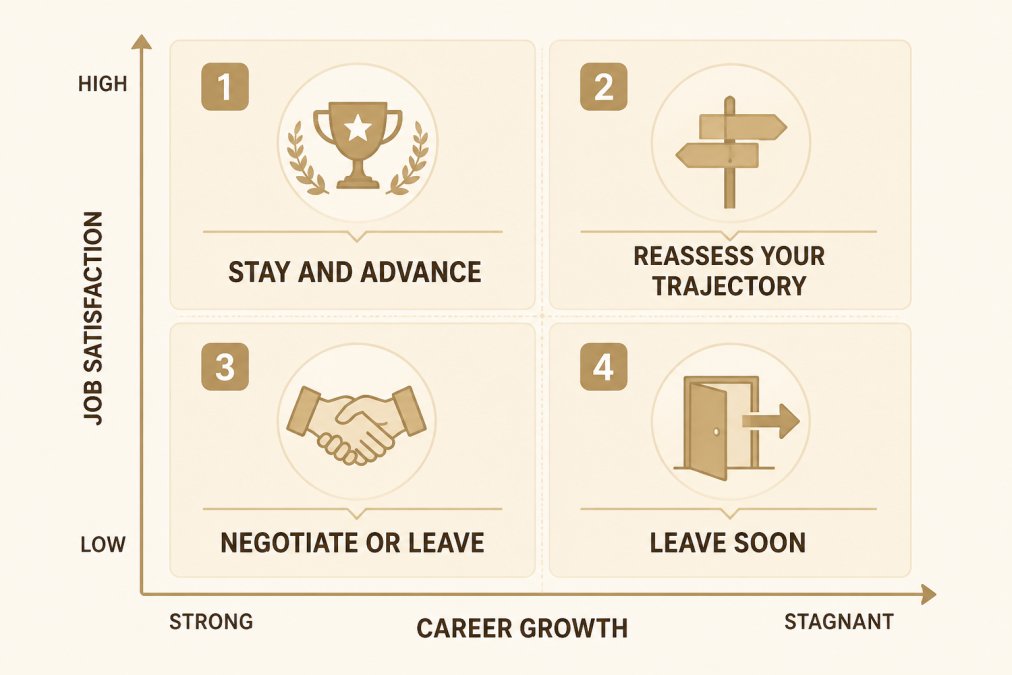
Quadrant 1: High Job Satisfaction + Strong Career Growth
Stay. You’re in the right place. Your work is meaningful, you’re developing professionally, and the environment supports both.
Quadrant 2: High Job Satisfaction + Stagnant Growth
Reassess your trajectory. You’re happy but not developing. Try to create growth opportunities: ask for new responsibilities, propose a project, or seek a lateral move. If the organization can’t accommodate growth, you’ll eventually need to leave.
Quadrant 3: Low Job Satisfaction + Strong Career Growth
Negotiate or leave. You’re learning but unhappy. If you’re in a deliberate tough assignment phase that builds specific skills, staying temporarily makes sense. If unhappiness is chronic, leave.
Quadrant 4: Low Job Satisfaction + Stagnant Growth
Leave soon. You’re unhappy and not developing. There’s no reason to stay unless financial constraints require delay.
Honestly assess where you fall on each axis. Job satisfaction: on a scale of 1-10, how much do you enjoy your work and environment? Career growth: are you developing professionally or stagnating? Your quadrant tells you what to do.
How to Resign From a Job Professionally and Build Your Exit Strategy
Once you’ve decided to leave, execution matters. A professional resignation protects your reputation, maintains references, and ensures smooth transition.
Ideally, you’ll have another job lined up before resigning. If you’re in a genuinely toxic or health-damaging situation, leaving without a job is sometimes necessary. If considering this, move to the Financial Runway Planning section first.
Give appropriate notice, typically two weeks for standard roles, longer for senior positions. Check your employment agreement for required notice periods. Provide notice in writing to your direct manager first, then HR. Keep the conversation brief and professional.
Your resignation letter should be brief, positive, and forward-looking. Avoid criticizing the organization, manager, or colleagues. You’re closing a chapter professionally.
Resignation Letter Templates and Key Steps
Template 1: Standard Resignation (Two Weeks’ Notice)
Dear [Manager’s Name],
I am writing to formally notify you of my resignation from my position as [Your Title] at [Company Name]. My last day of work will be [Date, typically two weeks from today].
I’m grateful for the opportunities I’ve had during my time here, particularly [mention one specific positive experience or skill development]. I’m committed to ensuring a smooth transition and will make myself available to document processes, train my replacement, or assist in any way needed during my notice period.
Thank you for your support and understanding.
Sincerely,
[Your Name]
Take the free 23-point assessment →
Template 2: Resignation With Extended Notice (Senior Role)
Dear [Manager’s Name],
I am writing to formally notify you of my resignation from my position as [Your Title] at [Company Name], effective [Date, typically four weeks or more from today].
During my notice period, I will prioritize transitioning my responsibilities, documenting key processes, and supporting the team in finding and training my replacement. I’m committed to making this transition as smooth as possible.
I appreciate the professional development and experiences I’ve gained here. I wish you and the team continued success.
Sincerely,
[Your Name]
Key Steps During Your Notice Period:
-
Document everything. Create written guides for your key responsibilities, processes, passwords, contacts, and ongoing projects.
-
Train your replacement. Spend time bringing them up to speed or create training materials for whoever takes your role.
-
Maintain performance. Don’t check out mentally or physically. Your final weeks set the tone for how you’ll be remembered and referenced.
-
Manage your emotions. Stick to your decision. Don’t get drawn into last-minute retention offers unless they genuinely address core problems.
-
Collect references. Ask colleagues and your manager if they’d serve as references. Get their contact information.
-
Understand your benefits. Know when your health insurance ends, what happens to your 401(k), whether you’re entitled to unused vacation pay, and other benefits details.
Financial Runway Planning Before You Leave
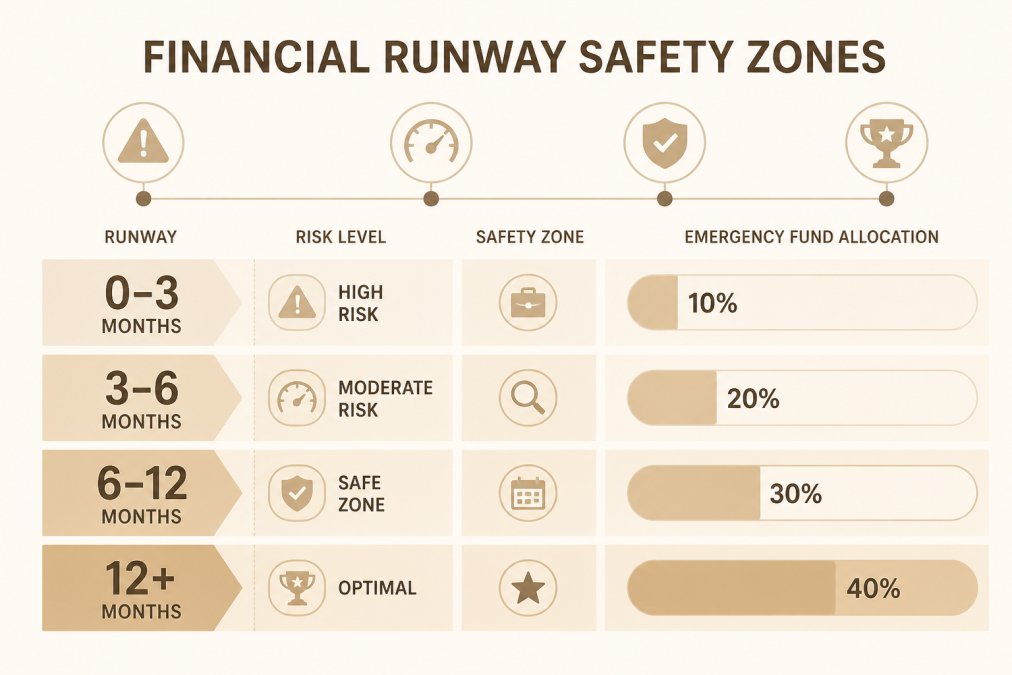
The biggest barrier to leaving is financial fear. Financial runway, the number of months you can live on savings without income, determines whether you can afford to leave.
Calculate Your Monthly Expenses:
List every monthly expense: rent or mortgage, utilities, insurance, food, transportation, childcare, debt payments. Be honest about your real monthly burn rate.
If your monthly expenses are $4,000 and you have $12,000 in savings, you have three months of runway. With $24,000, you have six months.
Determine Your Runway Target:
-
0-3 months: Only viable if you have another job lined up.
-
3-6 months: Moderate runway. You have time to find a role without desperation driving your decision.
-
6-12 months: Safe runway. You can be selective about your next role.
-
12+ months: Optimal runway. Maximum flexibility for sabbaticals, freelancing, or selective opportunities.
Build Your Runway:
If you lack adequate runway:
-
Save aggressively. Cut expenses, increase income through side work, redirect bonuses to savings.
-
Find another job first. The safest path. You leave one job and enter another with no gap.
-
Negotiate severance. In senior roles or during restructuring, you might negotiate a severance package.
-
Reduce expenses. Move to a cheaper place, cut discretionary spending, pause retirement contributions temporarily.
Most people underestimate what they can save when motivated. Set a specific savings target, calculate the timeline, and commit to it.
Don’t leave without runway unless you’re in crisis. Financial stress on top of job stress creates a worse situation. Give yourself the gift of a financial buffer. It changes how you approach your job search and the decisions you make about your next role.
Recognizing the signs it’s time to leave is difficult because leaving feels risky. It is. But staying in the wrong role is also risky, to your health, career, and family. The question isn’t whether leaving is risky. It’s whether staying is riskier.
If you’re navigating a complex relationship situation alongside career decisions, if infidelity, separation, or co-parenting conflict is complicating your ability to make clear career choices, After the Affair Series provides structured frameworks to help you think clearly. The free 23-point assessment can help you understand where you stand in your relationship, which often clarifies career decisions. When you’re not in survival mode managing relationship crisis, you can make better professional choices.
Start with your runway. Build your financial buffer. Then make your move with confidence.
Frequently Asked Questions
How do I know if it's time to leave my job or if I'm just having a bad week?
A bad week passes; career stagnation persists. If you've felt dread for 2+ months, notice ongoing physical symptoms like sleep loss or tension, or see no path for professional development after honest conversations with your manager, it's likely time to consider leaving. Burnout from temporary stress differs from chronic workplace culture problems. Track your mood patterns over 4-6 weeks. If the negativity is consistent and tied to specific workplace issues, not just workload, that's a signal worth taking seriously.
What are the main signs of a toxic workplace that mean I should leave?
Toxic work environments share predictable patterns: leaders who undermine staff, inconsistent rules applied by favoritism, zero accountability for misconduct, constant criticism without constructive feedback, and isolation of certain employees. You'll notice high turnover, people working through illness, and conversations that shift to whispers when leadership enters. If your workplace exhibits three or more of these signs and your attempts to set professional boundaries are ignored or punished, it's a signal to start planning your exit.
How do I resign from a job professionally without burning bridges?
Give at least two weeks' notice in writing. Keep your resignation letter brief, professional, and free of complaints, no matter how justified. State your last day clearly, offer to train your replacement, and document your current projects. During your notice period, maintain your work quality and professionalism. Avoid venting to coworkers or using company resources for personal job searching. Thank your manager for opportunities you genuinely received. This approach protects your professional reputation and ensures positive references for future roles, even if the job itself was a poor fit.
Should I have another job lined up before I leave, or is it okay to resign without one?
Ideally, secure a new role first to avoid income gaps and maintain continuous employment on your resume. However, if your workplace is genuinely harmful to your mental or physical health, leaving without a backup may be necessary. Before resigning without a job offer, ensure you have 6-12 months of living expenses saved, understand your health insurance options (COBRA or marketplace plans), and have a concrete job search strategy. Use your notice period to interview aggressively. Most employers understand gaps if you explain them as intentional transitions, but financial runway makes the process far less stressful.
How can I tell if I'm experiencing burnout that might improve, or if I have a genuine career mismatch?
Burnout is exhaustion from overwork or toxic conditions; career mismatch is misalignment between your values and the role itself. If you love the work but hate the environment or pace, burnout may improve with boundaries, delegation, or a different team. If you dislike the actual work, the tasks, industry, or skill set required, that's mismatch. Ask yourself: Would I want this job at a healthier company? If yes, it's burnout. If no, it's mismatch. Burnout can sometimes recover; mismatch rarely does without a career pivot.
This article was written using GrandRanker