Table of Contents
- Why Custody Exchanges with Narcissists Are Different
- Co-Parenting with a Narcissist Scripts: What to Say and What to Avoid
- Documenting High-Conflict Custody Exchanges for Court
- Court-Ordered Communication Apps and Neutral Exchange Methods
- Setting Boundaries That Actually Hold
- Safety Planning for Physical Exchanges
- Protecting Your Child from Emotional Fallout
- Recognizing Parental Alienation and Triangulation
- Frequently Asked Questions
Last Updated: September 23, 2026
Why Custody Exchanges with Narcissists Are Different
Managing child custody exchanges with narcissists requires a different approach than standard co-parenting. Narcissists use exchanges to control, provoke, or manipulate, showing up late, breaking agreements, making hostile comments in front of your child, or creating drama.
Your child is watching every interaction, learning how to handle conflict and boundaries. Vague advice like “stay calm” won’t work. You need specific scripts, clear documentation, and a safety plan.
The difference between parents who reduce conflict and those who cycle through drama is this: they stop trying to reason with the narcissist and start protecting themselves and their child instead.
Custody exchanges with narcissists aren’t about finding common ground. They’re about creating a system that removes opportunities for manipulation, documents everything, and keeps your child safe.
Co-Parenting with a Narcissist Scripts: What to Say and What to Avoid
Scripts for Common Exchange Scenarios
Scripts work by giving no emotional reaction and providing no fuel for conflict. Here are word-for-word responses for common situations.
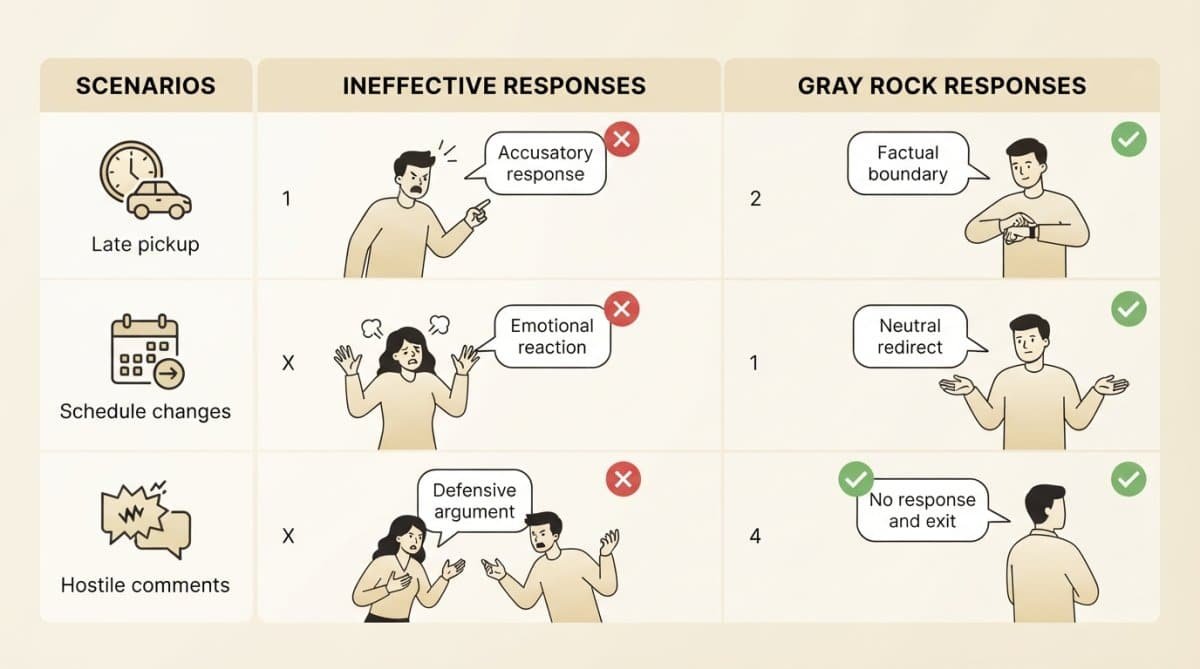
Scenario: Your ex shows up 30 minutes late
What NOT to say: “You’re always late. This is so disrespectful. You don’t care about our child.”
What to say: “I have another commitment at 3:15. I need to leave in five minutes with [child’s name]. Please be on time for the next exchange.”
The first triggers defensiveness. The second is factual, sets a boundary, and removes emotional hooks.
Scenario: Your ex makes a critical comment about you in front of your child
What NOT to say: “That’s a lie. You’re the one who destroyed this family.”
What to say: Nothing. Hand off your child and leave. Your child needs to see you stay calm and exit, not defend yourself.
Scenario: Your ex refuses to return your child on time
What NOT to say: “You’re breaking the custody agreement. I’m calling my lawyer.”
What to say: “Our agreement states pickup is at 5 PM. I expect [child’s name] at that time. If there’s a conflict, please let me know by text before the scheduled time.”
Send via text or email for documentation. Stay factual and reference the agreement without threatening legal action.
The Gray Rock Method in Practice
The gray rock method means becoming as uninteresting as a gray rock: flat tone, short answers, no personal information, no reaction to bait. Narcissists need emotional fuel. Remove it, and they lose interest in provoking you.
Gray rock in action:
Narcissist: “You look terrible. Have you given up on yourself?”
Gray rock response: “Mm-hmm.” (Then change the subject or end the conversation.)
Narcissist: “I heard you’re dating someone new. That’s pathetic.”
Gray rock response: “Okay.” (No explanation. No defense. No emotion.)
Narcissist: “You’re the reason [child’s name] has anxiety.”
Gray rock response: “I’m here to exchange [child’s name]. Do you have their backpack?”
Gray rock is about being boring, not rude.
:::pro-tip
Practice your gray rock responses out loud before an exchange. Your nervous system will want to react emotionally when provoked. Pre-rehearsed scripts bypass that impulse and keep you grounded.
:::
Documenting High-Conflict Custody Exchanges for Court
What to Document and How
Documentation is your legal protection. Judges read the record, not hear your story. That record comes from texts, emails, photos, and incident logs.
Document the following:
- Late pickups or drop-offs: Note expected vs. actual time, child’s safety and emotional state.
- Broken agreements: Document what was missed and impact on your child.
- Hostile behavior: Record what happened, when, and witnesses.
- Parental alienation: Document what your child reported and the date.
- Safety concerns: Log any incident affecting your child’s safety.
Create a simple log with these columns:
| Date | Time | What Happened | Witnesses | Impact on Child |
|---|---|---|---|---|
| 9/15/26 | 3:45 PM | Ex arrived 35 min late, child was anxious | Neighbor | Child asked if something was wrong with mom |
| 9/22/26 | 5:10 PM | Ex made comment about my new relationship in front of child | None | Child became quiet and withdrawn |
Digital Evidence Preservation
Text messages, emails, and photos are evidence. Preserve them properly so they hold up in court.
Never use evidence as a threat. Saying “I have screenshots of everything you’ve said” can backfire and make you look like the one escalating. Collect evidence quietly. Let your attorney decide when and how to use it.
Court-Ordered Communication Apps and Neutral Exchange Methods
Many courts require court-approved communication apps (OurFamilyWizard, Talking Parents) for custody discussions. These create automatic records that cannot be deleted. Check your agreement to see if one is required. If not, use email instead of text for major communications, it creates a time-stamped record.
If you use a court-ordered app, remember that judges can read every message. Write as if your judge is reading over your shoulder. Keep all communication focused on logistics and your child’s needs, never on your feelings about your ex.
Setting Boundaries That Actually Hold
Boundaries fail when they are unclear or when you do not enforce them. A narcissist tests every boundary to see which ones are real.
A clear boundary has three parts:
- The specific behavior you will not accept, “I will not listen to personal attacks during exchanges.”
- The consequence if the boundary is crossed, “If this happens, I will end the exchange and contact my attorney.”
- Your follow-through, You actually enforce it.
Safety Planning for Physical Exchanges
A safety plan is not about assuming your ex will harm you. It is about having a clear process if things escalate.
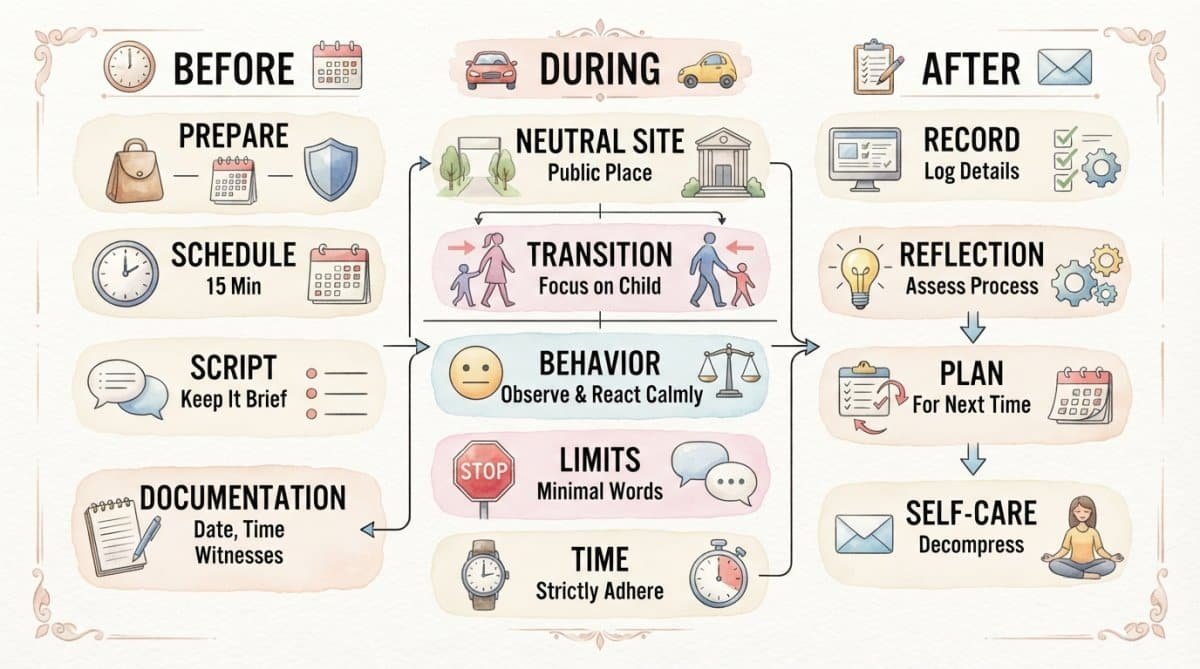
Before the exchange:
- Tell a trusted friend or family member the time and location of the exchange
- Have your phone charged and accessible
- Wear comfortable shoes you can move in quickly
- Park in a spot where you can exit easily
- Leave valuables at home
During the exchange:
- Stay alert. Do not get distracted by your phone or your surroundings.
- Keep your child close until the moment of handoff
- Use neutral language. Do not discuss personal topics.
- If your ex becomes aggressive, loud, or threatening, end the exchange immediately
- Say: “I’m leaving now. [Child’s name], let’s go.” Or: “I’m taking [child’s name]. I’ll contact my attorney.”
- Do not try to reason with someone who is escalating
After the exchange:
- If something unsafe happened, document it immediately. Write down what happened, when, and any witnesses.
- Contact your attorney if the safety concern was serious
- Do not retaliate or escalate in response
If your ex has ever been physically violent, used weapons, or made threats, do not do exchanges alone (Safety Planning with Children). Request that your custody agreement include supervised exchanges or exchanges at a neutral location with a third party present.
Protecting Your Child from Emotional Fallout
Your child is watching how you handle this conflict. They are also hearing things from your ex. They are processing the tension, the schedule changes, and the emotional weight of divided loyalty.
After an exchange, your child may be:
- Anxious or clingy
- Withdrawn or quiet
- Acting out or being defiant
- Asking questions about your ex
- Testing boundaries
Recognizing Parental Alienation and Triangulation
Parental alienation happens when one parent systematically damages the child’s relationship with the other parent. It can look like:
Your ex tells your child you do not love them
Your ex says you abandoned the family
Your ex tells your child they cannot trust you
Your ex makes your child choose sides
Your ex withholds communication or prevents phone calls
Your ex’s new partner makes comments to your child about you
Your ex tells your child’s teacher negative things about you
Your ex uses your child as a messenger: “Tell your mom I’m not paying for that.”
Signs your child is experiencing alienation:
- Your child suddenly refuses to see you or becomes hostile toward you
- Your child parrots criticisms that sound like an adult’s words
- Your child says things like “Mom/Dad said you don’t really love me”
- Your child seems afraid to enjoy time with you or talk about good things that happen
- Your child reports that your ex said negative things about you
Frequently Asked Questions
How do you handle a narcissist during a custody exchange?
Keep interactions brief and businesslike. Use the gray rock method: respond in monotone, provide minimal information, and avoid emotional reactions. Stick to logistics only (time, location, what the child needs). If the narcissist becomes hostile, end the conversation and document what happened. Use a neutral location like a public parking lot or police station parking lot for exchanges when possible. Never argue or defend yourself, narcissists thrive on conflict, and engaging feeds their need for control.
What is the gray rock method for co-parenting?
The gray rock method makes you as uninteresting as a gray rock, boring, unresponsive, and unrewarding to engage with. In custody exchanges, this means responding to provocations with flat, factual statements: ‘The pickup is at 3 p.m. Saturday’ instead of defending your parenting or reacting emotionally. Use neutral language, short sentences, and no personal details. This removes the emotional fuel narcissists need to escalate conflict and protects your children from witnessing heated exchanges.
How can I document custody exchanges for court?
Keep a detailed log of every exchange: date, time, who was present, what was said, and any concerning behavior. Note whether pickups were late, if your child arrived upset, or if hostile comments were made. Use a court-approved communication app like OurFamilyWizard to document written exchanges automatically. Take photos or videos of your child’s condition at handoff if there are safety concerns. Save all text messages and emails. This documentation becomes admissible evidence if custody disputes go to family court and shows a pattern of behavior.
What are the best boundaries to set for co-parenting with a narcissist?
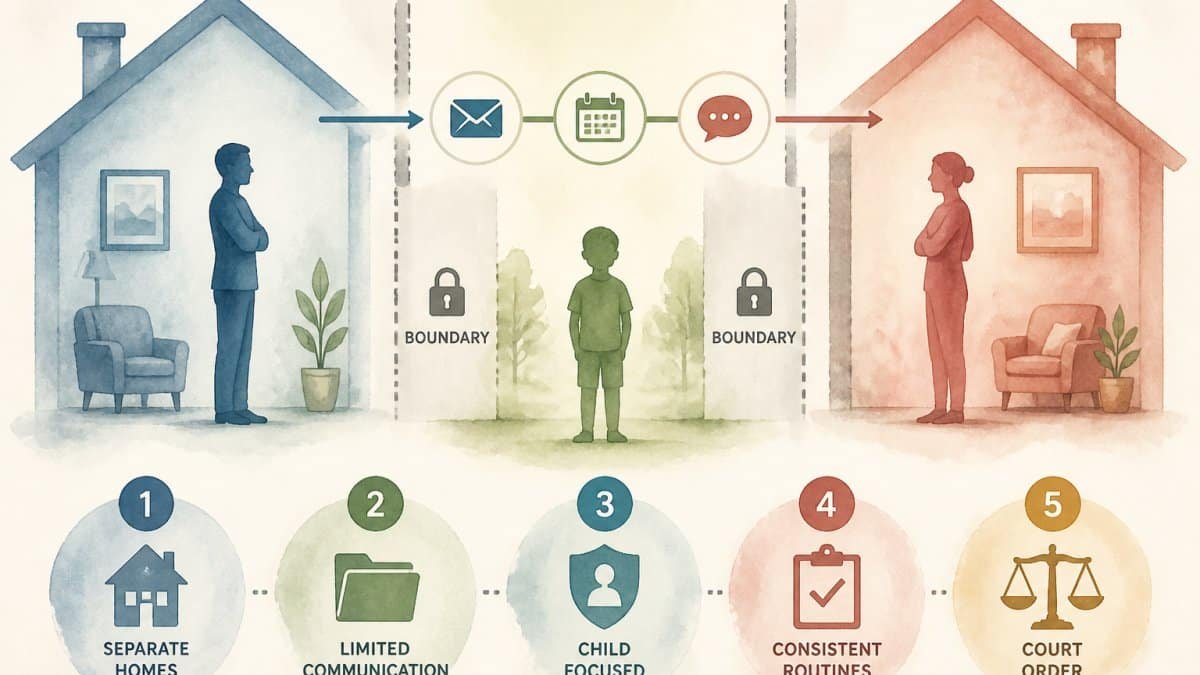
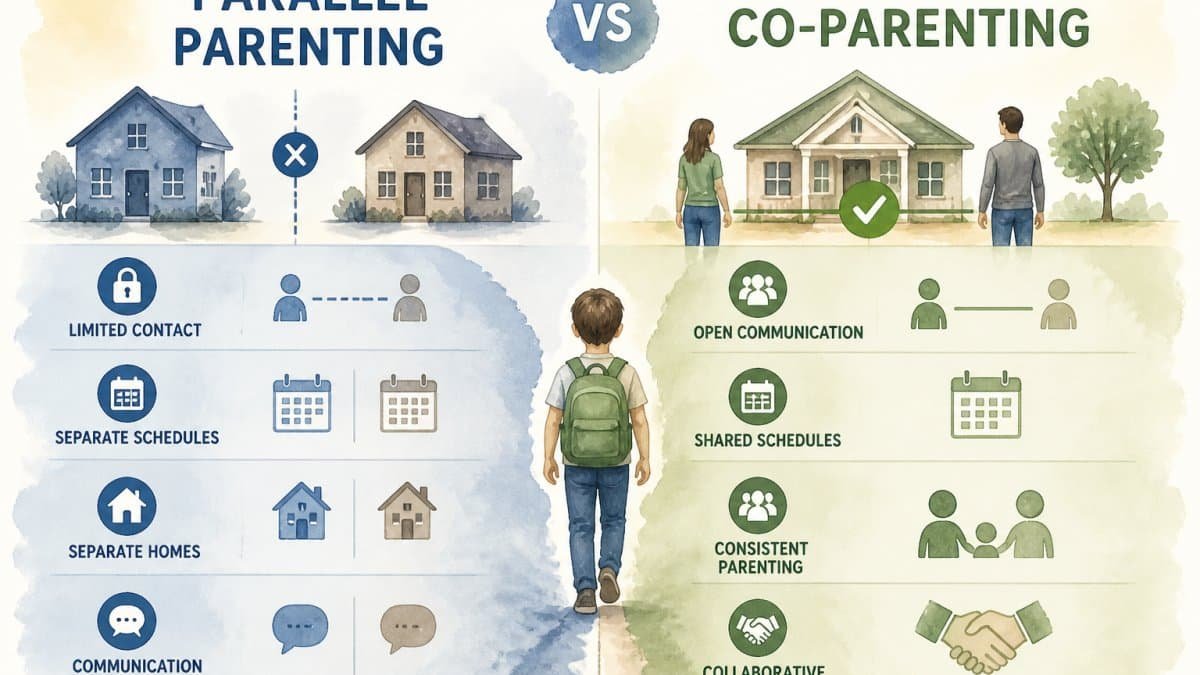
Establish clear, written boundaries in your custody agreement or parenting plan. Examples: communication only through a court-approved app, exchanges at a neutral location, no discussing adult issues with the child, and no unannounced visits. Enforce boundaries consistently and document violations. Do not negotiate or explain your boundaries, narcissists use explanations as opportunities to argue. State boundaries once and repeat them without elaboration if challenged. Parallel parenting (minimal direct interaction) often works better than traditional co-parenting with high-conflict ex-partners.