Last Updated: October 6, 2026
Table of Contents
What Counts as Violating a Custody Exchange Order
A custody exchange order violation occurs when a parent fails to follow the court-ordered schedule for picking up or dropping off a child, and understanding the legal implications of violating custody exchange orders is essential for protecting your parenting rights.
Courts take exchange violations seriously because they disrupt the child’s routine and undermine the other parent’s court-granted parenting time. What seems like a small delay to one parent is a direct violation to the other.
The violation doesn’t require intent. Missing a pickup because your car broke down is still technically a violation, though courts distinguish between intentional breaches and genuine emergencies.
Even a single violation can be documented and used in court. Build a record of every missed or late exchange, no matter how minor it seems at the time.
Common Custody Exchange Violations and What Triggers Enforcement
Missed pickups and late drop-offs
A missed pickup happens when the custodial parent isn’t ready at the scheduled time, or the non-custodial parent doesn’t show up to collect the child. Late drop-offs occur when a parent returns the child after the court-ordered time. Both trigger enforcement action.
Being 10 minutes late is still late. Being 30 minutes late is a clearer violation. Courts recognize that delays happen, but repeated lateness becomes a pattern that justifies enforcement. A single incident may not result in consequences, but documentation of repeated violations strengthens a motion to enforce.
Common scenarios that trigger enforcement:
- Custodial parent keeps child past the scheduled exchange time
- Non-custodial parent arrives more than 15-30 minutes late
- Parent fails to show up entirely without notice
- Parent arrives at wrong location or wrong time
- Unannounced changes to the exchange schedule
Failure to return the child on time
This violation is more serious than a late drop-off. If the order says the child must be returned by 6 PM Sunday, and the parent returns them at 7 PM, that’s a failure to return on time. If they don’t return the child at all, that’s parental kidnapping, a criminal matter.
Courts view failure to return as a direct assault on the other parent’s parenting time. It’s not just a scheduling inconvenience. It prevents the other parent from exercising their court-ordered rights.
What makes this violation serious:
- Removes the child from the other parent’s custody without permission
- Disrupts the child’s routine and school/activity schedules
- Demonstrates willful disregard for the court order
- Can escalate to custody modification proceedings
Unilateral changes to scheduled exchanges
A parent cannot simply decide to change the exchange time or location without court approval or the other parent’s written agreement. If the order says exchanges happen at the community center at 5 PM, a parent cannot unilaterally move it to their home at 4:30 PM.
Unilateral changes are violations because they undermine the entire structure of the parenting plan. They also create confusion and give one parent use over the other. Even if the change seems reasonable, it’s still a violation if both parents didn’t agree in writing.
Why courts enforce against unilateral changes:
- They destabilize the parenting schedule
- They give one parent power over the other
- They prevent proper documentation of exchanges
- They often precede more serious violations
Every violation, whether late, missed, or unilaterally changed, creates a documented pattern that courts use to assess whether the parent is complying with the order.
Contempt of Court for Custody Order Violation
Contempt of court occurs when a parent willfully violates a court order without a valid legal excuse.
The word “willful” is critical. A parent who misses a pickup because they were in a car accident has a legal excuse. A parent who misses it because they forgot has no excuse.
Contempt proceedings are separate from enforcement motions. In a contempt case, the judge can impose sanctions, fines, jail time, attorney fees, or custody changes.
What the court must prove for contempt:
- A valid court order existed
- The parent knew about the order
- The parent had the ability to comply
- The parent willfully violated the order without legal excuse
- The violation was substantial, not minor
Courts don’t hold parents in contempt for minor, one-time violations. They use contempt for patterns of willful non-compliance or serious single violations like complete failure to return a child.
Evidence for Custody Order Violation: What to Document
Documentation is your strongest tool. Without evidence, your claim of a violation is just your word against the other parent’s. With evidence, you have proof.
Documentation methods that hold up in court
Text messages and emails are the gold standard. They create a timestamped record of what was said and when.
Incident logs are written records you create immediately after each violation. Write down the date, time, what was supposed to happen, what actually happened, and any witnesses.
Photos and videos of the exchange location and time are helpful but not always necessary.
Witness statements from people present at the exchange carry weight.
Communications from the other parent admitting the violation are powerful. If they text “Sorry I’m running 45 minutes late,” that’s an admission. Save these.

Building a credible evidence timeline
Organize your evidence chronologically. Start with the first violation and document each one in order. Include:
- Date and time of the scheduled exchange
- Date and time the exchange actually occurred (or didn’t)
- How late or early it was
- Who was present
- Any communication about the violation
- Impact on the child (missed school, missed activity, upset)
A timeline shows a pattern. One missed pickup might be an accident. Five missed pickups over three months is a pattern of willful non-compliance.
Save everything. Screenshots, texts, emails, incident logs, photos, file them in a folder organized by date. Courts want to see patterns, and patterns require documentation.
Responding to a Missed Child Custody Exchange
Immediate steps at the exchange location
When the other parent doesn’t show up or is significantly late, stay calm and document the moment. Note the exact time you arrived and the exact time they arrived (or didn’t).
If they don’t show up at all, wait a reasonable time (typically 15-30 minutes, depending on your local court’s guidance), then leave. Document that you waited and when you left.
Contact the other parent immediately, but keep it factual, not emotional. Text: “I was at the park at 3 PM as scheduled. You didn’t arrive. I waited until 3:20 PM and left.
Do not:
- Take the child to the other parent’s home if they’re not at the exchange location
- Leave the child with someone else without explicit permission
- Engage in argument or accusation at the exchange
- Refuse to exchange the child if they do arrive (even late)
Communication after the violation
After the exchange, send a follow-up message documenting what happened.
Do not use inflammatory language like “You violated the court order” or “You’re being a terrible parent.” Courts read these messages. Neutral, factual documentation is more persuasive than emotional accusations.
If the other parent responds, save the response. If they deny being late, your documentation (timestamps, photos, witness statements) proves otherwise.
Request written confirmation of future exchanges. A simple text like “Confirming pickup tomorrow at 3 PM at the park” creates a record that both parents agreed to the time and place.
Child Custody Order Enforcement: Filing a Motion to Enforce
When to file and what the motion must include
File a motion to enforce after documenting a pattern of violations, as courts take seriously the legal implications of violating custody exchange orders when patterns emerge. One missed pickup might not justify a motion. Three or four missed pickups over several weeks does.
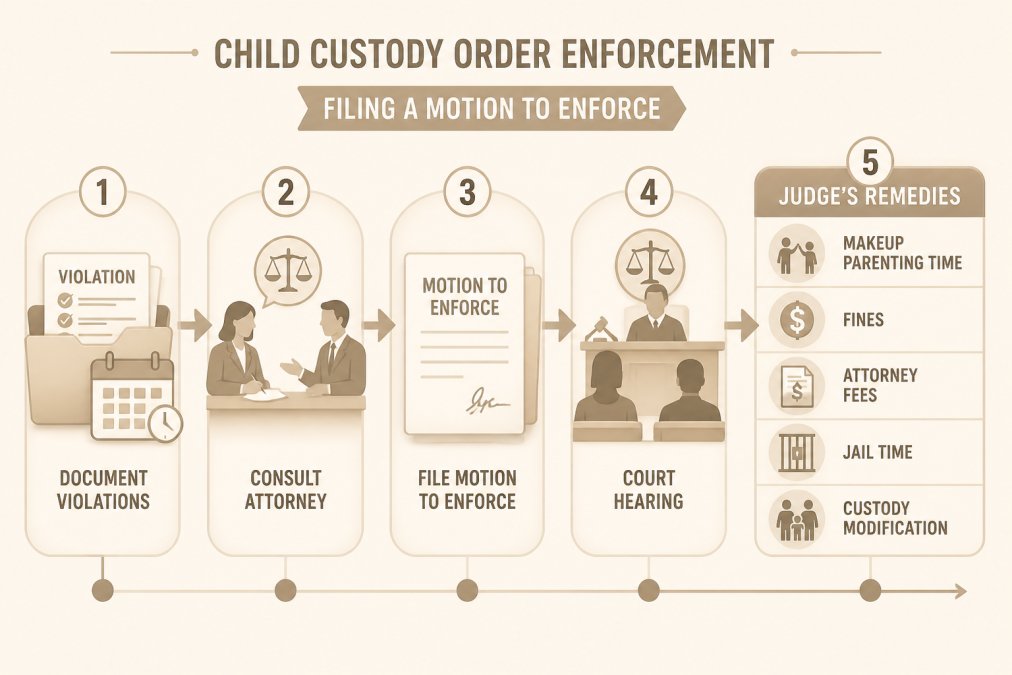
The motion must include:
- Your name and the other parent’s name
- The case number and court that issued the original order
- The specific language from the order that was violated
- Dates and times of each violation
- How you documented each violation (texts, incident logs, witnesses)
- The impact on you and the child
- What remedy you’re requesting (makeup time, fines, custody modification)
The motion should be clear and organized. Attach your evidence: screenshots, logs, photos, witness statements. Let the evidence speak for itself.
File the motion in the same court that issued the original custody order. Include a certificate of service showing you notified the other parent of the motion.
Legal remedies available to the court
When a judge finds a violation, they have several options:
Makeup parenting time is the most common remedy. If you lost time due to a missed exchange, the court awards you extra time to make up for it. This directly compensates you for the lost parenting time.
Fines penalize the violating parent. The amount varies by jurisdiction and the severity of the violation. Fines are typically $100-$500 per violation, but can be higher for repeated or egregious violations.
Attorney fees and court costs can be awarded to the parent who had to file the motion.
Jail time is rare but possible for willful, repeated violations. A parent might face jail time if they’ve been found in contempt multiple times and continue violating the order.
Custody modification is the most serious remedy.
Distinguishing Intentional Violations from Emergencies and Misunderstandings
Not every violation is willful. Courts recognize that life happens, car breakdowns, medical emergencies, traffic accidents.
Intentional violations are deliberate choices to ignore the order. A parent who decides to keep the child an extra day without permission is willfully violating.
Emergencies are legitimate reasons for non-compliance. A child gets sick and needs to stay with the custodial parent.
Misunderstandings happen when both parents interpreted the order differently or one parent didn’t understand the schedule.
The key is how the parent responds.
Courts consider:
- Whether the parent notified the other parent promptly
- Whether the parent offered makeup time
- Whether the parent has a history of violations
- Whether the excuse is credible and documented
- Whether the violation affected the child’s wellbeing
A single emergency excuse is reasonable.
Don’t assume the court will accept your emergency explanation. Document it. If your child was sick, keep medical records. If you were in an accident, keep the police report. Proof matters.
Custody exchange violations are serious because they disrupt your parenting time and your child’s stability. After the Affair Series provides a structured toolkit designed to help individuals navigate the complexities of betrayal, separation, and high-conflict co-parenting.
Frequently Asked Questions
What happens if a parent violates a child custody exchange order?
The violating parent can face contempt of court charges, which may result in fines, jail time, or both. The court may also modify the custody arrangement, award makeup parenting time to the other parent, or require the violating parent to pay attorney fees and court costs. The specific consequences depend on whether the violation was intentional, the number of prior violations, and state law. Repeated violations strengthen the case for custody modification in the non-violating parent’s favor.
What evidence should I keep after a missed custody exchange?
Document the date, time, and location of the missed exchange. Take timestamped photos or videos at the exchange location showing your presence. Save all text messages, emails, and call logs related to the violation. Write a detailed incident log noting what happened, who witnessed it, and any communication attempts you made. Keep records of any makeup parenting time offered or refused. Text message threads and written communications are admissible in court and form the foundation of a strong enforcement case.
Can a parent be held in contempt for missing a custody exchange?
Yes. Willful violation of a court-ordered custody exchange can result in contempt of court charges. The key factor is intent: the parent must have knowingly and deliberately violated the order without a valid emergency reason. Repeated missed exchanges or late drop-offs strengthen the contempt case. A judge may find contempt even on a first violation if the evidence shows deliberate disregard for the court order. Contempt can carry fines up to several thousand dollars and jail time depending on state law and the severity of the violation.
How does state law affect custody exchange violation consequences?
Each state defines contempt of court, enforcement remedies, and penalties differently. Some states impose mandatory jail time for repeated violations; others prioritize fines and custody modification. The exact language in your custody order and parenting plan also matters, a violation must breach the specific terms the judge ordered. Before filing a motion to enforce, consult a family law attorney in your state to understand the specific statutes, filing procedures, and likely outcomes. What constitutes willful noncompliance and the remedies available vary significantly by jurisdiction.