Table of Contents
Last Updated: September 16, 2026
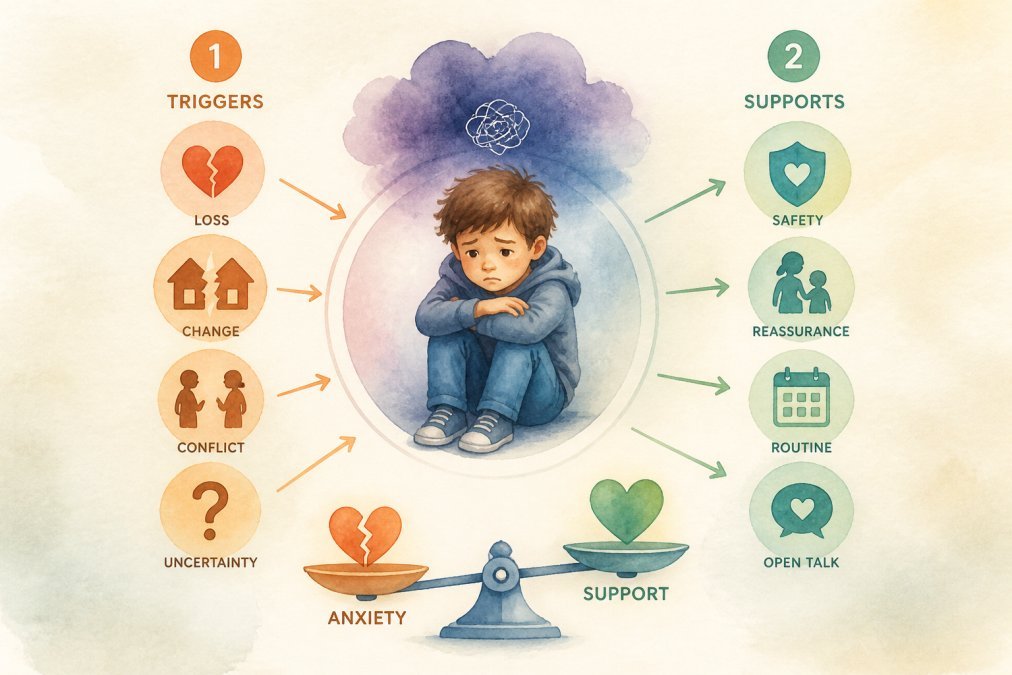
Why Divorce Anxiety Hits Children Differently at Every Age
Divorce anxiety is the persistent worry, fear, and emotional distress children experience when their parents separate, and it looks different at every developmental stage. This guide from After the Affair Series breaks down what children need at each age, with words and routines that calm the nervous system rather than spike it.
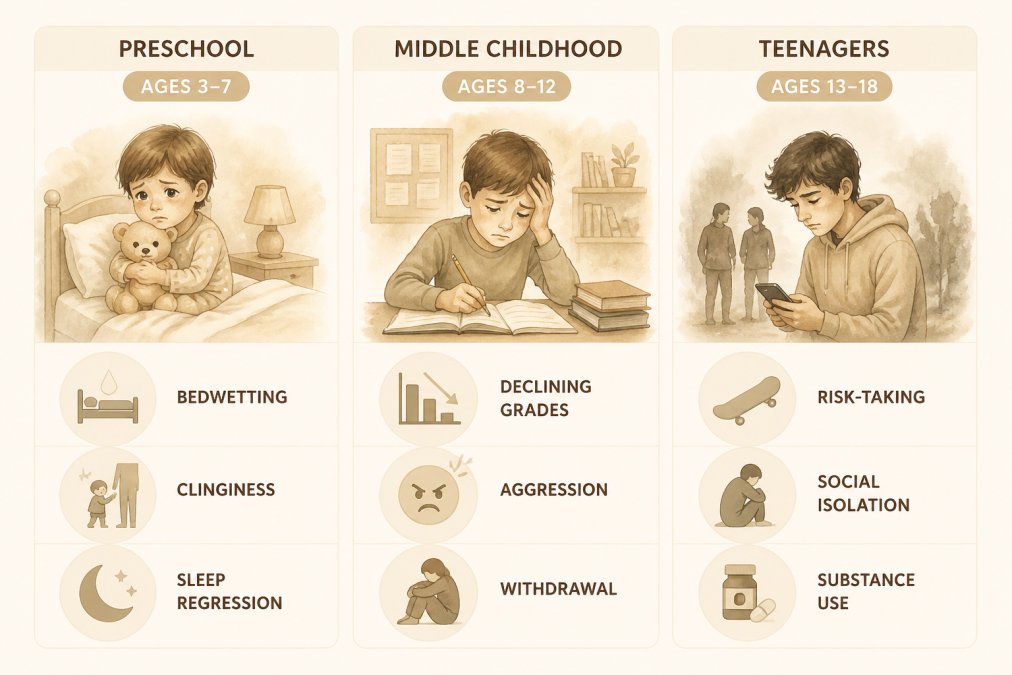
Preschool and Early Elementary (Ages 3-7)
Children this age think in concrete, self-referential terms, so a preschooler’s first reaction is often to assume they caused the split. Expect sleep regression, clinginess at drop-off, and a return to outgrown behaviors.
Middle Childhood (Ages 8-12)
This is where anger usually shows up, often aimed at the parent who left. Kids this age can love you and be furious with you in the same hour. Declining grades, aggression toward siblings, and withdrawal from favorite activities are common. Give them facts, not adult details, where they’ll sleep, which school they’ll attend, whether the dog is coming.
Teenagers (Ages 13-18)
Teenagers often look fine and aren’t. They understand the situation well enough to hide how much it hurts. Watch for risk-taking, social isolation, and a drop in school performance rather than tears.
Signs of Divorce Anxiety in Children You Should Never Ignore
The clearest signs of divorce anxiety in children are changes from their baseline, not any single behavior. A child who was always quiet isn’t necessarily struggling; a child who was outgoing and is now silent usually is. Anxiety isn’t sadness, sadness looks like tearfulness and withdrawal, while anxiety looks like vigilance: scanning for the next bad thing, repeated questions about the schedule, or tensing when the topic comes up.
Sleep and body signals
- Trouble falling asleep, frequent night waking, nightmares, or wanting to sleep in your bed
- Stomachaches, headaches, or fatigue with no medical cause, anxiety in children often shows up in the gut before it shows up in words
- Appetite changes, nail-biting, hair-pulling, or skin-picking
Behavioral regression and control-seeking
- Thumb-sucking, bedwetting, or baby talk in younger children
- Clinginess and separation anxiety at drop-offs, especially after transitions between homes
- Rigid insistence on routine or repeated questions about what happens next
Emotional and social shifts
- Anger and irritability, especially directed at one parent
- Withdrawal from friends, sports, or activities they previously loved
- New people-pleasing or over-compliance, a child who never complains may be managing adult emotions
- Statements of blame, guilt, or hopelessness
School and functioning
- Declining school performance or sudden refusal to go
- Trouble concentrating, forgetting assignments, or losing track of belongings
- Conflicts with teachers or peers that are out of character
A single symptom in isolation is normal. The clinical threshold most practitioners use is three or more symptoms appearing together, lasting more than four to six weeks, and interfering with at least one area of daily functioning, school, friendships, sleep, or eating. That combination is when you stop waiting it out and bring in outside support. One caveat: any statement about self-harm or not wanting to be alive is a call-this-week signal regardless of how long it has been going on.
What Anxiety Looks Like at Different Ages
Anxiety doesn’t announce itself the same way across childhood. A preschooler may lack words for worry, so it comes out as tantrums at drop-off or fear of the dark. A school-age child may ask “Who’s picking me up?” ten times a day because the answer is the only thing they can control.
When It’s Anxiety vs. Something Else
Divorce anxiety can overlap with depression, adjustment disorder, and attention problems, and the treatment differs. Anxiety is future-focused (“What if…”), depression is past- and self-focused (“I’m not worth…”), and adjustment disorder typically resolves within six months once the stressor stabilizes. If symptoms aren’t improving as the routine stabilizes, have a professional sort out the pattern.
Tracking Instead of Guessing
Keep a simple two-week log: date, what you saw, how long it lasted, and whether it affected school, sleep, or friendships. Patterns invisible day to day become obvious on paper, and a log is the most useful thing to bring to a pediatrician or therapist.
Co-Parenting Scripts for Difficult Conversations That Protect Your Child
Effective co-parenting scripts for difficult conversations share three features: they’re short, they don’t assign blame, and they don’t ask the child to manage an adult emotion. Rehearse them out loud, under stress, you default to whatever you’ve practiced.
Sample Script: Explaining the Separation
“We have something to tell you. Mom and Dad are going to live in two different homes. This is a grown-up decision, and it is not your fault. You are loved by both of us, and that will never change. You’ll still see both of us. We’ll tell you exactly what the week looks like, and you can ask us anything, anytime.”
Sample Script: Handling Your Child’s Anger
“You’re allowed to be angry. I’d be angry too. You don’t have to pretend this is fine. You can be mad at me and still love me. What I need from you is to tell me when it’s too big, so we can get you help with it.”
If your child asks a question you can’t answer yet, say so plainly: “I don’t know yet. I’ll tell you as soon as I do.” Children handle uncertainty far better than they handle being lied to and finding out later.
Building a Consistent Routine That Lowers Anxiety
A consistent routine is the most reliable anxiety reducer available to you, and it costs nothing. Predictability tells a child’s nervous system the world is still orderly, even when the family structure changed.
- Same drop-off and pick-up times, every week
- Same bedtime ritual at both homes, even if the homes look different
- A shared calendar the child can see, with both parents’ names on it
- One recurring tradition that survives the split, like Friday pancakes or Sunday calls
- Advance notice of schedule changes, never surprises
Digital Safety and Social Media: The Modern Stressor Most Parents Miss
Most guides on how to help children cope with divorce anxiety stop at routines and reassurance, skipping where modern kids actually spend their emotional energy: group chats, social media, and the phone in their pocket.
Set two rules early:
- No parent communicates with the child about the other parent through the child’s phone
- Nothing about the separation gets posted publicly until both parents agree on what the children will see
When to Seek Professional Help for Child Anxiety
Seek professional help when symptoms last more than four to six weeks, interfere with school or friendships, or include any talk of self-harm, the three thresholds separating a normal adjustment reaction from something that needs a clinician.
Specific signs that warrant a call this week:
- Any statement about not wanting to be alive, or self-harm of any kind
- Refusal to attend school for more than a few consecutive days
- A drop in grades severe enough to trigger school intervention
- Panic attacks, or physical symptoms that a doctor has ruled out medically
- Withdrawal from all friends and activities

The Right First Call Depends on What You’re Seeing
Start with your pediatrician for anything that could be medical, stomachaches, headaches, sleep disruption, appetite changes. Pediatricians can rule out physical causes, screen for anxiety and depression, and refer to a child psychologist or licensed family therapist. The American Academy of Pediatrics guidance on children’s mental health outlines what to expect from an evaluation and how to talk to your child about it.
Matching the Therapy to the Problem
The type of therapy matters more than the number of sessions.
- Cognitive behavioral therapy (CBT) is the most studied approach for childhood anxiety and is usually the first-line recommendation. It teaches kids to notice anxious thoughts and test them against reality.
- Family therapy helps when the conflict between parents is what’s driving the child’s symptoms. It treats the household system, not just the child.
- Individual therapy helps when the child’s own coping mechanisms have stalled and the anxiety is internal, rumination, avoidance, physical symptoms.
- Group therapy can be useful for teens who feel isolated and benefit from hearing peers describe the same experience.
Therapy works best alongside, not instead of, a calmer co-parenting arrangement. If the conflict between parents does not change, the child’s symptoms usually do not either, no matter how good the therapist is.
What to Do While You Wait for an Appointment
Waitlists for child therapists are commonly several weeks to several months, and that gap isn’t wasted time.
- Tell your child’s school counselor. Schools can provide a quiet space, check-ins, and short-term support at no cost while you wait for outside care.
- Keep the routine as steady as possible. Predictability is the intervention you can deliver today.
- Reduce the child’s exposure to conflict and to adult details about the separation.
- Ask your pediatrician whether a school-based or community-based program is available in the meantime.
Paying for It
Coverage varies widely. Most employer-sponsored plans and Medicaid cover child mental health services, but in-network child therapists are often thin and out-of-network reimbursement is usually partial. Before you book, ask: Is this provider in network? What’s the copay for a 50-minute session? How many sessions are authorized before a review?
What to Expect in the First Few Sessions
An evaluation usually covers the child’s history, the family situation, the symptoms and how long they’ve lasted, and how they affect daily life. The therapist will typically meet with parents separately and may ask permission to speak with the school. You should leave the first session with a working diagnosis or a plan to clarify one, how often you’ll meet, and what progress would look like.
School-Specific Support Strategies and Sibling Dynamics
Two support systems most parents overlook are the school and the sibling relationship, and both can do heavy lifting.
Keep these guardrails in place:
- Give each child one-on-one time with each parent, even twenty minutes
- Don’t let one sibling become the messenger or the mediator
- Expect different reactions and don’t compare them out loud
- If siblings are turning on each other, treat it as a signal, not a discipline problem
Frequently Asked Questions
At what age is a child most affected by divorce anxiety?
Research consistently shows that children between ages 5 and 8 tend to show the most visible distress during and after a divorce. At this developmental stage, children are old enough to understand something is wrong but lack the emotional regulation skills to process it. Preschoolers may regress with bedwetting or clinginess, while teens often internalize anxiety and show it through withdrawal or risk-taking. The intensity depends less on age and more on how much conflict they witness and how consistent their routine remains.
How can I identify signs of divorce anxiety in children during a separation?
Watch for behavioral changes that appear suddenly and persist: sleep disruptions, appetite changes, new fears about being abandoned, declining school performance, or physical complaints like stomachaches with no medical cause. Younger children may act out aggressively or regress to earlier behaviors. Teens might isolate, snap at family members, or lose interest in activities they previously enjoyed. Track these patterns for two to three weeks. If they worsen or interfere with daily functioning, that signals your child needs additional support beyond reassurance alone.
What should parents avoid saying to children during a divorce?
Never criticize the other parent in front of your child, share details about infidelity or legal proceedings, or use your child as a messenger between households. Avoid phrases like ‘Your father chose to leave us’ or ‘This is your mother’s fault.’ Also skip false promises such as ‘Nothing will change’ when routines clearly are shifting. Children need honest, age-appropriate information without being pulled into adult conflict. Keep explanations short, factual, and focused on what stays stable: your love, their school, and their relationship with both parents.
How do co-parenting scripts help when my ex refuses to communicate reasonably?
Structured scripts give you pre-planned responses that keep conversations child-focused and reduce the chance of escalation. When your ex is hostile, a script like ‘I understand you’re frustrated. Let’s stick to what works for [child’s name] this week’ redirects the exchange without engaging the attack. These tools work even with unpredictable ex-partners because they limit what you reveal emotionally and document your consistent, reasonable communication. Over time, this pattern protects your child from witnessing conflict and creates a record of your cooperative approach if custody disputes arise.