Table of Contents
- What Narcissistic Parental Alienation Looks Like
- Common Tactics Used by Alienating Parents
- Co-Parenting With a Narcissist Scripts and Communication Strategies
- Parallel Parenting Strategies to Minimize Conflict
- Parental Alienation Documentation Templates and Legal Protection
- Managing Your Stress and Protecting Your Emotional Boundaries
- Maintaining Your Child’s Bond With You During Alienation
- When to Seek Professional Legal and Mental Health Support
- Frequently Asked Questions
Last Updated: September 18, 2026
What Narcissistic Parental Alienation Looks Like
Narcissistic parental alienation is when one parent deliberately damages the other parent’s relationship with their child through manipulation, false accusations, and emotional control. The alienating parent uses their influence to turn the child against the targeted parent, often making the child believe the other parent is dangerous, uncaring, or unworthy of love.
What distinguishes this from normal post-divorce conflict is its deliberate, systematic nature, a parent might say, “Your mom forgot your birthday,” when she actually called and the child refused to answer, or intercept messages entirely to poison the child’s mind.
The targeted parent feels helpless, unable to prove private conversations while the child parrots lies back, gaslighting at its worst.
Recognizing these patterns is the first step to protecting your emotional boundaries and fighting for your relationship.
Common Tactics Used by Alienating Parents
Gaslighting makes you question your reality. The parent tells your child you said things you never said or denies events that happened, creating doubt about whether they can trust you.
Triangulation brings a third party into the conflict, the alienating parent tells your child, “Your dad said mean things about you to his new girlfriend,” or loops in teachers, coaches, or grandparents so multiple adults seem to agree you’re a bad parent.
Emotional manipulation uses guilt and fear, “If you go to your mom’s house, I’ll be alone and sad all weekend”, making the child feel responsible for the alienating parent’s emotions.
Projection flips the script. The narcissistic parent accuses you of the exact behaviors they’re committing, forcing you to defend yourself against accusations that describe the other parent’s actions.
Coercive control uses rules and surveillance, monitoring all communication, requiring the child to report everything you said or did, and setting unreasonable conditions on visits.
Parental interference blocks contact through unanswered messages, last-minute cancellations, and telling the child you don’t want to see them.
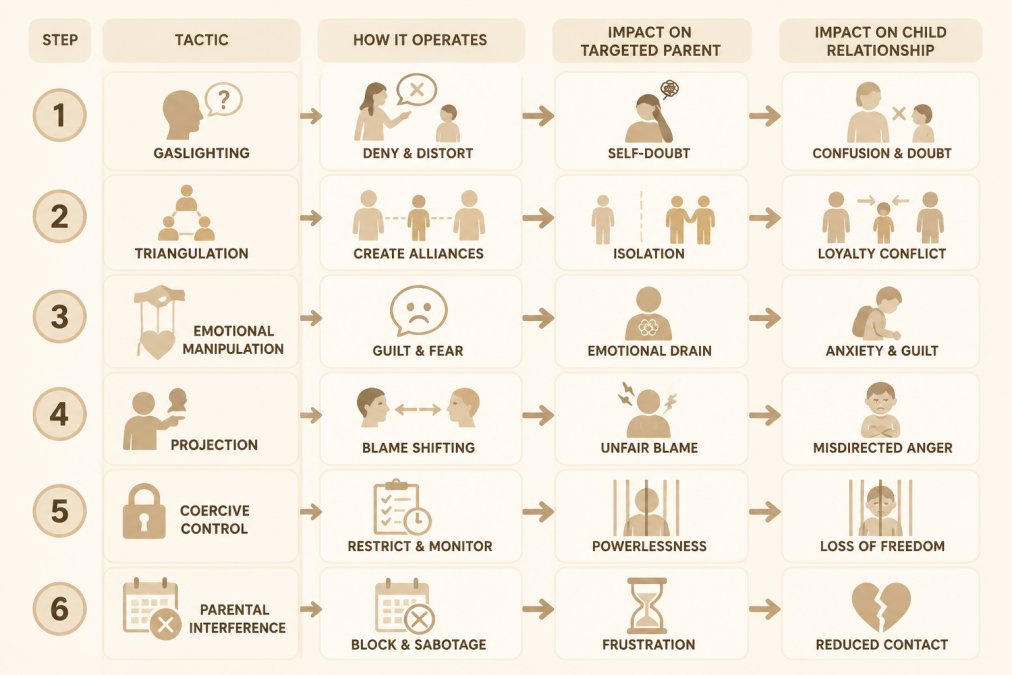
These patterns often extend beyond the parent-child dynamic, as recognizing the subtle signs of coercive control remains essential for understanding how an alienating partner destabilizes the entire family structure.
Co-Parenting With a Narcissist Scripts and Communication Strategies
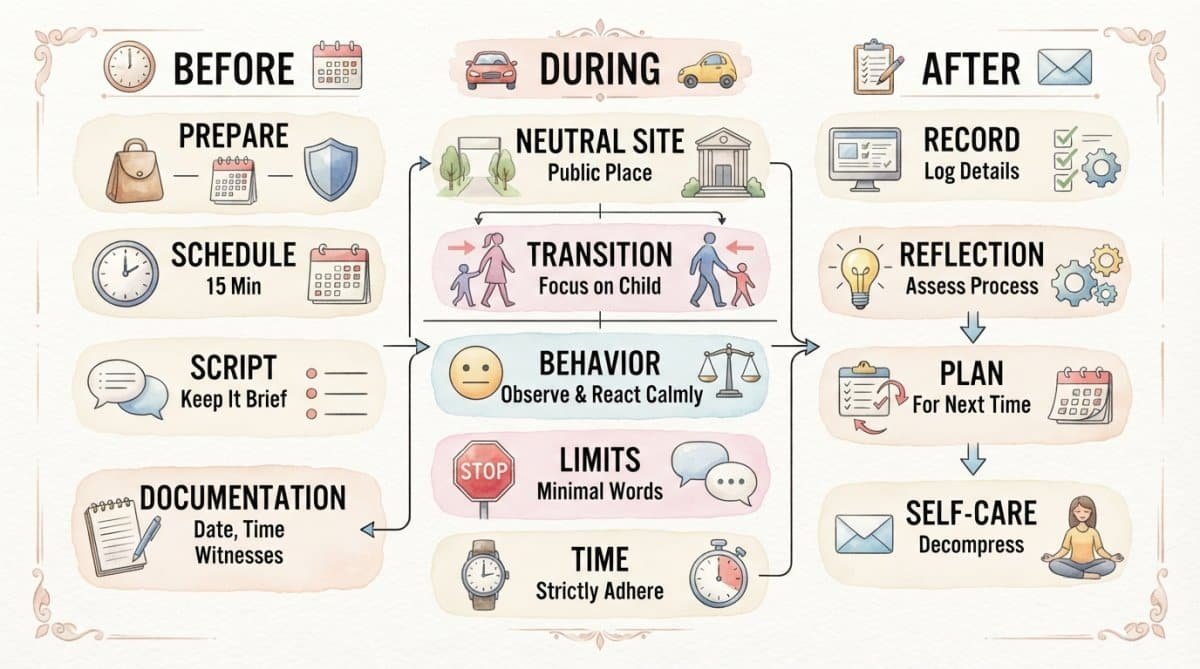
Communicating with a narcissistic co-parent requires scripts that protect you while focusing on your child’s needs, since narcissists twist words and escalate conflict.
The Gray Rock Method is the foundation. Respond in a flat, boring, unemotional way, no anger, defensiveness, or detailed explanations. A narcissist feeds on emotional reactions; when you give them nothing, they lose interest.
Example: Your ex texts, “You’re a terrible parent and our daughter told me you made her cry.”
Gray Rock response: “I’m focused on what’s best for our daughter. What time should I pick her up on Friday?”
Keep messages brief and business-like. Write as you would to a coworker, not someone you once loved.
Example script for a scheduling conflict:
“I have her scheduled for 6 PM Friday. Please confirm pickup time.”
NOT: “I really need to see her this week because we’ve been apart so long, and I miss her so much. Can you please let me know if Friday works?”
Document everything in writing via email or a co-parenting app. This creates a record if your ex lies about what was said.
Use “I” statements about facts, not feelings.
Weak: “I feel like you’re not letting me see our son.”
Strong: “Our custody agreement states I have him Thursdays 4-8 PM. He was not available last Thursday. Please confirm this week’s schedule.”
Set boundaries and hold them. Don’t engage with accusations or bait. Repeat the same response if they push: “I’m not discussing this. Please send me the pickup time for Saturday.” Don’t escalate, defend, or explain.
Use a co-parenting app like OurFamilyWizard or similar platforms to document all communication. This creates a timestamped record that can be used in court if needed. The app also prevents the narcissist from claiming they never received messages or agreed to schedules.
Parallel Parenting Strategies to Minimize Conflict
When co-parenting fails, parallel parenting becomes your lifeline: you make decisions for your time, the other parent makes theirs, with minimal coordination beyond the bare minimum.
Set clear boundaries about your parenting time. During custody time, you make the rules without needing permission or explanation.
Don’t share detailed information about your parenting, the narcissist will use it against you.
Create a written parenting plan that’s specific. Don’t leave room for interpretation. Instead of “reasonable bedtime,” write “8:30 PM on school nights.” Instead of “appropriate gifts,” write “gifts under $50.”
Accept that you can’t control what happens in the other home. Focus on what you can control: your response and what happens during your custody time.
Maintain consistency in your home. Be the stable, predictable parent. When your child returns upset or confused, listen without judgment and don’t bad-mouth the other parent, just be present and calm.
Parallel parenting means accepting that you and the other parent won’t see eye-to-eye. Stop trying to convince them you’re a good parent. Instead, show your child through your actions that you’re reliable, loving, and safe.

Parental Alienation Documentation Templates and Legal Protection
If you end up in court, documentation is everything. A judge needs evidence: dates, times, and what was said or done.
Create a parental alienation log. Use a simple spreadsheet or document. Record:
- Date
- Time
- What happened (be specific)
- Who witnessed it (if anyone)
- How it affected your child
- The tactic used (gaslighting, triangulation, etc.)
Example entry:
“March 15, 2026, 3:45 PM. Ex called our daughter and said I told her that Dad doesn’t love her. Daughter was upset and confused when I picked her up. She asked, ‘Did you say that?’ I said no and asked her to tell me exactly what Mom said. Daughter repeated the accusation. This is triangulation and false accusation.”
Keep all text messages and emails. Don’t delete anything. Save screenshots. Print them out. Store them digitally in a secure location (cloud backup, external drive). If the other parent deletes messages, you still have copies.
Record incidents of interference with contact. Every missed call. Every cancelled visit. Every time the child was unavailable when you were supposed to see them.
Example: “April 2, 2026. Scheduled pickup at 5 PM. Child did not answer phone. Ex said child was ‘busy.’ Requested makeup time. Ex refused and said makeup time is ‘not in the agreement.’ Documented via text message at 5:12 PM.”
Get written confirmation of plans. Before each visit, send a text or email confirming the time and place. This creates a record of what was agreed to.
Example: “Hi, confirming I’m picking up [child’s name] on Friday, April 8 at 6 PM. Please confirm receipt of this message.”
Document your attempts to maintain the relationship. Keep records of birthday cards you sent, gifts you gave, calls you made, messages you sent. This shows a judge that you’re trying to stay connected.
Do not record phone calls or in-person conversations without consent unless your state allows it. Some states are “two-party consent” states, meaning both people must agree to be recorded. Recording illegally can harm your case and may be a crime. Check your state’s laws first.
Managing Your Stress and Protecting Your Emotional Boundaries
Parental alienation is traumatic, you’re losing your relationship with your child while being blamed for it. You need tools to survive this emotionally.
Create a “crisis kit” for hard days: a list of people you can text, activities that calm you (music, walks, exercise), and reminders of why you’re fighting (photos of good times with your child, letters you write but don’t send). When you’re overwhelmed, pull out the kit instead of reaching out to your child in desperation.
Maintaining Your Child’s Bond With You During Alienation
Your child may be cold or hostile due to lies they’re being told. Stay consistent, loving, and present, your actions will speak louder than the other parent’s words.
When to Seek Professional Legal and Mental Health Support
Seek a family law attorney if: the alienation is severe and ongoing, you’re being denied custody or visitation, the other parent is making false accusations, or you want to modify custody. An attorney can advise on your state’s laws, help build your case, and represent you in court.
Frequently Asked Questions
What are the most common signs of narcissistic parental alienation?
Narcissistic parental alienation typically involves gaslighting (denying events occurred), triangulation (involving a third party to undermine you), enmeshment (blurring boundaries between parent and child), and emotional manipulation. The alienating parent may withhold visitation, badmouth you to your child, or claim you’re the problem in the relationship. Documentation of these patterns is critical for custody evaluations and legal proceedings. Watch for sudden changes in your child’s attitude toward you that coincide with time spent with the other parent.
How can I use co-parenting with a narcissist scripts without sounding robotic?
Scripts work best when you adapt them to your natural speaking style rather than reading them verbatim. The Gray Rock Method, for example, teaches you to respond with brief, emotionless facts rather than engaging emotionally, but you deliver this in your own words. Practice scripts beforehand so they feel automatic, not rehearsed. The goal isn’t perfection; it’s consistency and emotional protection. Most narcissists lose interest when they can’t provoke a reaction, so the ‘robotic’ quality actually works in your favor by reducing their motivation to escalate.
What should I document for a custody evaluation or court proceeding?
Document specific incidents with dates, times, what happened, who witnessed it, and the impact on your child. Include emails, text messages, and voicemails that show alienation tactics like badmouthing, withholding visitation, or coaching your child to reject you. Keep a separate record of positive interactions with your child and evidence of your involvement in their life (school attendance, medical appointments, activities). Parental alienation documentation templates help you organize this evidence clearly. Courts take documented patterns more seriously than vague complaints, so consistency and specificity matter.
Can parallel parenting strategies actually reduce conflict with a high-conflict narcissist?
Parallel parenting is designed specifically for situations where co-parenting cooperation is impossible. Instead of joint decision-making, each parent makes decisions independently during their own time with the child. Communication stays minimal and business-like, focused only on logistics. This removes opportunities for the narcissist to manipulate, control, or provoke you. While it doesn’t eliminate conflict entirely, it significantly reduces the frequency and intensity of interactions. Many parents report feeling less stressed and their children showing fewer behavioral problems once parallel parenting boundaries are in place.