Last Updated: July 26, 2026
- Why Co-Parenting Communication Matters for Your Children
- Core Principles of Co-Parenting Communication for Beginners
- Essential Co-Parenting Communication Strategies
- High-Conflict Co-Parenting Communication: Special Considerations
- Co-Parenting Communication Apps and Digital Tools
- Co-Parenting Communication Rules You Need to Know
- Self-Care and Emotional Regulation for the Communicator
- Conclusion: Building a Sustainable Co-Parenting Communication Plan
- Frequently Asked Questions
When separation or divorce happens, your communication with your co-parent becomes the foundation for your children’s emotional stability. This guide focuses on practical frameworks that help you navigate conversations with clarity and purpose, even when emotions run high. At After the Affair Series, we’ve seen how structured communication transforms hostile interactions into functional partnerships, not because parents suddenly like each other, but because they have tools that work.
Children in high-conflict co-parenting situations experience measurable stress that affects their academic performance, emotional regulation, and long-term relationship patterns. This guide provides actionable methods you can use today, starting with your next conversation.
Why Co-Parenting Communication Matters for Your Children
Your children are watching how you handle disagreement. They observe whether you can discuss their school performance, medical needs, or schedule changes without escalating into personal attacks. The quality of co-parenting communication directly impacts whether kids feel safe, supported, or caught in the middle.
Children with parents who communicate effectively about their needs report lower anxiety levels and stronger sense of security. Functional communication teaches them that problems get solved through clarity, boundaries, and mutual respect, not through blame or withdrawal. You’re modeling how adults handle disagreement for the rest of your children’s lives.
Co-parenting communication isn’t about becoming friends with your ex. It’s about [creating a functional system where](/structured-parenting-plan-for-high-conflict-a-practical-guide/) your children’s needs come first and both parents can discuss logistics without personal conflict bleeding into parenting decisions.
Core Principles of Co-Parenting Communication for Beginners
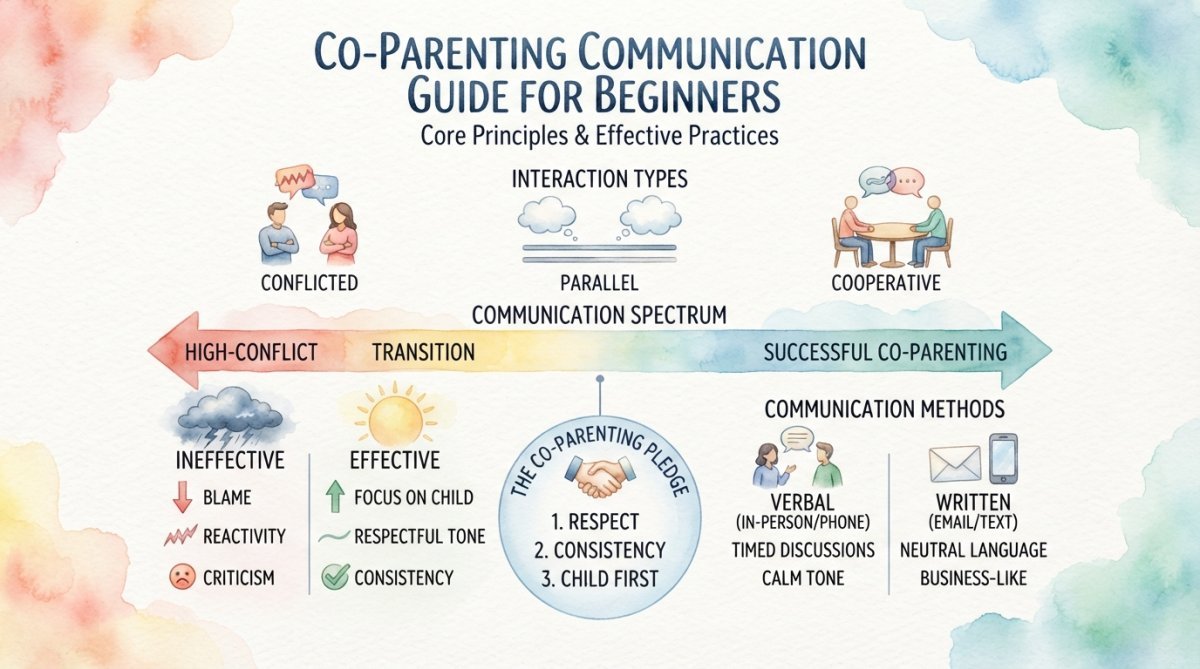
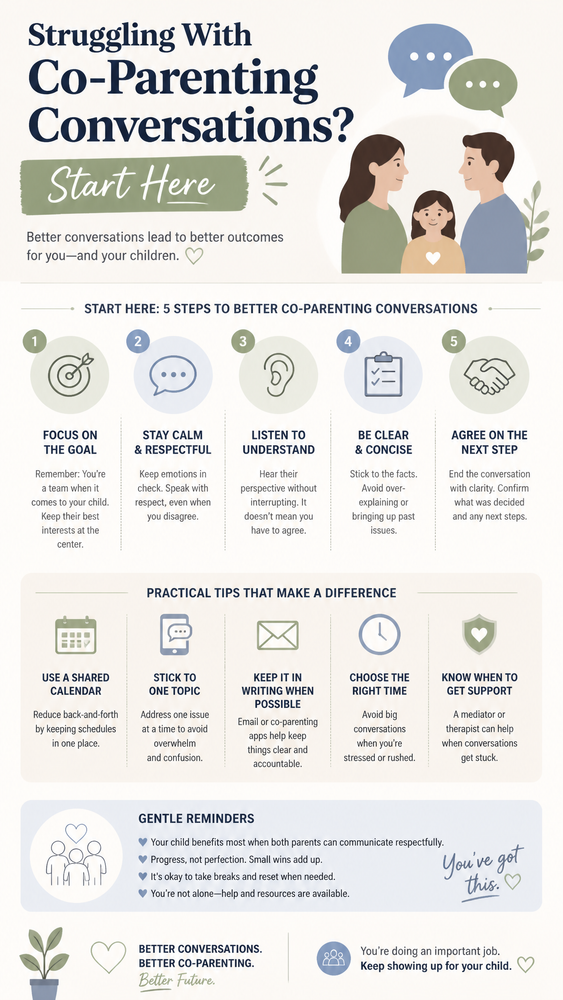
Every effective co-parenting communication approach rests on three core principles: child-centered focus, emotional regulation, and documented clarity. These principles apply whether your co-parent is reasonably cooperative or actively hostile.
Child-Focused Communication as Your Foundation
The single most powerful shift you can make is moving from “what I want” to “what our child needs.” Child-focused communication means naming the specific need or decision that requires discussion, then presenting options that serve that need. Instead of “You never help with homework,” try “Jordan is struggling with math. I’m available Tuesday and Thursday evenings. Which day works for you to help?” The second version removes blame, names the problem clearly, and offers concrete solutions.
When you lead with your child’s needs, you disarm defensiveness. Your co-parent can’t easily argue against “our daughter needs consistent bedtime routines.”
Before every co-parenting conversation, ask yourself: “What does my child need here, and what do I need?” If they conflict, prioritize the child’s need. This prevents using parenting logistics as a vehicle for processing your own anger about the relationship.
Active Listening in High-Conflict Situations
Active listening in co-parenting communication involves three steps. First, listen to understand their actual position, not to prepare your rebuttal. Second, reflect back what you heard: “So you’re saying Emma gets anxious before transitions, and you want to extend the handoff time by 15 minutes?” This confirms you understood correctly. Third, acknowledge any valid points before introducing your perspective: “You’re right that she does better with more transition time. Here’s what I’ve noticed about what helps.”
When your co-parent feels genuinely heard, they’re less likely to escalate. If you feel anger rising during a conversation, pause and say: “I need a moment to think about that. I’ll get back to you by tomorrow.” This prevents reactive statements that damage the co-parenting relationship.
Essential Co-Parenting Communication Strategies
The BIFF Method: Brief, Informative, Friendly, Firm
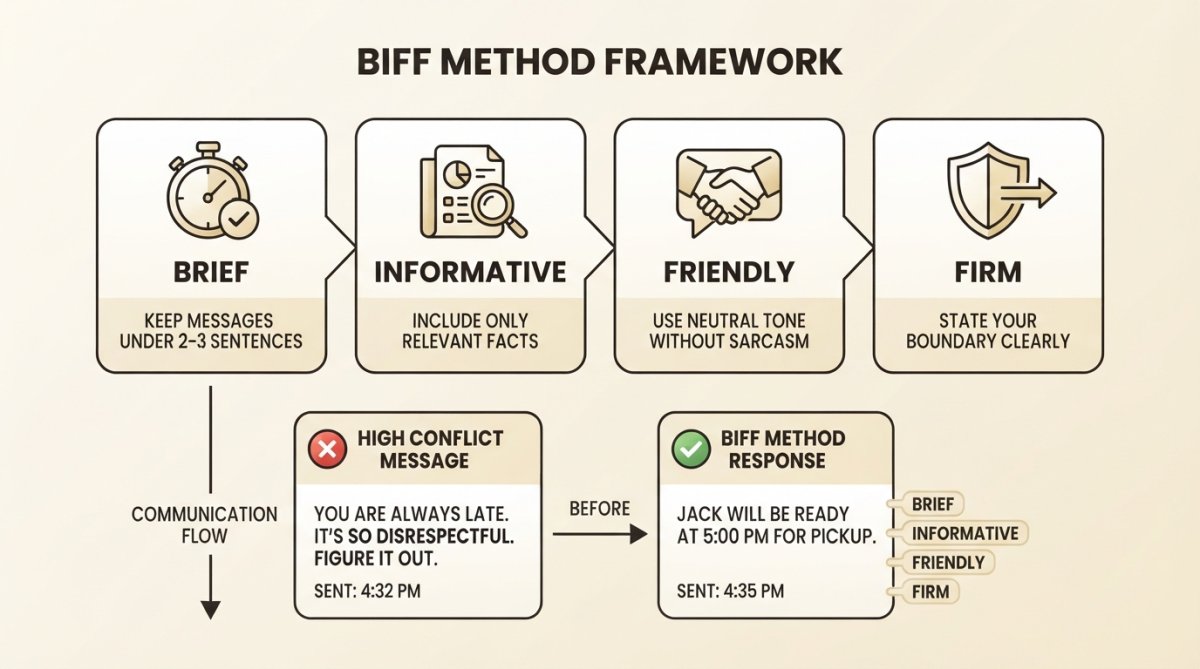
The BIFF method is a structured framework for written communication that removes emotional charge and prevents misinterpretation.
Brief means your message is short and focused. One topic per message. Instead of a long email detailing everything wrong with your ex’s parenting, send: “Jordan needs new soccer cleats for Saturday’s game. I can purchase them, or you can. Let me know by Thursday.”
Informative means you include only facts relevant to the decision at hand. Not your feelings, history, or what you think your co-parent should have done differently. Only: what needs to happen, when, and what options exist.
Friendly means your tone is neutral and professional, not cold or sarcastic. You’re treating this like a business communication.
Firm means you state your boundary or decision clearly without over-explaining. “I’ve scheduled the orthodontist consultation for March 15th. Please let me know if you have a scheduling conflict.” Not: “I really think we should get his teeth looked at soon, and I know you might have opinions, but…”
BIFF works because it removes the emotional content that triggers escalation. Your co-parent can’t argue with a fact.
Managing Emotions and De-Escalation Techniques
You will feel anger, resentment, hurt, and frustration during co-parenting communication. What matters is whether you act on those feelings or manage them.
Recognize your own escalation signs early. Does your chest tighten? Do you talk faster? Do you feel heat in your face? When you notice escalation, use the pause technique: “I need to step back and think about this. I’ll respond tomorrow.” This isn’t avoidance, it’s wisdom. Your brain cannot access problem-solving when your nervous system is in fight-or-flight mode.
Between the pause and your response, use a physical de-escalation technique: go for a walk, do breathing exercises (4 counts in, hold for 4, out for 4), or exercise. When you do respond, use “I” statements rather than “you” accusations. “I’m concerned that the schedule change will affect Maya’s sleep” is different from “You’re being irresponsible about her sleep.”
If your co-parent is actively hostile or abusive during conversations, de-escalation techniques have limits. You may need to shift to written-only communication, use a co-parenting app that documents everything, or involve a mediator.
Setting Boundaries for Communication
Clear boundaries protect your peace and prevent your co-parent from using communication as a way to maintain control.
State these boundaries clearly and enforce them consistently: “I’m available for parenting-related communication via email Monday through Friday, 9 a.m. to 5 p.m. Urgent situations outside these hours can be handled via text. Personal topics aren’t appropriate for our communication.” Then actually follow this rule. Boundaries create the space where you can both move forward.
High-Conflict Co-Parenting Communication: Special Considerations
Recognizing Escalation Patterns
In high-conflict co-parenting, certain topics reliably trigger escalation. Pay attention to what happens right before things blow up. Does your co-parent always escalate when you mention your new relationship? Do they get hostile specifically about financial discussions?
Once you recognize the pattern, you can plan around it. If money conversations always escalate, handle them via email only with specific numbers and clear documentation. If your new relationship triggers them, keep communication focused strictly on parenting.
Parallel Parenting When Direct Communication Fails
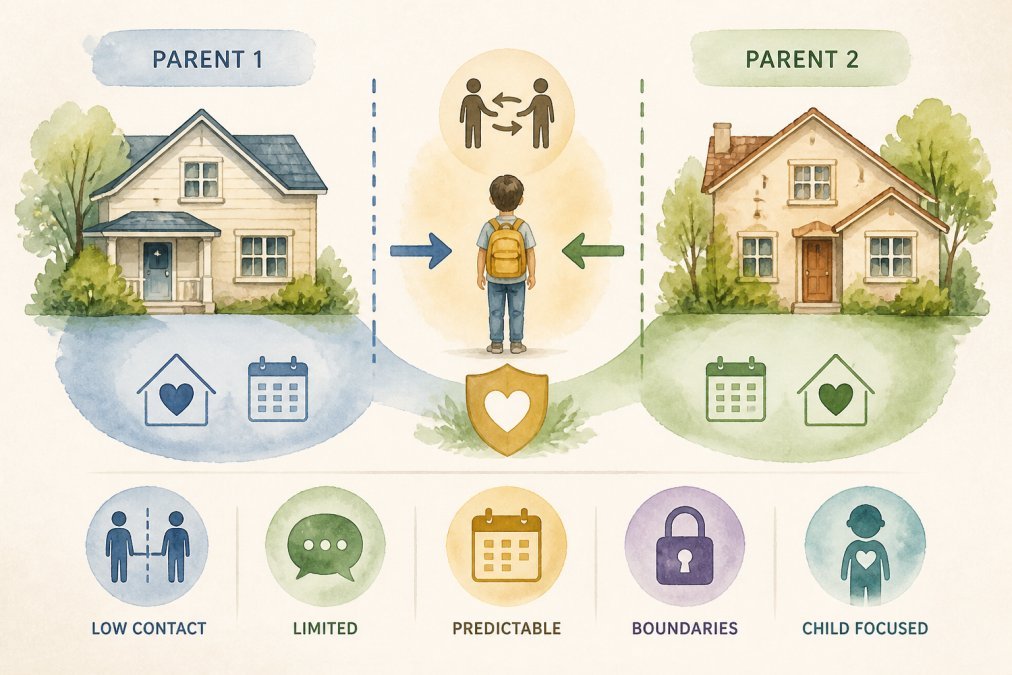
Parallel parenting is a structured approach for co-parents who cannot communicate effectively. Instead of trying to coordinate everything, you operate somewhat independently within your parenting time, with clear agreements about non-negotiable issues (medical care, school, major decisions) and flexibility about everything else.
In parallel parenting, you minimize direct communication and use a co-parenting app or written communication only. You don’t discuss day-to-day parenting choices or try to present a united front. You focus on what’s legally necessary and child-centered, and you let go of everything else. This approach works for high-conflict situations because it removes the opportunity for daily conflict.

Co-Parenting Communication Apps and Digital Tools
Technology can either escalate or de-escalate co-parenting communication. Co-parenting apps designed specifically for this purpose (such as OurFamilyWizard and CustodyXChange) provide shared calendars, expense tracking, message systems with read receipts, and automatic documentation. These tools create an objective record and make it harder for either parent to misrepresent what was agreed upon.
Digital Documentation and Legal Admissibility
Keep all important co-parenting communication in writing. After any significant conversation, send a brief email summarizing what was agreed: “We discussed Maya’s summer camp. You’re covering the deposit, I’m covering the balance. Camp starts June 15th. Confirming this is our agreement?”
Avoid sarcasm, insults, or anything that looks petty in writing. Remember: someday a judge might read this. Communicate like a professional, not like you’re venting to a friend. Assume everything you write might be read by someone else.
Digital Etiquette for Text and Email Communication
For text, keep messages brief and factual. Text is for urgent logistics: “I’m running 15 minutes late for pickup” or “Emma forgot her soccer cleats, can you bring them to the game?”
For email, use the BIFF framework. One topic per email. Clear subject line. Professional tone. Never send a message when you’re angry. Write it, save it as a draft, and read it the next day. If it looks hostile or petty, delete it and rewrite.
Avoid group texts that include your co-parent and your children. Keep co-parenting communication separate from family communication.
Co-Parenting Communication Rules You Need to Know
Choosing the Right Communication Channel
Email is best for important decisions, financial discussions, and anything that needs documentation. Email creates a clear record and allows time for thoughtful response.
Text is best for urgent logistics and quick confirmations. Not for complex discussions or anything emotionally charged.
Phone calls are best for time-sensitive issues that require immediate discussion. Schedule them in advance when possible: “Can we talk about the school situation tomorrow at 6 p.m.?”
In-person meetings should be rare in high-conflict co-parenting. If you need to meet, have a specific agenda, set a time limit, and consider meeting in a neutral location.
Co-parenting apps are best for regular logistics and for high-conflict situations. They create documentation, enforce professional tone, and prevent escalation.
The general rule: the more emotional or important the topic, the more documentation you need.
Scheduling Regular Check-Ins and Avoiding Common Pitfalls
Regular brief check-ins prevent small issues from becoming big problems. Schedule a monthly or quarterly co-parenting meeting to discuss upcoming changes, address logistics, and coordinate on bigger decisions.
Keep these meetings focused and time-limited. Common pitfalls to avoid: bringing up old grievances, discussing your personal life, making the meeting about anything other than the children’s needs, or allowing the conversation to extend beyond the scheduled time.
If the meeting starts to escalate, end it: “I think we should pause here and come back to this when we’re both calmer.” Document what you agree to. After the meeting, send a brief email confirming the agreements.
Self-Care and Emotional Regulation for the Communicator
Co-parenting communication requires emotional labor. Self-care isn’t selfish, it’s the foundation that allows you to show up as a calm, clear communicator instead of a reactive, triggered parent.
Physical self-care matters. Sleep, exercise, and nutrition affect your emotional regulation more than therapy or positive thinking. Emotional self-care means having people you can process with: a therapist, a trusted friend, or a support group. Not your children. Not your co-parent.
Boundaries around communication also protect your emotional wellbeing. Set specific times when you check co-parenting communication. Outside those times, don’t look. After a difficult conversation, take time to recover. The goal isn’t to never feel angry or hurt, it’s to feel those things and not act on them in ways that damage the co-parenting relationship.
Conclusion: Building a Sustainable Co-Parenting Communication Plan
Co-parenting communication is one of the hardest parts of separation or divorce. You’re managing logistics with someone you’re no longer in a relationship with, while processing grief, anger, and loss.
The frameworks in this guide, BIFF, child-focused communication, active listening, and clear boundaries, work because they remove the emotional charge from conversations and anchor everything to what matters: your children’s wellbeing. They’re not about being nice to your co-parent. They’re about creating a functional system where both parents can show up for their children.
After the Affair Series provides structured frameworks specifically designed for high-conflict co-parenting situations. The platform offers communication scripts for difficult conversations, guidance on managing escalation, and tools for documenting agreements, all built on the principle that your children’s emotional safety comes first.
Frequently Asked Questions
What is the difference between co-parenting and parallel parenting communication?
Co-parenting communication involves direct, collaborative interaction focused on shared parenting decisions and your child’s best interests. Parallel parenting is used when high-conflict co-parenting communication becomes too hostile, each parent makes independent decisions within their custody time. Parallel parenting minimizes direct contact and relies on written documentation through co-parenting apps or email. Choose parallel parenting when direct communication escalates conflict or puts your emotional wellbeing at risk.
How do I use the BIFF method in co-parenting communication with a difficult ex?
BIFF (Brief, Informative, Friendly, Firm) keeps messages focused on logistics, not emotions. Be Brief: limit messages to one topic. Informative: include only necessary details about parenting time or child needs. Friendly: use neutral tone without sarcasm. Firm: state your position clearly without debate. Example: ‘Sarah’s soccer practice is Tuesday 5-6pm. I’ll pick her up at 4:45pm from school.’ This approach works in high-conflict situations because it removes emotional triggers and creates a clear record.
What co-parenting communication rules should I follow to protect myself legally?
Document all important discussions in writing, email or co-parenting apps create court-admissible records. Avoid inflammatory language, personal attacks, or threats in any written communication. Keep messages factual and child-focused. Save all messages, even casual texts, as they may be needed in custody disputes. Use certified platforms like OurFamilyWizard or CustodyXChange that timestamp communications. Never discuss the other parent negatively with your child or via channels they might access. These practices protect you if communication becomes evidence in court proceedings.
How often should co-parents communicate, and what topics should we cover?
Frequency depends on your parenting plan and custody schedule. Most co-parents benefit from scheduled check-ins weekly or bi-weekly for logistics. Communicate about: school updates, health concerns, behavior changes, extracurricular activities, and schedule changes. Avoid rehashing relationship issues or discussing finances beyond child support. Use a shared calendar to reduce unnecessary messages. For high-conflict situations, limit communication to essential parenting topics only. Scheduling regular check-ins prevents miscommunication and shows you’re child-centered in your approach.
Can I use co-parenting communication scripts without sounding robotic or manipulative?
Scripts provide structure during emotional moments, not permanent dialogue. Practice scripts until they feel natural, then adapt them to your authentic voice. Your ex may notice initial changes in tone, but consistency demonstrates you’re prioritizing your child’s wellbeing, not manipulation. Frame scripts as boundaries, not tricks: ‘I’m communicating this way to keep things clear for our daughter.’ Scripts work best when paired with genuine emotional regulation, your calm tone and consistent follow-through matter more than perfect wording.
What should I do if my co-parent refuses to communicate or escalates during conversations?
If your ex refuses direct communication, shift to parallel parenting using written documentation only, email or co-parenting apps. If they escalate (yelling, threats, personal attacks), end the conversation immediately and respond in writing later. Use de-escalation techniques: stay calm, use neutral language, don’t defend yourself, and redirect to the child’s needs. Set clear boundaries: ‘I can discuss Sarah’s schedule, but I won’t discuss our relationship.’ If escalation involves threats or abuse, document it and consult your attorney about custody agreement modifications or court-ordered communication methods.
Co-parenting communication doesn’t improve overnight. You’ll have conversations that don’t go well. You’ll get triggered. You’ll slip back into old patterns. That’s normal. What matters is that you have a framework to return to and the commitment to keep trying. Your children are watching how you handle this. Build the co-parenting relationship they deserve by showing them that adults can disagree, set boundaries, and still work together for what matters most.