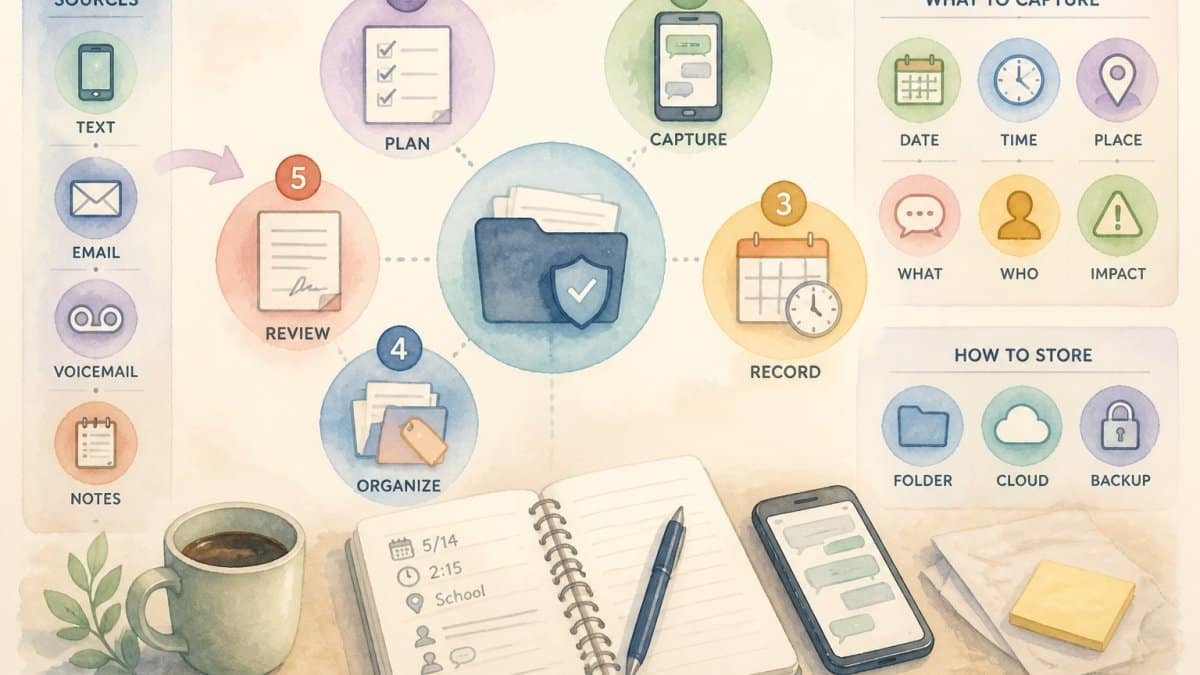
Table of Contents
Last Updated: October 2, 2026
Why Documentation Wins Custody Cases (and What Courts Actually Want)
Family court judges decide custody disputes using evidence, not emotion. When you know how to document high conflict co-parenting interactions, you turn chaotic exchanges into a clear, time-stamped record a judge can actually use. This guide from After the Affair Series breaks the process into simple, repeatable steps.
That single fact changes everything about how you should handle hostile texts, missed exchanges, and broken agreements. Judges see hundreds of cases.
Documentation is not about building a case against your ex. It is about showing the court a pattern of behavior over time.
Here is what most parents get wrong. They save everything but organize nothing. A folder of 400 screenshots proves less than 20 clean, labeled entries.
- Record incidents the same day they happen
- Stick to facts, not feelings
- Keep one system, not five
- Never edit or delete anything
Courts respond to patterns, not isolated events. A consistent log kept over months carries far more weight than a dramatic story told once.
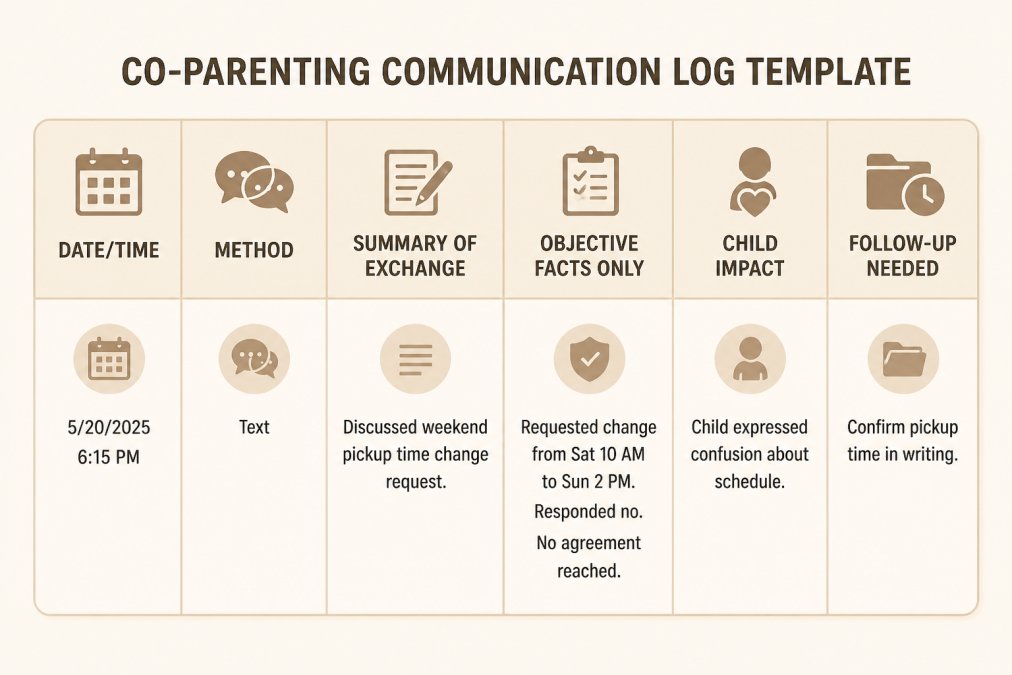
The Co-Parenting Communication Log Template That Holds Up in Court
A court-ready communication log is a simple table that records each exchange with your co-parent in a neutral, factual format. The structure matters more than the tool you use.
What to Record in Every Entry
Every entry needs six pieces of information. Skip any one of them and the record weakens.
- Date and time of the interaction
- Method used (text, email, app, phone, in person)
- Summary of what was said or done
- Objective facts only, no opinions
- Impact on the child, if any
- Follow-up needed, such as a response or action
Sample Log Entry Format
Here is how a clean entry looks:
| Date/Time | Method | Summary | Objective Facts | Child Impact | Follow-Up |
|---|---|---|---|---|---|
| Oct 2, 2026, 6:15 PM | Text | Exchange pickup | Arrived 6:15 PM. Other parent arrived 7:40 PM. No notice given. | Child waited 85 minutes in lobby | Note late arrival; keep record |
Notice the difference. “He was late again, as usual” is an opinion. “Arrived 7:40 PM, no notice given” is a fact.
How to Write a Factual Incident Report for Custody
A factual incident report is a short written account of a single event, written in plain language and free of blame. Think of it as a police-style report, not a diary entry.
Follow this order:
- State the date, time, and location
- Describe what happened in sequence
- Quote exact words in quotation marks
- Note who was present
- Describe any effect on your child
- Sign and date the report
Keep each report to one page. Attach photos, screenshots, or messages as numbered exhibits.
Writing angry commentary inside an incident report destroys its value. If a judge reads “he did this on purpose to hurt me,” the whole document looks biased, and the real facts get buried.
Best Apps for High Conflict Co-Parenting: What to Look For
The best co-parenting apps share one trait: they create a neutral, tamper-resistant record. The app matters less than the habit of using it for every message, but the wrong app can quietly weaken your record, and the right one can save you hours of manual logging.
What a Court-Ready App Actually Does
Look for these features, in this order of importance:
- Immutable, time-stamped messages that neither parent can edit or delete after sending
- Read receipts and login history showing when a message was opened and by whom
- Shared calendar with change-request and approval trails for custody schedules and exchanges
- Expense tracking with receipt attachments for shared costs like medical copays and school fees
- Court-ready export, a single PDF or print packet that preserves timestamps, sender names, and thread order
- Tone or sentiment flagging that warns you before you send a hostile reply
That last feature is the one most parents undervalue. A short cooling-off prompt at 11:00 PM has prevented more admissibility problems than any export button.
The Trade-Offs Nobody Mentions
Every app choice involves a trade-off, and the top-ranking articles skip this entirely.
- Closed-platform apps (messages only visible inside the app) create the cleanest record, but they also lock your evidence inside a company’s servers. If the company changes its export format or shuts down, your record is at risk. Export monthly.
- Email and SMS are universal and easy to authenticate, but they are also easy to delete, easy to spoof, and easy to flood with emotional content that hurts you in court.
- Free apps often monetize by limiting exports or history depth. A record you cannot fully download is a record you do not fully own.
A common pattern among parents who win documentation fights: one court-facing app for all communication, plus a monthly export saved to two locations they control.
A Practical Setup
- Choose one app and require all communication to run through it. State this in your parenting plan if you can.
- Turn on read receipts and calendar approvals.
- Export the full message history on the first of every month.
- Store the export in an encrypted folder (see the security guidance below) and keep a second copy off your phone.
- Keep a written backup log for anything that happens outside the app, in-person exchanges, phone calls, third-party reports.
The app holds the messages. The log holds the story. The export holds the proof.
Avoid any app that lets either parent delete history, edit sent messages, or hide read receipts. A record you can erase is a record a judge may distrust, and opposing counsel will ask about it.
Admissibility of Text Messages in Family Court: What You Need to Know
Text messages are generally admissible in family court when you can prove they are authentic and unaltered. Authentication is the key word. The court needs to believe the messages are real, complete, and came from the person you say sent them.
Most guides stop there. Here is what they leave out: the mechanism, the objections you will actually face, and how to store the evidence so it survives both a challenge and a break-in.
How Authentication Actually Works
Under the Federal Rules of Evidence, and the state rules that mirror them, a party authenticates evidence by producing “evidence sufficient to support a finding” that the item is what the party claims it is. In plain terms, you need to be able to say, under oath, how you obtained the message and that it has not been changed.
Common ways to authenticate a text thread:
- Your own testimony describing how you received it and that you preserved it unaltered
- The phone number or account the message came from, shown in the screenshot
- Metadata, the timestamp, carrier records, or app export log
- The other parent’s own admission that they sent it
A screenshot alone is weak. A screenshot plus your testimony plus an unaltered export from the original device is strong.

The Two Objections You Will Hear
Hearsay. The other side will argue the messages are out-of-court statements offered for the truth. In family court, this is often overcome because the statements are the other parent’s own words (a party-opponent statement) or because they are offered to show the effect on you or the child, not to prove the truth of what was said.
Best evidence / alteration. The other side will argue your screenshot is incomplete or edited. This is where most parents lose. Cropping, retyping, or “cleaning up” a thread hands them the objection.
Protecting Admissibility: A Concrete Checklist
- Keep the original device when possible. Do not factory-reset or trade it in.
- Take full screenshots that show the phone number, contact name, date, and time on every screen.
- Never crop out context, even the parts that make you look bad. A complete thread is more credible than a flattering one.
- Export threads rather than retyping them. Retyping is the fastest way to lose authentication.
- Back up to two separate locations you control, not just the cloud account tied to the phone.
- Log the date you captured each export and where it is stored.
Rules on evidence vary by state, so check your local court’s requirements. The Federal Rules of Evidence overview explains how authentication works in federal cases, and state courts follow similar logic.
The Gap Most Guides Miss: Secure Storage
You are building a file that contains your address, your schedule, your child’s school, and every hostile message your co-parent has sent. If that file is on a shared cloud account, a family device, or an email inbox the other parent can access, you have handed them your case.
A practical storage standard:
- Encrypt the folder. Use your phone’s or computer’s built-in encrypted folder, or a reputable encrypted archive tool.
- Use a unique password that is not reused anywhere else and is not stored in a shared password manager.
- Turn on two-factor authentication on the account holding the evidence.
- Keep one offline copy on an encrypted external drive stored somewhere the other parent does not have access to.
- Do not email evidence to yourself through an account the other parent can log into.
A common pattern: parents keep a working log on their phone and a sealed, encrypted archive updated monthly. If the case goes to court, the archive is the exhibit set.
The Psychological Toll, and How to Cap It
Recording every hostile message keeps you tethered to the conflict. Hyper-vigilant logging is a known burnout pattern: you reread the worst messages to write them down, you scan every notification for evidence, and you never fully disengage.
Cap it with structure:
- One fixed logging window per day. Fifteen minutes, same time, then close the folder.
- Do not respond during the logging window. Log first, reply later using BIFF.
- Separate the emotional channel from the evidence channel. Vent to a therapist, journal, or trusted friend, never inside the log.
- Review monthly, not hourly. Patterns emerge over months, not minutes.
Documentation should protect your peace, not consume it. A calm, consistent record kept for a year beats a frantic one kept for a month.
Admissibility is not about how much you save. It is about whether you can prove the messages are real, complete, and unaltered, and whether you can still function while keeping the record.
Communication Boundaries and the BIFF Response Method
The BIFF response method is a four-part way to reply to hostile messages: Brief, Informative, Friendly, and Firm. It keeps your replies short and neutral so they cannot be used against you later.
Here is how it works:
- Brief: Two or three sentences, nothing more
- Informative: Give only the facts needed
- Friendly: Stay polite, even when the other person is not
- Firm: End the conversation clearly
Example reply: “Thanks for the update. I will pick up Mia at 6:00 PM on Friday as scheduled. Please confirm if that changes.”
No insults. No explanations. No bait taken.
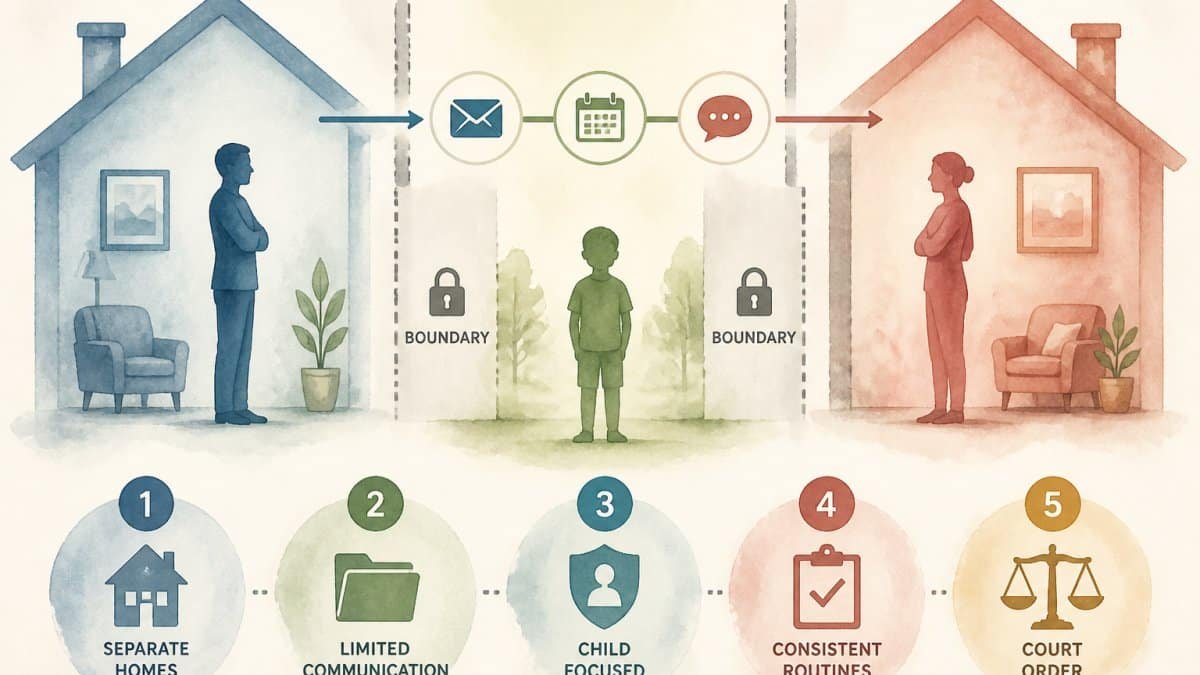
Set communication boundaries alongside BIFF. Stick to one channel, such as email or an app. Ignore messages sent through other channels and reply only through the agreed one.
The American Bar Association resources on family law note that clear, written communication reduces disputes and supports parenting plan enforcement.
Save your BIFF replies in the same log as incoming messages. A judge can then see both sides of the exchange and your consistent, calm tone.
Conclusion: Building a Documentation System That Protects Your Case
A documentation system works when it is simple enough to keep every day. Pick one app, one log template, and one time to update it.
Over time, your log becomes a clear record of your parenting, your consistency, and your child’s wellbeing.
The After the Affair Series toolkit provides structured communication scripts, so you are never guessing what to write in a hostile moment.
Frequently Asked Questions
What should be included in a co-parenting communication log?
A court-ready log includes the date and time of each interaction, the communication method (text, email, or app message), a factual summary of what was said or done, any impact on your child, and whether follow-up is needed. Stick to observable facts: ‘Ex arrived 45 minutes late for pickup’ rather than ‘Ex was being difficult again.’ Keep entries time-stamped and store them in a consistent format so patterns of behavior become visible over weeks and months.
Are text messages and emails admissible in family court?
Text messages and emails are generally admissible in family court if you can authenticate them, meaning you can show they came from the other party and were not altered. Screenshots alone may be challenged. Export full message threads with timestamps when possible, and avoid editing or deleting any part of the conversation. Rules vary by state, so confirm your local court’s requirements. A well-organized digital record is far stronger than a folder of scattered screenshots.
How do I keep my co-parenting documentation objective and factual?
Write only what a camera would have captured: times, dates, direct quotes, and observable behavior. Replace ‘He was hostile’ with ‘He raised his voice and called me a name in front of our daughter at 5:15 PM.’ Avoid labeling, diagnosing, or predicting your ex’s motives. If you feel emotional writing an entry, draft it in a notes app first, then rewrite it with neutral language before adding it to your log. Objective notes carry weight in mediation and litigation; editorial commentary weakens your credibility.
How can I use co-parenting apps to document interactions?
Co-parenting apps create time-stamped, tamper-resistant records that courts can request directly. Use the app for all scheduling, exchanges, and child-related communication so nothing happens in untracked channels. Many apps let you export records as PDFs for your attorney. If your ex refuses to use an app, keep a parallel log of every text or email and note when they declined to move communication to the shared platform.