Table of Contents
- How Divorce Settlements Affect Your Taxes
- Tax Treatment of Alimony After Divorce
- Property Division and Tax Basis in Divorce
- Capital Gains Tax on Divorce Home Sale
- Claiming a Child on Taxes After Divorce
- Filing Status and Tax Credits After Divorce
- Child Support and Tax Liability
- Tax Filing Checklist and Timeline for Divorce Year
- Frequently Asked Questions
Last Updated: October 16, 2026
How Divorce Settlements Affect Your Taxes
The tax implications of divorce settlements can impact your finances for years after your divorce is finalized.
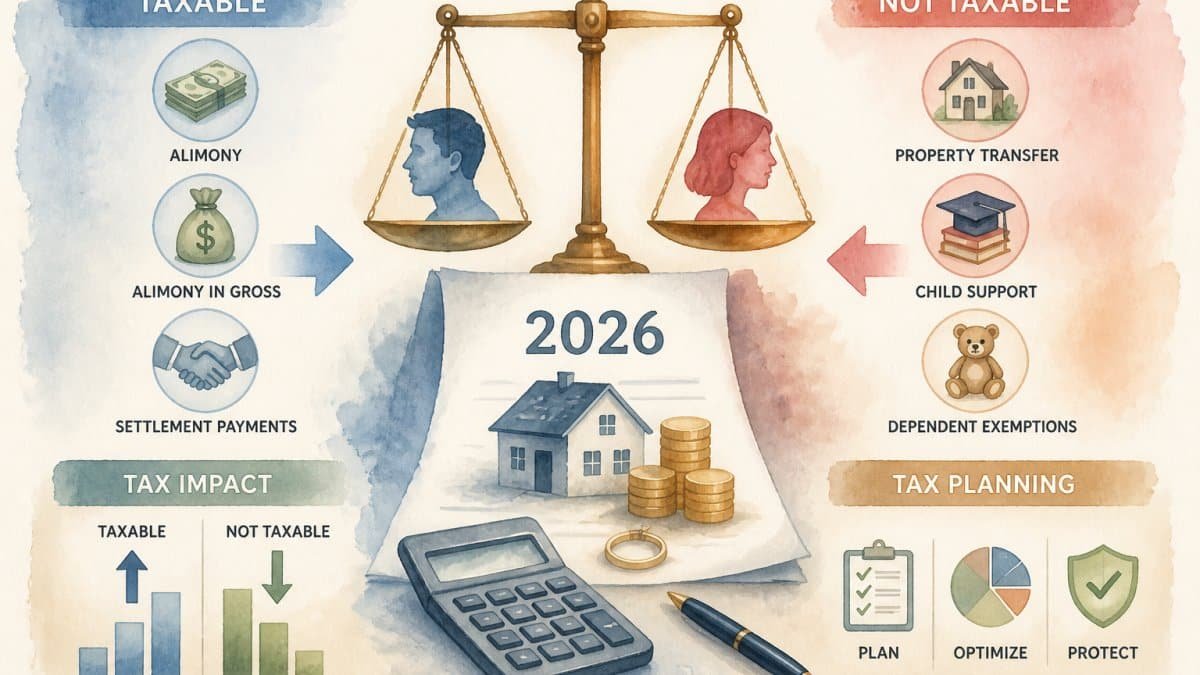
The IRS treats most property transfers between spouses as tax-free events. But capital gains, alimony, child support, filing status changes, and retirement account transfers all carry different tax consequences.
Property transfers between spouses incident to divorce are generally not taxable. However, the person receiving an asset inherits its tax basis, which affects future capital gains taxes.
Here’s what matters most: the tax implications of divorce settlements depend on the type of asset, when the transfer happens, and your filing status. Let’s walk through each scenario.
Tax Treatment of Alimony After Divorce
Alimony (also called spousal support or maintenance) has specific tax rules that changed in recent years, and they matter for both the payer and the recipient.
For alimony payments made under divorce decrees finalized after December 31, 2018, the payer cannot deduct alimony payments from their income (Topic no. 452, Alimony and separate maintenance). The recipient does not include alimony in their taxable income.
If your divorce was finalized before 2019, the old rules may still apply. The payer could deduct alimony, and the recipient had to report it as income.
Key points about alimony taxation:
- Payments must be in cash or cash equivalents
- Payments must stop upon the recipient’s death
- You cannot file a joint return with your ex-spouse
- The payer must have the recipient’s Social Security number to claim any deduction (under pre-2019 rules)
The IRS distinguishes alimony from child support. Child support is never deductible by the payer and never taxable to the recipient.
If you’re negotiating a settlement, clarify whether payments are alimony, child support, or property division. Each has different tax consequences. A small change in how the agreement is worded can save thousands in taxes over the life of the payments.
::: Precise language in these documents often hinges on a strategic property settlement negotiation that balances immediate liquidity needs against long-term tax liabilities.
Property Division and Tax Basis in Divorce
When you divide marital property during divorce, most transfers are tax-free. But the recipient gets the original tax basis, not the current fair market value.
Tax basis is what you paid for an asset. If you bought stock for $10,000 and it’s now worth $50,000, your basis is $10,000.
In a divorce, the person receiving the asset keeps the original basis, no “step-up” just because the property changed hands.
Example: You own a rental property worth $400,000. You paid $200,000 for it. In your divorce, your ex receives the property.
This is why asset-by-asset comparison matters. A property worth $400,000 today might deliver very different after-tax value depending on who receives it and when they sell.
Asset-by-Asset Tax Comparison
Different assets carry different tax consequences when transferred in divorce. Comparing after-tax value helps you negotiate a fair settlement.
Investment accounts (brokerage accounts):
- Transfer is tax-free
- Recipient inherits the original cost basis
- Future capital gains are taxable to the recipient
- Better to receive than appreciated real estate (easier to diversify and manage tax risk)
Retirement accounts (401k, IRA, pension):
- Transfer requires a Qualified Domestic Relations Order (QDRO) (Retirement topics, QDRO: Qualified domestic relations order)
- Transfer itself is tax-free
- Withdrawals are taxable to the recipient
- Recipient avoids the 10% early withdrawal penalty if they follow QDRO rules
- Better to receive than taxable accounts if you plan to hold long-term
Real estate (primary residence or rental property):
- Transfer is tax-free
- Recipient inherits original cost basis
- Future appreciation is taxable when sold
- Primary residence may qualify for $250,000 capital gains exclusion (if owned and lived in 2 of last 5 years)
- Rental property has no such exclusion
Cash and cash equivalents:
- No tax consequence on transfer
- No future tax liability
- Most flexible asset to receive
Business interests:
- Transfer is tax-free
- Recipient inherits the original basis
- Future appreciation is taxable
- Complex to value and divide; often requires professional appraisal
The after-tax value of an asset differs from its current market value. An investment account worth $100,000 with $60,000 in unrealized gains has less after-tax value than $100,000 in cash. When negotiating your settlement, ask for the after-tax value of each asset, not just the current value.
Capital Gains Tax on Divorce Home Sale
The marital home often represents the largest asset in a divorce. Understanding the capital gains tax rules is critical.
When you sell a home, you owe capital gains tax on the appreciation. However, the IRS allows a $250,000 exclusion if you’re single or $500,000 if you’re married filing jointly (Topic no. 701, Sale of your home).
After divorce, you lose married filing jointly status (unless you remarry), so your exclusion drops to $250,000, not $500,000.
Example: You and your ex bought a home for $300,000. It’s now worth $700,000. During the divorce, your ex receives the home. They sell it one year later for $700,000.
- Gain: $400,000
- Exclusion: $250,000 (single filer)
- Taxable gain: $150,000
- Federal tax (at 15% long-term rate): $22,500
- State tax varies by location
If you both owned the home and sold it together before the divorce was final, you could use the $500,000 exclusion (married filing jointly).
Timing the home sale matters. If you can sell the home before the divorce is finalized and file jointly, you save significant taxes.
If the home has significant appreciation and you’re dividing it in a divorce, consider selling it before the divorce is final and splitting the proceeds. This often saves more in taxes than one spouse keeping the home and the other receiving other assets of equal value.

Claiming a Child on Taxes After Divorce
Only one parent can claim each child as a dependent for tax purposes, a benefit worth roughly $400-$500 per child in tax savings.
By default, the parent with primary custody (more than 50% of the time) claims the child. However, you can agree otherwise in your divorce decree.
If the non-custodial parent claims the child, the custodial parent must sign IRS Form 8332 releasing the exemption.
Key rules:
- The child must live with you for more than half the year
- You must provide more than half the child’s financial support
- The child must be your biological or adopted child (not a stepchild, unless you legally adopted them)
- The child must be under 17 at the end of the tax year (for the child tax credit)
If both parents claim the same child, the IRS will disallow one claim.
Documenting this agreement clearly in your divorce decree is recommended. Specify which parent claims the child each year, or state that the primary custodian claims the child. Ambiguous language leads to disputes and IRS audits.
Filing Status and Tax Credits After Divorce
Your filing status changes the year your divorce is finalized, affecting your tax rate, standard deduction, and eligibility for certain credits.
If your divorce is final by December 31, you file as single for that entire tax year, not married filing jointly or married filing separately.
Filing status options after divorce:
- Single: You are unmarried and have no dependents
- Head of Household: You are unmarried, pay more than half the household expenses, and have a dependent living with you for more than half the year
- Qualifying Widow(er): You are eligible for 2 years after your spouse’s death (not applicable in divorce)
Head of Household status is typically more favorable than Single. It offers a higher standard deduction and lower tax rates.
Tax credits change after divorce:
- Child Tax Credit: $2,000 per child under 17 (2026)
- Earned Income Tax Credit (EITC): Available to lower-income workers with children
- Child and Dependent Care Credit: Available if you pay for childcare so you can work
The tax implications of divorce settlements include losing certain credits if you no longer qualify. For example, if your ex claims your child, you cannot claim the Child Tax Credit for that child.
File as Head of Household if you have a dependent living with you and pay more than half household expenses. This saves more in taxes than filing as Single.
Child Support and Tax Liability
Child support has straightforward tax rules: it is not deductible by the payer and not taxable to the recipient.
Unlike alimony, child support is for the child’s benefit, not the spouse’s, so it receives different tax treatment.
However, the tax implications of divorce settlements affect child support indirectly.
Also, child support and alimony are often combined in a settlement. If the agreement doesn’t specify amounts for each, the IRS may reclassify the payment.
Document the breakdown clearly in your settlement agreement. State the monthly amount for child support and the monthly amount for alimony separately.
Tax Filing Checklist and Timeline for Divorce Year
When you finalize your divorce, several tax deadlines and decisions affect your 2026 tax filing.
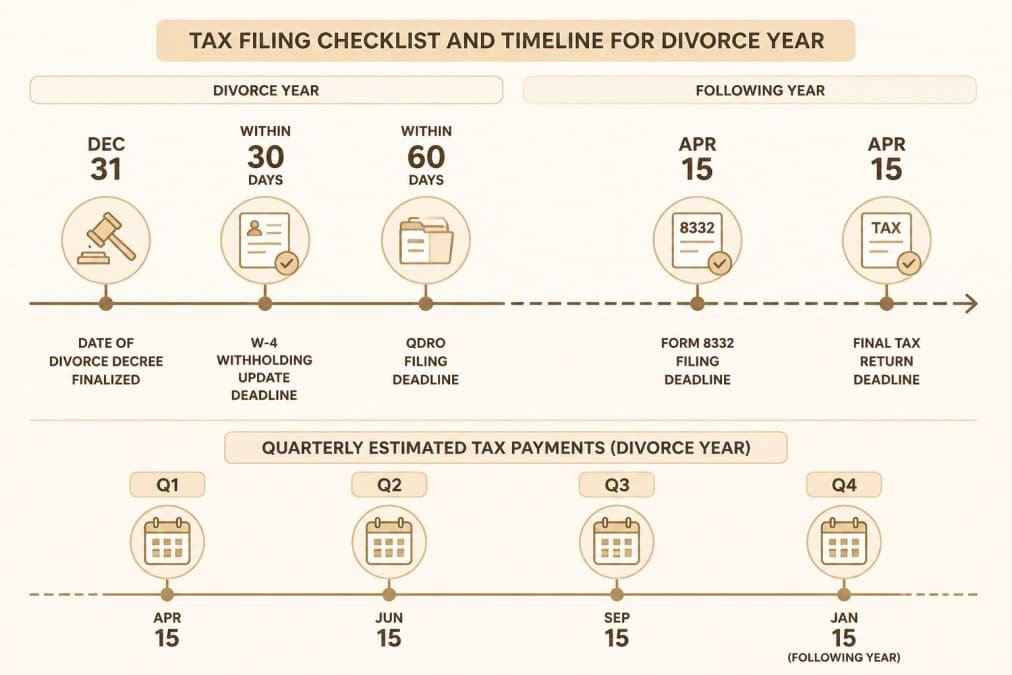
Use this checklist to stay on track:
| Task | Deadline | Impact |
|---|---|---|
| Obtain final divorce decree | Before Dec 31 | Determines filing status for the year |
| Update W-4 withholding | Within 30 days of divorce | Adjusts paycheck deductions for new filing status |
| File Form 8332 if applicable | With tax return (April 15) | Transfers dependent exemption to non-custodial parent |
| Obtain QDRO for retirement accounts | Within 60 days | Allows tax-free transfer of 401k/IRA |
| Finalize property transfers | By Dec 31 | Establishes tax basis and ownership for reporting |
| Claim correct filing status | April 15, 2027 | Single, Head of Household, or Married Filing Separately |
| Report alimony on Schedule 1 | April 15, 2027 | Pre-2019 divorces only; post-2018 is non-deductible |
| Report child support received | Not reported | No income tax consequence |
Key dates for 2026:
- January 31: Deadline for W-2 forms from employers
- February 15: Deadline for 1099 forms (interest, dividends, capital gains)
- April 15, 2027: Deadline to file your 2026 tax return
- June 15, 2027: Extended deadline if you file Form 4868
- Quarterly: Estimated tax payments due if you owe more than $1,000 in taxes
If your divorce is finalized mid-year, you may owe estimated taxes for the remainder of the year. Calculate your expected income and tax liability, then make quarterly payments to avoid penalties.
Consulting a tax professional before your divorce is finalized is recommended. They can model different settlement scenarios and show you the after-tax impact of each option. This clarity helps you negotiate a settlement that feels fair and delivers the financial security you need.
The tax implications of divorce settlements extend beyond the year of your divorce.
Frequently Asked Questions
Is money received in a divorce settlement taxable?
Most property transfers between spouses as part of a divorce settlement are not taxable events. However, the tax implications depend on the asset type. Cash transfers for property division are generally tax-free, but alimony is taxable income to the recipient. Retirement account transfers via a Qualified Domestic Relations Order (QDRO) are not immediately taxable but distributions later are. Investment accounts transferred may trigger capital gains tax if they’ve appreciated significantly. Consult a tax professional about your specific settlement to determine what portions are taxable.
How is alimony taxed after divorce?
Alimony (also called spousal support or maintenance) is taxable income to the recipient and may be deductible by the payer, depending on when the divorce was finalized. For divorces finalized after December 31, 2018, alimony is not deductible by the payer and is not taxable to the recipient. For earlier divorces, different rules may apply if the decree hasn’t been modified. The divorce decree or separation agreement must clearly specify which payments are alimony versus property settlement to ensure correct tax treatment. Verify your decree language with a tax advisor.
What happens to capital gains tax when a home is transferred in a divorce?
Transferring the marital home to one spouse in a divorce is generally not a taxable event at the time of transfer. However, capital gains tax becomes relevant when the home is later sold. If you inherited the home through divorce, your tax basis is generally the original purchase price. If you sell within 2 years of the divorce and meet other requirements, you may qualify for the $250,000 individual capital gains exclusion (or $500,000 if filing jointly in the year of sale). Document the home’s fair market value on the divorce date for future tax calculations.
Who can claim a child as a dependent after divorce?
Generally, the parent with primary custody (more than 183 nights per year) can claim the child as a dependent. However, the custodial parent can release this right to the non-custodial parent by signing Form 8332. The divorce decree should specify which parent claims the exemption each year or in alternating years. Only one parent can claim the child per tax year. The child must be under age 17 (for the child tax credit) or under age 24 if a full-time student. Ensure your divorce settlement explicitly addresses dependent claims to avoid IRS disputes and verify your arrangement matches your actual custody schedule.