TL;DR:
- Healing from betrayal trauma is achievable through a structured, compassionate process that prioritizes safety and emotional processing. Understanding trauma symptoms and setting firm boundaries facilitate effective recovery, with ongoing self-care and professional support essential throughout the journey. Progress measure and pacing are crucial, as re-traumatization can occur if the pace surpasses your capacity for healing.
- Key Takeaways
- Understanding betrayal trauma and its emotional impact
- Setting up your recovery workflow: Tools and prerequisites
- Step-by-step emotional recovery workflow
- Common pitfalls and how to avoid them
- Measuring progress and knowing when to seek extra support
- What most recovery guides miss: The power and risk of pacing
- Frequently asked questions
Finding out your partner has been unfaithful can shatter your entire sense of reality. One moment you had a life that made sense, and the next, you’re questioning everything you thought you knew. The grief, rage, numbness, and confusion don’t arrive in any predictable order, and that chaos alone can make recovery feel impossible. But here’s what we know from clinical practice and real-world experience: healing after infidelity is absolutely possible when you follow a structured, compassionate process. This guide walks you through a clear workflow, from understanding your trauma to measuring genuine progress, with practical tools at every stage.
Key Takeaways
| Point | Details |
|---|---|
| Trauma shapes recovery | Both the betrayal event and your unique reaction influence the healing process. |
| Structure enables healing | A step-by-step workflow provides direction and reassurance during recovery. |
| Therapy accelerates progress | Trauma-focused therapies are strongly recommended for lasting emotional recovery. |
| Pacing is protective | Honoring your emotional pace reduces risk of re-traumatization and builds lasting resilience. |
| Recovery is non-linear | Setbacks are normal and regular progress checks help you know when to seek extra support. |
Understanding betrayal trauma and its emotional impact
Before you can begin to heal, you need to understand what has actually happened to you. Betrayal trauma is not just heartbreak. It is a genuine psychological and often physical injury that reshapes how your nervous system functions, how you perceive safety, and how you relate to other people.
Research confirms that subjective betrayal predicts PTSD, depression, and dissociation beyond what the objective facts of the affair alone would suggest. In other words, it’s not just what happened but how deeply it violated your sense of trust and identity that determines how severely you are affected. This matters because it validates every intense feeling you’re carrying right now.
Common symptoms of betrayal trauma include:
- Intrusive thoughts and flashbacks about the affair
- Hypervigilance, such as constantly checking your partner’s phone or location
- Anxiety, panic attacks, or a persistent sense of dread
- Emotional numbness or dissociation (feeling detached from your own life)
- Depression and loss of motivation
- Sleep disturbances and physical symptoms like nausea or exhaustion
- Difficulty concentrating or making basic decisions
“Your reaction to betrayal is not a sign of weakness. It is the predictable response of a healthy nervous system to a deeply threatening event.”
Recognizing these as trauma responses rather than personal flaws is genuinely the first and most important step. Many people torture themselves with thoughts like, “Why can’t I just get over this?” or “I should be stronger.” That self-attack only adds a second layer of injury on top of the original wound. Once you can see the signs of healing after betrayal, you’ll understand that your nervous system is trying to protect you, not punish you.
| Trauma symptom | What it looks like in daily life |
|---|---|
| Intrusive thoughts | Replaying discovery moments during meals or work |
| Hypervigilance | Feeling anxious whenever partner is uncontactable |
| Dissociation | Watching your life as if from a distance |
| Emotional numbing | Inability to feel joy even in previously loved activities |
| Physical symptoms | Nausea, appetite changes, heart palpitations |
Setting up your recovery workflow: Tools and prerequisites
With a clear understanding of betrayal trauma’s effects, it’s essential to gather the right tools and supports before starting your workflow. Jumping into recovery without preparation is like trying to run a marathon without training or shoes.
The benefits of therapy after infidelity are well-documented. APA guidelines prioritize trauma-focused psychotherapies as first-line interventions for individuals whose post-infidelity symptoms resemble trauma. If your symptoms include dissociation, severe anxiety, or inability to function day-to-day, trauma-focused therapy is not optional. It is the foundation.
Essential prerequisites for your recovery workflow:
- Identify at least one trusted person you can be honest with (a friend, therapist, or support group)
- Create physical safety, which may include decisions about shared living arrangements if needed
- Map your primary stress triggers (specific locations, times of day, social situations)
- Establish basic self-care anchors: regular sleep, food, and movement, even imperfect versions
- Decide whether you want to pursue reconciliation or separation, knowing this decision can change
| Support option | Best suited for | Key limitation |
|---|---|---|
| Individual therapy | Processing personal trauma | May not address relational dynamics |
| Couples therapy | Rebuilding together | Not appropriate if trauma is unresolved |
| Support groups | Reducing isolation | Varies in quality and format |
| Self-guided programs | Flexible pacing and privacy | Requires self-discipline |
| Crisis helplines | Acute distress | Not a substitute for ongoing support |
Pro Tip: Before your first therapy appointment, write a brief timeline of the betrayal and your major emotional reactions since discovery. This helps your therapist assess where you are and what type of support will help most.
Exploring coping strategies that feel natural alongside professional help creates a more sustainable daily structure. You can also browse practical tips for emotional healing to build on what already works for you. For additional survivor-centered perspectives, the survivors guide offers grounded, practical wisdom from a recovery-focused lens.
Step-by-step emotional recovery workflow
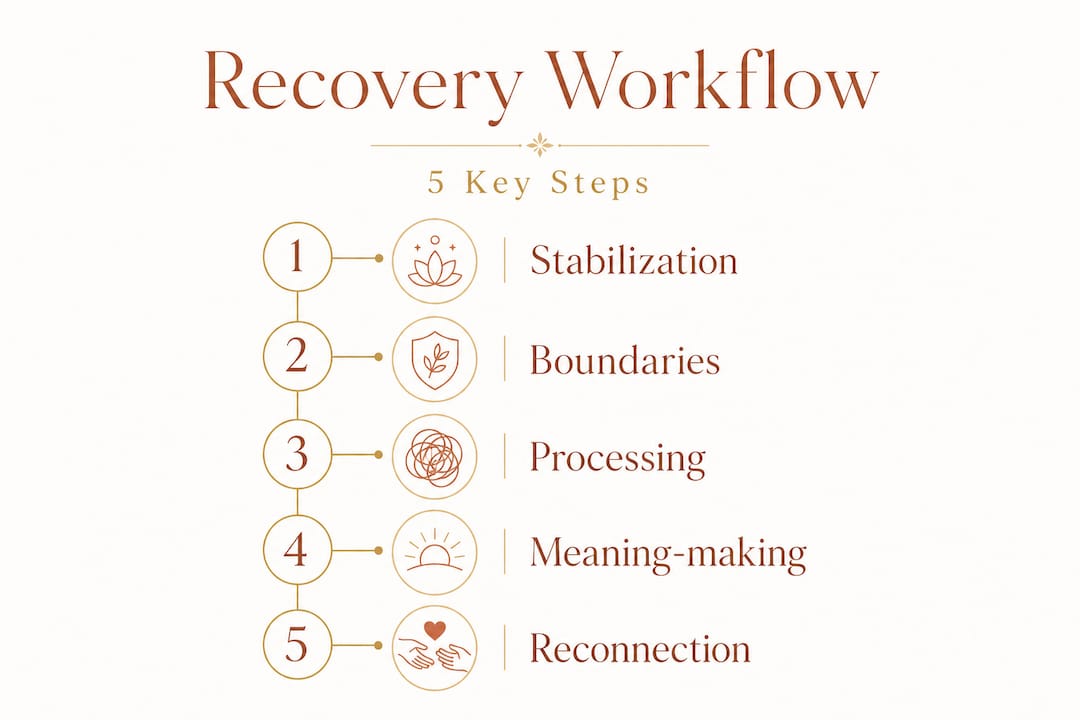
Now that you have your prerequisites in place, here is the actionable recovery workflow. These steps are sequential by design, but know that you will likely revisit earlier stages as new information emerges or life circumstances shift.
1. Safety and stabilization
Your first priority is reducing emotional volatility, not fixing the relationship. Focus on breathing techniques, grounding exercises (such as the 5-4-3-2-1 sensory method), and establishing daily routines that give your nervous system predictability. Stabilization must come before deeper trauma work because attempting to process deep pain before you feel safe only intensifies symptoms.
2. Information gathering and boundary-setting
Decide what you need to know about the affair and communicate that clearly. Boundaries around ongoing contact with the affair partner, phone access, and transparency are set here, not negotiated indefinitely.
3. Emotional processing
This is where the bulk of your healing happens. Journaling, therapy sessions, and grief work belong in this phase. You’re allowing yourself to fully feel anger, sorrow, shame, and fear in a contained and supported way rather than suppressing or exploding.
4. Meaning-making
After emotional processing, many people begin to ask larger questions about identity, values, and what they want their life to look like. This is healthy and necessary. Whether you stay or leave, rebuilding a personal narrative that has coherence is essential.
5. Gradual reconnection
Reconnection can mean reconnecting with yourself, with a partner if reconciliation is the path, or with life in general after deep withdrawal. This step should never be rushed. Trust the trauma-informed self-trust guide principle that self-trust must be rebuilt before external trust can follow.
The authoritative APA guidelines emphasize trauma-focused psychotherapy as the foundation for each of these phases when symptoms are clinically significant. You can also use the recovery checklist to track your movement through these stages, and explore real-life recovery examples to see how others navigated similar terrain.
Pro Tip: Keep a brief daily log rating your emotional volatility on a scale from 1 to 10. Over weeks, you’ll see trends that show genuine progress even when individual days feel hopeless.
Recovery statistic: Studies show that untreated betrayal trauma symptoms can persist for years, but structured therapeutic intervention significantly shortens recovery timelines and reduces the severity of long-term psychological effects.
Common pitfalls and how to avoid them
As you move through the workflow, beware of these common traps that can quietly undermine your progress. Most people hit at least one of these. Knowing them in advance gives you the awareness to course-correct before the damage deepens.
Rushing relational repair. Many people, exhausted by the pain of conflict, push toward forgiveness or reconciliation before they’ve processed the original wound. This almost always backfires, producing a surface-level peace that fractures again under ordinary relationship stress. Forgiveness, where it happens, is a byproduct of thorough healing, not a shortcut to it.
Staggered disclosure. This is one of the most damaging patterns in recovery. Staggered disclosure is re-traumatizing, meaning when a partner reveals the affair in drips, each new piece of information can restart the trauma cycle from the beginning. If you are the betrayed partner, it’s reasonable to ask for a complete, single disclosure, ideally with a therapist present.
“Every new piece of information after the initial disclosure lands like a fresh betrayal. Complete honesty, as painful as it is in the moment, is far less harmful than partial truths revealed over time.”
Additional pitfalls to watch for:
- Isolating yourself from friends and family, which removes the social scaffolding your nervous system needs
- Setting rigid recovery timelines, such as “I should be over this in three months,” which creates shame and false pressure
- Avoiding professional help when symptoms include persistent nightmares, inability to work, or thoughts of self-harm
- Using alcohol or substances to manage emotional pain, which delays processing and adds new complications
The key to processing emotional trauma effectively is allowing it to move through you rather than around you. Every shortcut costs more time in the long run.
Measuring progress and knowing when to seek extra support
Once you’re actively engaged with your workflow, it’s vital to regularly check your progress against clear benchmarks. Recovery is non-linear, but that doesn’t mean it’s unmeasurable.
Signs that genuine healing is underway:
- Emotional intensity decreases in duration and frequency, even if it hasn’t disappeared
- You can go longer periods without intrusive thoughts
- Self-care feels possible again (eating, sleeping, exercising)
- You begin making plans for your future, however tentative
- Moments of genuine laughter or enjoyment return
Red flags that indicate you need additional support:
- Persistent nightmares or severe sleep disruption lasting more than a few weeks
- Thoughts of self-harm or harming others
- Complete social withdrawal lasting more than two to three weeks
- Inability to function at work or care for children or dependents
- Shame and self-blame that feel fixed and unshakeable
It’s worth understanding that moral injury and PTSD overlap significantly, sharing features like guilt, shame, and profound loss of trust. If you’re feeling not just traumatized but morally contaminated (believing you “should have known” or “deserved this”), that’s a sign that trauma-focused PTSD treatment may directly address what you’re experiencing.
| Progress marker | Frequency to check | Action if absent |
|---|---|---|
| Reduced emotional volatility | Weekly | Revisit stabilization phase |
| Improved sleep quality | Bi-weekly | Consult therapist or GP |
| Social engagement | Monthly | Consider group therapy |
| Future-oriented thinking | Monthly | Reassess meaning-making work |
| Reduced intrusive thoughts | Weekly | Discuss trauma-specific therapy options |
For deeper insight into how betrayal affects anxiety and daily functioning, exploring the effects of infidelity on anxiety can help you contextualize your symptoms. If you feel spiritually unmoored alongside the emotional pain, the trauma-informed steps to spiritual clarity resource addresses that specific dimension of recovery.

What most recovery guides miss: The power and risk of pacing
Here’s something that rarely gets said directly: most structured recovery guides, including this one, carry an invisible assumption that you will move forward at a relatively consistent pace. The reality is far messier, and that messiness is not a problem to be fixed. It’s actually where the real healing happens.
In clinical practice and in working with people navigating infidelity, the single biggest source of setback is not failed reconciliation or poor communication. It’s self-blame that follows an “off-script” recovery. Someone moves through three steps of the workflow successfully, then a trigger sends them back to raw grief, and they conclude they’re broken or doing it wrong.
The truth is the opposite. An “off-script” moment, where stabilization is needed again before moving forward, is often a sign that the nervous system is doing exactly what it should: pacing the depth of the work to match available capacity. Rushing past readiness to reach closure faster is one of the most common ways people inadvertently re-traumatize themselves.
This applies especially to relational reconnection. Many couples feel social pressure to declare a turning point, to announce they’re working through it, or to perform recovery for the comfort of family and friends. But reconnection that happens before genuine stabilization and emotional processing is a fragile structure. It can hold for a time, but it rarely holds under real stress.
The therapists we most respect in this field now recommend returning to stabilization before each major relational step, not just at the beginning. Before the first serious conversation about reconciliation, stabilize. Before meeting with a couples therapist for the first time, stabilize. Before discussing boundaries around disclosure, stabilize. This rhythm of “step forward, ground again” is what produces lasting change rather than surface healing.
If you’re working with clients or supporting someone you love through infidelity, the guidance on how to guide clients after infidelity reinforces this principle with practical, clinically grounded frameworks. Honor the pace. The process will breathe when you let it.
Take the next step in your recovery journey
You’ve built a clear picture of what betrayal trauma involves, what tools you need, and how to move through recovery with intention. Knowing the steps is powerful. Having structured resources to support each step is what turns knowledge into actual healing.
At After the Affair, we’ve built a library of structured checklists, evidence-informed guides, and real-world case studies specifically designed for every phase of what you’re experiencing. Whether you’re in the first raw weeks or further along and feeling stuck, there’s a resource mapped to where you are right now. Start with the 7-step recovery checklist to assess where you stand, explore relationship growth after infidelity for what becomes possible beyond survival, and if you’re in the early days, the guide on navigating infidelity first months will give you the immediate footing you need.
Frequently asked questions
How long does emotional recovery after infidelity typically take?
Recovery time varies widely depending on trauma severity, available support, and individual factors, but most people require anywhere from several months to a few years. Setbacks are a normal part of the process, not evidence of failure.
What are the first signs that emotional healing has started after betrayal?
Early signs include reduced emotional volatility, moments of genuine enjoyment returning, improved self-care habits, and a gradual ability to think about the future again.
Can trauma-focused therapies help with betrayal trauma?
Yes. Trauma-focused psychotherapies are first-line interventions for betrayal-related trauma symptoms, with approaches like Cognitive Processing Therapy and Prolonged Exposure showing strong evidence for reducing PTSD, depression, and dissociation.
Is it normal to feel anger or numbness even months after an affair?
Absolutely. Subjective betrayal predicts PTSD and dissociation well beyond what the objective facts of the affair would suggest, meaning intense or blunted emotions months later are recognized trauma responses, not character flaws.
What if my partner discloses new information after we’ve started recovery?
New information after recovery has begun can restart the trauma cycle significantly. Staggered disclosure risks re-traumatization, which is why complete, single disclosure early in the process, ideally supported by a therapist, is strongly recommended.
Recommended
- 7 Steps-Infidelity Recovery Checklist – After the Affair Series
- How to Cope After Infidelity – After the Affair Series
- How to Guide Clients After Infidelity for Healing – After the Affair Series
- Effective tips for emotional healing after infidelity