How to Communicate With a Cheating Ex Without Conflict

Learn how to communicate with a cheating ex without conflict using scripts, boundaries, and de-escalation strategies for peaceful co-parenting.

Last Updated: October 12, 2026

How to Communicate With a Cheating Ex Without Conflict: Core Principles

Learning how to communicate with a cheating ex without conflict starts with one decision: how much contact you actually need.

This guide lays out scripts, boundaries, and exit plans that can help keep conversations calm.

The core principle is simple. You control your side of every exchange. You cannot control theirs.

That single shift changes everything.

The Difference Between No Contact and Limited Contact

No contact means zero communication except through a third party or a court-ordered channel. It works when there are no shared responsibilities.

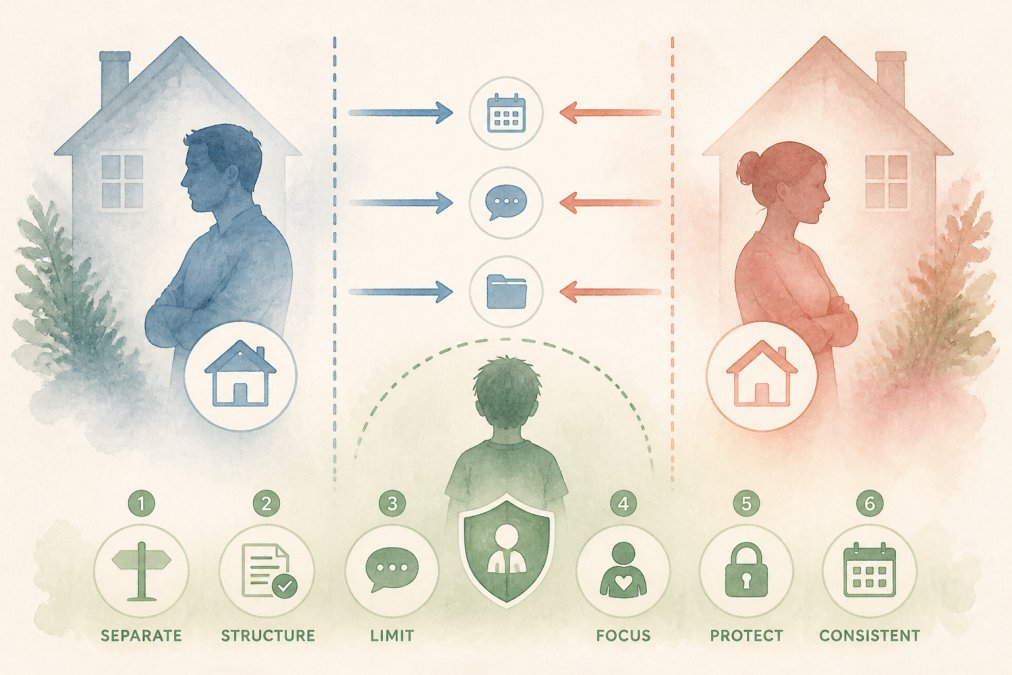
Limited contact means you communicate only about logistics, only in writing, and only when necessary. This is the realistic option for co-parents.

Ask yourself one question: do we share children, finances, or property?

  • If no, no contact is usually best.
  • If yes, limited contact is your path.
  • If there is a safety concern, use a monitored or app-based channel.

Why Emotional Reactions Fuel Arguments

Every screaming match needs two people. Remove your half, and the argument dies.

A common mistake is answering a hostile text within minutes. That speed hands your ex control of your emotions. Wait. Write your reply. Delete it. Write a shorter one.

Calm is not weakness. It is strategy.

Pro Tip
Before you reply to any message, ask: “Would I be comfortable if a judge read this out loud?” If the answer is no, rewrite it. This one habit prevents most conflict.

What to Say to an Ex Who Cheated on You: Scripts That Lower the Temperature

Knowing what to say to an ex who cheated on you matters less than knowing what not to say. Skip the accusations, the rehashing, and the demands for an apology.

Use short, neutral statements that close loops instead of opening fights.

Try these:

  • “I’m not available to discuss that. I can talk about the schedule.”
  • “I hear you. My answer is still no.”
  • “Let’s keep this to the kids’ plans.”

Each line does the same job. It ends the exchange without adding heat.

A 4-Step Conversation Agenda for Difficult Topics

When a real conversation is unavoidable, run it like a meeting. Structure beats emotion.

  1. State the topic in one sentence. “We need to settle the holiday schedule.”
  2. Give your position once. “I’d like the kids on the 24th.”
  3. Ask one question. “Does that work for you?”
  4. Set a deadline. “Please reply by Friday so I can plan.”

No backstory. No blame. No third topic. If the talk drifts, return to step one.

Communication Scripts for High-Conflict Co-Parenting

Communication scripts for high-conflict co-parenting work because they remove improvisation. You are not composing angry replies at midnight. You are choosing from a small set of tested lines.

Keep three scripts ready at all times:

  • The redirect: “That’s not something I can discuss. What time is pickup?”
  • The delay: “I can’t answer that right now. I’ll get back to you.”
  • The boundary: “I won’t continue this conversation if there’s yelling.”

Say them word for word. Your ex may push. Repeat the same line. Repetition is the point.

Infidelity recovery courses, free quizzes, and tools for healing after betrayal

The Gray Rock Method for Hostile Exchanges

The Gray Rock Method means becoming so uninteresting that a hostile ex loses interest in provoking you. You give short, flat, boring answers. No emotion. No drama. No fuel.

It looks like this:

  • Answer questions with one word when you can.
  • Skip opinions, jokes, and personal news.
  • Never react to insults.

This is not about being cruel. It is about being safe and steady.

Watch Out
Gray Rock can backfire if you use it to punish rather than protect. If your ex feels stonewalled on a real parenting issue, conflict rises. Stay boring on conflict, but stay clear on logistics.

How to Keep Co-Parenting Messages Brief and Neutral

Keeping co-parenting messages brief and neutral is a skill you can build in a week. The rule is simple: write like a coworker, not a spouse.

Before you send anything, check it against these filters:

  • Is it about the children or logistics?
  • Would a stranger read it as calm?
  • Can it be shorter?

If a message fails any filter, cut it.

The BIFF Format for Written Communication

The BIFF format stands for Brief, Informative, Friendly, Firm. It is one of the most useful tools for written messages to a difficult ex.

Here is how it works in practice:

ElementWhat It MeansExample
BriefOne or two sentences“Pickup is at 5.”
InformativeFacts only, no emotion“The school called about the form.”
FriendlyPolite, not warm“Thanks for confirming.”
FirmClear boundary“I can’t change the time.”

BIFF keeps your messages readable by a judge, a mediator, or a co-parenting app record. That matters if conflict ever goes to court.

Using a Co-Parenting App for a Difficult Ex

A co-parenting app for a difficult ex does three things at once. It timestamps every message, blocks editing, and keeps a clean record.

Most apps also offer a shared calendar, expense tracking, and a message log you can export.

Benefits include:

  • A written record of every exchange
  • Less room for “he said, she said”
  • A single place for schedules and receipts

Pick one app and stay on it. Moving between texts, email, and calls scatters your evidence.

Key Takeaway
The app is not the strategy. The app is the container. Your calm, brief messages are the strategy.

De-Escalation and Exit Strategies When Conversations Turn Hostile

Hostile talks rarely explode without warning. Tension builds first, and your job is to notice it early and leave before it escalates. Most people miss the early signals because they are busy defending themselves.
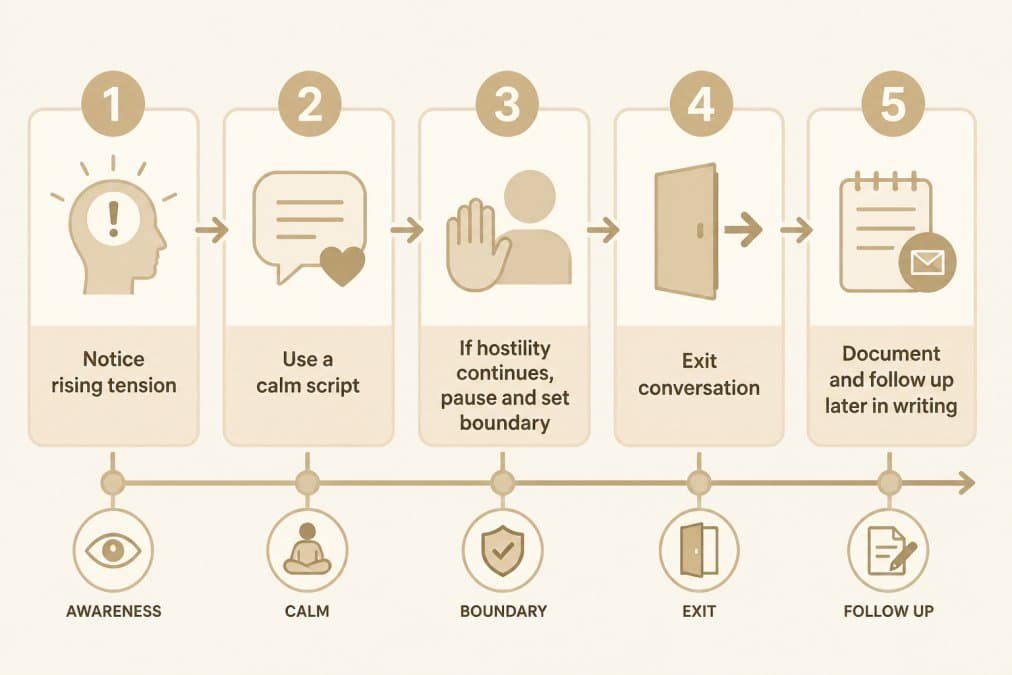
Flowchart showing de-escalation steps: 1. Notice rising tension, 2. Use a calm script, 3. If hostility continues, pause and set boundary, 4. Exit conversation, 5. ### Early Warning Signs to Catch Before Things Blow Up Watch for these signals in yourself and in your ex: - **Voice changes.** Volume rises, pitch tightens, or speech speeds up. - **Body language.** Jaw clenching, pointing, pacing, blocking a doorway. - **Language shifts.** Name-calling, sarcasm, absolutes ("you always," "you never"), or dredging up old grievances. When you notice two or more of these at once, treat it as a stop sign. You are no longer in a conversation, you are in a fight. ### The Pause Script: Buying Time Without Escalating You do not need to win the moment. You need to slow it down. Use one of these lines, word for word: - "I want to keep this calm. Let's slow down." - "I'm not able to do this right now. I'll respond in writing." - "I need a few minutes. I'll come back to this." Say it once. Do not explain, justify, or repeat it in a louder voice. If your ex pushes, move to the boundary step. ### Setting the Boundary and Exiting A boundary without an exit is just a threat. Pair them: 1. **Name the behavior.** "You're raising your voice." 2. **State the limit.** "I won't continue if this keeps up." 3. **Exit cleanly.** "I'm ending this call. We can try again tomorrow." Then actually leave. End the call. Walk out of the room. Close the door. Do not deliver a parting shot, that is what reopens the fight. If you are in person and feel unsafe, leave immediately. Do not announce it, do not negotiate it, and do not stay to "finish the point." Your safety outranks any conversation. ### What to Do After You Exit Exiting is not the end of the exchange, it is a change of channel. Follow these steps within an hour: - **Write it down.** Note the date, time, what was said, and who was present. If you use a co-parenting app, log it there so it is timestamped. - **Do not reply in the moment.** Give yourself at least a few hours, ideally overnight. - **Switch to writing.** Follow up by message or app, not by phone or in person. Written words cool faster than spoken ones, and they create a record. :::tip Decide your exit line before the conversation starts. Rehearse it out loud. In a heated moment, you will not invent a calm sentence, you will only use one you already know. ::: :::warning If your ex blocks your exit, stands in a doorway, takes your keys or phone, or follows you, stop treating this as a communication problem. That is a safety problem. See the safety section below. ::: ### When to Stop Trying to De-Escalate De-escalation works when both people want the temperature lower. If your ex escalates every time you try, that is information. In that case, stop having live conversations altogether. Move to written-only contact, use a co-parenting app, and consider a third-party exchange for handoffs. You are not failing at communication, you are choosing a channel that fits the reality. ## Safety Planning and Digital Boundaries With a Cheating Ex Safety comes before conversation. If your ex has ever threatened you, your children, or your property, treat communication as a safety issue, not a relationship issue. The goal is not to win arguments. The goal is to stay safe while you handle logistics. ### Know the Difference Between Conflict and Abuse Conflict is mutual and unpleasant. Abuse is a pattern of control. Watch for: - **Intimidation.** Threats, yelling, looming, blocking exits, damaging property. - **Monitoring.** Reading your messages, tracking your location, showing up unannounced. - **Isolation.** Pressuring you to cut off friends, family, or support. If any of these are present, do not try to "communicate better." Your ex is not a difficult conversation partner, they are a safety risk. Shift your plan. ### Digital Boundaries to Set This Week Your phone and accounts are the front door to your life. Close the ones you can: - **Change passwords** on email, banking, social media, and any shared streaming or cloud accounts. Use a password manager and turn on two-factor authentication. - **Turn off location sharing** in your phone settings and in any family or map apps. - **Check for tracking.** Look for unfamiliar devices on your accounts and unfamiliar apps on your phone. A domestic violence advocate can help you check safely. :::warning Do not change your communication pattern abruptly if you fear retaliation. Sudden silence can escalate risk. Talk to an advocate first, and make a plan before you act. ::: ### When Not to Meet in Person Skip in-person conversations entirely if any of these are true: - Your ex has been physically violent or has threatened violence. - Your ex has a history of ignoring boundaries or showing up uninvited. - Your ex uses drugs or alcohol in a way that makes them unpredictable. Use a written channel instead. For custody handoffs, consider a public location, a police station parking lot, or a supervised exchange center. Many family courts recognize these options. ### Where to Get Help You do not have to figure this out alone. These are public, no-cost starting points: - The [National Domestic Violence Hotline
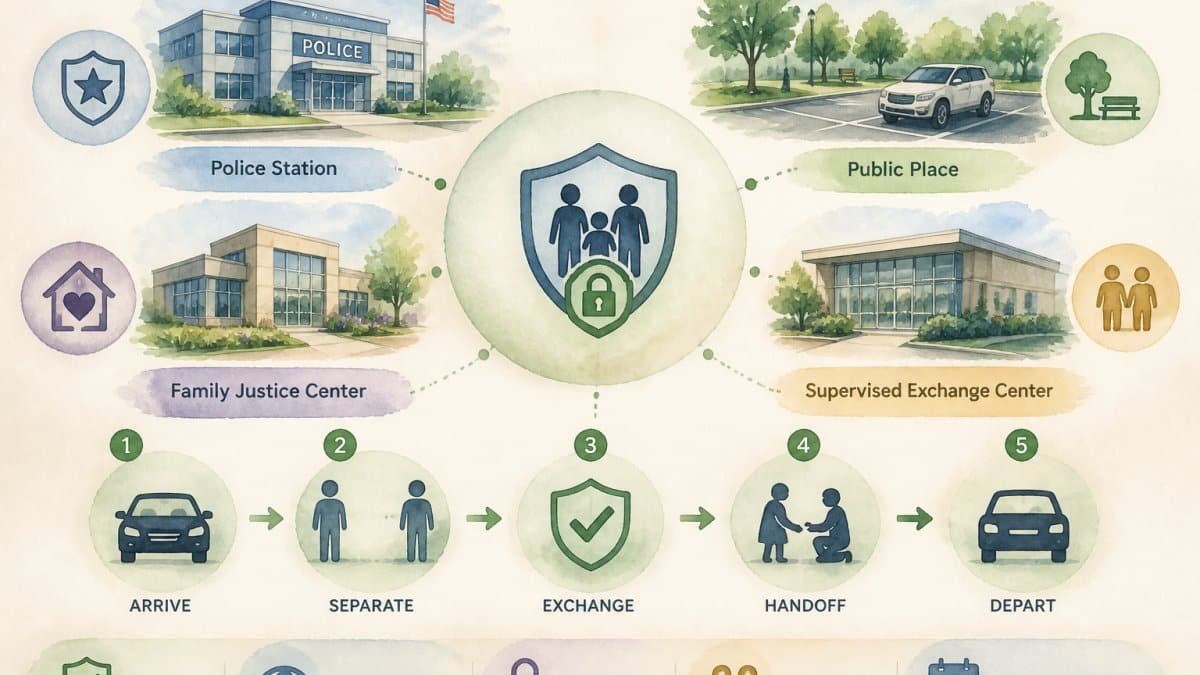
Flowchart showing de-escalation steps: 1. Notice rising tension, 2. Use a calm script, 3. If hostility continues, pause and set boundary, 4. Exit conversation, 5. ### Early Warning Signs to Catch Before Things Blow Up Watch for these signals in yourself and in your ex: – **Voice changes.** Volume rises, pitch tightens, or speech speeds up. – **Body language.** Jaw clenching, pointing, pacing, blocking a doorway. – **Language shifts.** Name-calling, sarcasm, absolutes (“you always,” “you never”), or dredging up old grievances. When you notice two or more of these at once, treat it as a stop sign. You are no longer in a conversation, you are in a fight. ### The Pause Script: Buying Time Without Escalating You do not need to win the moment. You need to slow it down. Use one of these lines, word for word: – “I want to keep this calm. Let’s slow down.” – “I’m not able to do this right now. I’ll respond in writing.” – “I need a few minutes. I’ll come back to this.” Say it once. Do not explain, justify, or repeat it in a louder voice. If your ex pushes, move to the boundary step. ### Setting the Boundary and Exiting A boundary without an exit is just a threat. Pair them: 1. **Name the behavior.** “You’re raising your voice.” 2. **State the limit.** “I won’t continue if this keeps up.” 3. **Exit cleanly.** “I’m ending this call. We can try again tomorrow.” Then actually leave. End the call. Walk out of the room. Close the door. Do not deliver a parting shot, that is what reopens the fight. If you are in person and feel unsafe, leave immediately. Do not announce it, do not negotiate it, and do not stay to “finish the point.” Your safety outranks any conversation. ### What to Do After You Exit Exiting is not the end of the exchange, it is a change of channel. Follow these steps within an hour: – **Write it down.** Note the date, time, what was said, and who was present. If you use a co-parenting app, log it there so it is timestamped. – **Do not reply in the moment.** Give yourself at least a few hours, ideally overnight. – **Switch to writing.** Follow up by message or app, not by phone or in person. Written words cool faster than spoken ones, and they create a record. :::tip Decide your exit line before the conversation starts. Rehearse it out loud. In a heated moment, you will not invent a calm sentence, you will only use one you already know. ::: :::warning If your ex blocks your exit, stands in a doorway, takes your keys or phone, or follows you, stop treating this as a communication problem. That is a safety problem. See the safety section below. ::: ### When to Stop Trying to De-Escalate De-escalation works when both people want the temperature lower. If your ex escalates every time you try, that is information. In that case, stop having live conversations altogether. Move to written-only contact, use a co-parenting app, and consider a third-party exchange for handoffs. You are not failing at communication, you are choosing a channel that fits the reality. ## Safety Planning and Digital Boundaries With a Cheating Ex Safety comes before conversation. If your ex has ever threatened you, your children, or your property, treat communication as a safety issue, not a relationship issue. The goal is not to win arguments. The goal is to stay safe while you handle logistics. ### Know the Difference Between Conflict and Abuse Conflict is mutual and unpleasant. Abuse is a pattern of control. Watch for: – **Intimidation.** Threats, yelling, looming, blocking exits, damaging property. – **Monitoring.** Reading your messages, tracking your location, showing up unannounced. – **Isolation.** Pressuring you to cut off friends, family, or support. If any of these are present, do not try to “communicate better.” Your ex is not a difficult conversation partner, they are a safety risk. Shift your plan. ### Digital Boundaries to Set This Week Your phone and accounts are the front door to your life. Close the ones you can: – **Change passwords** on email, banking, social media, and any shared streaming or cloud accounts. Use a password manager and turn on two-factor authentication. – **Turn off location sharing** in your phone settings and in any family or map apps. – **Check for tracking.** Look for unfamiliar devices on your accounts and unfamiliar apps on your phone. A domestic violence advocate can help you check safely. :::warning Do not change your communication pattern abruptly if you fear retaliation. Sudden silence can escalate risk. Talk to an advocate first, and make a plan before you act. ::: ### When Not to Meet in Person Skip in-person conversations entirely if any of these are true: – Your ex has been physically violent or has threatened violence. – Your ex has a history of ignoring boundaries or showing up uninvited. – Your ex uses drugs or alcohol in a way that makes them unpredictable. Use a written channel instead. For custody handoffs, consider a public location, a police station parking lot, or a supervised exchange center. Many family courts recognize these options. ### Where to Get Help You do not have to figure this out alone. These are public, no-cost starting points: – The [National Domestic Violence Hotline

(https://www.thehotline.org/get-help/) offers 24/7 support by phone and chat.

If you fear for your safety, contact a local advocate before you change any communication pattern. They can help you build a plan that fits your situation, including what to say, what to save, and where to go if things escalate.

Key Takeaway
A documented, written-only channel reduces both conflict and risk. But documentation is not a substitute for a safety plan. Build the plan first, then choose the channel.

Conclusion: Protecting Your Peace and Your Children

Conflict with a cheating ex rarely ends because of one perfect conversation. It fades when you stop supplying the fuel.

Decide your contact level. Pick your scripts. Use one app. Exit hostile talks early.

Your children watch how you handle this. Calm, consistent communication teaches them something no argument ever could.

Frequently Asked Questions

How can I communicate with a cheating ex without starting an argument?

Keep interactions focused on logistics and use neutral language. Avoid rehashing the infidelity or assigning blame. Try the BIFF method: keep messages Brief, Informative, Friendly, and Firm. For example, instead of ‘You lied to me again,’ say ‘I need the school forms by Friday.’ If your ex tries to provoke you, respond with a short, calm statement like ‘I’m not going to discuss that. Let’s stick to the schedule.’ This approach reduces conflict and keeps the focus on practical matters.

What should I say to an ex who cheated on me?

Focus on what you need moving forward, not on the betrayal. If you must communicate, use a script like: ‘I’m not ready to talk about the past. Right now, I need to confirm the pickup time for the kids.’ This keeps the conversation forward-looking and avoids triggering defensiveness. If you’re not co-parenting, you may choose limited or no contact. When contact is necessary, keep it brief and neutral. The goal is to protect your emotional energy and reduce opportunities for conflict.

How do I set boundaries with an ex who cheated?

Set clear, specific boundaries and communicate them once, calmly. For example: ‘I will only respond to texts between 9 AM and 5 PM on weekdays’ or ‘I will not discuss our past relationship.’ If your ex violates a boundary, enforce it consistently: end the conversation or mute notifications. Use written communication when possible to create a record. Boundaries are not about controlling your ex; they protect your time and emotional health. Expect pushback, but stay firm and avoid justifying or explaining your limits repeatedly.

What should I do if my ex becomes hostile during a conversation?

Disengage immediately. Use a pre-planned exit line like ‘I’m ending this conversation now. We can try again when things are calmer.’ Then hang up, leave the room, or stop responding to texts. Do not argue or defend yourself. If hostility happens in person, ensure you have a safe way to leave. Document the incident in writing afterward, noting date, time, and what was said. If hostility is frequent, switch to a co-parenting app that logs all messages and consider consulting a family law attorney about your options.


pinit fg en rect red 28

Author

  • S. J. Howe

    S.J. Howe, a counsellor with over twenty years of experience, specialises in helping couples navigate infidelity, betrayal, and relational trauma. Together, they blend lived experience with therapeutic expertise to guide readers through every stage of healing.

Scroll to Top