If you’ve just discovered that your partner has been unfaithful, you are probably looking for one thing above all else: how to survive an affair, not in the abstract, but today, right now, in the next few hours. At AfterTheAffair.uk, the most common question people ask when they first reach out is not “should I stay?” but “how do I get through today?”, and that question is exactly what this guide answers.
This is not about whether to save your relationship or walk away. That decision can wait. Right now, survival comes first.
- The Emotional Shockwave: What You're Feeling Is Normal
- Surviving Infidelity in Your Marriage: The First 72 Hours
- Coping With Your Partner's Affair Day by Day
- Emotional Support: Who to Tell and Who to Lean On
- Getting Through Infidelity When Children Are Involved
- Looking Forward: From Survival Mode to Genuine Recovery
The Emotional Shockwave: What You’re Feeling Is Normal
Why the brain treats betrayal like a physical trauma
The affair emotional impact you’re experiencing is not weakness. It is biology.
Research in trauma psychology shows that betrayal by a romantic partner activates the same stress-response pathways as other acute trauma, elevating cortisol, disrupting sleep architecture, and impairing short-term memory. That is why so many people describe the moment of discovery as feeling physically ill: shaking hands, nausea, chest tightness, an inability to string thoughts together. Your body is not overreacting. It is responding exactly as it would to any serious threat.
Betrayal trauma theory, developed by psychologist Jennifer Freyd, explains this further. When a person we depend on for safety becomes the source of harm, the brain struggles to process both realities at once. The result is a kind of cognitive crash, intrusive thoughts, emotional flooding, and moments of eerie numbness sitting side by side.
The emotional rollercoaster of the first days and weeks
In the days after discovery, most people cycle rapidly between rage, grief, disbelief, and a strange flatness. You may feel furious one hour and desperate to hold your partner the next. You may find yourself unable to eat, or eating compulsively. Sleep either disappears entirely or becomes the only escape.
A common pattern clinicians observe is what is sometimes called a “hyper-vigilance loop”, repeatedly checking your partner’s phone, email, or location in an attempt to feel safe again. This is understandable. But it rarely brings the sense of safety it promises, and it tends to deepen the anxiety spiral. Naming the pattern is the first step to interrupting it.
None of this means you are broken. It means you are human, and something genuinely harmful has happened to you.
Surviving Infidelity in Your Marriage: The First 72 Hours
What to do (and what not to do) right now
Managing the shock of infidelity in the first 72 hours is less about making progress and more about not making things worse. Here is the clearest guidance on that:
Do:
- Tell one trusted person who will support you without immediately pushing you toward a decision.
- Eat something, even if you have no appetite. Your nervous system needs fuel.
- Sleep if you can, even broken sleep matters.
- Write down what you know and feel, in a private journal, to externalise the mental noise.
Don’t:
- Post about the affair on social media. What goes online cannot be unsaid, and it will affect every outcome, legal, social, co-parenting, that comes later.
- Make permanent decisions (leaving, divorcing, forgiving, reconciling) while in acute shock.
- Confront the affair partner directly. This rarely gives the closure it seems to promise.
- Drink heavily. Alcohol amplifies emotional dysregulation and impairs the sleep quality you desperately need.
Affair recovery specialists consistently note that the biggest mistake betrayed partners make in the first week is forcing a permanent decision, stay or leave, before the nervous system has had any chance to regulate. Survival comes before resolution.
Protecting yourself practically without making permanent decisions
Surviving infidelity in marriage also means taking some quiet, practical steps, without locking yourself into irreversible outcomes.
If you share finances, pause any large joint financial decisions until you have had time to think clearly and, ideally, take legal or financial advice. This is not about revenge or control; it is about protecting your interests while your judgement is temporarily impaired by shock. Similarly, avoid signing or agreeing to anything significant, property, business, major loans, right now.
If you need physical space, create it. Stay with a friend or family member if that helps. You do not have to decide whether the relationship is over to choose not to sleep in the same bed tonight.
Coping With Your Partner’s Affair Day by Day
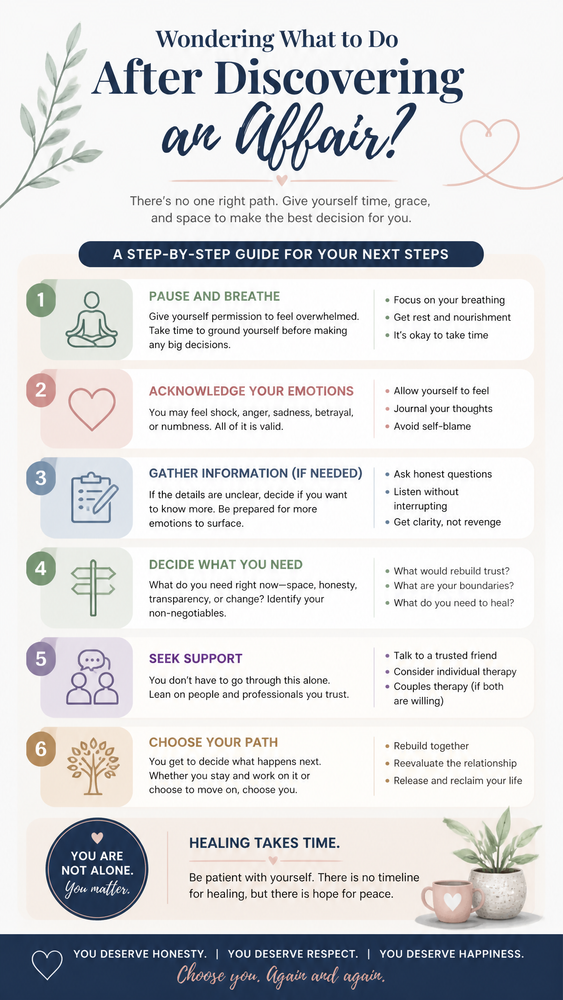
Grounding techniques for when the thoughts won’t stop
Coping with your partner’s affair is a daily, incremental process, not a single act of will. The intrusive thoughts will return. The question is what you do when they arrive.
A few techniques that genuinely help:
Box breathing: Inhale for four counts, hold for four, exhale for four, hold for four. Repeat four times. This directly activates the parasympathetic nervous system and dials down the acute stress response within minutes.
Scheduled rumination: Rather than fighting the thoughts all day, set a 20-minute window, say, after dinner, where you allow yourself to think about the affair fully. Outside that window, when a thought intrudes, acknowledge it (“I see you, I’ll get to you at 7pm”) and redirect your attention. This reduces the sense that you must resolve everything immediately.
Journaling: Writing out intrusive thoughts removes them from the loop of silent repetition. You don’t need to analyse what you write. Just get it out of your head and onto paper.
Building a minimal daily structure
When everything feels destabilised, structure becomes an anchor. You do not need an ambitious routine, just a minimal scaffold for the day.
Set a wake time. Eat at roughly predictable intervals. Get outside once, even briefly. These are not solutions to the pain; they are a container that stops the pain from consuming the entire day.
Getting through infidelity is not a straight line. There will be better days and significantly worse ones. Progress is measured in weeks and months, not hours. Expect setbacks and plan for them.
Emotional Support: Who to Tell and Who to Lean On
Choosing your support circle carefully matters enormously right now.
Tell one or two people who meet these criteria: they care about you (not primarily about the drama), they can hold a confidence, and they will not pressure you into a decision about your relationship. A close friend who has been through something similar, a sibling you trust absolutely, or a parent who leads with support rather than judgement, these are the right people.
Be cautious about telling people who have a strong pre-existing opinion about your partner, either positive or negative. People who love your partner may minimise what happened. People who dislike them may push you to leave before you are ready. Both responses, however well-intentioned, can make you feel more alone.
Professional support is worth considering from the outset, not just once the acute phase has passed. A therapist who specialises in affair recovery can give you the one thing a support network cannot: a space with no agenda about what you should decide. Affair recovery counselling in the UK is available both in person and online, which matters when you can barely leave the house.
Avoid the temptation to process everything publicly, on social media, in group chats, or with peripheral acquaintances. Information shared in crisis rarely stays contained, and the fallout can complicate everything that comes later.
Getting Through Infidelity When Children Are Involved
If you have children, getting through infidelity requires an additional layer of management, not suppressing your own needs, but shielding them from the adult crisis as much as possible.
Children need routine and emotional predictability, especially when something has shifted in the household atmosphere. Children cope best when the discovering parent maintains that routine and steadiness, even when internally in crisis. Children as young as five pick up on parental distress and may internalise it as their own fault. Maintaining school runs, mealtimes, bedtime rituals, and ordinary conversation gives them the message that they are safe, even if the adults around them are struggling.
What to tell children depends on their age and the situation. As a general principle: do not lie, but do not share adult detail. “Mum and Dad are having some difficult conversations about grown-up things” is honest without being harmful. Avoid having conflict, arguments, or tearful phone calls in front of them. If you need to break down, do it privately or with your support person, not within earshot of a child.
Do not use children as messengers, confidants, or emotional support. They are not equipped for that role, and it causes lasting damage.
Looking Forward: From Survival Mode to Genuine Recovery
Surviving an affair and recovering from one are two different things, and it is worth understanding the boundary between them.
Survival mode is where you are now: managing the acute shock, getting through each day, keeping basic functions intact. It is enough. It is the right focus.
Recovery is what becomes possible later, when the nervous system has had some chance to regulate and you can begin to think with more clarity. Recovery involves making considered decisions about the relationship, doing deeper work on the grief and anger, and gradually rebuilding a sense of self that does not depend on the affair as its organising fact. For couples who choose to stay together, rebuilding trust after infidelity is its own sustained process, one that requires commitment from both partners and usually benefits significantly from professional guidance.
Surviving infidelity in marriage long-term is possible. Many people come through this experience with a clearer sense of who they are and what they need, regardless of whether the relationship continues. But that clarity takes time to arrive, and it cannot be forced.
If you are not sure where to start, a structured first step can help more than an open-ended search. A free affair recovery assessment can give you a clearer picture of where you are in the process and what kind of support would help most, without any commitment. When you are ready to go deeper, specialist counselling is there.
Right now, though, the only task is today. One hour, one day, one step.