Discovering a partner’s infidelity doesn’t just break trust, it rewrites the past. Everything you thought was true about your relationship is suddenly uncertain, and that disorientation is one of the reasons it’s so hard to rebuild trust after infidelity. The path forward is real, but it’s not quick, and it’s rarely a straight line.
This guide offers practical, step-by-step strategies, not platitudes, for couples who want to try.
- Why Trust Is So Hard to Rebuild After Cheating
- Step 1, Stop the Bleeding: Immediate Actions After Betrayal Is Revealed
- Step 2, Rebuilding Trust Through Radical Transparency
- Step 3, Communication Strategies That Actually Work
- Step 4, Long-Term Healing: Regaining Trust in a Relationship Over Time
- How to Know If Your Relationship Can Recover
Why Trust Is So Hard to Rebuild After Cheating
Couples therapists consistently find that partners who come in after infidelity describe the discovery as one of the most traumatic experiences of their lives, comparable in symptom profile to post-traumatic stress. That’s not metaphor. The brain processes betrayal as a threat, flooding the nervous system with the same responses triggered by physical danger.
Infidelity doesn’t just damage the present, it corrupts the shared story the couple has been building together. Memories that felt safe suddenly feel like lies. Future plans feel fragile. The betrayed partner loses not just the relationship they thought they had, but their confidence in their own perception of reality.
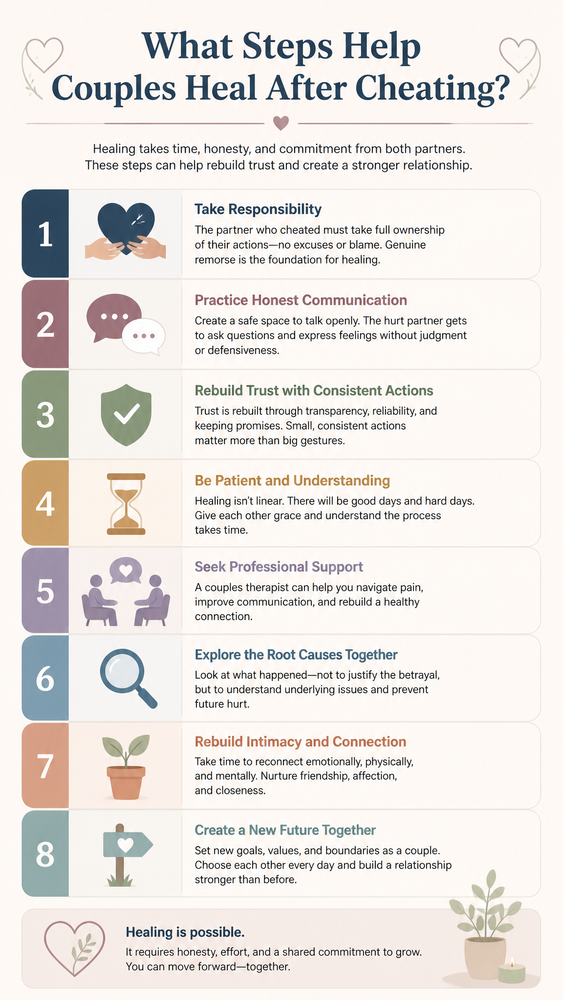
Dr. Shirley Glass, a couples therapist and infidelity researcher, coined the concept of “walls and windows”, arguing that affairs thrive when partners open windows of intimacy to someone outside the relationship while building walls against their spouse. Recovery requires deliberately reversing that dynamic: reopening emotional intimacy inside the relationship and closing it off outside.
Expect the process to take months or years, not weeks. Progress is non-linear. Good weeks are followed by bad ones. That’s not failure, that’s how broken trust recovery actually works.
Step 1, Stop the Bleeding: Immediate Actions After Betrayal Is Revealed
The first days and weeks after discovery are the most destabilising. Clear, honest action from the unfaithful partner matters enormously here.
Full Disclosure vs. Drip-Feeding the Truth
One of the most damaging patterns in rebuilding a relationship after cheating is the drip-feed: the unfaithful partner releases partial truths, the betrayed partner accepts them, then more details emerge later, restarting the trauma cycle from scratch each time.
Couples in structured affair recovery programmes describe this clearly: each new partial disclosure resets the betrayed partner’s trauma response to day one. That makes full and timely honesty a clinical priority, not just a moral one.
Full disclosure means answering questions honestly and completely, without volunteering graphic sexual detail that serves no healing purpose. The goal is truth that lets the betrayed partner understand what actually happened, so they can begin to make sense of it.
Establishing a No-Contact Agreement
The unfaithful partner must end all contact with the affair partner promptly and clearly. Ambiguity here, “we work together,” “it’s complicated”, signals to the betrayed partner that the relationship with the affair partner still has some value. It doesn’t.
A no-contact agreement should be explicit: no messages, no calls, no casual contact. Where circumstances genuinely require interaction (a shared workplace, for instance), the betrayed partner is informed of every encounter. This isn’t control, it’s the minimum foundation on which trust can begin to grow.

Step 2, Rebuilding Trust Through Radical Transparency
Radical transparency is the sustained practice of making yourself legible to your partner. It’s the unfaithful partner’s active choice to remove ambiguity, not because they’re forced to, but because they understand why it matters.
Practical Transparency Tools Couples Use
In practice, transparency might include:
- Shared location access, a live location app both partners can check at any time
- Open device access, phone, email, and social media available to the betrayed partner without advance notice
- Consistent check-ins, a brief message or call when arriving somewhere or changing plans
- Proactive communication, telling your partner about situations before they happen, not after
The key word is voluntary. These tools work when the unfaithful partner offers them freely as acts of reassurance. Framing matters: “I want you to feel safe” lands differently than “fine, if you need to check my phone.”
Avoiding the Surveillance Trap
Transparency can slide into surveillance, and surveillance corrodes recovery from both ends. The betrayed partner becomes hypervigilant and exhausted; the unfaithful partner feels permanently on trial. Neither state supports healing.
The practical fix is to agree together on what transparency looks like and to set a review date, perhaps three months out, where you both assess whether the current arrangements still feel necessary. Transparency tools are scaffolding, not a permanent structure. As felt safety grows, they can be eased back by mutual agreement.
Step 3, Communication Strategies That Actually Work
Most couples find that talking about the affair quickly spirals into accusation, shame, and shutdown. The conversation itself becomes re-traumatising. Structured formats break that pattern.
Structured Conversation Formats
Couples therapists often recommend a dedicated timed check-in: a 20-minute slot, agreed in advance, specifically for affair-related conversation. Outside that slot, both partners have permission to postpone the topic. This does two things: it prevents the affair from consuming every interaction, and it ensures the betrayed partner knows the conversation will happen, reducing the urge to press for it at the worst moments.
Within those conversations, impact statements are more productive than blame language. “When I found out, I felt like the ground disappeared beneath me” opens dialogue. “You destroyed everything” closes it. Both feelings are valid, but one invites a response, and the other invites defence.
Handling Triggers Without Re-Traumatising
Triggers are inevitable. A song, a location, an unexpected text notification, any of these can pull the betrayed partner back to the initial shock. A shared signal word or phrase, something simple the betrayed partner can say to flag they’ve been triggered, gives both partners a tool to use in the moment.
When the signal is used, how the unfaithful partner responds matters. Defensiveness or dismissal deepens the wound. Acknowledgement, “I hear you, I’m here, what do you need right now?”, begins to rebuild the felt safety that Dr. Sue Johnson, the originator of Emotionally Focused Therapy, identifies as the core requirement for recovery. Her point is important: re-establishing felt safety must come before genuine forgiveness is even possible.
Step 4, Long-Term Healing: Regaining Trust in a Relationship Over Time
Regaining trust is not primarily about removing negatives, it’s about actively building new positives. Stopping harmful behaviour clears the ground; new shared history is what actually grows trust back.
Building New Relationship Rituals
New rituals create new memories that the affair didn’t touch. These don’t need to be grand gestures. A Sunday morning routine you didn’t have before. A weekly walk. A shared project. Small, repeated, consistent acts compound over time into a new shared story, one that belongs to the recovered relationship, not the one that was broken.
Milestones matter too. The first month without a major rupture. The first holiday that felt like the two of you again. Noticing and naming these moments reinforces that progress is real, even when it doesn’t feel linear.
When to Seek Professional Support
Going it alone is possible for some couples, but couples who engage with structured support navigate triggers, transparency agreements, and difficult conversations more effectively than those who try to manage entirely without it.
If conversations consistently escalate rather than progress, if one partner feels permanently stuck in the early trauma response, or if months have passed without any sense of forward movement, that’s the signal to seek specialist affair recovery counselling in the UK. A good therapist doesn’t take sides, they help both partners process what happened and build the skills the relationship now needs.
A structured affair recovery programme can also provide a clear roadmap for couples who feel overwhelmed by the open-endedness of healing. Structure reduces the mental load of not knowing what to do next.
How to Know If Your Relationship Can Recover
Not every relationship should be saved, and one of the most honest things this guide can say is that staying together is not always the right outcome. Parting with clarity and support is a valid choice too.
That said, three indicators suggest a relationship has genuine recovery potential.
Both partners are willing to do the work. Recovery cannot be carried by one person. If the unfaithful partner is minimising, justifying, or refusing to engage, the foundation for rebuilding doesn’t exist yet. Genuine remorse is a different quality than defensiveness, and betrayed partners can usually feel the difference.
There is still basic emotional safety. Recovery is not possible in an environment where one partner feels afraid, controlled, or chronically unsafe. Safety is the precondition for everything else.
The betrayed partner retains some agency. Recovery that is pressured, stay or I’ll [threat], forgive me now or [ultimatum], is not recovery. The betrayed partner needs genuine choice, including the choice to leave, for any decision to stay to carry real weight.
If you’re not sure where you are in any of this, a free affair recovery assessment can help you map your current position, what stage of recovery you’re in, what’s blocking progress, and what kind of support is most likely to help. It’s a low-barrier starting point.
Recovery is hard. It is also real. Couples do come through this, not back to what they had, but forward to something that can be, in time, more honest and more durable than before.