TL;DR:
- Genuine growth after an affair can occur alongside ongoing distress, equipping individuals to build resilience.
- Measuring posttraumatic growth across five domains—such as personal strength and appreciation for life—provides a practical recovery map.
- Progress is nonlinear; embracing both pain and growth ensures a compassionate, realistic approach to healing.
Most people assume that healing after an affair is simply about feeling less pain. The idea goes: once the hurt fades, you’ve made it through. But that framing leaves out one of the most important truths backed by psychological research, which is that genuine, lasting growth after betrayal can exist right alongside ongoing distress. You don’t have to be “over it” to be growing. Understanding this changes everything about how you approach recovery, what you measure, and what you allow yourself to hope for.
Table of Contents
- Defining post-affair growth: Beyond reduced distress
- The five domains of posttraumatic growth after infidelity
- Distress and growth: The complex relationship post-affair
- Fostering post-affair growth: Actionable steps and mindset shifts
- Why post-affair growth is misunderstood and what really matters
- Next steps: Resources for healing and growth after infidelity
- Frequently asked questions
Key Takeaways
| Point | Details |
|---|---|
| Growth and pain coexist | Personal growth after infidelity can occur alongside ongoing distress and emotional turmoil. |
| Five domains measure progress | Progress is best judged across personal strength, relating, new possibilities, appreciation for life, and existential change. |
| Recovery is not linear | Healing after betrayal follows a unpredictable path and progress may come in fits and starts. |
| Actionable steps matter | Identifying areas for growth and using evidence-based strategies creates real change. |
| Resources support the journey | Checklists, guides, and supportive networks can foster recovery and help individuals track their transformation. |
Defining post-affair growth: Beyond reduced distress
When people talk about healing after an affair, the conversation usually centers on symptoms. Are you sleeping? Have you stopped crying? Can you go a full day without thinking about it? These are understandable measures, but they tell only a fraction of the story.
“Post-affair growth” closely overlaps with the established concept of posttraumatic growth (PTG), a term researchers use to describe the positive psychological change that can emerge from a major life crisis. PTG doesn’t mean the trauma wasn’t real or damaging. It means the person found a way to build something new in the aftermath.
This is a critical distinction. Growth after an affair isn’t about returning to who you were before. In fact, trying to go back is often exactly what stalls recovery. Instead, the path forward involves a different kind of expansion, one that can look unfamiliar and even uncomfortable at first.
“Healing isn’t the removal of scars. It’s learning to carry them without letting them define every step.”
The effects of infidelity are wide-ranging, touching self-esteem, trust, identity, and worldview. PTG acknowledges that these disruptions, while painful, can become the very ground from which something meaningful grows. Here’s what that growth can look like in practice:
- Stronger sense of personal identity, especially after being forced to examine what you truly value
- Greater empathy and emotional intelligence, developed through the raw experience of deep hurt
- A clearer sense of what you want from relationships and from life itself
- Renewed appreciation for things you previously took for granted
- Spiritual or philosophical shifts, including rethinking beliefs about people, purpose, and meaning
These are not abstract ideas. They’re measurable domains that researchers have studied extensively, and they form the backbone of understanding real post-affair growth.
The five domains of posttraumatic growth after infidelity
Psychological researchers have identified a structured way to understand and measure PTG. PTG is measured using the Posttraumatic Growth Inventory (PTGI), which captures five distinct domains where growth can occur: personal strength, relating to others, new possibilities, appreciation for life, and spiritual or existential change.
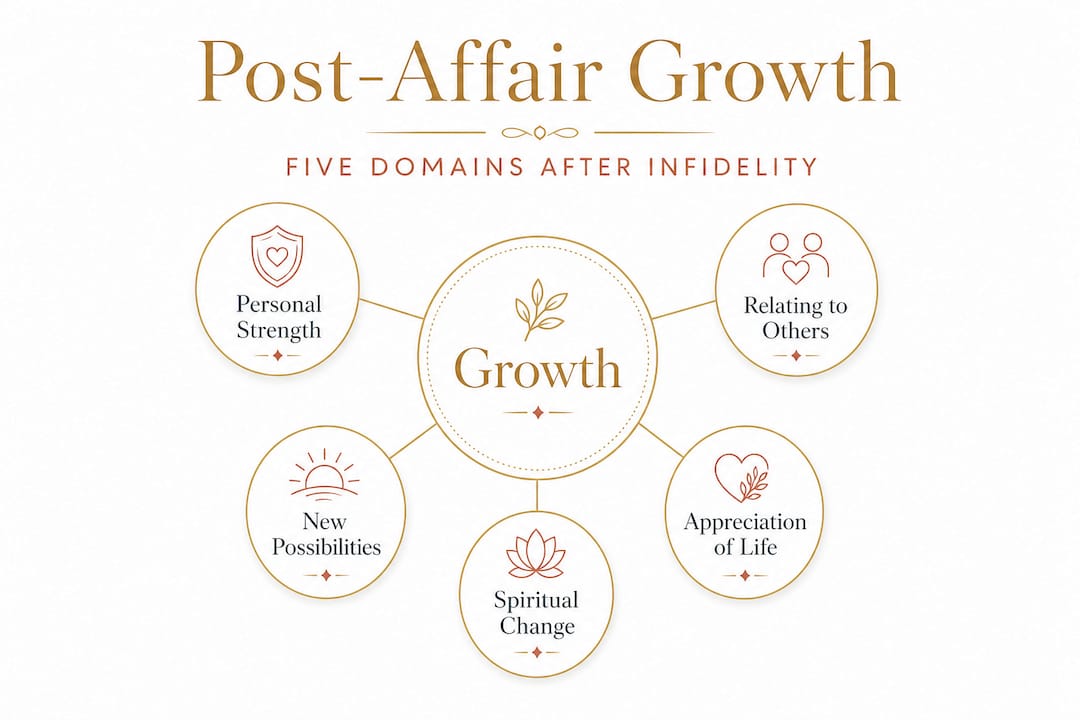
Let’s look at how each domain plays out in the real experience of post-affair recovery.
| PTG Domain | What it looks like after an affair |
|---|---|
| Personal strength | Realizing you survived something you thought would break you |
| Relating to others | Building deeper, more honest connections with friends, family, or a new or renewed partner |
| New possibilities | Discovering new goals, interests, or directions in life you hadn’t previously considered |
| Appreciation for life | Finding gratitude for small moments, relationships, and your own resilience |
| Spiritual/existential change | Rethinking core beliefs about trust, love, forgiveness, and your own purpose |
Understanding these domains matters because they give you a map. Without a map, recovery can feel shapeless and impossible to measure. With one, you can start to notice real shifts.
Here’s how you might work through each domain in a practical, ordered way:
- Personal strength: Start by acknowledging what you’ve already endured. Surviving the initial shock of discovery is not a small thing. Begin recording moments where you handled something you didn’t think you could.
- Relating to others: Notice how betrayal has changed your conversations. Many people report becoming more honest, less performative, and more willing to express real emotions with people they trust.
- New possibilities: Ask yourself what doors have opened, even reluctantly. A new perspective on your career, a dormant creative interest, or the recognition that you want a fundamentally different kind of relationship.
- Appreciation for life: This often comes gradually. Small pleasures, a morning walk, a real laugh with a friend, moments of silence that feel okay rather than suffocating, become markers of progress.
- Spiritual or existential change: This is often the deepest domain. It involves asking hard questions about what you believe about people, relationships, forgiveness, and your own identity.
Connecting these personal growth strategies to the PTG framework gives your recovery a structure that goes far beyond just “feeling better.”
Distress and growth: The complex relationship post-affair
Here is one of the most counterintuitive and important findings from the research on PTG. High PTG can coexist with clinically significant posttraumatic stress symptoms. You can be genuinely growing and still feel devastated. These are not opposites.
This matters enormously for anyone in the middle of post-affair recovery. The assumption that “if I were really healing, I wouldn’t still be this upset” is not only false but actively harmful. It makes people doubt their own progress and dismiss real growth because it doesn’t look like the calm, resolved state they expected.
| Common misconception | Evidence-based reality |
|---|---|
| “Real healing means feeling less pain” | Growth and distress frequently occur at the same time |
| “If I’m still angry, I haven’t grown” | Anger can coexist with meaningful positive change |
| “Healing is linear” | Most people experience waves, not a straight upward line |
| “Growth means the relationship is saved” | Personal growth is independent of relationship outcomes |
Processing emotional trauma after an affair is not a tidy, sequential process. Some days you’ll feel glimpses of strength, clarity, and even gratitude. The next day might bring a wave of grief that feels like you’re starting over. Both experiences are valid, and both can be happening at the same time as genuine growth unfolds underneath the surface.
Pro Tip: Instead of measuring your healing by how much pain you feel on a given day, try measuring it by tracking small shifts in your behavior and thinking, like whether you asked for support, set a boundary, or noticed something positive about yourself. These are real indicators of growth that emotional pain can obscure.
The practical value of normalizing this coexistence is significant. When you stop expecting pain to disappear before growth can happen, you free yourself to notice what’s actually changing. You can access emotional healing tips without needing to be “ready” or “past it” first. You can take meaningful steps even while you’re still grieving.
This is one of the most compassionate and realistic frameworks available for post-affair recovery. It meets you where you are rather than demanding you be somewhere else first.

Fostering post-affair growth: Actionable steps and mindset shifts
Knowing what PTG looks like is important. Knowing how to actively foster it is where the real work begins. The research is clear that growth should be benchmarked using PTG domains, such as strength, relating, new possibilities, life appreciation, and existential change, rather than only tracking distress levels or relational improvements.
That shift in measurement changes everything about how you approach each day. Here’s a practical guide to fostering growth in each area:
- Identify your growth edge. Look at the five PTG domains and notice which feels most alive for you right now. That’s often where your energy wants to go, even if it feels uncomfortable.
- Build a support network with intention. Not everyone in your life is equipped to hold space for this kind of healing. Seek out people who can listen without rushing you toward a conclusion, and consider working with a therapist who understands trauma.
- Use structured resources. Checklists, guides, and frameworks aren’t just practical tools. They reduce the cognitive overwhelm of trying to figure out what to do next when you’re emotionally exhausted. The healing stages framework, for example, gives you a reference point when progress feels invisible.
- Practice vulnerability deliberately. Growth almost always requires a degree of emotional exposure. This might mean admitting to a friend how much you’re struggling, or acknowledging to yourself a truth about the relationship that you’ve been avoiding.
- Engage with evidence-based recovery tools. Working with approaches endorsed by specialists, including those recommended by a therapist recovery tips resource, gives your recovery a clinical grounding that self-help alone may not.
- Create a weekly check-in ritual. Once a week, briefly reflect on each PTG domain. Where did you show strength? Did you connect more deeply with anyone? Did you notice something you appreciated? Did your sense of possibility shift? This practice keeps growth visible and concrete.
Pro Tip: Don’t track whether your pain decreased this week. Instead, ask yourself: “Did I grow in any one of the five PTG domains?” Even a small “yes” is a real measure of forward movement, and it’s one that distress scores often miss entirely.
One critical mindset shift is moving from recovery as “getting back to normal” toward recovery as “building something new.” The normal that existed before the affair is gone. That’s not a comforting thought, but it’s a freeing one. Because what comes after can be more honest, more intentional, and more fully yours than what came before.
Why post-affair growth is misunderstood and what really matters
Here’s something that most recovery advice won’t say plainly enough: the mental health world has a distress problem. Not because distress isn’t important, but because it’s treated as the only meaningful metric of recovery. Reduce the symptoms, and success is declared. But that framework leaves out the deeper transformation that PTG research consistently identifies.
We’ve worked with enough people in post-affair recovery to know that symptom reduction is often the last thing to shift, even when real growth is already underway. Someone might still struggle with intrusive thoughts or trust issues while simultaneously discovering a resilience they never knew they had, deepening their relationships with their children, or clarifying a career direction they’d been avoiding for years. That’s growth. And it’s invisible if all you’re measuring is distress.
The most honest and important reframe we can offer is this: track your self-worth after betrayal not by the absence of pain, but by the presence of change. Ask whether your sense of who you are has deepened. Ask whether you’re relating differently to the people around you. Ask whether you hold a fuller, more nuanced view of yourself and your life than you did before. These questions get closer to real healing than any pain scale.
Growth after an affair is also nonlinear in a way that surprises people. Progress isn’t a clean upward climb. It’s often three steps forward, two steps back, with occasional sideways moves that feel like going nowhere. But viewed over months rather than days, the trajectory becomes visible, and it’s almost always upward, even when it doesn’t feel that way in the moment.
Give yourself the permission to be both broken and growing at the same time. That’s not a contradiction. That’s exactly what real recovery looks like.
Next steps: Resources for healing and growth after infidelity
If you’ve connected with the research and frameworks in this article, the next question is always: “So what do I actually do?” That’s exactly the right question, and the answer is to start with structure.

The infidelity recovery checklist offers a grounded, step-by-step starting point that aligns with what the research says about how meaningful recovery actually unfolds. For those who want to go deeper into rebuilding trust and connection, the relationship growth guide addresses the relational dimensions of PTG with compassion and clarity. And if you’re looking for ongoing support, the full resource library brings together evidence-informed materials across every stage of the recovery journey. You don’t have to figure this out alone, and you don’t have to feel “ready” to take the next step.
Frequently asked questions
Can you experience growth after an affair even if you’re still hurting?
Yes. Research confirms that high PTG coexists with clinically significant posttraumatic stress symptoms, meaning distress and genuine growth are not mutually exclusive.
How is post-affair growth measured or recognized?
Growth is tracked across five established domains, including personal strength, relating to others, new possibilities, appreciation for life, and spiritual or existential change, using validated research inventories.
What practical steps help foster post-affair growth?
Identify which PTG domain feels most active for you right now, use structured checklists and evidence-based guides, seek quality support, and benchmark your progress on domain-based growth rather than symptom reduction alone.
Are healing checklists or guides helpful for post-affair growth?
Structured guides reduce cognitive overwhelm and help you track real progress across PTG domains, making genuine change visible even on days when emotional pain makes it hard to see how far you’ve come.
Recommended
- Personal growth after infidelity: strategies for healing
- Stages of Healing – After the Affair Series
- Step-by-step infidelity recovery: Heal, grow, rebuild
- Relationship Growth After Infidelity – After the Affair Series