TL;DR:
- When a co-parent lies to children, calm, documented responses protect both the child and the parent.
- Children at different developmental stages require tailored approaches; young children need emotional anchors, while teens benefit from factual corrections.
- My co-parent lies to our kids: how a child’s age changes everything
- What are the best ways to document co-parent lies?
- How can you protect your child emotionally at home?
- When should you bring in professionals and legal support?
- Key Takeaways
- What I’ve learned about staying steady when the other parent isn’t
- FAQ
When a co-parent lies to your kids, the most effective response is calm, developmentally informed, and documented. Parental alienation and co-parent dishonesty are the clinical terms for what many shared-custody parents experience daily: a former partner who distorts facts, makes false promises, or badmouths the other parent directly to the children. The damage is real. Children caught in these situations face anxiety, loyalty conflicts, and eroded trust in both parents. The good news is that your response matters more than the lie itself. This guide gives you a concrete plan for protecting your children emotionally, maintaining your credibility legally, and managing co-parenting communication issues without making things worse.
My co-parent lies to our kids: how a child’s age changes everything
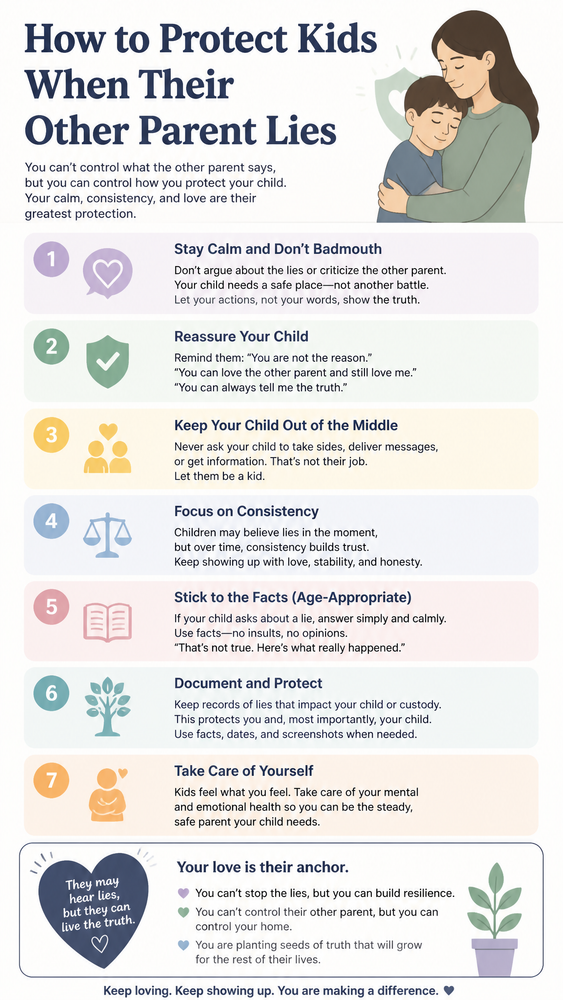
Children do not process dishonesty the same way at every age. Developmental stage shapes how a child understands, internalizes, and reacts to a co-parent’s lies. Getting this wrong can cause more harm than the original lie.
Younger children (ages 3–9)
Young children build their sense of safety through repetition, tone, and consistency. They cannot fact-check a parent’s claims, and they are not supposed to. When a co-parent tells a six-year-old that “Mommy doesn’t love you enough to come to your game,” that child absorbs it as truth. Your job is not to argue the point. Your job is to provide a steady, warm, predictable environment that quietly contradicts the lie over time.
Avoid correcting the lie directly with young children. Instead, use simple, grounding statements: “I love you, and I will always show up for you.” Repetition of these anchors builds the emotional safety that counters the confusion. Interrogating a child after a visit, or asking leading questions about what the other parent said, increases anxiety and puts the child in the middle.
Teenagers (ages 10–17)
Teenagers develop moral reasoning and can observe patterns over time. A 14-year-old who hears that “your dad never pays for anything” will eventually notice whether that matches reality. Teens can handle gently named inconsistencies without a full character attack on the other parent.
The right approach with teens is honest but restrained. You can say, “I know you heard something different. Here is what I know to be true.” Do not call the other parent a liar. Do not recruit your teenager as an ally. Teens who feel used as messengers or confidants develop resentment toward the parent who put them there.
Pro Tip: With teenagers, name the behavior, not the person. “That information isn’t accurate” lands better than “Your father is lying to you.” One preserves the relationship; the other forces a choice.
What are the best ways to document co-parent lies?
Documentation is your most powerful tool in any custody dispute involving dishonesty. Retaliatory language and emotional outbursts damage parental credibility. Calm, objective record-keeping does the opposite.
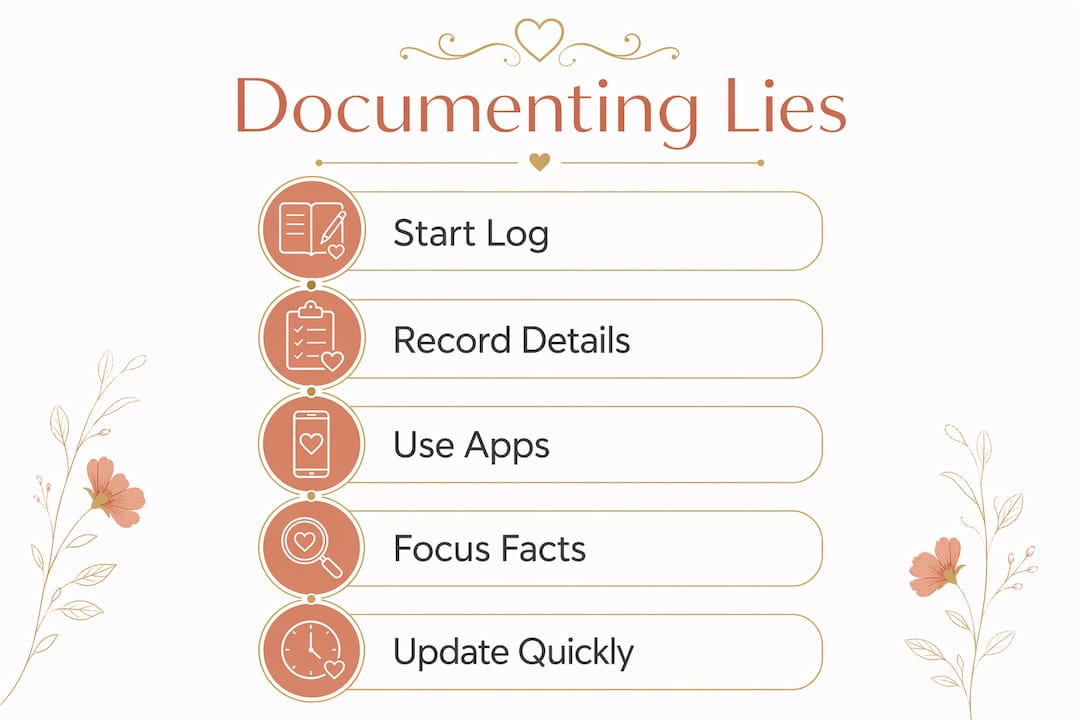
Start with a dated log. Every incident should include the date, what was said or done, who witnessed it, and how your child responded. Vague entries like “he lied again” carry no weight. Specific entries like “On march 14, 2026, my daughter told me her father said I had canceled her birthday party. I have a text from march 10 confirming the party date” are admissible and credible.
Court-approved apps like OurFamilyWizard create time-stamped, uneditable records of all co-parenting communication. Judges and custody evaluators treat these records as reliable. Screenshots of regular text messages can be altered or disputed. OurFamilyWizard logs cannot. That difference matters in a courtroom.
Documentation for custody proceedings should focus strictly on child-centered facts. Record how the lie affected your child’s behavior, sleep, school performance, or emotional state. Avoid personal attacks or emotional narratives in your log. Neutral, verifiable facts about your child’s routine and needs are the most effective evidence.
| Response type | Good practice | Bad practice |
|---|---|---|
| Verbal reaction | Calm, factual statement to child | Angry correction or counter-accusation |
| Written record | Dated, specific, child-focused log | Vague emotional entries or rants |
| Communication channel | OurFamilyWizard or court-approved app | Heated text exchanges or phone calls |
| Legal framing | Pattern of behavior with evidence | Single accusation without documentation |
| Professional support | Therapist or parenting coordinator | Recruiting family members as witnesses |
Pro Tip: Log incidents within 24 hours while details are fresh. Include your child’s exact words and any behavioral changes you observed. This specificity is what custody evaluators look for when assessing credibility.
How can you protect your child emotionally at home?
Your home environment is the single most powerful counter to a co-parent’s dishonesty. Keeping routines, a calm tone, and consistent bedtime rituals helps children relearn safety after exposure to conflict or lies. Predictability is the antidote to chaos.
Children caught in loyalty conflicts often lie themselves, not out of malice but out of self-protection. Aggressive correction backfires. Validating your child’s feelings while calmly stating facts preserves their emotional stability and keeps the door open for honest conversation later.
The goal is to be your child’s emotional anchor. You can learn more about how children cope emotionally with parental conflict and what helps them feel safe during turbulent periods.
Here is a clear breakdown of what to do and what to avoid:
Do:
- Keep daily routines consistent, including mealtimes, homework, and bedtime
- Validate your child’s feelings without agreeing with false information (“I can see you’re confused. That makes sense.”)
- Use neutral, calm language when correcting misinformation
- Involve a child therapist if your child shows signs of anxiety, withdrawal, or behavioral changes
- Reassure your child that loving both parents is always okay
Don’t:
- Interrogate your child after visits or ask leading questions about what was said
- Speak negatively about the other parent in front of your child
- Force your child to choose sides or act as a messenger
- Dismiss your child’s feelings, even if the information they received was false
- Overcompensate with gifts or leniency to “win” your child’s loyalty
Pro Tip: After a difficult exchange, give your child 30 minutes to decompress before engaging. Reduce questions and increase calm, physical presence. A snack, a walk, or a quiet activity does more than a conversation in that first half hour.
When should you bring in professionals and legal support?
Professional support shifts the burden of proof away from you and onto neutral experts. Therapists and pediatricians can provide unbiased observations of your child’s behavior that carry significant weight in custody evaluations. A therapist who documents a child’s anxiety, sleep disruption, or fear of one parent becomes a credible third-party voice in court.
Judges rarely penalize alleged lying without a documented pattern. Labeling a co-parent a liar without evidence can backfire legally and professionally. Professional input builds that pattern objectively, without you having to make accusations directly.
For high-conflict situations, parallel parenting is the most effective structure. It minimizes direct contact, routes all communication through recorded channels, and removes the opportunity for manipulation. Avoiding JADE behaviors (Justifying, Arguing, Defending, Explaining) protects your mental health and keeps your responses clean and credible.
| Professional | Role | When to involve |
|---|---|---|
| Child therapist | Documents behavioral changes; provides emotional support | Early signs of anxiety, withdrawal, or loyalty conflict |
| Parenting coordinator | Mediates disputes; enforces court orders | Repeated communication breakdowns or violations |
| Pediatrician | Observes physical and emotional health changes | Sleep issues, regression, or somatic complaints |
| Family law attorney | Advises on documentation and court strategy | Pattern of documented dishonesty affecting custody |
| Parent coach | Builds communication skills; reduces reactive responses | Ongoing co-parenting communication issues |
Coercive co-parents use lies as control tactics. The most effective counter is not confrontation. It is showing up as the stable, predictable parent whose behavior speaks louder than any false narrative. Professional documentation makes that contrast visible to the court.
Key Takeaways
When a co-parent lies to your children, your most effective tools are emotional consistency at home, factual documentation, and professional support rather than direct confrontation.
| Point | Details |
|---|---|
| Age-appropriate responses | Younger children need emotional anchors; teens benefit from calm, factual corrections without character attacks. |
| Document everything | Use OurFamilyWizard or similar apps to create dated, child-focused, uneditable records. |
| Protect the home environment | Consistent routines and calm tone reduce child anxiety more than any verbal correction of lies. |
| Involve neutral professionals | Therapists and pediatricians provide credible third-party observations that support custody evaluations. |
| Parallel parenting works | For high-conflict situations, reducing direct contact and using recorded channels protects both you and your child. |

What I’ve learned about staying steady when the other parent isn’t
The hardest part of this situation is not the lie itself. It is the urge to correct it loudly, immediately, and in front of your child. I understand that urge completely. When someone distorts reality for your kids, every instinct says to fight back.
Here is what I have seen work, and what I have seen destroy otherwise strong cases. Parents who stay calm, document quietly, and let their consistent behavior do the talking almost always come out ahead. Parents who react emotionally, recruit their children as allies, or make sweeping accusations in court lose credibility fast.
Many co-parent lies stem from fear of losing the child’s love, not from calculated malice. Recognizing that does not excuse the behavior. It does make it easier to respond without matching the chaos. Detachment is not indifference. It is strategy.
The parents who protect their children best are the ones who abandon the hope of cooperative co-parenting with someone who refuses to cooperate. They focus instead on being the emotional anchor their child can always count on. That is not giving up. That is choosing what you can actually control.
If you are dealing with manipulation that goes beyond dishonesty, the Aftertheaffair resource on stopping parental manipulation offers concrete guidance on recognizing and responding to coercive tactics.
— S.J.Howe
Support for parents navigating betrayal and co-parenting conflict
Dealing with a co-parent who lies to your children is exhausting, and it rarely exists in isolation. For many parents, it follows the breakdown of a relationship shaped by betrayal, infidelity, or emotional manipulation. Healing from that while also protecting your children requires a structured approach.
Aftertheaffair offers a free 7-step infidelity recovery checklist designed for parents and partners working through the aftermath of betrayal. It covers emotional stabilization, rebuilding trust, and creating healthier co-parenting dynamics even when the other party is not cooperating. If you are ready to move from surviving to building something more stable for yourself and your children, this is a practical starting point.
FAQ
What counts as a co-parent lying to your kids?
Co-parent lying includes false statements about the other parent, broken promises blamed on the other parent, and distorted accounts of shared history. It also includes withholding information that affects the child’s sense of reality or safety.
Can a co-parent be legally penalized for lying to children?
Judges require a documented pattern before penalizing a co-parent for dishonesty. A single accusation without evidence rarely changes custody outcomes. Consistent, factual documentation over time is what moves courts to act.
How do I talk to my child about something the other parent said that isn’t true?
Use calm, age-appropriate language and validate your child’s feelings first. With young children, offer reassurance without directly contradicting the other parent. With teens, state the accurate facts simply and without attacking the other parent’s character.
What is parallel parenting and when does it help?
Parallel parenting is a structure that minimizes direct contact between co-parents and routes all communication through recorded, court-approved channels. It works best in high-conflict situations where cooperative co-parenting is not possible.
Should I tell my child’s school or doctor about the co-parenting issues?
Informing your child’s school counselor and pediatrician is appropriate when your child shows behavioral or emotional changes. These professionals can document what they observe, which provides neutral, credible support for custody evaluations.
Recommended
- Stop Your Narcissistic Ex from Manipulating Your Kids
- How to Tell Kids About an Affair – After the Affair Series
- Signs Your Co-Parent Is Gaslighting You About the Kids
- Healthy Co-Parenting – After the Affair Series