Discovering a partner’s affair is one of the most disorienting experiences a person can go through. In the hours and days after, most people don’t need another lecture on trust. They need something to do right now that helps them get through the next hour. This guide sets out practical self-help for betrayed spouses, with a UK focus on where to find free or low-cost support when self-help alone isn’t enough.
- Understanding the Betrayal Trauma Response
- Emotional First-Aid: Immediate Self-Help for Betrayed Spouse Recovery
- Support for Betrayed Spouse UK: Helplines and Local Resources
- Betrayed Spouse Self Care: Boundaries and Building a Support Network
- Self-Compassion and Identity Rebuilding After Infidelity
- When Self-Help Isn't Enough: Signs You Need Professional Counselling
Understanding the Betrayal Trauma Response
Betrayal by a partner isn’t like other kinds of loss. It’s a shock to your nervous system as much as your heart. Understanding why can make the early weeks feel less frightening.
Why Discovery Feels Like Physical Shock
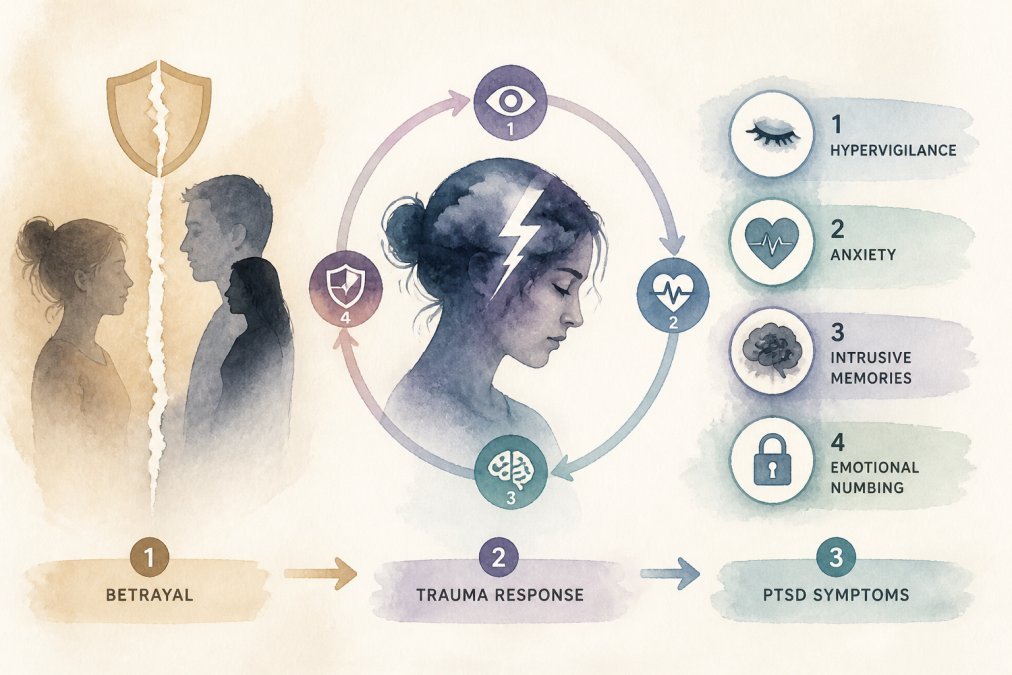
Betrayal trauma is a recognised psychological injury, not a character flaw or a sign of weakness. Unlike general relationship grief, it involves a breach of safety from the very person you relied on for security. That’s part of why the body reacts almost like it would to physical danger.
A betrayed spouse in the first weeks after discovery often describes symptoms mirroring acute stress: racing thoughts, disrupted sleep, and a compulsive need to check phones or emails for more evidence. This isn’t obsessive behaviour in the clinical sense. It’s the brain trying to re-establish a sense of control after the ground has shifted underneath it.
Common Betrayed Spouse Emotions in the First Weeks
In the early days, betrayed spouse emotions tend to swing widely. Anger, numbness, panic, and a strange kind of relief can all show up within the same hour. Many people also experience intrusive images, hypervigilance around their partner’s behaviour, and a loss of appetite or focus at work.
None of this means something is wrong with you. It means your mind is processing a genuine threat to your sense of safety. For a deeper look at how this differs from ordinary grief, and how counselling can help, it’s worth exploring betrayal trauma in more depth with a qualified counsellor.
Emotional First-Aid: Immediate Self-Help for Betrayed Spouse Recovery
Before any deep healing work can begin, most people need what therapists sometimes call emotional first-aid. These are small, practical actions that calm the nervous system enough to think clearly again.
Grounding Techniques for Panic and Intrusive Thoughts
When intrusive thoughts or panic hit, grounding techniques can interrupt the spiral. The 5-4-3-2-1 method is one of the simplest: name five things you can see, four you can touch, three you can hear, two you can smell, and one you can taste. This pulls attention back into the present moment.
Slow breathing helps too. Try inhaling for four counts, holding for four, and exhaling for six. Doing this for two or three minutes can lower a racing heart rate and make it easier to respond rather than react.
Therapists working with betrayal trauma often frame the initial shock as a psychological injury rather than a personal failing. That’s why they usually recommend grounding techniques and short, structured journalling before any deeper trauma processing work begins. Light, self-guided versions of EMDR-informed exercises exist, but they work best when a trained therapist introduces and supervises them rather than when someone attempts them alone.
Journalling Prompts for the First 30 Days
Betrayed spouse journalling gives shapeless feelings somewhere to go. It doesn’t need to be polished or even coherent. The goal is release, not literature.
Useful prompts for the first month include:
- What am I feeling right now, without judging it?
- What do I need today to feel even slightly safer?
- What thought keeps coming back, and what would I say to a friend who had it?
- What is one thing I did today that helped me cope?
Writing for ten minutes a day, even badly, can reduce the mental loop of replaying the same scenes. Many people find it easier to sleep once the thoughts are on paper rather than circling in their head.
Support for Betrayed Spouse UK: Helplines and Local Resources
Self-help tools matter, but they work best alongside real human support. The UK has a reasonably strong network of free and low-cost services, though it can be hard to know where to start.
UK Helplines and Crisis Contacts
If distress becomes overwhelming, the Samaritans are available 24 hours a day on 116 123, free from any phone. This is a good first call if you’re struggling to cope safely with what you’re feeling, especially at night when other services are closed.
For structured talking support, NHS talking therapies offer free, self-referral access to counselling across England. Equivalent services exist in Scotland, Wales, and Northern Ireland. Relate also provides relationship counselling geared toward couples and individuals dealing with infidelity, with sliding-scale fees in many areas.
Choosing Between Books, Forums and Support Groups
Some people find comfort in reading about others’ experiences before they’re ready to talk. Books written by therapists who specialise in infidelity can offer language for feelings that are hard to articulate alone. A curated list of betrayed spouse books UK readers recommend can be a useful starting point.
Others prefer the immediacy of a support group, where they can hear from people going through something similar in real time. If you’re weighing the two, it helps to compare what support groups and structured reading each offer before deciding which fits your current stage of recovery. Online forums sit somewhere in between: accessible any time, but less consistent in quality of advice.
Betrayed Spouse Self Care: Boundaries and Building a Support Network
Self care after betrayal isn’t about bubble baths. It’s about protecting your capacity to function while your nervous system recovers.
Setting Boundaries During the Recovery Period
One of the most protective steps a betrayed spouse can take is limiting or eliminating contact with the affair partner, and asking their spouse to do the same. Ambiguity here tends to prolong distress, so clear boundaries, even temporary ones, reduce the number of fresh shocks you have to absorb.
It’s also worth pausing major decisions where possible. Divorce, moving house, or quitting a job are easier to think through clearly once the acute shock has settled, usually a matter of weeks rather than days.
Who to Tell, and Who Not To
Telling people can bring relief, but it can also complicate things if done too widely too soon. A small circle of two or three trusted people, a close friend, a sibling, a therapist, is usually more helpful than broadcasting the situation to everyone you know.
Think about who can hold space for your pain without pushing you toward decisions you’re not ready to make. You can always tell more people later. You can’t easily undo an early conversation with someone who wasn’t the right listener.
Self-Compassion and Identity Rebuilding After Infidelity
Shame and self-blame are almost universal after infidelity. Many betrayed spouses quietly ask themselves what they did wrong, even when the answer is nothing.
Self-compassion is a skill, not a personality trait, and you can practise it. That might mean speaking to yourself the way you’d speak to a close friend in the same situation, or simply noticing self-critical thoughts without acting on them. Over time, rebuilding your identity, remembering who you are outside the relationship and the betrayal, becomes as important as processing the event itself.
When Self-Help Isn’t Enough: Signs You Need Professional Counselling
Self-help gives you tools to get through the day. It isn’t a substitute for professional support when the injury runs deeper than daily coping can manage.
Red Flags: Depression, Self-Harm Thoughts, Relationship Breakdown
Certain signs mean it’s time to seek professional help rather than continue with self-help alone:
- Persistent low mood or hopelessness lasting more than a few weeks
- Any thoughts of self-harm or not wanting to be alive
- Inability to function at work or care for children
- The relationship repeatedly cycling through disclosure, conflict, and false reassurance without progress
If any of these apply, contact a GP or the Samaritans immediately and look for a qualified counsellor. Both are reasonable, sensible steps.
How Affair Recovery Counselling UK Complements Self-Help
Many betrayed partners report that the most acute distress eases within the first few months when they combine self-help routines with some form of outside support. Full trust rebuilding, however, typically takes considerably longer, and that longer process usually benefits from professional guidance.
Affair recovery counselling in the UK can help you process betrayal trauma safely, decide whether to stay or separate, and rebuild, whether alone or with your partner, with structure rather than guesswork. If journalling and grounding have helped but you feel stuck, a free self-assessment is a low-pressure way to see what level of support might help you move forward next.