You check the phone at midnight. Nothing. You check again an hour later. Still nothing. You know it’s not helping, yet you can’t put it down. If this loop sounds familiar, you’re not broken. You’re not “obsessive” in some shameful, uncontrollable way. You’re describing a specific trauma response, and there’s a way out of it that doesn’t require you to white-knuckle your way to trusting again.
- Why You Can't Stop Checking Your Partner's Phone After an Affair
- The Compulsion Cycle: Trigger, Check, Relief, Repeat
- Grounding Techniques for Anxiety After Infidelity
- A Step-by-Step Protocol to Regain Control Without Snooping
- Releasing Shame Around Checking Behaviour
- When to Seek Professional Help vs Self-Help Strategies
This piece explains why checking a partner’s phone after an affair feels involuntary, walks through the compulsion cycle driving it, and gives you a concrete protocol for stepping back from monitoring, without demanding you pretend everything’s fine before it actually is.
Why You Can’t Stop Checking Your Partner’s Phone After an Affair
If you’ve asked yourself why you can’t stop checking your partner’s phone after they cheated, here’s the honest answer: your brain is doing exactly what it’s designed to do after a threat. It’s trying to prevent the same shock from happening twice.
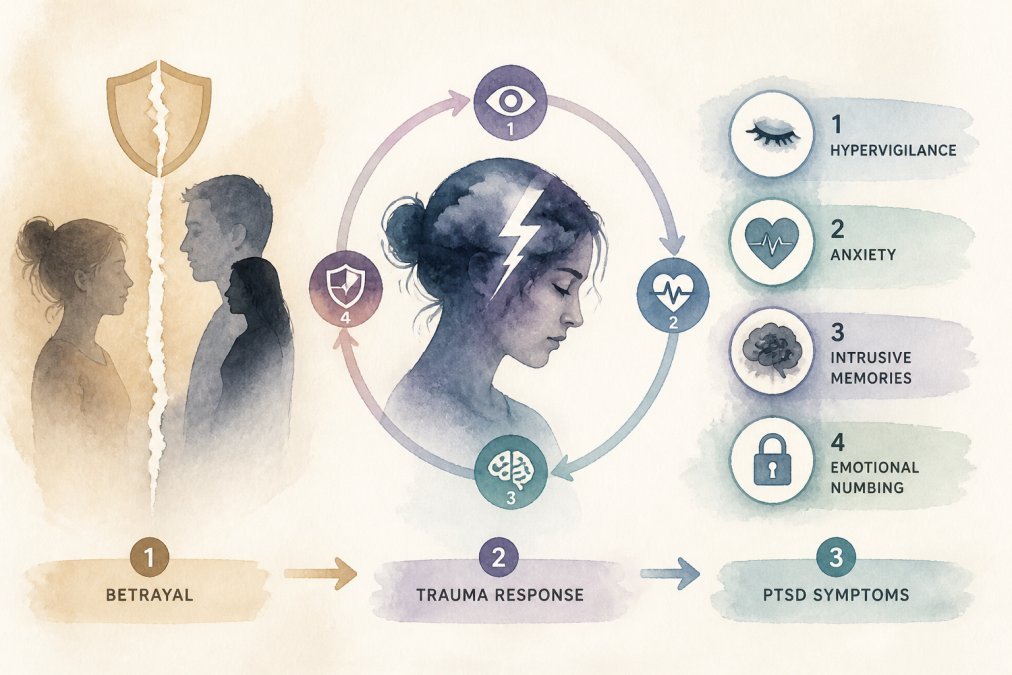
Betrayal trauma researchers describe the hyper-vigilance many partners feel after discovering an affair as a survival response, not a character flaw. The nervous system stays on high alert because it got blindsided once and is trying to stop that from happening again. Your threat-detection system doesn’t know the difference between checking a phone and scanning for a predator. It just knows it got caught off guard, and it doesn’t want a repeat.
The Hyper-Vigilance Loop Explained
Before discovery, you likely felt safe. You didn’t scrutinize your partner’s phone at all. Then came the discovery, and with it, proof that your instincts had missed something important. That’s a direct hit to your sense of judgment and safety.
Afterward, your brain recalibrates. It decides that missing warning signs once means it must never miss them again. So it starts scanning constantly, for tone shifts, late replies, a phone left face-down, anything that resembles the conditions around the original betrayal. This is hyper-vigilance after affair discovery in action, and it’s automatic, not chosen.
Is This Normal After Betrayal?
Yes. Obsessively checking a partner’s phone after an affair is one of the most common reactions betrayed partners have, even though general anxiety advice rarely names it or normalizes it. Clinicians who work with betrayed partners commonly note that surveillance behaviors, phone checking, tracking, re-reading old messages, tend to spike in the weeks right after discovery. They then either fade with structured reassurance or intensify without it.
On aftertheaffair.uk, we frame compulsive checking as one of the most common and least discussed struggles betrayed partners bring into recovery work. It’s rarely about distrust of the partner specifically. It’s more about the nervous system needing a sense of control after being blindsided.
The Compulsion Cycle: Trigger, Check, Relief, Repeat
Phone checking anxiety after infidelity doesn’t operate like a habit you can simply decide to quit. It runs on a self-reinforcing loop with four stages: trigger, check, relief, and rising anxiety again.
A trigger arrives. Your partner is quiet for too long, a notification pops up, or it’s just a certain time of night that reminds you of when you found out. Anxiety spikes. You check the phone. If nothing suspicious appears, you get a hit of relief. That relief feels so good that your brain quickly learns: checking equals safety.
The problem is that relief never lasts. Within minutes or hours, the anxiety creeps back, because checking never actually addressed the underlying fear. It only silenced it temporarily. So you check again. Each cycle strengthens the pattern, training your brain that checking is the only reliable way to feel calm.

Why Checking Feels Necessary But Backfires
Picture a partner who checks a phone at 2am, feels a wave of relief when nothing new appears, then finds themselves checking again an hour later. That’s a textbook trigger-check-relief-anxiety loop, not a lack of willpower. The relief is real. It’s just short-lived, and that’s exactly what keeps the cycle going.
This is why generic advice like “just trust them” or “stop being paranoid” fails. It ignores the mechanism. Obsessive checking after cheating isn’t a decision you’re making badly. It’s a learned pattern your nervous system picked up to manage unbearable uncertainty. Breaking it means interrupting the loop itself, not just gritting your teeth harder.
Grounding Techniques for Anxiety After Infidelity
You can’t reason your way out of a nervous system response. But you can give your body different signals while the urge to check passes through you. The goal isn’t to suppress the urge. It’s to create enough space that you get to choose your response instead of being driven by it.
In-the-Moment Tools to Delay a Check
When the urge hits, try a timed pause instead of an outright ban on checking. Tell yourself you can check in ten minutes if the urge is still there. Often, by the ten-minute mark, the intensity has already dropped.
Pair the pause with something physical. Slow, extended exhales, a longer out-breath than in-breath, tell your nervous system the danger has passed, even before your thoughts catch up. Cold water on your wrists or face can do something similar.
Journaling the urge itself also helps. Write down what triggered it, how intense it feels on a scale of one to ten, and what you’re actually afraid will happen if you don’t check. This turns a vague compulsion into something you can examine rather than just obey. Over time, the written record often reveals patterns, certain times of day, certain triggers, that you can plan around.
Longer-Term Nervous System Regulation
In-the-moment tools help you survive a single urge. Longer-term regulation reduces how often those urges fire in the first place.
Consistent sleep and regular movement both lower baseline anxiety. That matters because a tired, wired nervous system reads far more situations as threats. Practices like slow-paced breathing exercises, done daily rather than only during a spike, gradually train your baseline arousal down. Many people also find it useful to build a short daily check-in with themselves, not the phone, but their own body, noticing tension and consciously releasing it before it builds into a full trigger response.
None of this erases the underlying injury. But it does widen the gap between trigger and reaction, which is exactly where choice becomes possible again.
A Step-by-Step Protocol to Regain Control Without Snooping
Knowing how to regain control after an affair means replacing covert surveillance with something both of you agree to. That distinction matters enormously. Secretly checking a phone keeps you in a one-person system built on fear. An agreed structure puts control back in your hands without requiring your partner to hand over blind, unverifiable trust.
Here’s a practical sequence to work through, ideally with your partner, and ideally alongside a counsellor if one is available to you.
- Name the specific fears driving the checking. Not “I don’t trust you,” but concrete fears: a specific app, a specific contact, a specific time of day.
- Ask for what would actually reduce those fears, rather than open-ended access to everything. Specificity makes agreements sustainable.
- Set a review point, such as four to six weeks out, to reassess what’s working.
- Agree on how disagreements about the agreement itself get handled, ideally before they happen, not mid-argument.
Building a Transparency Agreement Together
A transparency agreement is a mutually negotiated set of terms about what information gets shared openly, so neither of you has to rely on covert surveillance to get reassurance. It might include things like sharing locations, being reachable within a reasonable window, or being open about new contacts. Both people agree to it; nobody extracts it under pressure.
The key difference between a transparency agreement and surveillance is consent and openness. Surveillance happens in secret and runs on fear alone. A transparency agreement is discussed, time-bound, and revisited. It’s a bridge, not a permanent monitoring system.
Weaning Off Monitoring Gradually
Once a transparency agreement is in place, monitoring should reduce on a schedule, not disappear overnight. Trust rebuilds through a track record of small kept agreements, not a single leap of faith.
You might start by checking in with your partner directly about a worry, instead of the phone, once a day. Then move to a few times a week. Base each step down on evidence that the current level is working, not on pressure to “just get over it” faster than feels honest. This gradual approach is what rebuilding trust without snooping actually looks like in practice: deliberate, paced, and responsive to how you’re really doing.
Releasing Shame Around Checking Behaviour
Many betrayed partners feel almost as ashamed of the checking as they were hurt by the affair itself. That shame is misplaced. Checking is a coping response to a real injury, not evidence of who you are as a person.
It can help to say the fact out loud, even just to yourself: you were deceived, and now your mind is working overtime to prevent it from happening again. That’s not weakness. It’s a predictable response to a threat that turned out to be real.
Self-compassion here isn’t about excusing behavior that’s hurting you or the relationship. It’s about approaching yourself the way you’d approach a friend in the same situation, with understanding, while still working toward change. Shame tends to intensify compulsions, because it adds a second layer of pain on top of the anxiety, and people in pain reach for whatever gives them relief fastest. Compassion, paired with the structured steps above, tends to loosen the grip far more effectively than self-criticism ever does.
When to Seek Professional Help vs Self-Help Strategies
Grounding techniques and a transparency agreement resolve a lot of cases on their own. But some situations need more support than self-help can realistically provide, and recognizing that early saves time and pain.
Signs the Compulsion Needs Extra Support
Consider reaching out for professional help if any of the following are true: the checking is escalating rather than easing over several weeks, it’s costing you sleep on most nights, it’s spilling into other areas like work or friendships, or it’s creating conflict that neither of you can de-escalate on your own. Covert tracking apps, repeatedly breaking your own agreed limits, or feeling unable to function without checking are also signs the cycle has outgrown self-help tools.
None of this means you’ve failed. It means the injury is significant enough to warrant structured support, the same way a serious physical injury needs more than rest and ice. A therapist experienced in betrayal trauma and affair recovery anxiety can help you work through intrusive thoughts after infidelity directly, rather than just managing their symptoms one urge at a time.
If you’re not sure which category you’re in, a free affair recovery assessment can help you get a clearer picture of where you stand and whether a more structured recovery course could help you break the cycle for good. Self-help tools matter, and they work for many people. But you don’t have to figure this out entirely on your own. Reaching for more support isn’t a sign you’re doing recovery wrong. It’s a sign you’re taking it seriously.