Table of Contents
Last Updated: September 12, 2026
Why Boundaries With a Narcissistic Ex-Spouse Are Different
Setting boundaries with a narcissistic ex-spouse is harder than ordinary co-parenting limits because the other person treats every boundary as a challenge to win, not a request to respect. This guide from After the Affair Series breaks down the behavioral boundaries, scripts, and documentation habits that hold up in high-conflict divorce, plus the digital and emotional tactics most guides skip. The core tension: you cannot control your ex. What you can govern is your own responses, your documentation, and the environment your children live in.
Boundaries vs. Control: What You Can Actually Govern
A boundary is a rule about your own behavior; control is a demand about someone else’s. “I will not respond to messages after 8 p.m.” is a boundary. “You must stop texting me at night” is a control request, and with a narcissistic ex-spouse it hands them a lever to pull.
Practically, this means rewriting your rules before you enforce them:
- Boundary: I will reply to hostile messages within 24 hours, in writing, once.
- Control: You need to stop being hostile.
- Boundary: I will leave a pickup if it becomes a confrontation.
- Control: You have to be civil at exchanges.
The first version of each pair is enforceable by you alone; the second depends on your ex’s cooperation, the power dynamic they want to keep.
Behavioral Boundaries That Hold Up in High-Conflict Divorce
Behavioral boundaries survive high-conflict divorce when they are specific, enforceable without the other person’s cooperation, and documented consistently. Vague limits like “I need more respect” collapse the first time they are tested.
A workable set looks like this:
- One communication channel, in writing, for all logistics
- A 24-hour response window for non-emergencies
- No phone calls after a hostile exchange; written follow-up only
- Immediate exit from any in-person confrontation
A common mistake is announcing a boundary during an argument. Threats made mid-conflict are the easiest thing for a narcissistic ex to reframe as proof you are unstable. State boundaries in writing, in neutral language, and only enforce them, never negotiate them in the moment.
The JADE Trap: Stop Justifying, Arguing, Defending, Explaining
JADE stands for Justify, Argue, Defend, Explain, and every one of those moves gives a narcissistic ex-spouse the engagement they are looking for. When accused, state the fact once and stop.
What it sounds like in practice:
- Instead of “I was five minutes late because traffic was terrible and you know I always…” say “I arrived at 5:05. The schedule change is in the app.”
- Instead of “That’s not what happened, you’re twisting it,” say “I see it differently. The record shows otherwise.”
Short, factual, boring replies remove the fuel for someone who treats every explanation as ammunition.
Co-Parenting Scripts for a High-Conflict Ex
Co-parenting scripts for a high-conflict ex work because they remove emotion from the exchange, the only variable you control. The goal is not to make your ex reasonable, but to make your messages unquotable as evidence of instability and unusable as a hook for a fight.
Every script below follows the same pattern: acknowledge the request, state your position in one sentence, and stop.
Send scripts from a notes app, not from the emotional state you are in when you read the message. Drafting, waiting an hour, then sending the neutral version cuts reactive replies more than any other single habit.
Template Scripts for Pickup, Money, and Schedule Changes
Copy these, fill in the specifics, and keep them short on purpose.
Pickup or exchange conflict:
“I will be at [location] at [time] as scheduled. If you are not there within 15 minutes, I will document the missed exchange and follow the parenting plan.”
Money or expense dispute:
“The expense for [item] is covered under [section] of our agreement. I have attached the receipt. I will not discuss this by phone; please respond in writing.”
Schedule change request:
“I cannot accommodate the change on [date]. I can offer [alternative date] instead. Please confirm in writing.”
Hostile or accusatory message:
“I am not able to engage with this. The schedule stands as written. I will only respond to messages about [child’s name] logistics.”
Boundary restatement after a violation:
“Per my previous message, all communication will be in writing through [channel]. I will not respond to calls or texts on this topic.”
Using the Grey Rock Method for Co-Parenting
The grey rock method for co-parenting means becoming as uninteresting as a grey rock: brief, neutral, and emotionally flat in every interaction. Narcissistic abuse feeds on reaction. When you stop supplying reactions, the payoff shrinks.
How to grey rock without sounding robotic:
- Answer logistics questions only, in one or two sentences
- Skip greetings, emojis, and any detail about your life
- Do not react to insults, bait, or comparisons
- Keep your tone identical whether the message is hostile or friendly
Grey rock can feel unnatural at first, and your ex may escalate before they adjust, an escalation covered next.
Documenting Narcissistic Abuse for Court
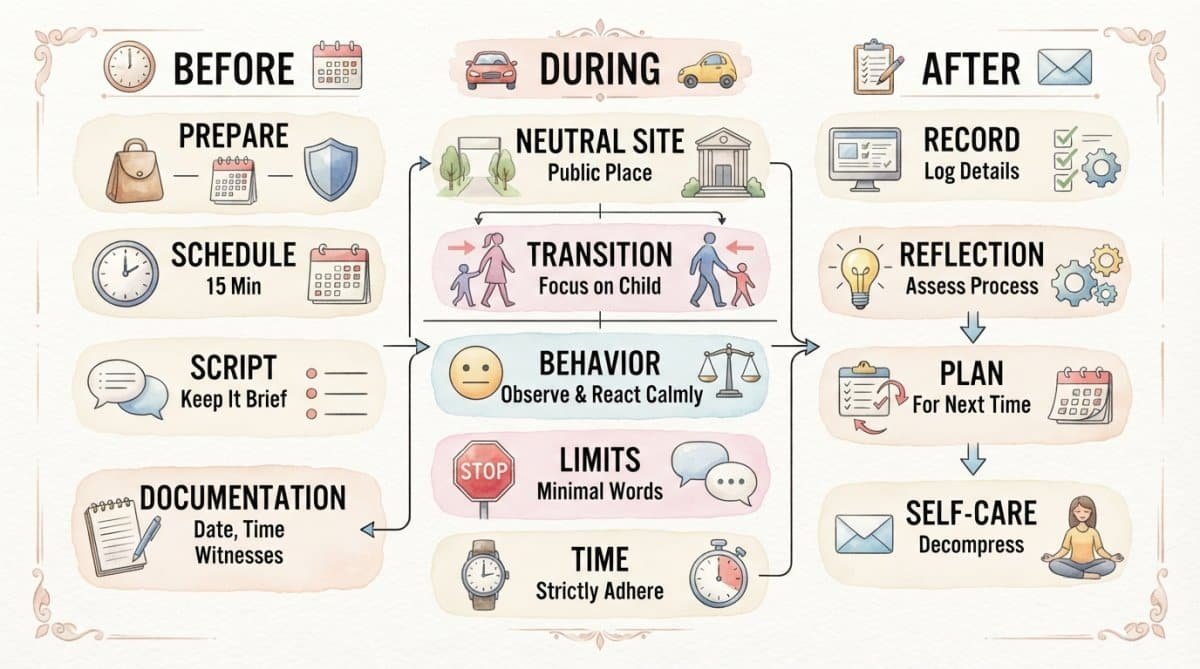
Documenting narcissistic abuse for court means keeping a contemporaneous, unemotional log a judge or attorney can read without your commentary. Memory is not evidence; a dated record is. Start today, even if you never file.
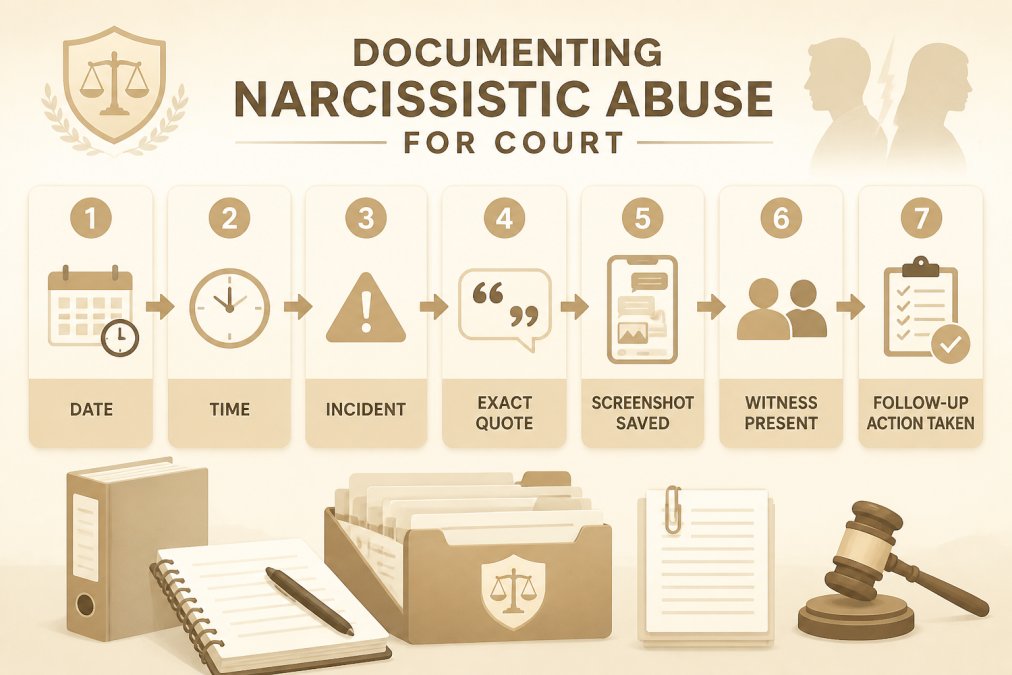
Log these fields for every incident:
- Date and time
- Exact quote or message, copied word for word
- Screenshot or export saved to a backup folder
- Witness present, if any
- Follow-up action you took
The National Domestic Violence Hotline safety planning guide recommends keeping documentation in a secure location the other party cannot access, which matters as much as what you record.
A communication log built in neutral, factual language is far more persuasive than one written in anger. Write every entry as if a stranger will read it, because in court, one will.
Digital Boundaries and the Extinction Burst
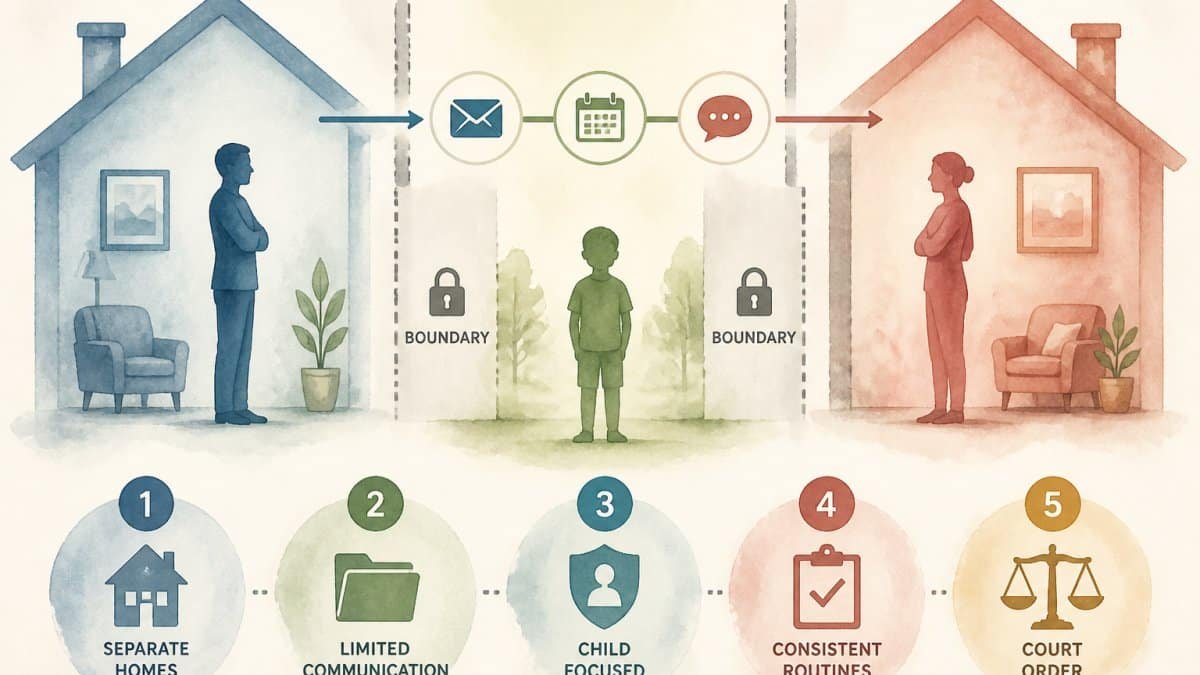
Digital boundary setting is where most guides stop at “go no contact,” which is not an option when you share children. The workable version is channel control: you decide which pipes your ex can reach you through, what they record, and what happens when they are misused. Verbal boundaries are easy to ignore; a filtered inbox and a court-admissible message log are not. Establishing these technical barriers provides the necessary foundation for implementing effective legal custody strategies that prioritize the stability of your children over the volatility of your ex-spouse.
Collapse every channel into one: pick a co-parenting app or a single email address and route all logistics there. Then close the side doors:
- Phone: Set your ex’s contact to Do Not Disturb with a custom ringtone of silence. Emergency exceptions should be defined in writing in advance, a medical emergency involving the child, not a late reply about a hoodie.
- Text messages: If your parenting plan or state rules allow, keep texts for emergencies only and reply to logistics by moving the thread into the app or email. Screenshot the original before you move it.
- Email: Create a filter that auto-labels messages from your ex into a folder. Read that folder on a schedule, not on notification. This alone removes the reflex-reply problem.
- Co-parenting apps: Most (OurFamilyWizard, TalkingParents, AppClose) timestamp every message, log edits, and produce a court-ready export. Turn on read receipts only if your plan requires them; otherwise leave them off so your ex cannot weaponize “you saw it and didn’t answer.”
- Social media: Block or restrict your ex on every platform that is not required for logistics. Do not announce it. Do not post about the conflict. Assume every post is being screenshotted by someone.
- Shared calendars: Give view-only access where the app allows it. If your ex can edit the calendar, they can create a false record that you missed an event.
What the Extinction Burst Actually Looks Like
An extinction burst is the predictable spike in behavior right after the reinforcement stops: when a response that used to produce a payoff, your reaction, no longer does, the person escalates before the behavior fades (peer-reviewed research). This is not a sign your boundary failed. It is the sign it is working.
A common pattern after you stop replying to late-night hostile texts:
- Days 1-3: Volume increases. More messages, longer messages, new accusations.
- Days 4-10: Channel-hopping. They try email, then a call, then a message through a family member or the child.
- Weeks 2-4: Escalation attempts aimed at getting any reaction, threats to file, threats about custody, sudden warmth, or a fake emergency.
- Weeks 4-8: If you hold, the behavior usually drops to a lower baseline. It does not disappear; it changes shape.
Do not announce that you are going silent, and do not explain the extinction burst to your ex. Naming the tactic gives them a new script. Just hold the channel rule and log what happens.
Rules That Survive the Burst
- One channel for logistics, nothing else.
- No replies outside your stated hours except a genuine emergency as defined in your parenting plan.
- Screenshot or export, save to a backup folder your ex cannot access, then disengage.
- If a message is hostile, do not answer the hostility. Answer only the logistics question inside it, or not at all.
- If your ex uses the child’s phone or account to reach you, treat that as a documented channel violation and note it in your log.
The goal is not to make your ex stop messaging. The goal is to make every message land in a place you control, on a schedule you set, with a record you can use.
Helping Children When the Other Parent Won’t Change
Most guides tell you to “protect the children” without explaining how. Children of a narcissistic parent are often recruited as messengers, spies, and emotional confidants, and they need their own boundary language, not just yours. Give them scripts, permission, and a predictable home base, without turning them into your therapist or ally.

Age-Banded Scripts Children Can Actually Use
Children need short, repeatable lines they can say without sounding coached. Rehearse them out loud, in a calm moment, like a fire drill.
Ages 5-8: Keep it about safety and belonging.
- “I don’t want to talk about that. Can we play something?”
- “That’s a grown-up question. You should ask my mom/dad.”
- “I’m going to go read now.”
Ages 9-12: Add a name for the pressure.
- “I’m not comfortable answering that.”
- “I don’t want to be in the middle. Please ask the other parent directly.”
- “I’m going to my room. I’ll come back when we can talk about something else.”
Ages 13-17: Give them the option to disengage and the right to have complicated feelings.
- “I’m not going to pass messages. You can text the other parent yourself.”
- “I love you, and I’m not going to talk about the divorce with you.”
- “I need a break from this conversation. I’ll talk to you tomorrow.”
The Three Rules That Protect Kids Most
- No message-carrying. If your ex sends a note, a gift, or a demand through your child, do not answer through the child. Reply through your one documented channel. Tell the child: “That was for me, not for you. I’ll handle it.”
- No reporting on the other household. Do not ask what your ex said, did, or bought. If the child volunteers it, listen without interrogating and without reacting. Curiosity here reads as recruitment.
- No choosing sides. Say it plainly: “You are allowed to love both of us. You are not responsible for how either of us feels.”
When the Other Parent Pressures the Child Directly
A common pattern is a narcissistic parent who leans on the child for emotional support, asks them to report on you, or punishes them for setting a limit. You cannot stop it, but you can prepare the child.
- Name the tactic without naming the parent. “Sometimes grown-ups ask kids to keep secrets or take sides. That’s not your job.”
- Give the child an exit. “If you feel stuck, you can say you need to use the bathroom, or call me and I’ll come get you. No questions.”
- Document what the child tells you in neutral language, dated, in your log. Do not prompt, do not lead, do not put words in their mouth.
- If the pressure crosses into coaching, alienation, or safety concerns, that is a conversation for your attorney and, in many jurisdictions, a guardian ad litem or custody evaluator (ojp.gov). Bring the log, not the emotion.
Rehearse the script before you need it. Parents with a sentence ready for a child’s hard question deliver it calmly, and calm is what the child remembers.
You cannot make the other parent consistent or kind. You can make your home predictable, give your child language for the pressure, and keep the conflict out of their backpack. That is the boundary that matters most.
Conclusion
You cannot force a narcissistic ex-spouse to respect a boundary, but you can make every boundary about your own behavior, responses, and records. The JADE technique, grey rock, written scripts, and consistent documentation protect your peace and your children’s stability even when the other parent never changes. Expect the extinction burst, keep your log current, and hold the line on what is yours to govern.
Frequently Asked Questions
How do you handle a narcissistic ex-spouse who ignores boundaries entirely?
You enforce consequences instead of repeating the request. If a boundary is ‘no calls after 8 p.m.,’ the consequence is your phone going to Do Not Disturb at 8 p.m., not a third reminder. Document each violation with date, time, and exact wording. When violations pile up, the pattern itself becomes evidence for your attorney. Consistency is what separates a boundary from a suggestion.
What are examples of healthy boundaries to set during co-parenting?
Common ones include communicating only through a court-approved app, limiting topics to the children’s needs, refusing to discuss the past relationship, and keeping exchanges at a neutral location. Each boundary should be specific, enforceable, and tied to a behavior rather than a feeling. Vague rules like ‘be respectful’ give a high-conflict ex room to argue. Specific rules like ‘schedule changes require 48 hours’ notice’ do not.
What is the grey rock method and how does it work with a narcissistic ex-spouse?
The grey rock method means making your responses so brief and neutral that they offer nothing to react to. You answer logistics only (‘Yes, 5 p.m. works’), skip emotional content, and avoid defending yourself. The goal is to remove the emotional payoff a narcissistic ex-spouse seeks. Expect an extinction burst first: attempts to provoke you often increase before they fade.
When should you involve legal counsel regarding boundary violations?
Bring in an attorney when violations involve the children’s safety, repeated interference with custody arrangements, or threats. Also call when you have a documented pattern, not a single incident. A communication log showing ten ignored boundary requests carries more weight than one angry text. If your ex uses the court system itself to harass you, that also warrants legal review.