Table of Contents
Last Updated: September 13, 2026
How Parental Conflict Affects Children’s Resilience
Children bounce back not because divorce was handled perfectly, but because adults kept conflict away from them, the strongest predictor of adjustment.
Resilience in children of divorce is the capacity to recover and adapt after family disruption, built through activities to build resilience in children of divorce, consistent routines, emotional validation, and protection from parental conflict. It is not a fixed trait but a skill set parents can deliberately build.
At After the Affair Series, we work with parents navigating this terrain while processing their own betrayal and grief. Kids fare best when at least one parent stays steady and emotionally available.
This matters because the research on family transition is consistent. The American Academy of Pediatrics guidance on helping children cope with divorce notes that children’s adjustment depends heavily on the level of conflict they witness, not on the divorce itself. Keep the fighting out of earshot, and you have already done the heaviest lifting.
Signs of Emotional Distress in Children of Divorce
Emotional distress in children of divorce shows up differently at every age, and rarely looks like sadness. It looks like behavior.
Younger children regress: bedwetting returns, thumb-sucking reappears, sleep breaks apart. School-age children become clingy, withdrawn, or aggressive. Teens pull away and act indifferent, easy to misread as “handling it fine.”
Watch for these behavioral cues:
- Changes in appetite, sleep, or energy that last more than two weeks
- Drop in grades or sudden disinterest in activities they used to love
- Physical complaints with no medical cause, like stomachaches before transitions
- Regression to younger behaviors
- Anger directed at one parent, or at both
Do not treat a child’s calm demeanor as proof they are fine. Many children suppress distress to protect the parent they sense is struggling. If a child stops mentioning the other parent entirely, that silence is a signal, not a resolution.
Keep a simple log. Patterns matter more than any single bad day.
Age-Appropriate Coping Strategies for Divorce
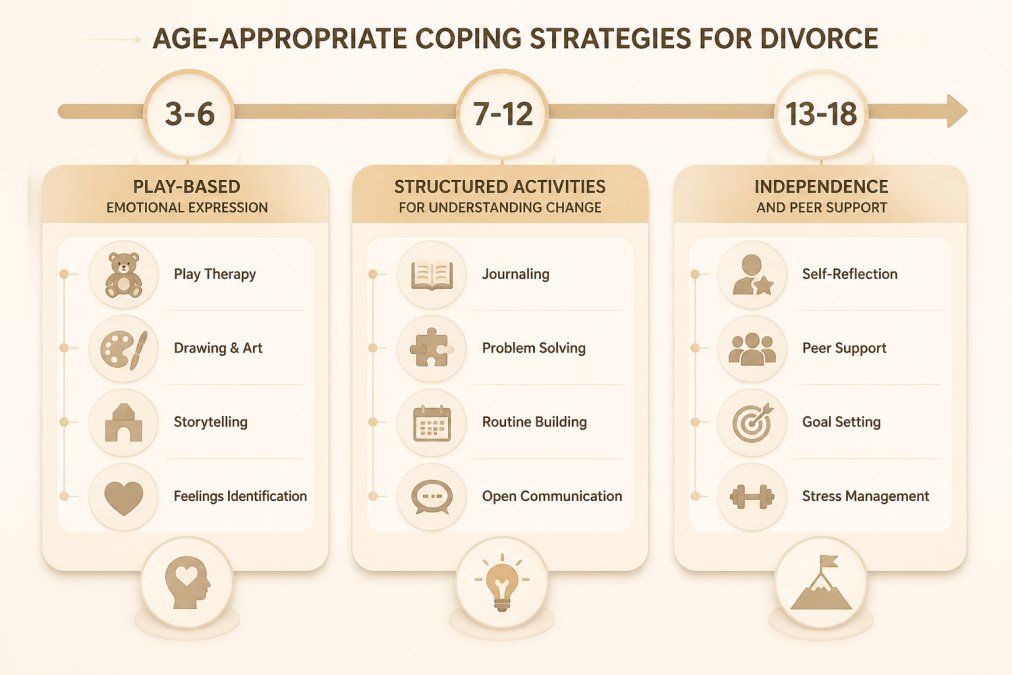
Age-appropriate coping strategies for divorce match the activity to the child’s developmental stage, because a six-year-old and a sixteen-year-old process loss differently.
Developmental research shows children’s understanding of divorce shifts with cognitive maturity. Preschoolers think magically and often believe they caused the split. School-age children assign blame and worry about loyalty. Teens reason abstractly while pulling away toward peers.
Fostering a sense of stability often requires parents to prioritize consistent routines that incorporate engaging screen-free activities to help children process their emotions through shared physical play.
Ages 3-6: Play-Based Emotional Expression
Preschoolers lack the vocabulary for grief, so play becomes the language. The goal is not to explain the divorce but to keep their world predictable and give feelings an outlet.
- Feelings charades. Act out happy, sad, angry, and scared faces and have your child guess, then swap roles. Naming emotions builds emotional intelligence early; keep bursts short and let the child lead.
- Dollhouse storytelling. Let your child act out a “two-house” scenario with toys. Do not correct the story. Watch what themes repeat, a recurring scene of a parent leaving or returning is a child working through separation anxiety.
- The goodbye ritual. Create a consistent, short goodbye at every handoff, a specific phrase, hug, and count to three. Predictability reduces separation panic. Keep it identical every time, even when the child cries.
- A comfort object that travels. A stuffed animal or blanket that goes between homes gives the child a continuous thread. Let the child choose it.
- Picture schedules. For pre-readers, a row of images showing the day’s sequence, breakfast, school, pickup, dinner, bed, reduces anxiety about what comes next.
Keep sessions to ten or fifteen minutes; repetition beats intensity. If a child regresses, respond with calm redirection, not punishment, regression is a stress signal, not manipulation.
Ages 7-12: Structured Activities for Understanding Change
This age group wants to understand what is happening and often blames themselves. Structured activities give them mastery and a way to voice worries without putting a parent in the middle.
- A family calendar they control. Let them mark custody days, school events, and calls with the other parent in their own color. Review it weekly so they can anticipate transitions rather than be surprised by them.
- A “two homes, one kid” journal. A shared notebook where they write or draw one thing from each home. It normalizes the split and gives you a window into what they notice. Do not read it unless invited.
- A worry box. They write worries and drop them in. Once a week, open it together and address what you can; for worries you cannot fix, name and validate them rather than dismissing them.
- The “what I can control” list. Have the child list what they can control (their backpack, their room, their attitude) and what they cannot (the custody schedule, the other parent’s mood). This cognitive-behavioral tool reduces anxiety.
- A letter they do not have to send. Some children carry anger they cannot say aloud. Writing a letter to a parent, a situation, or the divorce itself, then deciding whether to keep, shred, or send it, gives anger a container.
- Role-play scripts for hard moments. Practice what to say when a classmate asks why their parents live apart, or when a parent puts them in the middle. Rehearsal reduces the freeze response.
Watch for self-blame language: “If I had been better, they wouldn’t have…” Correct it directly and repeatedly. Children this age need to hear, in plain words, that the divorce is not their fault and not theirs to fix.
Teens: Independence and Peer Support
Teens need autonomy and peers more than a hovering parent. Give them space, then stay available. Divorce can either accelerate separation prematurely or give a teen a healthy rehearsal for independence.
- Let them set the call schedule with the non-custodial parent where possible. A teen forced into a rigid schedule often disengages; a teen who chose it is more likely to keep it.
- Support one consistent outside activity, a sport, a job, a club. It anchors identity outside the family conflict and gives them a peer group not defined by the divorce.
- Drive-time talks. Teens often open up in the car, side by side, not face to face. Use the commute. Do not fill silence; let them start.
- A “no questions” check-in. Offer a standing time, Sunday breakfast, a walk, where the teen can talk or not. The reliability of the offer matters more than any single conversation.
- Respect their relationship with the other parent. Even if you disagree with the other parent’s choices, do not recruit the teen as an ally. Teens caught between parents carry the heaviest load.
- Watch for parentification. A teen who becomes the emotional caretaker of a grieving parent, or the de facto parent of younger siblings, is not building resilience, they are losing their adolescence. Redirect that responsibility back to adults.
With teens, the goal is not to get them to talk about the divorce. It is to keep the relationship warm enough that they will come to you when they are ready. Pushing for conversation closes the door.
School-Home Collaboration: The Overlooked Layer
Most guides stop at home, but children spend much of their waking hours at school, where teachers and counselors can reinforce resilience or undermine it.
- Tell the teacher what is happening, briefly. A short note, “We are going through a family transition; please let me know if you see changes in focus or mood”, gives context without oversharing.
- Ask for a heads-up on behavior shifts. A drop in grades, sudden withdrawal, or new aggression at school is data. Coordinate rather than react.
- Loop in the school counselor. Counselors can offer a neutral adult, a small-group setting, or a check-in routine, a low-barrier, no-cost support many families never use.
- Keep both households on the same page with the school. If both parents can receive school communications, do it. A child should not have to relay information between homes and school.
- Request a 504 or IEP evaluation only if there is a documented need. Do not pursue formal accommodations reflexively; start with informal coordination.
A child who hears the same calm message at home and school, the divorce is not their fault, they are safe, adults are handling adult things, gets the strongest reinforcement.
Co-Parenting Communication Scripts That Protect Kids
Co-parenting communication scripts are pre-written, neutral phrases used in place of reactive responses, so your child never becomes the messenger or hears the conflict. They work even with a hostile ex because they control what you put into the exchange, not the other person.
The core rule: keep it businesslike, brief, and about logistics, never the relationship.
Here are scripts you can adapt:
- For a hostile text: “I understand you’re frustrated. I can only discuss [child’s name]’s schedule here. Let’s keep this to logistics.”
- For a last-minute change: “That doesn’t work for us this week. I can offer Thursday or Saturday instead. Let me know which.”
- For a child used as messenger: “Please send that to me directly. [Child’s name] shouldn’t be in the middle of this.”
- For an accusation: “I’m not going to argue about that. I’ll stick to the schedule we agreed on.”
This is the same principle behind the Gray Rock Method, which After the Affair Series teaches for high-conflict interactions: become uninteresting to provoke, and the provocation loses its fuel.
Scripts are not about winning. They are about removing your child from the line of fire and keeping a written record that stays calm and factual.

Daily Activities to Build Resilience at Home
Daily activities to build resilience in children of divorce work through repetition, not grand gestures. Small, predictable moments compound. The mechanism is simple: predictability lowers baseline stress, and repeated positive interactions build a secure base, the sense that the world is manageable even when it changes.
Morning and Evening Anchors
- A consistent morning routine. Same order, same pace, every day at your house. Predictability is emotional safety. For younger children, a visual sequence (get dressed, eat, brush teeth, shoes) removes repeated instructions.
- A nightly check-in. One question: “What was the best and hardest part of your day?” Listen without fixing. Works for ages five and up; for teens, keep it optional and low-pressure.
- A two-minute goodbye ritual. A specific phrase, hug, and count, identical every time. The ritual does the emotional work so the child does not have to.
- A bedtime story or audio. For children in two homes, a recorded story from the other parent can play any night, keeping the absent parent present without a live call.
Connection Activities by Age
- Ages 3-6: Parallel play. Sit on the floor and play alongside your child rather than directing. Narrate what they are doing. This builds language and emotional regulation at once.
- Ages 3-6: The “feelings weather report.” Ask, “What’s the weather inside you today?” Sunny, cloudy, stormy. It gives a pre-verbal child vocabulary for mood.
- Ages 7-12: A weekly one-on-one outing. Fifteen minutes of undivided attention beats an hour of distracted presence. Let the child choose the activity.
- Ages 7-12: A shared project. Build, cook, or grow something. A project with a visible result gives a sense of competence that divorce can erode.
- Teens: A standing side-by-side activity. Driving, hiking, cooking, gaming. Teens talk more when not looked at directly.
- Teens: A “no agenda” time. A regular slot where nothing is required. The reliability of the offer matters more than any single conversation.
Responsibility and Mastery
- Chores and responsibilities. Age-appropriate tasks signal that life is normal and they are capable. A four-year-old can put away toys; a ten-year-old can do laundry; a teen can manage a small budget.
- A “kid’s choice” night. Once a week, the child picks the dinner or movie. Control over small things rebuilds the agency divorce takes away.
- A family meeting. Ten minutes, once a week. Review the calendar, name one thing that went well, one thing that was hard. Structure gives children a predictable place to raise concerns.
Positive Reinforcement That Actually Works
Notice and name the behavior you want more of: “You handled that transition really well.” Specific praise builds resilience faster than generic encouragement. “You kept trying even when it was hard” teaches a process; “you’re so smart” teaches a fixed trait.
A printable weekly resilience planner, with columns for morning routine, one-on-one time, a shared activity, a responsibility, and a check-in, turns this list into something a parent can actually run. The value is not the paper; it is the repetition.
A Note on What Not to Do
- Do not use activities as a substitute for addressing conflict. A child who plays a board game with you and then hears you shouting on the phone has not gained ground.
- Do not force participation. An activity a child resists becomes a chore, not a connection.
- Do not compare your child’s adjustment to a sibling’s or friend’s. Children process at different speeds.
- Do not treat a good week as proof the work is done. Resilience is maintained, not achieved once.
Digital and Remote Co-Parenting Activities
Digital and remote co-parenting activities keep the non-custodial parent present between visits, especially when distance or schedules limit in-person time. Done well, they reduce the sting of separation.
- Scheduled video calls at a fixed time. Predictability matters more than length. A reliable ten minutes beats an unpredictable hour.
- Shared online games. A cooperative game played over a call gives the child a shared activity, not an interrogation.
- A shared photo album. Both parents and the child add to it, building a continuous record of the child’s life across two homes.
- Voice messages instead of texts. A parent’s voice is warmer and easier for young children to receive.
- Read-aloud videos. The far-away parent records bedtime stories the child can play any night.
A common mistake is letting calls become check-ins on the other parent. Keep the focus on the child’s day, interests, and world.
When to Seek Professional Help
Professional help is warranted when distress persists, deepens, or interferes with daily functioning, not when a child simply has a hard week. Grief after divorce is normal. A child who stops functioning is not.
Seek support if you notice:
- Symptoms lasting more than a month with no improvement (aacap.org)
- Withdrawal from friends, family, and activities they once enjoyed
- Talk of self-harm, or any expression of wanting to disappear (nimh.nih.gov)
- A sharp, sustained drop in school performance
- Sleep or eating disruption that does not resolve
Start with your child’s pediatrician, who can refer you to a trauma-informed child therapist. School counselors are also a strong, low-barrier first step that keeps home and school aligned.
Your own mental health support matters too. A regulated parent is the strongest protective factor a child has; self-care is infrastructure, not selfishness.
You do not have to do this perfectly, just consistently. Keep conflict away from your kids, stay present, and use the activities above as your how.
Frequently Asked Questions
What are the 7 C’s of resilience for children?
The 7 C’s are competence, confidence, connection, character, contribution, coping, and control. In the context of divorce, these translate to practical supports: building competence through age-appropriate tasks, confidence via positive reinforcement, connection through consistent routines, character by modeling values, contribution by involving kids in family decisions, coping through emotional validation, and control by offering choices. These pillars help children adapt to family changes and develop long-term psychological adjustment.
How can co-parenting communication impact a child’s resilience?
Co-parenting communication directly affects a child’s sense of emotional safety and stability. When parents use structured scripts and keep conflict away from children, kids experience less anxiety and better emotional regulation. Conversely, hostile interactions increase stress and can lead to behavioral issues. Using tools like the Gray Rock Method or neutral communication apps reduces exposure to parental conflict, allowing children to focus on healthy development and resilience-building activities.
What are age-appropriate activities to help children process divorce?
For ages 3-6, use play-based activities like drawing feelings or puppet shows. Ages 7-12 benefit from structured activities such as journaling, creating a calendar of visits, or reading books about divorce. Teens often prefer peer support groups, independent projects, or physical outlets like sports. These activities provide emotional validation and teach coping mechanisms. Always tailor to the child’s maturity and interests, and consider professional support if distress persists.
How do you know if a child is struggling to cope with divorce?
Watch for signs of emotional distress such as regression (thumb-sucking, bedwetting), sleep disturbances, academic decline, aggression, withdrawal, or frequent physical complaints. Teens may exhibit risky behavior or depression. These behavioral cues indicate a need for additional support. If you notice these signs, increase reassurance, maintain consistent routines, and consider a child therapist. Early intervention strengthens resilience and prevents long-term mental health issues.