Last Updated: October 18, 2026
Table of Contents
When to Modify a Child Custody Exchange Schedule: The Triggers
Most parents wait too long to change a custody exchange schedule, pushing through a handoff that no longer works until a missed pickup turns into a court filing. Addressing it early saves stress.
Small logistics problems become big legal fights when nobody addresses them. Two triggers matter most: a real change in circumstances, and what serves your child.
Significant Change in Circumstances and the Child’s Best Interests
Courts use two tests when reviewing a request to change a custody order. First, has there been a substantial change in circumstances since the last order?
A substantial change is more than inconvenience, a real shift in a parent’s life or a child’s needs. Examples include:
- A new job with different hours or a longer commute
- A move that changes school distance or transportation
- A child’s new medical, educational, or emotional needs
Judges apply a legal standard that varies by state law: some states require a “significant” change, others “material” or “continuing.” The wording differs, but the idea is the same, something real has shifted.
Filing a motion to modify based on frustration alone usually backfires. If you cannot point to a specific, documented change, a family court may deny the request and order you to pay the other parent’s legal fees.
Temporary Adjustments vs. Permanent Order Modifications
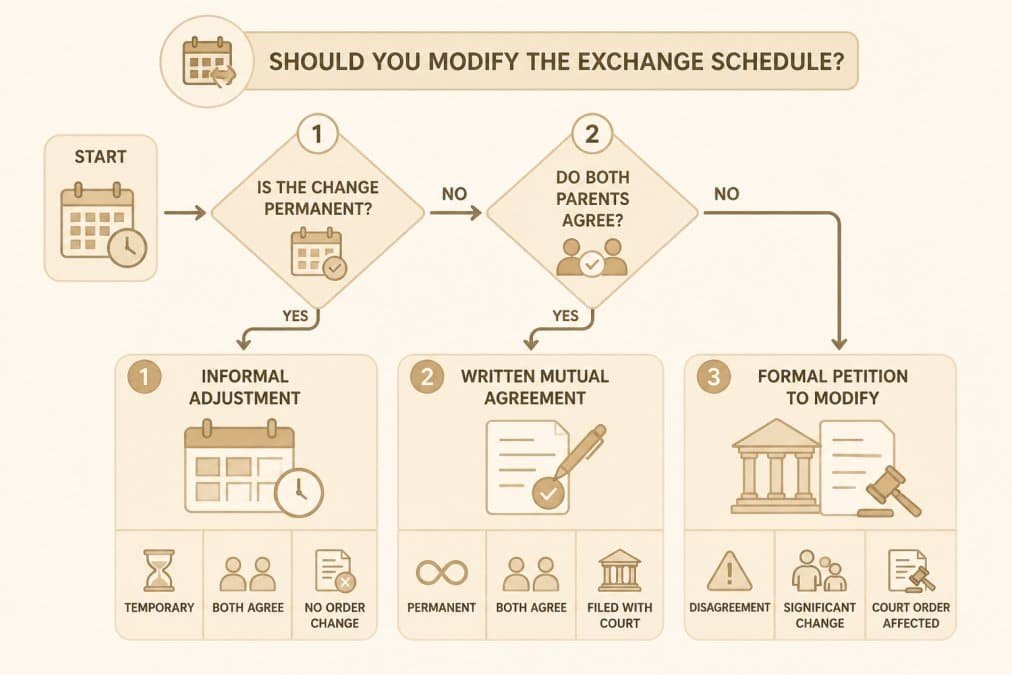
Not every change needs a court date. A temporary adjustment covers a short-term situation, a work trip, a summer camp, a surgery recovery. You and the other parent agree to swap a weekend, then return to the existing order; no filing needed as long as both parents consent. A permanent modification changes the court order itself and requires a written agreement filed with the court or a judge’s approval after a petition.
How to Request a Custody Schedule Change
Start with documentation, not demands. A calm, evidence-based request succeeds far more often than an emotional one, whether you are negotiating with the other parent or standing before a judge.
Documenting the Problem Before You Ask
Keep a simple log for at least a month before you raise the issue. Record:
- Dates and times of each exchange, including late pickups or no-shows
- What happened and who was affected
- Any communication about the problem
Save texts and emails; a shared co-parenting app keeps communication records neutral and timestamped. If conflict is severe, a dated journal becomes valuable evidence in family court.
Proposing the Change in Writing
Put your request in a short, factual message. Avoid blame. State the problem, the proposed fix, and a reply deadline.
Here is a template you can adapt:
“Hi [name], I’d like to talk about the Wednesday exchange. The 6 p.m. handoff conflicts with [child]’s tutoring, and we’ve arrived late four times this month. I propose moving it to 5 p.m. or switching to Thursday. Could we agree on one option by [date]? Happy to discuss.”
This keeps the tone businesslike and creates a written agreement trail if you later need court approval.
Send schedule proposals through a co-parenting app or email, never verbally. A written record protects you if the other parent later claims the conversation never happened.
Child Custody Schedule Change Due to Work Schedule Conflicts
A parent’s work schedule is one of the most common reasons for a custody exchange schedule change: shift changes, new jobs, overtime, and travel all collide with fixed exchange times. Courts see work commitments as legitimate but are less sympathetic to requests that look like convenience, so frame the change around stability for your child, not your preference.
Start With the Exchange Itself, Not the Whole Order
Ask yourself:
- Which exact exchange is failing? (e.g., Wednesday 6 p.m. handoff)
- Why is it failing? (shift start, commute, childcare gap)
- What is the smallest change that fixes it? (move time by two hours, swap day, change location)
A temporary adjustment covers a short-term situation: a temporary shift change, a training period, a seasonal overtime requirement.
A permanent modification changes the court order itself. It requires either a written agreement filed with the court or a judge’s approval after a petition.
Ask one question: will this still be true in six months? If yes, pursue a formal modification.
Concrete Alternatives to Propose
If your new hours make a weekday exchange impossible, propose a concrete alternative:
- Swap weekday time for a full weekend every other week
- Shift the exchange time by two hours to fit your shift
- Move the exchange location to your child’s school or a relative’s home to reduce driving
Document the job change with an offer letter, schedule printout, or pay stub showing the new hours. Show that the new arrangement keeps your child’s routine intact: same school, same bedtime, same activities. A schedule conflict framed as “here is how we protect our child’s stability” lands far better than “my boss changed my hours.”
Put It in Writing and Decide Whether to File
If the other parent agrees, put the change in writing, even for a temporary swap, a short email or co-parenting app message confirming dates and times protects both of you if a dispute arises later.
If the other parent refuses a reasonable work-related adjustment, do not unilaterally change the schedule. Document the conflict, propose a trial period, and consider mediation or a motion to modify if the change is significant and lasting.
Custody Exchange Schedule Examples That Reduce Conflict
The right exchange schedule depends on your child’s age, school holiday schedule, and how far apart the parents live. Here are practical patterns that cut friction.
| Schedule Type | Best For | Exchange Pattern | Conflict Risk |
|---|---|---|---|
| 2-2-3 rotation | Young children, nearby parents | Two days, two days, three days | Higher (frequent handoffs) |
| Week-on, week-off | School-age kids, stable homes | One handoff per week | Lower (fewer exchanges) |
| 3-4-4-3 | Cooperative parents | Midweek dinner visit | Medium |
| Alternating weekends | Long-distance parents | Friday to Sunday, every other week | Lower |
For high-conflict situations, fewer handoffs mean fewer chances for a custody dispute: a week-on, week-off parenting-time arrangement with one exchange per week is often calmer than a rotation requiring three or four handoffs.
When the Other Parent Disagrees With the Change
Disagreement is common, especially in high-conflict co-parenting. Stay calm and procedural: the parent who documents calmly and follows the process usually preserves their position, while the parent who reacts emotionally loses ground.
Step 1: Restate the Request and Ask for a Specific Objection
First, restate your request in writing and ask for their specific objection. Sometimes the “no” is about timing or logistics, not the change itself. A small compromise, like a trial period, can unlock agreement.
A useful message sounds like this:
“I understand you have concerns about moving the Wednesday exchange. Can you tell me specifically what does not work about the 5 p.m. option? If the time is the problem, I can offer 5:30 or Thursday instead. I would like to find something that works for both of us by [date].”
This keeps the tone businesslike, forces the other parent to articulate a concrete objection, and creates a written record if you later need court approval.
Step 2: Offer a Written Trial Run
If the other parent is hesitant, propose a written trial period, typically 30 to 60 days. A trial run lowers the stakes: the other parent is not agreeing to a permanent change, only testing whether the new exchange works. Put the trial in writing, including start date, end date, and what happens when it ends. If it goes well, convert it to a permanent modification; if not, return to the existing order without a fight.
Step 3: Suggest Mediation
If they refuse outright, suggest mediation. Many courts require mediation before a custody hearing, and some offer free or low-cost mediation through the court. Mediation is confidential, faster and often cheaper than litigation, and a neutral mediator can help both parents focus on the child’s schedule rather than past grievances. Bring your documentation: the exchange log, the proposed alternatives, and any written responses from the other parent.

Step 4: File a Petition or Motion to Modify
If mediation fails and the change is significant and lasting, file a petition to modify or motion to modify. The filing should include:
- The existing order and the specific exchange provision you want changed
- A clear statement of the substantial change in circumstances
- The proposed new exchange schedule
A family law attorney can tell you what your state law requires before you file; local rules control the outcome. Some states require a parenting plan or parenting time evaluation before a modification hearing, and some require a showing of a significant or material change rather than mere inconvenience.
What Not to Do: Avoid Unilateral Changes
Never withhold the child or break the court order to force a change. Unilateral changes, refusing an exchange or changing the location without agreement, can hurt your position with a judge and create a custody dispute you did not want; a judge may treat them as a violation even if your reasons were reasonable. If the other parent is violating the order, document it and file a motion to enforce rather than retaliating.
Do not use the exchange itself as a negotiation tactic. Refusing a handoff or changing the location without agreement can be treated as a violation of the court order, even if your underlying request is reasonable.
When the other parent disagrees, the winning move is procedural: document, propose, mediate, and file only if the change is significant and lasting. Emotional reactions and unilateral changes cost you credibility in family court.
Child-Centered Handoffs: Exchange Safety and Conflict Reduction
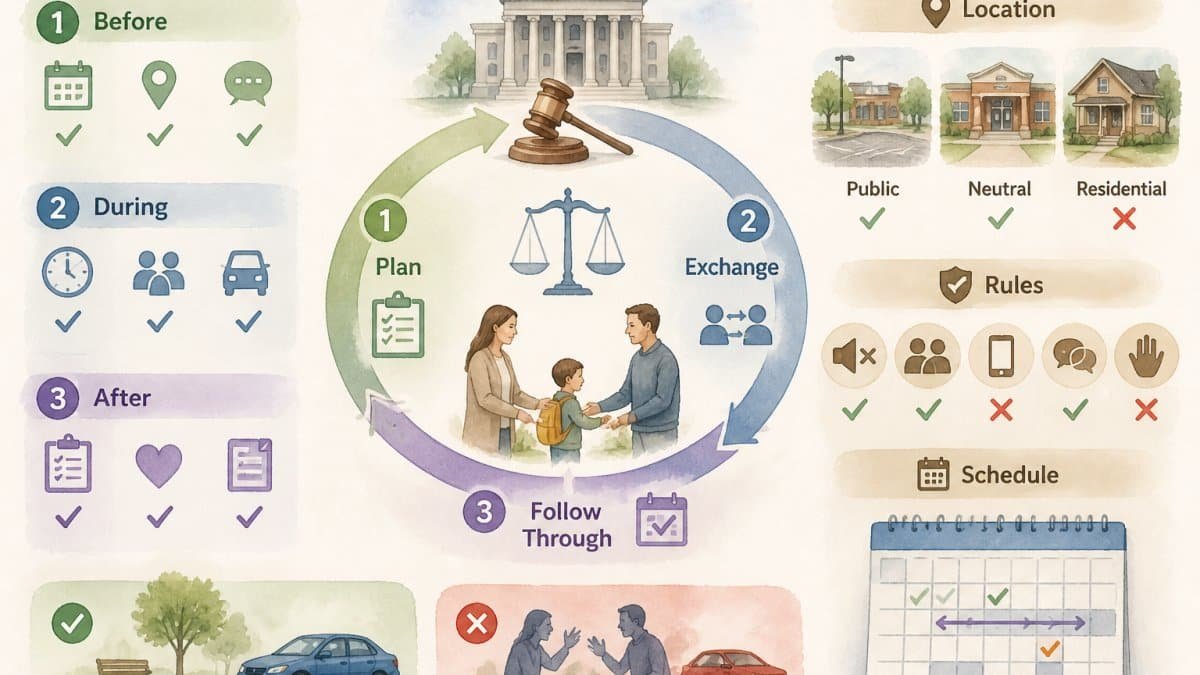
The best exchange is boring. No arguments, no lingering, no drama in front of your child. A handoff should take minutes and feel predictable.
Here is a short checklist for calmer exchanges:
- Confirm the time and exchange location the day before
- Keep the handoff under five minutes
- Avoid discussing anything except the child’s immediate needs
For hostile situations, the Gray Rock Method helps: stay neutral, unemotional, and brief, giving the other parent nothing to react to. This protects your child from witnessing conflict and protects you from accusations.
If exchanges regularly turn hostile, request a neutral public exchange location or a supervised handoff through a third party. Many courts will approve this when you can show a documented pattern of conflict.
Child-centered handoffs put the child’s emotional safety first, the same standard a judge uses. When your behavior at every exchange reflects calm and consistency, you build a record that supports any future request to modify the schedule.
Conclusion
Changing a custody exchange schedule is not about winning. It is about matching the schedule to your child’s real life and your real circumstances. Document the problem, propose the fix in writing, and know when a temporary swap needs to become a formal modification. When the other parent disagrees, stay procedural and calm, and let the record speak for you.
Frequently Asked Questions
Can parents change a custody exchange schedule without going to court?
Often yes, if both parents agree and the change is minor or temporary. A written agreement that spells out the new pickup and drop-off times, exchange location, and start date keeps things clear and reduces later disputes. However, if the change conflicts with an existing court order, most family courts require a formal modification or at least notice to the court. Because state law and individual orders vary, confirm with a family law attorney whether your written agreement needs court approval before you rely on it.
What counts as a significant change in circumstances for modifying custody?
Courts generally look for a change that is substantial, material, and not anticipated when the existing order was entered. Examples include a parent’s major work schedule shift, a child’s changing school or medical needs, a relocation, or a documented pattern of missed exchanges. A one-time inconvenience usually is not enough. Judges also weigh the child’s best interests, so document how the current exchange schedule is affecting your child’s routine, schooling, or wellbeing before you file.
How do I document problems with a custody exchange schedule?
Keep a simple journal with dates, times, locations, and what happened at each exchange. Save text messages, emails, and any communication records in one folder. Note missed exchanges, late arrivals, and any handoff conflicts without editorializing. If a work schedule change is the reason, include pay stubs, employer letters, or shift schedules. This documentation supports a petition to modify and shows the court a pattern rather than a single bad day.
Can a work schedule change justify modifying custody exchanges?
It can, especially if the new schedule makes the current exchange times unworkable and the change is lasting rather than temporary. Courts weigh whether the change is substantial and how it affects the child’s best interests. A shift from day to night hours, a new commute, or mandatory weekend work may qualify. Propose a concrete alternative exchange schedule in writing, show you are prioritizing the child’s time with both parents, and be ready to document the work change with employer records.