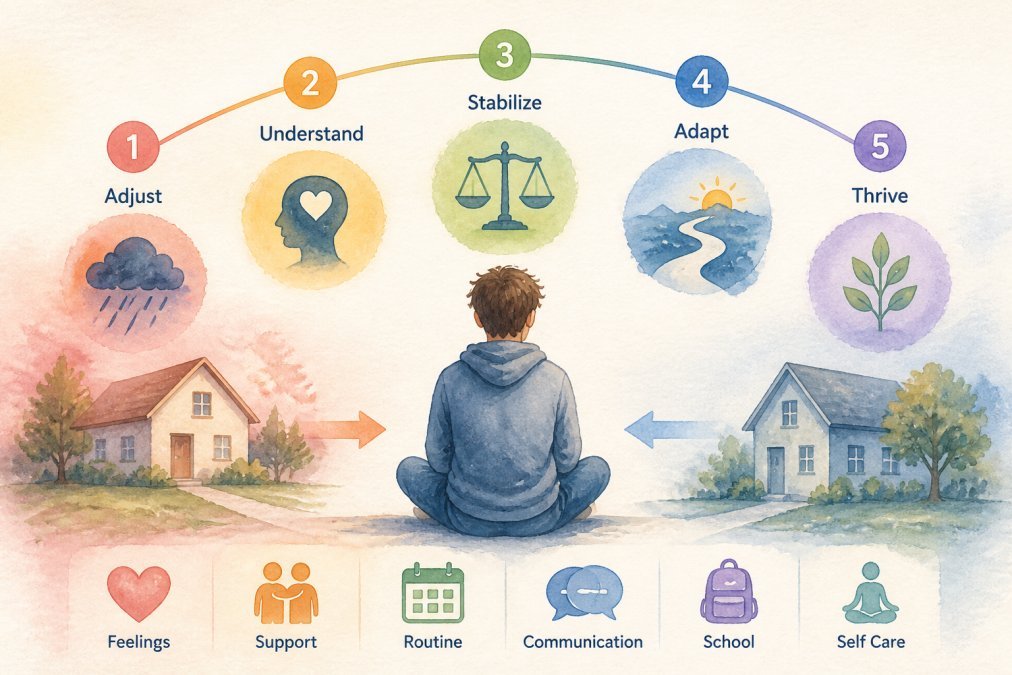
The window of tolerance is the zone of nervous system arousal where you can feel strong emotions, think clearly, and respond instead of react. Psychiatrist Dan Siegel coined the term to describe that middle band of functioning, and it matters because most of what feels like “losing it” or “shutting down” after a betrayal or trauma is really your nervous system slipping outside that zone. Inside the window, you can hold a hard conversation with your partner, weigh a decision calmly, and access memory and logic. Outside it, you land in one of two states:
- Hyperarousal — flooded, panicked, reactive, unable to stop scanning for threat
- Hypoarousal — numb, foggy, disconnected, physically and mentally shut down
The NHS’s guidance on post-traumatic stress describes these swings as core features of trauma response, and clinicians increasingly track how fast someone returns to their window after a trigger as a real measure of recovery progress. Aftertheaffair built its recovery framework around this same idea: regulation first, insight second.
Key Takeaways
Widening your window of tolerance depends on matching regulation tools to your actual arousal state and tracking rebound time as your real progress marker.
| Point | Details |
|---|---|
| Identify your state first | Hyperarousal needs calming tools; hypoarousal needs gentle activation, never the reverse. |
| Track rebound time weekly | The minutes or hours to recover from a trigger is a more honest progress marker than “feeling better.” |
| Build your map while calm | List triggers, early signs, and matched tools before you need them, not during a spike. |
| Combine body and mind work | Therapy that pairs cognitive processing with somatic regulation widens the window fastest. |
| Set an escalation threshold | Decide in advance what rebound pattern means it’s time to involve a therapist or GP. |
Table of Contents
- What Is the Window of Tolerance Model, Exactly?
- Hyperarousal vs. Hypoarousal: How to Tell Which State You’re In
- How Do You Know You’ve Left Your Window of Tolerance?
- Why Does Trauma Narrow the Window of Tolerance?
- Techniques to Return to Your Window of Tolerance in the Moment
- How Therapy Widens Your Window of Tolerance Over Time
- Mapping Your Own Window and Building a Safety Plan
- The Credentials Behind This Guide
- Why the Standard Advice on This Topic Falls Short
- Sources
- FAQ
What Is the Window of Tolerance Model, Exactly?
Siegel developed the concept in the late 1990s while studying how the brain integrates emotional experience, and it has since become one of the most widely used frameworks in trauma therapy. The model rests on a simple premise: your nervous system has a bandwidth. Within that bandwidth, the prefrontal cortex, the part of the brain responsible for reasoning, impulse control, and perspective, stays online and connected to the more primitive survival circuitry underneath it.
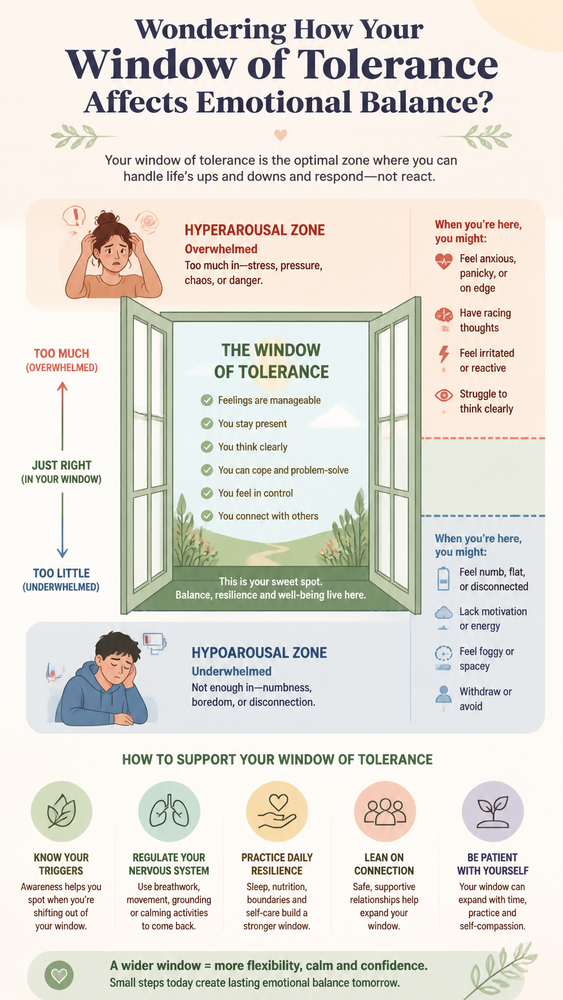
Push past the edges of that bandwidth, and the relationship flips. The amygdala and brainstem take over, the prefrontal cortex goes quiet, and you lose access to the exact skills you need most: patience, context, the ability to hear your partner without hearing an attack.
The autonomic nervous system runs this whole show through two branches. The sympathetic branch revs you up (fight or flight). The parasympathetic branch, specifically its dorsal vagal pathway, shuts you down (freeze or collapse) when fighting or fleeing isn’t an option. A well-regulated nervous system moves fluidly between these branches and returns to baseline quickly. A dysregulated one gets stuck at the extremes or swings between them with almost no warning.
Picture it as three stacked bands:
- The window itself — calm alertness, curiosity, connection, the ability to problem-solve
- Hyperarousal above it — anxiety, anger, panic, racing thoughts, an activated body that won’t settle
- Hypoarousal below it — numbness, dissociation, exhaustion, a body that has gone still or heavy
For someone in the early weeks after discovering an affair, that window often narrows to almost nothing. A partner’s tone of voice, a phone notification, or a familiar restaurant can trigger a full swing from one extreme to the other in seconds. That’s not weakness. It’s a nervous system doing exactly what trauma trained it to do.
Understanding the pattern is not the same as breaking it
You Can Explain Why This Happened. Can You Explain Why You’re Still Stuck In It?
Most people in affair recovery can narrate their entire situation with total clarity, the timeline, the triggers, the whole story, and still find themselves back in the same spiral by evening. Insight was never the missing piece. This free assessment shows you exactly where the gap actually is.
Take the Free Affair Recovery Clarity Check →A few honest questions · a scored result · 4 minutes · free
Hyperarousal vs. Hypoarousal: How to Tell Which State You’re In
Most people assume dysregulation always looks like panic. It doesn’t. Many times, it looks like the opposite: going blank, going quiet, feeling nothing at all when you’d expect to feel everything.
Hyperarousal tends to show up as:
- A racing or pounding heart, shallow and fast breathing
- Muscle tension, jaw clenching, restless hands or legs
- Racing thoughts, catastrophizing, an urge to argue, flee, or control the situation
- Irritability that flares with almost no warning
- Difficulty sitting still or sleeping
Hypoarousal tends to show up as:
- A slowed heart rate, shallow or barely noticeable breathing
- Heavy limbs, a body that feels distant or unreal
- Blank thinking, trouble finding words, a sense of watching yourself from outside
- Flat affect, low energy, a pull toward sleep or withdrawal
- Emotional numbness where you know you should feel something and don’t
The SimplyPsychology overview of the window of tolerance model notes that mismatching a regulation technique to the wrong state is one of the most common errors people make — trying to calm someone who is already shut down, or trying to activate someone who is already flooded, usually backfires. Recognizing which state you’re in isn’t a diagnostic exercise. It’s the first decision point that tells you which tools will actually help in the next five minutes.
How Do You Know You’ve Left Your Window of Tolerance?
The exit from your window rarely announces itself with a siren. It shows up in small, deniable moments: your jaw tightens reading a text, your mind goes blank mid sentence, you snap at your kid over something trivial. Betrayal trauma has a specific set of common triggers worth knowing by name: an unexplained absence, a familiar scent, a shared photo resurfacing, a question about “where were you.”
Three quick self-check questions can catch the slide before it becomes a full episode:
- Can I still hear the other person’s words as information, not attack? If everything sounds like a threat, you’re likely drifting toward hyperarousal.
- Do I know what I’m feeling right now, in one word? If the answer is nothing, or you can’t locate a feeling at all, that often signals hypoarousal.
- Is my breathing fast and high in my chest, or slow and barely there? Either extreme is a signal, not a character flaw.
A short internal script helps in the actual moment: “This is my nervous system, not the full truth of this situation. I can pause before I respond.” Saying it silently, even once, buys a few seconds of prefrontal access that a flooded or shut down brain doesn’t otherwise have.
Pro Tip: Keep the script on your phone’s lock screen or a sticky note for the first few months after discovery. In the middle of a spike, you won’t remember the wording. You just need to see it.
Why Does Trauma Narrow the Window of Tolerance?
Trauma doesn’t just create bad memories. It recalibrates the nervous system’s threat detection settings, and that recalibration is why a narrowed window feels so persistent even when the danger has passed. The amygdala becomes quicker to fire, the baseline stress hormone level rises, and the whole system starts treating ambiguous situations as if they were dangerous ones.
Autonomic dysregulation following trauma is linked to lasting changes in how the nervous system calibrates arousal, changes that persist well after the original threat has ended and that respond to body-based regulation work over time.
That finding, drawn from peer-reviewed research on autonomic dysregulation and the window of tolerance model, explains something that trips up a lot of people newly facing betrayal trauma: why calm logic (“he says it’s over, I should feel fine”) doesn’t switch off the physical alarm. The nervous system isn’t listening to logic. It’s listening to pattern-matched threat cues.
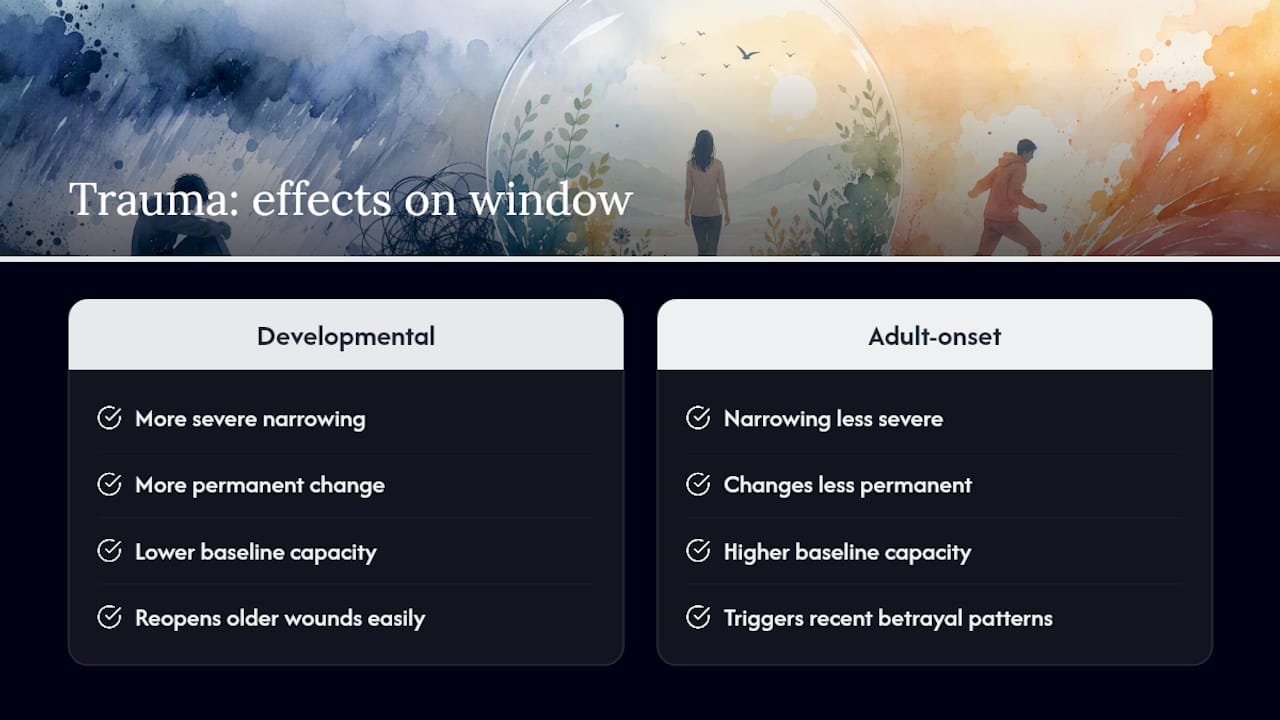
Developmental trauma, meaning trauma experienced in childhood while the nervous system is still being built, tends to narrow the window more severely and more permanently than trauma experienced as an adult. An adult with a previously wide window who experiences a partner’s betrayal usually has more baseline capacity to draw on, even if it doesn’t feel that way in month one. Someone with earlier attachment wounds often finds the affair reopens a much older, much narrower operating range. Neither trajectory is fixed. Both respond to the same class of regulation work, just on different timelines.
Techniques to Return to Your Window of Tolerance in the Moment
The tool has to match the state, not the other way around. This is the single most misunderstood piece of self-regulation advice, and getting it backward can genuinely make things worse.
For hyperarousal, you need to lower activation:
- Paced breathing with a longer exhale than inhale (try a four count in, six or eight count out) signals safety directly to the vagus nerve.
- Grounding through the five senses, naming five things you see, four you hear, three you can touch, pulls attention out of the threat loop and into the present room.
- Progressive muscle relaxation, tensing and releasing muscle groups one at a time, gives racing energy somewhere concrete to go.
- Cold water on the wrists or face triggers a mild dive reflex that slows heart rate within seconds.
For hypoarousal, you need to raise activation, gently:
- Movement, even standing up and walking to another room, reintroduces the body to the present moment.
- Cold stimulation still works here too, but paired with movement rather than stillness. Splashing cold water while pacing beats sitting still with it.
- Reaching out to a safe person, even a short text, engages the social nervous system that shutdown otherwise silences.
- A structured, low-stakes task, folding laundry, sorting mail, gives the mind something concrete to organize around.
The mistake almost everyone makes at some point is applying calming techniques across the board. A slow, quiet meditation app is exactly the wrong tool for someone already numb and disconnected — it can deepen the shutdown instead of easing it, a pattern documented clearly in trauma therapy literature. If mindfulness practice is part of your routine, choosing the right style for where you actually are rather than the style that sounds most soothing on paper makes a measurable difference.
Pro Tip: Test your go-to calming technique when you’re not in crisis. If a slow breathing exercise makes you feel more agitated, or a grounding exercise makes you feel more foggy, you may have the state backward. Adjust before you actually need it.

Bodily cues of trauma often show up before the emotional ones do, which is why tracking physical symptoms alongside emotional ones gives a fuller picture of where you actually stand on any given day.
How Therapy Widens Your Window of Tolerance Over Time
In-the-moment tools manage a single spike. Widening the window itself, so spikes happen less often and recovery from them speeds up, is longer work, and it’s the work most trauma-focused therapy is actually built around.
A handful of approaches show up consistently in this space:
- Trauma-focused CBT helps identify and restructure the thought patterns that keep the threat-detection system on high alert.
- EMDR (Eye Movement Desensitization and Reprocessing) works through targeted eye movements to help the brain reprocess stuck traumatic memories.
- Somatic experiencing and sensorimotor psychotherapy work through the body directly, releasing trapped activation rather than talking through it. Somatic approaches have gained particular traction for betrayal trauma because the body often holds the shock long after the mind has “processed” the facts.
- DBT skills (Dialectical Behavior Therapy) build a toolkit of specific, teachable regulation techniques for both hyper and hypoarousal.
Skilled trauma therapists work deliberately at the edges of a client’s window rather than avoiding it altogether. This dual focus, staying grounded in present-moment safety while carefully approaching difficult material, is what research on autonomic dysregulation points to as the most consistently effective combination: cognitive processing paired with body-based regulation, not either alone.
Progress rarely looks dramatic. It looks like a shorter rebound time: the gap between getting triggered and getting your thinking brain back online. Early in trauma-informed therapy, that gap might be hours. Months in, it’s often down to minutes. That shrinking gap, more than the absence of triggers altogether, is the honest marker of a widening window.
Mapping Your Own Window and Building a Safety Plan
A one-page map of your own patterns turns an abstract concept into something you can actually use under pressure. Build it while you’re calm, not while you’re mid-spike.
- List your personal triggers. Be specific: a certain song, a late text reply, a particular time of night.
- Note your early warning signs for each state. What does your hyperarousal look like versus your hypoarousal? Write the bodily cues, not just the emotional ones.
- Match a tool to each state in advance. Write down the one or two techniques that actually work for you, not the ones that sound good in theory.
- Track your rebound time. After a trigger, note roughly how long it takes before you can think clearly again. Log it weekly.
- Set a threshold for professional help. Decide now, while regulated, what rebound time or symptom pattern means it’s time to call a therapist rather than manage it alone.
| Rebound Time | What It Suggests |
|---|---|
| A short rebound time | Suggests strong regulation capacity; current tools are working |
| A rebound time from short to several hours | May be normal during active recovery; keep tracking |
| A rebound time lasting most of a day or longer | Consider adding professional support alongside self-tools |
| No return to baseline without outside help | Escalate to a therapist or your GP promptly |
A free printable window of tolerance template can serve as the physical version of this map, something to keep somewhere visible rather than buried in a notes app. If your rebound times consistently land in the longer bands, or you notice thoughts of self-harm, that’s the clear line for contacting a GP or crisis service rather than continuing with self-directed work.
Noticing the pattern is not the same as proving it
You Can Feel the Pattern. Can You Prove It to a Judge?
A diary of what happened reads as emotional venting. A structured, timestamped record reads as evidence. Most parents lose that distinction until it costs them. The free checklist shows you exactly what to document today, before the evidence window closes.
Get the Free Red Flag Checklist →3 categories · 5 minutes · free
The Credentials Behind This Guide
This article draws on peer-reviewed research and NHS-published guidance on trauma and post-traumatic stress, alongside established clinical frameworks including Dan Siegel’s original window of tolerance model. It’s written for education, not diagnosis, and it isn’t a substitute for individualized clinical care.
Aftertheaffair’s book series maps directly onto this regulation work across the stages of betrayal recovery:
- Early survival resources aimed squarely at stabilizing hyperarousal and hypoarousal in the first weeks
- Decision-making guides for once your window has widened enough to think past the immediate crisis
- Transformation and growth material for the longer work of rebuilding regulatory capacity and trust
If you’re newly in the thick of it, the 7-step infidelity recovery checklist breaks the earliest, most disorienting phase into a sequence you can actually follow when your thinking brain isn’t fully online. It’s built for exactly the state most readers of this article are in right now.
Why the Standard Advice on This Topic Falls Short
Most articles on the window of tolerance stop at definition and a list of breathing exercises, and that’s where they do readers a disservice. The real leverage point isn’t knowing the concept exists. It’s correctly diagnosing which state you’re in before you reach for a tool, because a mismatched tool doesn’t just fail to help, it can actively deepen a shutdown or spike an already flooded system.
The other place conventional advice falls short is progress measurement. Telling someone to “notice when they feel better” is vague to the point of useless during active betrayal trauma, when feelings are unreliable and contradictory by the hour. Rebound time is a far more honest number, and it’s one you can actually log.
If there’s one place to start, it’s the self-check questions, not the breathing techniques. Know your state first. The right tool follows naturally once you do, and readers working through structured recovery material tend to make faster, steadier progress than those managing symptoms in isolation.
— S.J.Howe
This article is general information, not a substitute for advice from a qualified doctor. Consult a qualified healthcare professional about your own circumstances before acting on anything here.
Sources
- What Is the Window of Tolerance, and Why Is It So Important? | Psychology Today
- Window of tolerance — trauma and therapy | SimplyPsychology
- Post-traumatic stress disorder (PTSD) – NHS
- Autonomic dysregulation and the Window of Tolerance model (PubMed)
- How trauma can affect your window of tolerance | Verywell Mind
FAQ
What Is the Window of Tolerance in Simple Terms?
It’s the zone of nervous system arousal where you can feel emotions and stay level-headed at the same time, staying connected to clear thinking instead of flipping into panic or shutdown.
What Are the Four F’s of Trauma Response?
The four F’s typically referenced are fight, flight, freeze, and fawn, describing the automatic survival strategies the nervous system defaults to when it’s pushed outside the window of tolerance.
What Is the Difference Between Hyperarousal and Hypoarousal?
Hyperarousal is an overactivated state marked by panic, racing thoughts, and physical tension, while hypoarousal is an underactivated state marked by numbness, fog, and disconnection.
How Long Does It Take to Widen Your Window of Tolerance?
There’s no fixed timeline, but a practical marker is rebound time, the gap between a trigger and returning to clear thinking, which typically shortens over weeks to months of consistent regulation work and therapy.
Can You Expand Your Window of Tolerance on Your Own?
Self-directed tools like paced breathing, grounding, and movement can widen your capacity somewhat, but lasting change usually requires professional support, especially when rebound time stays long or symptoms escalate.
Recommended
- Mastering Your Boundaries: Essential Strategies for Lasting Empowerment
- How to Protect Your Mental Health When Triggers Are Constant
- The Opportunistic Affair – After the Affair Series
- Behavioral Red Flags in Kids – After the Affair Series