Hysterical bonding is a short, adrenaline-and-dopamine-fueled surge of sexual and emotional closeness that shows up after someone discovers a partner’s affair. It’s common and understandable, but it isn’t the same thing as repaired trust. What you’re feeling is your attachment system fighting to keep the relationship intact, not proof the relationship is safe again. If you’re in the middle of it, treat it as a signal to get support, not a signal to skip the harder work ahead.
- What Hysterical Bonding Looks Like: The Signs You’ll Recognize
- Why This Happens: The Biology and Psychology Behind It
- How Long Hysterical Bonding Usually Lasts
- Does Hysterical Bonding Help or Hurt Recovery?
- What to Do Right Now: Self-Care, Boundaries, and Getting Help
- How After the Affair Supports This Stage of Recovery
- Hysterical Bonding vs. Trauma Bonding: Why the Confusion Matters
- The Part Nobody Tells You About Hysterical Bonding
- FAQ
TL;DR:
- Hysterical bonding is driven by the body’s survival response, often lasting days to months, and intensifies with secrecy, unanswered questions, or prior attachment issues.
- It manifests through reassurance-seeking, mood swings, impulsive sex, and boundary erosion, which indicate a need to focus on processing rather than rushing to rebuild trust.
- The biological and psychological mechanisms behind it involve adrenaline and dopamine surges that mimic early attraction, making the pull feel urgent and confusing.
- Addressing it effectively requires stabilizing the body, setting boundaries, and seeking professional individual therapy before making major relationship decisions.
- Mistaking hysterical bonding for genuine repair risks re-entering crisis cycles or confusing it with trauma bonding, which involves longer-term, recurring patterns of harm and reconciliation.
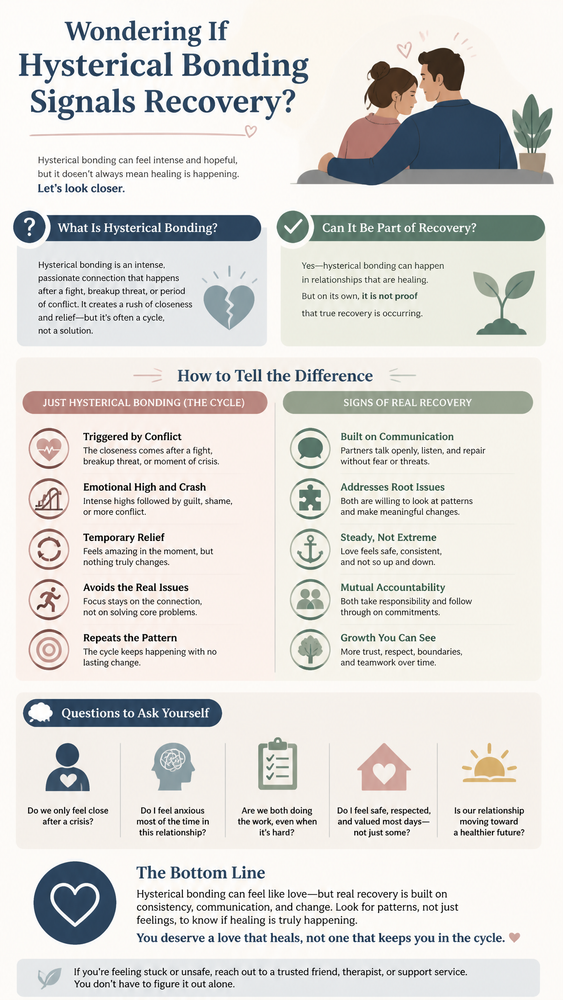
What Hysterical Bonding Looks Like: The Signs You’ll Recognize
The pull is rarely subtle. Most people describe it as feeling like a “first crush” again, except the butterflies are laced with panic. Once you know the pattern, it’s easier to name what’s happening instead of assuming it means the relationship has healed.
Emotional signs tend to show up first:
- Constant need for reassurance (“Do you still love me? Are you sure?”)
- Sharp mood swings, from rage to affection within the same hour
- Idealizing the partner, remembering only the good years, minimizing the betrayal
Physical and sexual signs often follow within days:
- A sudden, intense surge in sexual desire, sometimes more intense than at any point earlier in the relationship
- Using sex to soothe panic or to feel “chosen” again rather than out of genuine desire
- Physical restlessness: trouble sleeping, appetite changes, an inability to sit still
Behavioral signs are where the risk lives:
- Rushed forgiveness before any real conversation about what happened
- Boundaries that quietly disappear: checking the partner’s phone one day, deleting the evidence the next
- Clinginess or an inability to tolerate the partner leaving the room
One common pattern: a woman finds explicit messages between her husband and a coworker, confronts him, and within 48 hours they’ve had the most passionate sex of their marriage, without a single question about the affair being answered. Another: a man discovers his wife’s yearlong emotional affair and finds himself unable to stop initiating sex, even while still furious, because the alternative (sitting with the fear she’ll leave) feels unbearable. Neither of these is dysfunction. Both are the nervous system doing exactly what it’s built to do under threat.
Why This Happens: The Biology and Psychology Behind It
Betrayal registers in the brain as a threat to survival, not just to the relationship. That triggers the same biological alarm system that fires during any perceived danger, and it explains why the pull toward your partner can feel so disproportionate to what you’d choose if you were thinking clearly.
The biology: adrenaline floods the body the moment betrayal is confirmed, and that spike can trigger a dopamine surge that mimics the chemistry of early-stage attraction, the same rush PopSugar’s coverage of hysterical bonding compares to falling for someone new. Fear of losing your partner activates that same reward circuitry, which is why the desire can feel so urgent and so confusing at once.
The psychology: your attachment system reads abandonment as an emergency. Choosing Therapy describes hysterical bonding as an emotion-focused coping response, meaning it’s designed to manage the feeling of the crisis rather than to fix the crisis itself. Sex and closeness become a fast way to quiet abandonment anxiety, even though the underlying betrayal hasn’t been addressed at all.
What makes it worse: secrecy still lingering, unanswered questions about the affair, or a prior history of anxious attachment all intensify the pull. If you already struggled with fear of abandonment before the betrayal, this phase tends to hit harder and last longer. Healthline’s explanation of hysterical bonding notes it’s fairly common precisely because it taps into such a basic survival response, and recommends professional support to process what’s actually happened rather than riding the wave alone.
None of this means you’re “addicted” to your partner or making a mistake by wanting them close. It means your body is doing what bodies do when the ground shifts. The problem isn’t the feeling. It’s mistaking the feeling for resolution.
How Long Hysterical Bonding Usually Lasts
Most people move through it in days to a few months, according to Choosing Therapy’s overview, though the range varies a lot by circumstance. Ongoing secrecy, unanswered questions about the affair, or a prior trauma history tend to stretch it out. Clear boundaries, honest disclosure, and professional support tend to shorten it.
You’ll usually notice it fading when the intensity of the sexual pull starts to level out and you find yourself able to ask harder questions without panicking that asking them will drive your partner away. If months pass with no shift at all, that’s a sign to bring in outside support rather than wait it out.
Does Hysterical Bonding Help or Hurt Recovery?
In the moment, it genuinely helps. The closeness feels real because it is real. It restores a sense of connection when everything else feels like it’s collapsing, and there’s nothing wrong with taking comfort where you can find it during a crisis.
The risk shows up over time. When sex and reassurance substitute for actually processing what happened, the betrayal doesn’t get resolved, it gets buried. Business Insider’s reporting on hysterical bonding cites therapists who describe sex after infidelity as sometimes functioning as a way to compare, reclaim, or test one’s own attractiveness against a betrayal, an attempt to regain control that can mask deeper problems instead of solving them. Couples who skip straight to reconnection without ever naming what broke often find themselves right back in crisis six months later, confused about why the closeness didn’t “fix” anything.
So how do you know which mode you’re in? A few markers help:
| Signal | Likely safe to explore closeness | Better to pause and process first |
|---|---|---|
| Honesty about the affair | Full disclosure has happened | Questions remain unanswered |
| Motivation | Genuine desire for connection | Fear of losing the partner |
| Emotional state | Calm enough to also feel angry | Panic if partner steps away |
| Boundaries | Still intact | Eroding daily |
If most of your answers land in the second column, that’s not a failure. It’s information. It tells you the priority right now is processing, not proving anything to yourself or your partner through sex.
What to Do Right Now: Self-Care, Boundaries, and Getting Help
The urge to either fall completely into your partner or completely shut them out are both understandable. Neither one, acted on impulsively, tends to serve you well. Here’s a sequence that actually holds up.
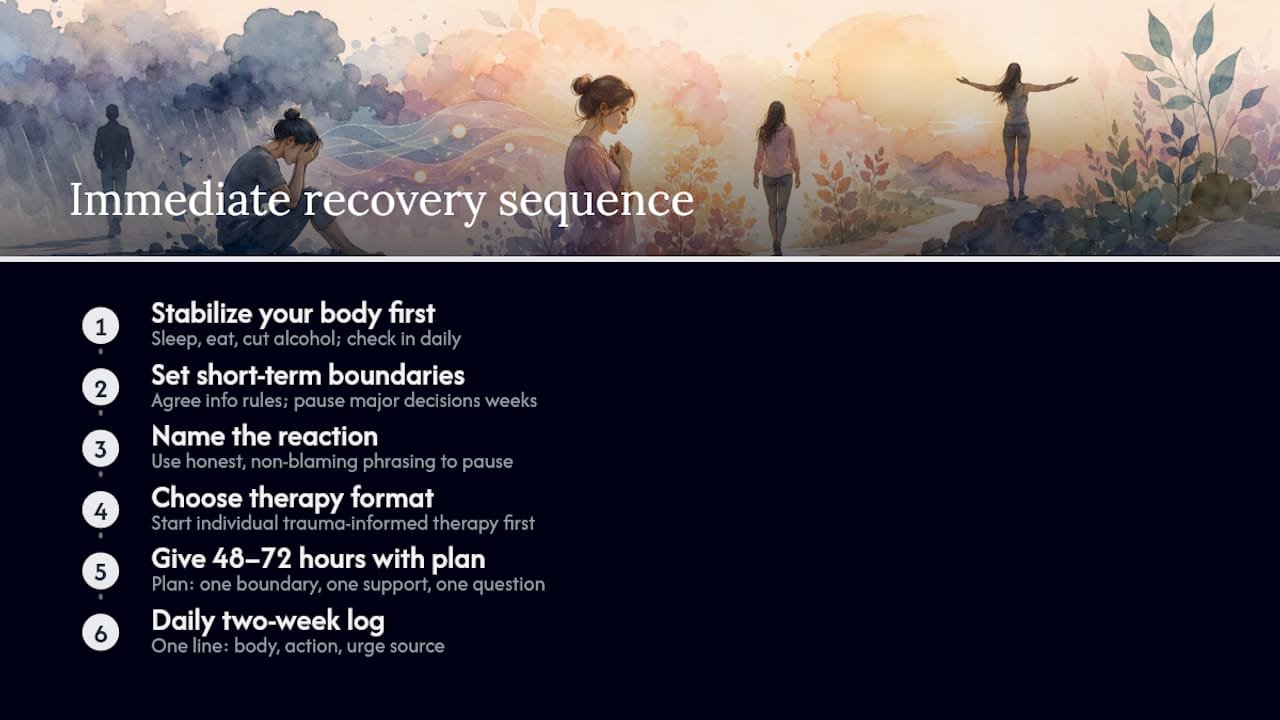
1. Stabilize your body first. Sleep, food, and cutting back on alcohol sound basic, but a nervous system running on adrenaline and no sleep cannot make good decisions. Check in with a friend or family member daily, even briefly, so you’re not processing this in total isolation.
2. Set short-term boundaries before making big decisions. Agree with your partner on ground rules for what information gets shared and when. Pause any major decisions, moving out, filing for divorce, quitting a job, for at least a few weeks while the initial shock settles.
3. Name the reaction without blaming yourself for it. Try language like, “I know I’ve been pulling you close and I think it’s fear talking, not trust. I need us to slow down and actually talk about what happened.” That sentence does two things: it’s honest, and it doesn’t require your partner to defend themselves yet.
4. Choose the right therapy setup. Individual, trauma-informed therapy is almost always the right starting point, since you need space to process shock and grief that has nothing to do with managing your partner’s feelings. Couples therapy has a place, but only once both people are genuinely committed to the process, not using sessions to relitigate blame. Gottman Institute research on affair recovery points to rebuilding friendship and communication in structured steps rather than rushing straight to physical reconciliation. For guidance on which format fits your situation, After the Affair’s comparison of therapy options walks through both paths.
5. Give yourself 48 to 72 hours with a plan, not just a reaction. Write down one boundary, one support person you’ll call, and one question you want answered before you make any decision about the relationship’s future.
Pro Tip: Keep a simple daily log for two weeks: one line on how you felt physically, one on what you did, one on whether the urge to reconnect sexually came from calm or from panic. Patterns you can’t see in the moment become obvious on paper.
If grounding and processing feel overwhelming to do alone, structured guidance on working through emotional trauma after infidelity breaks the early weeks into smaller, less frightening steps.
How After the Affair Supports This Stage of Recovery
Naming what’s happening is only step one. The harder part is knowing what to actually do with the next hour, the next week, the next month, and that’s where structured tools matter more than another article explaining biology.
The 7 Steps Infidelity Recovery Checklist is built for exactly the stage you’re likely in right now: immediate stabilization, when you need concrete tasks instead of vague advice about “healing.” The Stages of Healing guide maps out what comes after stabilization, so you can see whether your current urges toward closeness are moving you toward genuine processing or into avoidance. And because hysterical bonding and trauma bonding get confused constantly, the series’ explainer on trauma bonding draws the line clearly.
- Use the checklist to track daily stabilization tasks, not just feelings
- Use the Stages of Healing guide to check whether you’re progressing or stuck in a loop
- Use the trauma bonding guide if the connection feels compulsive rather than comforting
The After the Affair series is written by S.J.Howe, whose background combines personal experience of betrayal recovery with structured, evidence-informed frameworks built specifically for this work, rather than general relationship advice repurposed for infidelity.
Hysterical Bonding vs. Trauma Bonding: Why the Confusion Matters
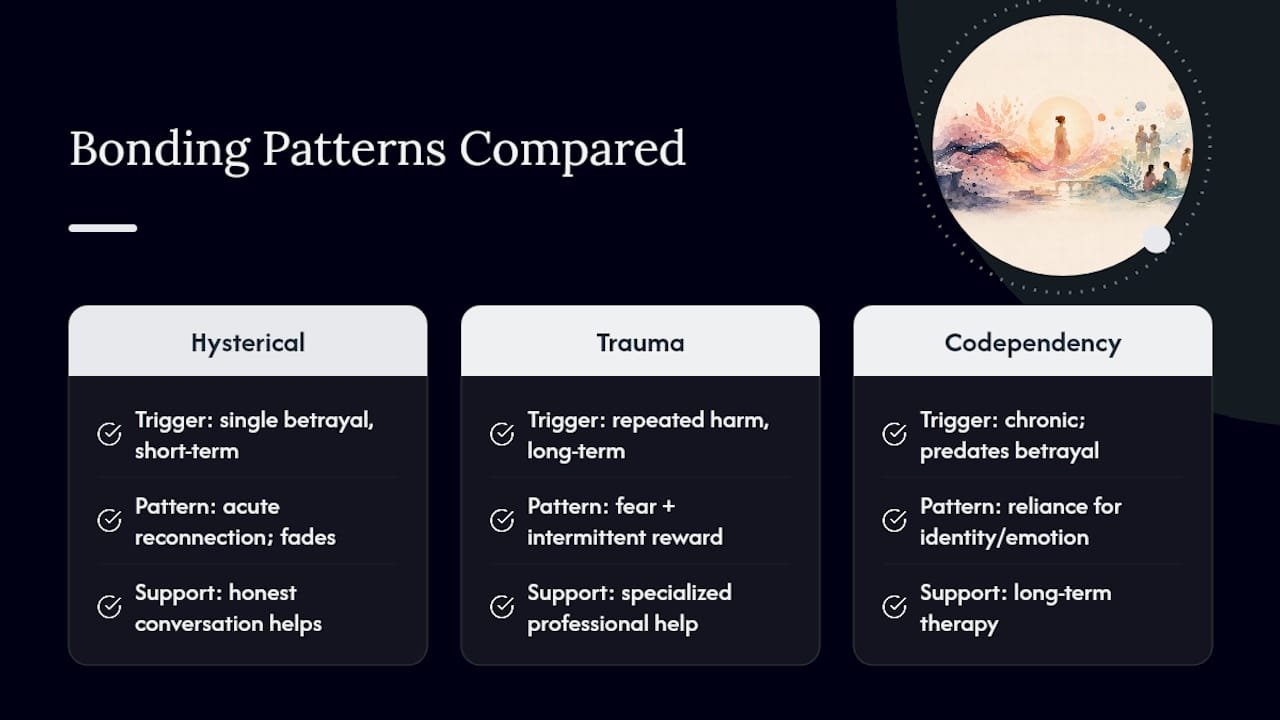
People frequently use these two terms interchangeably, and the mix-up causes real harm because the two point in opposite directions. Hysterical bonding is a short-term, acute reaction to a single betrayal discovery. It tends to fade as shock wears off and honest conversation begins. Trauma bonding describes a longer, more entrenched pattern, usually built across repeated cycles of harm and reconciliation, where the connection itself becomes tangled up with fear, intermittent reward, and difficulty leaving even when the relationship is clearly damaging.
Codependency is a third, related but distinct pattern: a chronic reliance on a partner for identity or emotional regulation that predates any single betrayal and often outlasts it. If your intense pull toward your partner started the day you found out about the affair and is already softening within weeks, that’s consistent with hysterical bonding. If you’ve noticed this same push-pull dynamic across years, multiple betrayals, or a relationship you can’t quite explain why you stay in, that’s worth naming as trauma bonding instead, and it usually calls for different professional support.
Cultural background shapes both how hysterical bonding gets expressed and how much permission people feel to talk about it. In cultures or families where divorce carries heavy stigma, the pressure to “prove” a marriage survived can intensify the rush toward reconciliation sex, sometimes for the benefit of extended family rather than the couple itself. Gender norms play a role too: men are frequently discouraged from naming vulnerability, so the same intense reconnection urge that a woman might describe as anxious clinging gets relabeled by a man as simply wanting sex, without examining the fear underneath it. Age and relationship stage matter as well. Couples early in a relationship, without shared finances or children, tend to move through this phase faster than couples with decades of entangled life, where the stakes of separation amplify the biological pull to reconnect. None of these factors change the underlying mechanism. They change how visible it is, and how much support someone feels able to ask for.
The Part Nobody Tells You About Hysterical Bonding
Most articles on this topic treat hysterical bonding like a symptom to manage and move past as quickly as possible. That framing undersells it. The intensity you feel isn’t a malfunction, it’s evidence that your attachment system still works, which is actually useful information heading into recovery, not just a phase to survive.
Where conventional advice falls short is in treating “wait it out” as sufficient guidance. Waiting without structure just means you’re improvising through one of the more disorienting experiences a relationship can produce, hoping clarity arrives on its own. It sometimes does. More often, couples drift into a pattern where sex substitutes for the conversation that never happens, and the same unresolved betrayal resurfaces a year later, dressed up as a new fight about something else entirely.
If there’s one thing to prioritize first, it’s this: separate the urge to reconnect from the decision about whether the relationship deserves to continue. You can hold your partner close tonight and still owe yourself an honest conversation next week. Those two things are not in conflict.
— S.J.Howe
This article is general information, not a substitute for advice from a qualified doctor. Consult a qualified healthcare professional about your own circumstances before acting on anything here.
Sources
- Hysterical Bonding: What It Means and Why It Happens | Healthline
- What Is Hysterical Bonding? | Choosing Therapy
- Hysterical Bonding and Why People Sleep With Their Cheating Partner | Business Insider
- Not just friends: Recovering from an emotional affair | The Gottman Institute
FAQ
What are the signs of hysterical bonding?
The main signs are intense reassurance-seeking, sharp mood swings, a sudden surge in sexual desire, rushed forgiveness, and boundaries that erode faster than usual, all appearing shortly after discovering a partner’s betrayal.
How long does hysterical bonding last?
It typically lasts anywhere from a few days to several months, according to Choosing Therapy, with ongoing secrecy or unresolved questions tending to stretch it out and clear boundaries plus therapy tending to shorten it.
Can being cheated on lead to PTSD?
Betrayal trauma can produce symptoms that overlap with PTSD, including intrusive thoughts, hypervigilance, and sleep disruption, which is why trauma-informed individual therapy is often recommended as a first step in processing emotional trauma after infidelity.
What is the difference between hysterical bonding and trauma bonding?
Hysterical bonding is a short-term reaction to a single betrayal discovery that usually fades within weeks or months, while trauma bonding describes a longer-term, entrenched attachment pattern built through repeated cycles of harm and reconciliation.
Reading this won’t change tomorrow’s message
You Know the Tactic Now. Do You Know What You’ll Actually Do When It Lands?
Understanding grey rock is not the same as doing it at 9pm when your phone buzzes. Most parents can explain the theory perfectly and still bite the bait every single time. The gap between the two is exactly what the free self-check measures.
Get Your Ex Out of Your Head ->5 scenarios, scored result, 4 minutes free
Recommended
- The 30-Day Recovery Protocols for Betrayal Trauma
- Trauma Bond After an Affair: What It Is, and How to Break It
- Acute Betrayal Shock: Immediate Signs and What to Do
- How to Cope After Infidelity