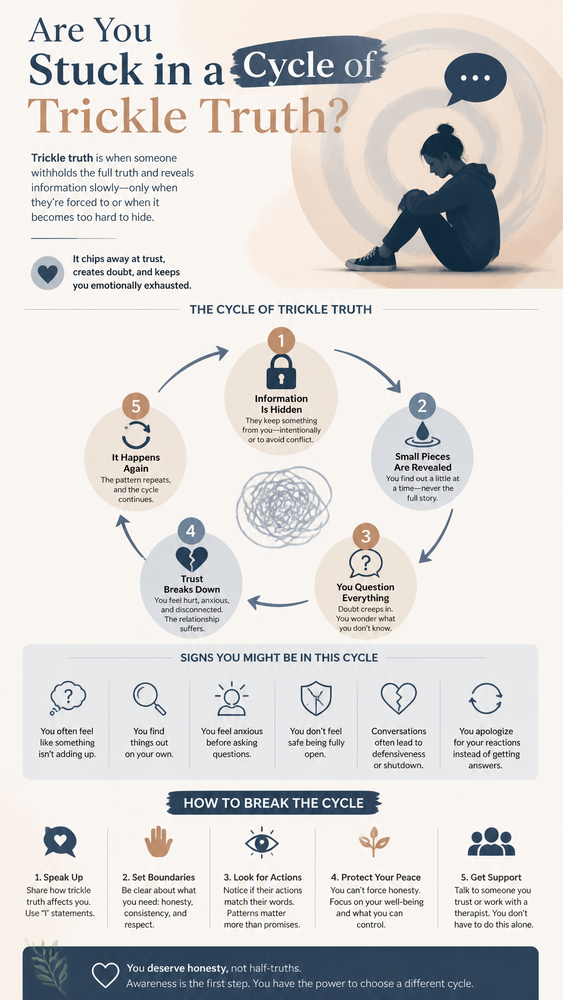
Trickle truth is the gradual, partial release of details about an affair, usually offered only when the betrayed partner catches a contradiction or finds new evidence. It causes more damage than a single disclosure because each new fact reopens the trauma response, forcing the betrayed partner to relive discovery day again and again. Stopping the cycle usually requires a structured disclosure process, often with a therapist, rather than more questioning.
Table of Contents
- What Is Trickle Truth (Staggered Disclosure)?
- Why Does Trickle Truth Happen?
- Why Trickle Truth Damages Recovery
- Signs You’re Being Given Trickle Truth
- Full Therapeutic Disclosure vs. Trickle Truth
- How to Stop the Cycle and Respond Constructively
- When to Seek Professional Help
- What Trickle Truth Actually Feels Like
- Structured Disclosure Support From Aftertheaffair
- Sources
- FAQ
TL;DR:
- Trickle truth often results from shame, fear, and avoidance, leading to staged disclosures that control the timing and content of information.
- Repeatedly reopening trauma during ongoing revelations causes severe anxiety, hypervigilance, and stalls trust rebuilding efforts.
- Recognizable signs include inconsistent timing, vague language, and new details surfacing only after evidence is found, signaling ongoing drip-feeding.
- Therapy recommends a structured, one-time full disclosure session with a professional to prevent retraumatization and facilitate trust recovery.
- Keeping a detailed record of disclosures helps identify patterns and provides concrete evidence for therapy, aiding in breaking the cycle of partial truths.
What Is Trickle Truth (Staggered Disclosure)?
Trickle truth, also called staggered disclosure or partial truth telling, happens when someone who cheated reveals information about the affair in small, incomplete pieces over weeks, months, or years, rather than all at once. It’s different from two other patterns therapists see often:
- Dumping disclosure: everything comes out in one uncontrolled, chaotic flood, often during an argument, with no preparation and no support in place.
- Trickle truth: facts leak out only when pressed, discovered, or cornered, with the discloser controlling the pace and the content.
- Structured full disclosure: a planned, complete account delivered once, usually prepared with a therapist’s guidance.
The term shows up constantly in infidelity recovery forums and therapy blogs because it names something betrayed partners already feel in their gut: that they’re still being managed, not told the truth.
Why Does Trickle Truth Happen?
Trickle truth rarely stems from a coordinated plan to torture a partner. It usually comes from a mix of shame, fear, and cognitive avoidance that makes full honesty feel unbearable in the moment.
- Shame and fear of consequences: admitting the full scope risks the relationship ending, so the discloser rations the truth to manage that risk.
- Compartmentalization: many people who cheat mentally separate the affair from their “real” life, so details genuinely surface unevenly as memory and defenses shift.
- Attachment-style testing: some partners disclose in stages to gauge the other’s reaction before revealing more, an unconscious test of whether the relationship can survive.
- Avoidance under pressure: each confrontation produces just enough truth to end that specific conversation, not the whole story.
Clinical practice descriptions from therapists who work with betrayal cases describe staged disclosure and dumping as the two most common dysfunctional patterns they encounter, particularly in cases involving sex addiction or long-running affairs where the discloser has years of details to manage.
Understanding the pattern is not the same as breaking it
You Can Explain Why This Happened. Can You Explain Why You’re Still Stuck In It?
Most people in affair recovery can narrate their entire situation with total clarity, the timeline, the triggers, the whole story, and still find themselves back in the same spiral by evening. Insight was never the missing piece. This free assessment shows you exactly where the gap actually is.
Take the Free Affair Recovery Clarity Check ->A few honest questions, a scored result, 4 minutes free
Why Trickle Truth Damages Recovery
Every new revelation functions like a fresh discovery day. The betrayed partner’s nervous system doesn’t file it as “more information about something I already know.” It reads as a new betrayal, and the body responds accordingly: racing heart, insomnia, intrusive thoughts, the same acute stress response as the original disclosure.
Clinicians who treat betrayal trauma report that this repeated retraumatization is a primary driver of the anxiety, hypervigilance, and depressive symptoms that show up in trickle truth cases specifically, often more severe than what’s seen after a single, complete disclosure. Trust-rebuilding depends on the betrayed partner believing the story has stabilized. When it keeps shifting, therapy stalls, because you can’t process a wound that keeps reopening.
Many betrayed partners describe the ongoing dishonesty and the changing story as more damaging than the affair itself — it’s not the act they can’t get past, it’s not knowing whether they now finally have the whole picture.
Pro Tip: Track the date and content of each new disclosure in a private note. A dated record helps a therapist distinguish a genuinely new memory from a pattern of managed drip-feeding.
Signs You’re Being Given Trickle Truth
Certain phrases and timing patterns show up so consistently in betrayal recovery cases that they’ve become recognizable red flags.
- “I told you everything” followed by a new detail weeks later. This is the single clearest marker. Genuine full disclosure doesn’t need revisiting.
- Vague language around timing or people, such as “it wasn’t a big deal” or “I don’t really remember,” especially when specifics later contradict the vague version.
- New facts surfacing only after you find evidence, rather than being offered voluntarily.
- Details that shrink the story’s severity each time, then quietly expand again once you’ve calmed down.
- Defensive reframing when you ask a direct question, redirecting to your reaction instead of answering.
Keeping a simple log of what was said and when isn’t paranoid. It gives a therapist concrete material to work with instead of two competing memories of the same conversation.
Full Therapeutic Disclosure vs. Trickle Truth
Therapists who specialize in betrayal trauma consistently steer couples away from staggered disclosure and toward a structured, clinician-supported process instead. The logic is straightforward: one prepared, complete disclosure gives the betrayed partner a single traumatic event to process, while trickle truth generates an unpredictable series of them.
A typical structured protocol looks like this:
- The discloser writes a full account privately, often with a therapist reviewing it first for completeness and tone.
- The clinician preps both partners on what the session will involve and what ground rules apply.
- Disclosure happens in a single scheduled session, with the therapist present to manage pacing and emotional flooding.
- A follow-up “impact session” gives the betrayed partner space to process reactions and ask clarifying questions within a contained window.
| Factor | Trickle truth | Structured full disclosure |
|---|---|---|
| Timing | Unpredictable, reactive | Scheduled, prepared |
| Emotional cost | Repeated retraumatization | One acute, contained event |
| Therapy progress | Frequently stalls or restarts | Enables focused forward work |
| Trust rebuilding | Undermined by inconsistency | Built on a stable account |
Structured disclosure isn’t painless, but therapists who use this method find it gives couples a fixed point to work from, rather than an open wound that never closes.
Reading this won’t change tomorrow’s message
You Know the Tactic Now. Do You Know What You’ll Actually Do When It Lands?
Understanding grey rock is not the same as doing it at 9pm when your phone buzzes. Most parents can explain the theory perfectly and still bite the bait every single time. The gap between the two is exactly what the free self-check measures.
Get Your Ex Out of Your Head ->5 scenarios, scored result, 4 minutes free
How to Stop the Cycle and Respond Constructively
If you recognize this pattern in your own relationship, both partners have a role in ending it.
- Regulate before you engage. If a new detail surfaces, give yourself time to calm your nervous system before demanding more answers. Reactive questioning tends to produce reactive, incomplete answers.
- Request a written account. Ask directly for a complete, written history of the affair, prepared in advance rather than answered on the spot. Preparing a written account before a scheduled session contains the damage far better than piecemeal interrogation.
- Bring in a clinician. A therapist experienced in betrayal trauma can hold the disclosure session, pace the conversation, and prevent it from becoming another argument.
- Set a boundary on timing. Say plainly: “I need everything, and I need it on a set date, not whenever it comes up.” That’s a reasonable ask, not an overreaction.
- Know when to pause. If you notice you’re re-interrogating the same ground without new information, that’s a signal to stop and let the clinical process do its work instead.
Pro Tip: A simple script works well here: “I’m not asking you to relive this alone. I’m asking you to write it down once, fully, with a therapist’s help, so we’re not doing this over and over.”
When to Seek Professional Help
Certain signals mean self-management isn’t enough and specialist support should come next.
- Discoveries keep surfacing more than a few weeks after the initial disclosure.
- You notice symptoms consistent with anxiety, depression, or hypervigilance that aren’t easing over time.
- Conversations about the affair repeatedly end in the same unresolved argument.
- The relationship’s future decision (stay or leave) feels impossible to reach because the facts keep changing.
A specialist in betrayal trauma or sex-addiction recovery can hold the disclosure session, prepare both partners beforehand, and run impact sessions afterward, as described in a practical guide to rebuilding trust after betrayal. Clinical guides on staggered disclosure note that without that structure, recovery timelines extend considerably and anxiety symptoms tend to persist longer. Deciding between individual and couples therapy often depends on whether trust has broken down enough that joint sessions feel unsafe yet.
What Trickle Truth Actually Feels Like

Betrayed partners often describe trickle truth as worse than the affair itself, and that’s not an exaggeration born of anger. It’s a rational response to being told, repeatedly, that you finally have the full picture when you don’t. Recognizing that your reaction to a new detail is a trauma response, not an overreaction, is often the first real relief people get.
If you’re in this right now, do one small thing today: write down the date and exact wording of the last disclosure. That single note becomes useful evidence for a therapist later, and it gives you something concrete to hold onto besides the fear of what comes next.
Structured Disclosure Support From Aftertheaffair
If you’re stuck in a cycle of partial admissions and need a way to move toward one complete, honest account, Aftertheaffair built its resources specifically for this stage. The 7 Steps Infidelity Recovery Checklist walks you through requesting and processing a structured disclosure, without needing to script it yourself in the middle of a crisis.

The checklist pairs practical language for setting disclosure boundaries with guidance on what a complete account should actually include, so you’re not relying on memory alone to know if something’s missing. For couples who want ongoing support beyond the first disclosure, the online recovery course covers the ground a single conversation with a therapist often can’t. Start with the checklist today if you need a next step that doesn’t involve another confrontation.
Sources
For deeper reading, the Business Insider explainer on trickle truthing covers the psychology behind proactive disclosure. Brian Nuckols’ clinical breakdown of retraumatization and Connect Couples Therapy’s comparison of disclosure methods both offer practical, therapist-informed detail. For a broader look at rebuilding, see Aftertheaffair’s trust-rebuilding timeline.
This article is general information, not a substitute for advice from a qualified doctor. Consult a qualified healthcare professional about your own circumstances before acting on anything here.
- Trickle Truth: Why Partial Disclosure Retraumatizes — Brian Nuckols
- Full disclosure vs staggered disclosure: a path to healing infidelity — Connect Couples Therapy
- Understanding staggered disclosure and its impact on betrayal trauma — Insights Counseling Center
FAQ
What Is Trickle Truth in a Relationship?
Trickle truth is when someone who cheated reveals details about the affair gradually, usually only when confronted or caught, rather than disclosing the full story at once.
How Long Do Affairs Take to Fully Come Out After Discovery?
There’s no fixed timeline. Cases involving trickle truth can stretch on for months or years, while structured full disclosure aims to deliver the complete account in a single prepared session.
What Are the Stages of Recovering From Infidelity?
Recovery frameworks vary by clinician, but most describe a broad arc moving from acute crisis and discovery, through disclosure and information-gathering, into decision-making about the relationship, and finally toward rebuilding or separation. Aftertheaffair’s growth-after-infidelity resources map this arc in more practical detail.
What Usually Predicts Infidelity in a Relationship?
Research on infidelity points to a mix of factors rather than one single cause, including relationship dissatisfaction, opportunity, and individual attachment patterns, so no single predictor explains every case.
Is Trickle Truth Always a Sign of Ongoing Lying?
Not necessarily. It sometimes reflects shame or memory fragmentation rather than an intent to keep cheating hidden, though the effect on the betrayed partner is retraumatizing either way.
Noticing the pattern is not the same as proving it
You Can Feel the Pattern. Can You Prove It to a Judge?
A diary of what happened reads as emotional venting. A structured, timestamped record reads as evidence. Most parents lose that distinction until it costs them. The free checklist shows you exactly what to document today, before the evidence window closes.
Get the Free Red Flag Checklist ->3 categories, 5 minutes, free
Recommended
- Trickle Truth After an Affair
- How disclosure shapes your healing after infidelity
- Therapist tips for affair recovery: heal and rebuild trust
- Rebuilding trust: what transparency after betrayal means