Hiring a private investigator for an infidelity case in the US typically costs several thousand dollars, with complex cases potentially costing significantly more. That range isn’t vague padding. It reflects real variables: where you live, how cautious your spouse is, and how many hours of surveillance the case actually requires.
Table of Contents
- How much does a private investigator cost for infidelity cases?
- What factors push private investigator fees higher or lower?
- Legal considerations that affect your investigation and its costs
- How to choose and work with a private investigator effectively
- What does a typical infidelity investigation timeline look like?
- Managing your emotional health while the investigation is underway
- How to budget for a private investigator in an infidelity case
- Key Takeaways
- FAQ
How much does a private investigator cost for infidelity cases?
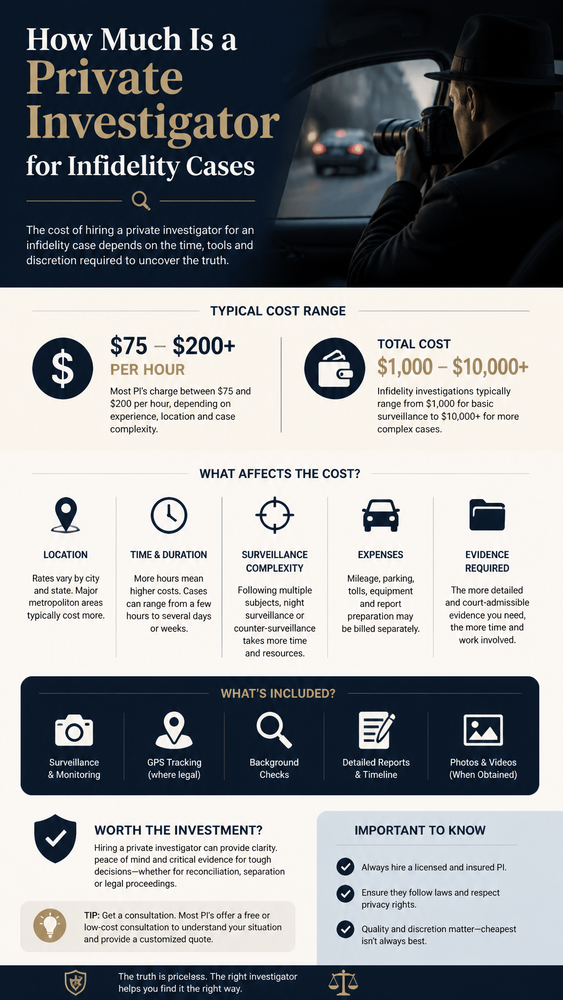
The short answer: most people spend somewhere between $2,000 and $6,000. Here’s what drives that number.
- Hourly rates run $85–$250 per hour, with $125–$200 being the most common range for experienced investigators. Rates at the lower end of that band typically reflect straightforward daytime surveillance in mid-sized markets.
- Typical case hours fall between 15 and 30 hours of surveillance over one to two weeks, though complex cases can reach 40 hours.
- Retainers are paid upfront and generally range from $500 to $5,000 depending on scope and location.
- Flat fees or packaged services exist but are less common. When offered, they usually cover a defined number of surveillance hours plus a written report.
- Additional expenses such as mileage, tolls, parking, and equipment use can add 20–30% to the base cost. A case budgeted at $3,000 in labor can land closer to $3,900 once those line items appear.
In high-cost urban markets like Manhattan, retainers alone often run $2,000–$3,500, with total case costs between $2,000 and $8,000.
What factors push private investigator fees higher or lower?
Cost isn’t random. Five variables account for most of the spread between a $1,500 case and a $10,000 one.
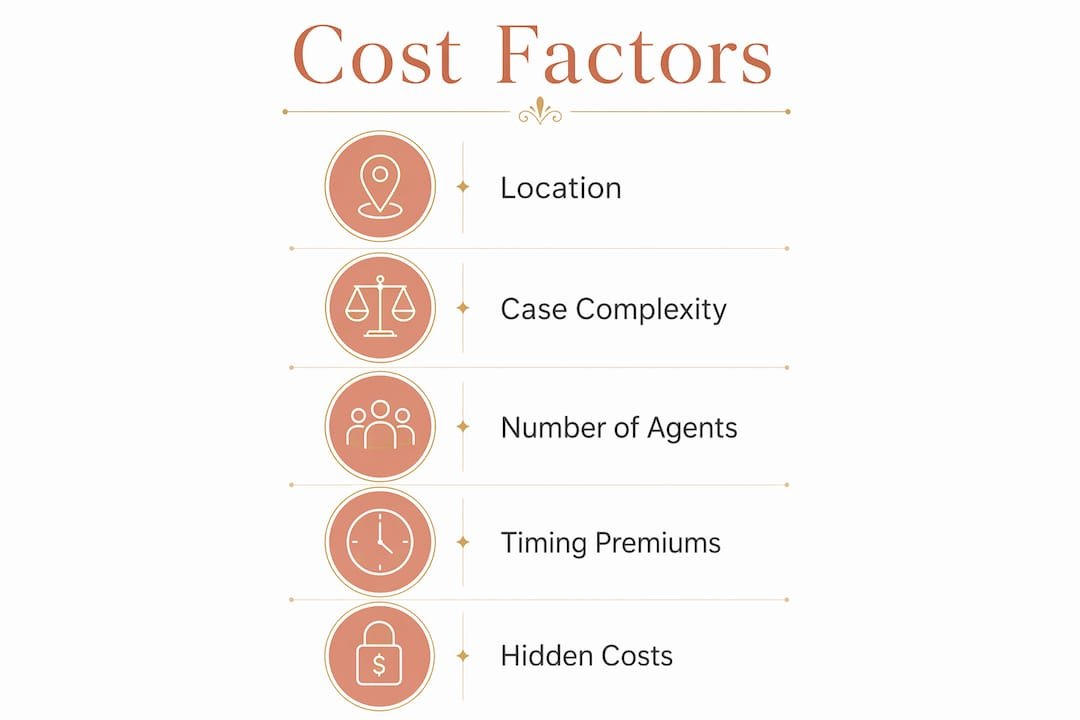
Location matters more than most people expect. Investigators in New York City, Los Angeles, and Miami charge significantly more than those in smaller metros, both because their overhead is higher and because demand supports it. A South Florida firm may charge $125 per hour, while a Manhattan agency billing two agents for the same case can run $300 per hour combined.
Case complexity is the biggest wildcard. A spouse with predictable routines who stays local is far cheaper to surveil than one who travels frequently, varies their schedule, or takes active counter-measures like switching vehicles.
Number of agents required changes the math fast. Reliable coverage in a busy urban environment often requires two investigators working in tandem, which doubles the hourly labor cost.
Timing adds a premium. Evening, weekend, and holiday surveillance typically costs more than standard business-hours work. If your spouse’s suspected activity happens on Friday nights, budget accordingly.
Hidden costs deserve their own line in your planning. Mileage reimbursement, toll charges, hotel stays for out-of-town surveillance, and specialized equipment fees are real and common. Ask for an itemized estimate before signing anything.
Legal considerations that affect your investigation and its costs
Surveillance is legal in all 50 states, but that doesn’t mean every piece of evidence collected will hold up in court. Admissibility varies by jurisdiction, and a divorce judge in Texas applies different standards than one in California.
- Evidence gathered without following proper documentation protocols can be challenged or excluded entirely.
- Clients who consult a family law attorney before hiring a PI avoid wasting money on evidence that serves no legal purpose.
- Investigators must maintain chain-of-custody records, timestamped photos or video, and detailed field notes to make their findings legally defensible.
- Low bids often signal shortcuts in documentation and procedure. An investigator who quotes half the market rate may deliver evidence that falls apart under cross-examination.
- If your goal is a favorable divorce settlement or custody arrangement, the quality of evidence matters as much as the fact of it.
Pro Tip: Before you hire anyone, spend one hour with a family law attorney. That conversation will tell you exactly what kind of evidence your jurisdiction requires, which shapes the entire scope and cost of the investigation.

How to choose and work with a private investigator effectively
The difference between a $3,000 case that delivers clear evidence and a $5,000 case that delivers nothing useful usually comes down to how you selected and briefed the investigator.
- Interview at least two or three investigators and ask each for a written estimate with a maximum cost cap.
- Verify licensing. Every state has its own PI licensing requirements; check your state’s licensing board directly.
- Ask specifically about experience with infidelity cases. General surveillance work is not the same skill set.
- Be honest about your budget upfront. Reputable investigators welcome that conversation and will tell you what’s realistic within your range.
- Insist on a written contract specifying the retainer amount, hourly rate, expense categories, and the approval process required before costs exceed the agreed cap.
- Expect regular updates during active surveillance. A professional won’t leave you in silence for days at a time.
Pro Tip: Share any behavioral patterns you’ve already noticed, such as specific days, locations, or times your spouse acts differently. Targeted investigations cost less and produce better evidence than open-ended surveillance with no starting point.
What does a typical infidelity investigation timeline look like?
Most cases run one to three weeks from the first day of active surveillance to the delivery of the final report. Here’s how that time breaks down.
- Week 1: Field surveillance begins. The investigator establishes the subject’s routine, identifies key locations, and begins documenting activity.
- Mid-investigation: Billing updates occur. If the retainer is running low and the case requires more hours, the investigator should contact you for authorization before continuing.
- Final phase: Documentation and reporting. The investigator compiles timestamped evidence, writes a formal report, and prepares materials for potential legal use.
- Extended cases: When a subject travels, changes routines, or requires multiple agents, timelines stretch and costs rise. It is wise to include a budget buffer to cover unexpected costs.
Court testimony, if required, is typically billed separately at the investigator’s standard hourly rate. That’s a cost many clients don’t anticipate.
Managing your emotional health while the investigation is underway
The financial cost of an infidelity investigation is real, but it runs alongside an emotional cost that’s just as significant. Waiting for answers while paying for surveillance is genuinely hard.
Integrating therapeutic support during this period isn’t a luxury. It’s a practical way to avoid making impulsive decisions based on partial information. The After the Affair Series offers evidence-informed frameworks for exactly this stage: the uncertainty before you know, and the clarity after. If you’re working through the early shock of suspected betrayal, coping strategies for infidelity can help you stay grounded while the investigation runs its course.
Avoid sharing investigation details widely. A small, trusted circle, or a professional therapist, is the right audience. Online marriage counseling after infidelity can also provide structured support for couples navigating this period together, regardless of what the investigation ultimately reveals.
Use the investigation outcome as a tool for informed decision-making, not as a trigger for immediate action. Whatever the findings, you’ll be in a better position to respond thoughtfully if you’ve had consistent support throughout.
How to budget for a private investigator in an infidelity case
Set a realistic ceiling before you sign anything. A practical budgeting approach:
- Get three written estimates with itemized expense categories, not just hourly rates.
- Add 25% to the highest estimate as your true budget ceiling. Hidden costs are the rule, not the exception.
- Clarify what the retainer covers. Some investigators apply the full retainer to hours worked; others treat part of it as a non-refundable administrative fee.
- Ask about partial refunds. If the case resolves faster than expected, a reputable investigator will return unused retainer funds.
- Separate the investigation budget from your legal budget. Attorney fees for a contested divorce can run into the tens of thousands. The PI cost is one line item in a larger financial picture.
- Don’t let price alone drive the decision. A $1,500 investigation that produces inadmissible evidence costs more in the long run than a $4,000 one that holds up in court.
Key Takeaways
Most infidelity investigations in the US cost several thousand dollars, with hourly rates varying and additional expenses possibly increasing the total cost.
| Point | Details |
|---|---|
| Typical cost range | Most infidelity investigations run $2,000–$6,000; complex cases can exceed $10,000. |
| Hourly rate range | Experienced investigators charge $85–$250 per hour, with $125–$200 most common. |
| Hidden expenses | Mileage, tolls, lodging, and equipment add 20–30% beyond the base hourly cost. |
| Written contract matters | Insist on a contract with a cost cap and an approval process before costs exceed the agreed amount. |
| Emotional support is parallel | Therapeutic resources like the After the Affair Series help you stay grounded during the investigation. |
FAQ
What is the average cost of an infidelity investigation in the US?
Most infidelity investigations run $2,000–$6,000; complex cases can exceed $10,000. Hourly rates and retainers vary widely, and cases involving travel or multiple agents may be substantially more expensive.
Is surveillance by a private investigator legal in all states?
Yes, surveillance is legal in all 50 states, but the admissibility of evidence varies by jurisdiction. Consulting a family law attorney before hiring a PI helps align the investigation with your legal goals.
How long does an infidelity investigation typically take?
Most investigations run one to three weeks of active surveillance, followed by documentation and reporting. Cases involving travel or unpredictable subjects can extend beyond that range.
What hidden costs should I expect when hiring a PI?
Mileage, tolls, parking, hotel stays for out-of-town surveillance, and equipment fees are common additions. These can increase the total cost by 20–30% beyond the quoted hourly rate.
How do I know if a private investigator is reputable?
Verify their state license, ask specifically about infidelity case experience, and insist on a written contract with a cost cap. A reputable investigator welcomes budget discussions and provides regular updates throughout the case.
Recommended
- Top 6 SurviveYourPartnersAffair.com Alternatives in 2026 – After the Affair Series
- Individual or Couples Therapy After Infidelity? – After the Affair Series
- Why Do Cheaters Stay? The Truth About What Your Spouse Really Wants – After the Affair Series
- Spotting the signs of infidelity: Key patterns and how to cope