Table of Contents
- Quick Comparison: Top Tools for Healing from Infidelity
- How We Evaluated These Tools
- 1. After the Affair Series: Structured Scripts for Setting Boundaries After Infidelity
- 2. Betrayal Trauma Recovery Steps: Infidelity ER App
- 3. T30: Daily Accountability and Trust Rebuilding
- 4. BetterHelp: Professional Therapy for Couples and Individuals
- 5. Free Peer Support: ISA, ShareWell, and Beyond Affairs Network
- Understanding Your Infidelity Recovery Timeline
Last Updated: August 17, 2026
Quick Comparison: Top Tools for Healing from Infidelity
Healing from infidelity requires structured support, practical tools, and access to expertise when you need it most. The right resource can mean the difference between staying stuck and moving forward.
This guide covers seven evidence-based options addressing different aspects of infidelity recovery: from structured communication scripts and daily accountability apps to professional therapy and peer support networks. Many people benefit from combining multiple approaches.
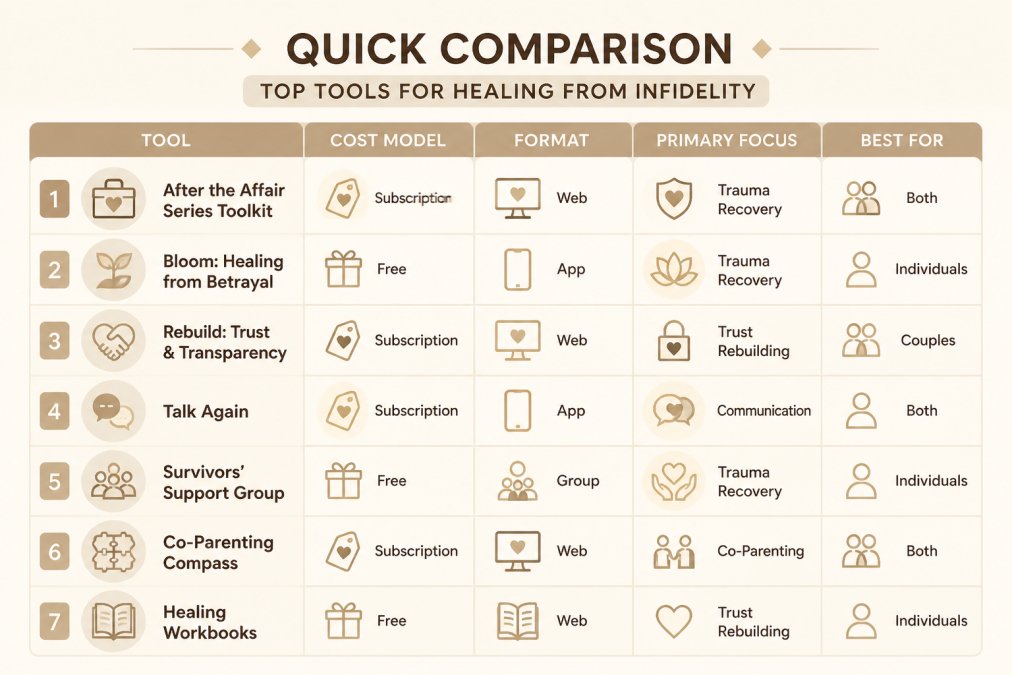
| Tool | Format | Cost | Primary Focus | Best For |
|---|---|---|---|---|
| After the Affair Series | Web toolkit | Pricing varies | Communication & co-parenting scripts | High-conflict situations & parenting |
| Infidelity ER | Mobile app | Subscription | Structured recovery phases | Couples actively rebuilding |
| T30 | Mobile app | Subscription | Daily trust rebuilding & transparency | Couples committed to reconciliation |
| BetterHelp | Online therapy | Subscription | Professional couples & individual therapy | Those seeking licensed therapist guidance |
| ISA (Infidelity Survivors Anonymous) | In-person/online groups | Free | Peer support & 12-step recovery | Individuals seeking community healing |
| ShareWell | Online groups | Free/Subscription | Peer support & emotional processing | Those needing immediate, accessible support |
| Beyond Affairs Network (BAN) | In-person/online groups | Free | Betrayal trauma peer support | Betrayed spouses in recovery |
How We Evaluated These Tools
We evaluated each option across six key criteria that align with what research and clinical practice tell us works during affair recovery.
Structured guidance reduces decision fatigue during chaos. Accessibility ensures you can reach support immediately, when you need it most. Cost spans the full spectrum so you can find what fits your budget. Flexibility for relationship status matters because different tools serve different decision points: deciding whether to stay, committed to reconciliation, or separated and co-parenting. Trauma-informed approach recognizes betrayal as genuine trauma rather than a communication problem. Practical application means you can deploy scripts and frameworks in real conversations immediately.
1. After the Affair Series: Structured Scripts for Setting Boundaries After Infidelity
If you’re navigating high-conflict interactions, After the Affair Series delivers structured, ready-to-use frameworks for moments when you need clarity.
The platform provides 50+ age-appropriate scripts for specific scenarios: telling your children, responding when your ex minimizes what happened, setting boundaries without escalating conflict. A free 23-point assessment scores your situation and points you toward relevant tools.
The Gray Rock Method, a technique for deflating hostile interactions by becoming emotionally unresponsive, is taught with specific language patterns. Rather than memorizing a concept, you get actual phrases to use when your ex baits you into conflict.
Most relationship guides offer broad principles ("communicate clearly," "set boundaries"). After the Affair Series gives you exact words for when your ex demands relationship details, when your child asks why a parent isn’t coming to an event, or when you need to refuse an unreasonable request without triggering escalation. For parents managing high-conflict co-parenting while healing from infidelity, this addresses a gap that therapy alone often misses.
After the Affair Series is most valuable if you’ve already decided about your relationship status.
2. Infidelity ER: Mobile App
Infidelity ER, created by a couples therapist specializing in affair recovery, structures the entire healing journey into five distinct phases. Each phase has specific emotional work, behavioral steps, and milestones.
The five-step process moves from immediate crisis stabilization through decision-making, active rebuilding, and finally integration into a new normal. Within each phase, the app provides advice, reflection prompts, journaling space, and the ability to submit personal questions to the therapist for guidance.
What distinguishes Infidelity ER is its recognition that affair recovery isn’t linear. The app acknowledges that you’ll cycle through emotions, that triggers will emerge months later, and that rebuilding trust is a marathon, not a sprint.
The app requires active engagement from both partners if you’re using it as a couple. If your partner isn’t willing to participate or is still in denial about the affair, the app’s effectiveness drops significantly.
The app offers a one-month automatic renewal subscription.
3. T30: Daily Accountability and Trust Rebuilding
T30 focuses on daily, visible actions that rebuild trust through transparency, emotional honesty, and consistent repair.
Each day, both partners complete check-ins: an emotion journal, an empathy journal, a deep journal for processing difficult feelings, and a tracking system for significant events. Selected information is visible to your partner to demonstrate honesty and give both of you evidence that repair is happening.
T30 integrates with location-sharing apps like Life360, but adds recovery context rather than surveillance. Location sharing alone feels like monitoring; T30 frames it within a larger pattern of transparency and repair, changing the emotional experience from "I’m being controlled" to "We’re both committed to rebuilding."
Couples who’ve already decided to reconcile and are actively working to rebuild trust. This tool is not for couples still deciding or where one partner is unwilling to engage.
The daily structure prevents the common pattern where couples do well for a few weeks, then slip back into old patterns. T30 offers monthly and yearly subscription options.
4. BetterHelp: Professional Therapy for Couples and Individuals
BetterHelp makes professional therapy accessible without the barriers of traditional therapy: no waiting lists, no geographic limitations, no rigid appointment times.
BetterHelp connects you with licensed therapists specializing in infidelity trauma, relationship repair, and individual healing. You can work individually or as a couple. Therapists use evidence-based approaches including Emotionally Focused Therapy (EFT) and the Gottman Method, both designed for couples working through affairs.
The platform offers flexibility: message your therapist between sessions, adjust appointment times, and switch therapists if needed. For couples, having a trained professional moderate difficult conversations prevents arguments from spiraling into blame and defensiveness.
BetterHelp’s effectiveness depends heavily on finding the right therapist. The platform lets you have an initial consultation before committing. If your first match doesn’t work, try a different therapist.
BetterHelp typically costs $70 to $100 per week, or $280 to $400 per month, depending on factors such as your location, preferences, and therapist availability. A subscription includes weekly live sessions, messaging with your therapist, and access to journaling tools and webinars. BetterHelp also accepts insurance with over 125 insurance plans, and eligible members’ average copay is $23 per session. Financial aid may be available for those who qualify, and BetterHelp accepts FSA/HSA cards.
5. Free Peer Support: ISA, ShareWell, and Beyond Affairs Network
Free peer support groups reduce isolation, normalize your experience, and connect you with people who truly understand what you’re going through.
Infidelity Survivors Anonymous (ISA) uses a 12-step model adapted from addiction recovery. The structure provides clear milestones and a community of people at different stages of healing. Meetings are facilitated by other survivors, creating a unique dynamic: you’re learning from people who’ve already walked the path you’re on. ISA is a non-profit 501(c)(3) organization.
ShareWell offers daily online peer support groups focused on infidelity. Unlike ISA’s 12-step framework, ShareWell is more open-ended: you share your story, listen to others, and gain perspective. Daily availability helps during the acute crisis phase. ShareWell offers a free plan that includes up to four groups monthly, and paid memberships for unlimited groups and other features.
Take the free 23-point assessment →
Beyond Affairs Network (BAN) specifically serves betrayed spouses. Founded by Peggy Vaughan, author of The Monogamy Myth, BAN focuses on the trauma experienced by the person who was betrayed. BAN is a network of free infidelity support groups.
Free peer support doesn’t replace therapy, but it reduces shame, connects you to community, and helps you feel less alone. Many people benefit from combining peer support with professional therapy.
The limitation is that peer support depends on the quality of the group facilitator and participants. If one group doesn’t feel right, try another.
6. Healing Families: Comprehensive Courses and Community
Healing Families bridges the gap between self-guided learning and professional therapy. The app offers transformative courses tailored for betrayed partners, unfaithful partners, and couples, including on-demand webinars, expert guidance, and access to a supportive community.
The courses cover managing emotions, rebuilding intimacy, understanding attachment patterns, and processing trauma. The community component reduces isolation by connecting you with others navigating the same journey.
Healing Families requires consistent engagement and works best for people who’ve moved past the immediate shock and are ready for deeper work.
7. After the Affair Book: Healing the Pain and Rebuilding Trust When a Partner Has Been Unfaithful
For those who prefer reading, After the Affair: Healing the Pain and Rebuilding Trust When a Partner Has Been Unfaithful by Janis Spring offers a comprehensive, expert-backed roadmap. Spring is a nationally recognized therapist specializing in infidelity.
The book walks both hurt and unfaithful partners through three stages of healing: normalizing the crisis, deciding whether to recommit, and rebuilding trust and intimacy. It includes a section addressing online affairs and provides concrete strategies for the unfaithful partner to earn back trust and for the hurt partner to open up to connection.
What makes this book different is that it acknowledges the genuine trauma of betrayal. It’s not about "communication skills"; it’s about processing a real injury and deciding whether repair is possible.
People who process information through reading, who want expert guidance without the cost of therapy, and who appreciate the depth that a book allows.
A book requires self-motivation. If you struggle with follow-through without external structure, pair this with another tool that provides accountability.
Understanding Your Infidelity Recovery Timeline
The tools for healing from infidelity work differently depending on where you are in the recovery process.
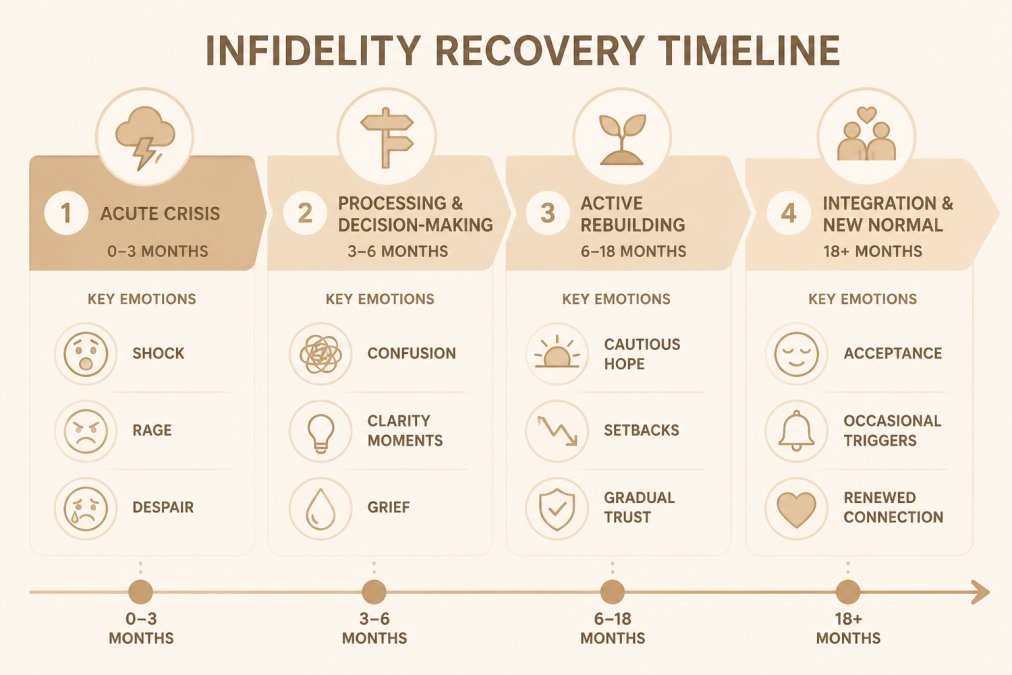
Phase 1: Acute Crisis (0-3 months). Discovery or disclosure of infidelity creates a genuine crisis. Your nervous system is in overdrive. You can’t sleep, can’t focus, and every detail of the affair plays on repeat. During this phase, you need immediate, accessible tools: daily peer support groups, crisis-focused apps like Infidelity ER that structure the chaos, and scripts for conversations you must have right now.
Don’t expect to do deep therapeutic work during this phase. Your brain is in survival mode. Tools that provide structure, reduce decision-making, and normalize what you’re experiencing matter most.
Phase 2: Processing and Decision-Making (3-6 months). As acute shock subsides, you face a critical question: do you want to try to rebuild this relationship, or do you want to leave? This phase is often the hardest emotionally because you’re cycling through hope and despair. You need tools that help you think clearly: individual therapy to process your own trauma, peer support to hear how others navigated this decision, and the After the Affair book to understand the landscape you’re navigating.
Many people need professional guidance during this phase. A therapist can help you distinguish between "I want to stay because I’m afraid to leave" and "I want to stay because I believe repair is possible."
Phase 3: Active Rebuilding (6-18 months). If you’ve decided to reconcile, this phase is about the actual work of rebuilding. You need tools that provide daily structure and accountability: T30 for couples, Infidelity ER for ongoing guidance, and ongoing therapy to process triggers and setbacks. Scripts from After the Affair Series become most useful here; you’re not in crisis, but you’re also not fully healed.
Betrayal trauma recovery isn’t linear. You’ll have weeks where things feel stable, then a trigger will send you backward. Tools that acknowledge this reality and help you navigate setbacks without losing hope are essential.
Phase 4: Integration and New Normal (18+ months). The affair becomes part of your history rather than the center of your present. You still have triggers, but they’re less frequent and less destabilizing. Peer support and insights from resources like Healing Families help you integrate the experience into a new understanding of yourself and your relationship.
Many people find they need different tools at different phases. You might start with peer support and crisis scripts, move into individual therapy and the After the Affair book, transition to couples work with T30 and BetterHelp, and eventually land on a combination of peer support and occasional professional guidance.
Healing from infidelity is possible with the right support at the right time. After the Affair Series provides the structured scripts and frameworks you need to navigate high-conflict moments with clarity and protect your peace while managing co-parenting or relationship decisions. Whether you combine it with peer support, professional therapy, daily accountability apps, or expert-backed books, the key is finding tools that match your current phase of healing and your specific needs. Take the free 23-point assessment to identify where you are in the recovery process, then choose the combination of tools that will support you through the journey ahead.
Frequently Asked Questions
How long does it take to heal from infidelity?
Healing from infidelity typically unfolds across 18-24 months, though the timeline varies significantly based on individual circumstances, the depth of betrayal trauma, and commitment to recovery work. The acute crisis phase lasts 3-6 months, followed by active rebuilding that extends 6-18 months. Many people report meaningful progress within 6-9 months of consistent work with tools for healing from infidelity, but full emotional integration and trust restoration often requires patience beyond the first year. Couples using structured approaches like daily accountability apps or therapy typically progress faster than those working alone.
What are the three phases of affair recovery?
The three primary phases are: (1) Crisis and stabilization, where the focus is managing acute emotional dysregulation and establishing basic safety; (2) Processing and decision-making, where you explore whether to reconcile or separate while addressing betrayal trauma recovery steps like understanding triggers and regulating your nervous system; (3) Rebuilding and integration, where couples or individuals work on restoring trust, renegotiating boundaries, and creating a new relational foundation. Each phase benefits from different tools: crisis apps for immediate support, therapy platforms for processing, and structured communication scripts for rebuilding.
Can I use these tools if my ex refuses to participate in recovery?
Yes. Many tools support individual healing independent of your partner's participation. Peer support groups like ISA and Beyond Affairs Network, therapy platforms like BetterHelp, and apps like Infidelity ER all work for solo recovery. If you're co-parenting, tools offering scripts for setting boundaries after infidelity help you manage hostile communication without requiring cooperation. However, couples-specific tools like T30 require both partners' active engagement. Focus on individual betrayal trauma recovery steps first, then decide whether reconciliation is viable based on your partner's willingness to engage in repair work.
Is there a difference between free support groups and paid therapy for infidelity recovery?
Free peer support groups (ISA, ShareWell, Beyond Affairs Network) provide community, validation, and shared experience from others navigating betrayal trauma, reducing isolation. They're accessible and immediate but don't provide clinical diagnosis or treatment planning. Paid therapy platforms like BetterHelp offer licensed therapists trained in infidelity recovery, trauma-informed approaches, and evidence-based methods like Emotionally Focused Therapy. Many people benefit from combining both: peer support for community and daily encouragement, plus professional therapy for processing complex trauma and developing personalized strategies. Your choice depends on your trauma severity, budget, and whether you need clinical intervention.
This article was written using GrandRanker