Yes, mutual infidelity recovery is possible, but only if both of you commit to parallel accountability, not a competition over who was worse. When both partners cheated, either at the same time, in sequence, or as retaliation, the path forward looks different from standard affair recovery, and most guidance out there doesn’t account for that. You each need to own your own actions while healing together, and that dual task is exactly why couples in this situation stall out or give up too soon.
Here’s what to do in the first 72 hours, before anything else:
- Stop all contact with outside partners immediately. No closure texts, no “just checking in,” no exceptions for either of you.
- Set a 20-minute transparency conversation, not a marathon confession session. Agree on basic facts (is it over, is there ongoing risk) without demanding every detail yet.
- Pause big decisions. Don’t file for divorce, don’t move out, don’t tell the extended family. Give yourselves two weeks before any irreversible move.
Two quick rules matter here. Don’t shame each other publicly, on social media, to mutual friends, or in front of kids, since that shame usually fuels the exact secrecy that caused the affairs. And don’t retaliate with a “revenge” affair or contact just to feel even; it resets the clock on both of your healing. Mayo Clinic’s guidance on infidelity recovery notes that marriages commonly survive affairs when both spouses commit to the work, avoid rushing decisions, and use structured accountability and counseling. Research on what’s called the “apologizer’s dilemma” also explains why couples where both partners cheated often freeze entirely, a pattern this article breaks down in detail below.
- Key Takeaways
- What Does Mutual Infidelity Recovery Actually Involve?
- Stabilize First: Safety, Transparency, and Short-Term Agreements
- Why Individual Reflection Has to Come Before Joint Talks
- How Do You Talk About It Without Both Blaming Each Other?
- What Real Remorse Looks Like When You Both Broke Trust
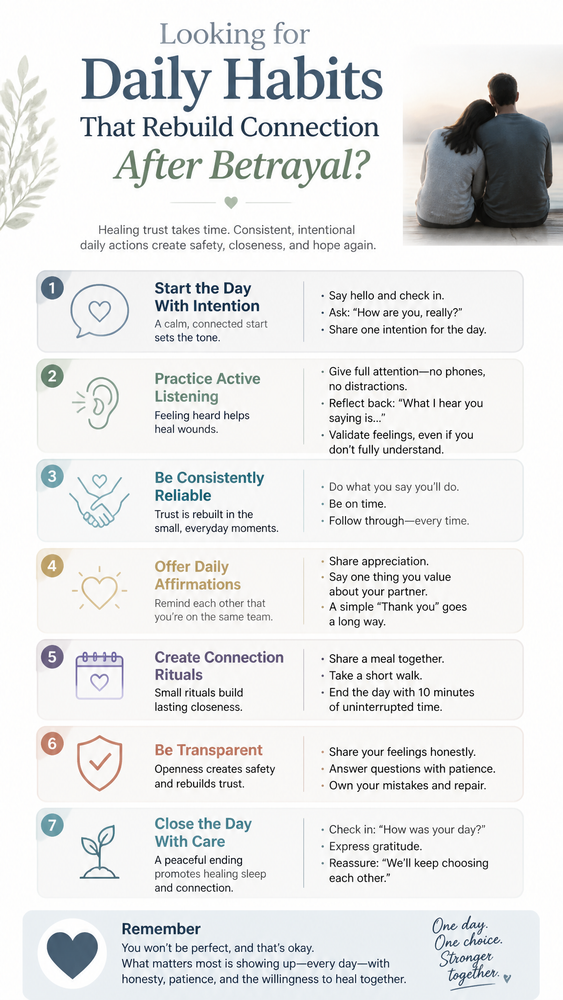
- Rebuilding Trust Through Daily and Weekly Habits
- When Should You Bring in a Therapist?
- Staying Together or Separating: How to Decide
- A 6-Week Recovery Plan You Can Start This Week
- Why Saying Sorry First Feels So Hard for Both of You
- An Editorial Note on Realistic Hope
- How Aftertheaffair Resources Support Each Stage
- FAQ
Key Takeaways
Mutual infidelity recovery succeeds when both partners take parallel individual accountability while building shared safety and transparency through consistent, verifiable actions over months, not days.
| Point | Details |
|---|---|
| Stop contact within 72 hours | End all contact with outside partners immediately and pause major decisions for two weeks. |
| Do individual work before joint talks | Draft private apology statements and process shame separately before major joint conversations. |
| Use a no-blame meeting structure | Set a time limit, a goal, and a timeout protocol so conversations don’t become blame contests. |
| Verify accountability, don’t just trust promises | Map each commitment to a concrete verification method and a realistic timeline. |
| Get structured support early | A program like Aftertheaffair’s 7 Steps checklist or a trauma-informed therapist reduces guesswork in the hardest weeks. |
What Does Mutual Infidelity Recovery Actually Involve?
Mutual infidelity recovery means both partners simultaneously repair their own damaged trustworthiness while jointly rebuilding a shared sense of safety, and it fails most often when couples skip the individual half and jump straight to “let’s just move past it.” That shortcut leaves both people carrying unprocessed shame, which resurfaces later as defensiveness or score-keeping.
The standard infidelity recovery model assumes one betrayed partner and one unfaithful partner. That framework breaks down fast when both people cheated, because there’s no clear injured party to comfort and no clear offender to hold accountable. Instead, you have two people who each need to apologize, and two people who each deserve an apology. That double role is disorienting, and it’s why couples in this exact situation often describe feeling stuck in a way that standard “how to recover from cheating” advice doesn’t address.
Clinicians who work with these couples describe two common patterns: parallel infidelity, where both partners cheated independently without knowing about the other’s affair, and retributive infidelity, where one partner cheated in response to discovering the other’s affair. The emotional dynamics differ between the two, but the recovery mechanics overlap: both require mutual acceptance of responsibility, both require slower rebuilding than either partner wants, and both can succeed.
Stabilize First: Safety, Transparency, and Short-Term Agreements
Before you talk about why the affairs happened, you need to stop the bleeding. That means eliminating ongoing contact with outside partners and creating a predictable baseline neither of you has to guess about day to day.
Stop these immediately, without negotiation:
- Any ongoing contact, secret or otherwise, with the person or people involved in either affair.
- Deleting messages, browser history, or financial records related to the affairs (this destroys the transparency you’ll need later).
- Discussing the affairs with mutual friends or family before you’ve agreed together on what to share.
- Using the affair as a weapon in unrelated arguments (“well, at least I didn’t…”).
Once contact is cut off, agree on a short-term safety checklist. This isn’t about permanent surveillance. It’s a temporary structure that lowers anxiety while trust rebuilds.
- Phone and account access: agree on what’s shared and for how long, and set a review date (30 or 60 days) rather than an open-ended arrangement.
- Location transparency for a defined window, not indefinitely.
- A no-contact list covering both affair partners and anyone who actively enabled the affairs.
- A daily check-in, even a two-minute one, so silence doesn’t become the default.
Full disclosure is where most couples get this wrong in one of two directions: total avoidance or total interrogation. Neither works. A measured approach to disclosure tends to protect both partners better than either extreme, since too little information breeds suspicion and too much detail can retraumatize without adding safety.
Pro Tip: Write your transparency agreement down, literally on paper, with both signatures. Verbal agreements evaporate under stress, and a written one gives you something neutral to point back to when memory gets fuzzy or tempers flare.
If either of you feels physically unsafe, or if there’s any pattern of coercive control, this is the point to involve a domestic-safety professional or attorney before continuing couples work.
Understanding the pattern is not the same as breaking it
You Can Explain Why This Happened. Can You Explain Why You’re Still Stuck In It?
Most people in affair recovery can narrate their entire situation with total clarity, the timeline, the triggers, the whole story, and still find themselves back in the same spiral by evening. Insight was never the missing piece. This free assessment shows you exactly where the gap actually is.
Take the Free Affair Recovery Clarity Check →A few honest questions · a scored result · 4 minutes · free
Why Individual Reflection Has to Come Before Joint Talks
Each of you needs private processing time before you sit down together, because shame and guilt distort what you say in the moment. A partner drowning in shame either shuts down completely or overcorrects into a defensive, blame-shifting monologue, and neither version produces a useful conversation.
Individual reflection isn’t about assigning yourself a punishment. It’s about understanding your own role clearly enough that your eventual apology means something. A few structured exercises help:
- Journaling prompts: What need was I trying to meet outside the relationship? What did I tell myself to make the affair feel justified? What would I need to see from my partner to feel safe being vulnerable again?
- A single-person worksheet that separates facts (what happened, when) from interpretations (what I think it means about us) and feelings (what I feel right now, without editing).
- An accountability statement draft, written alone first, before either of you speaks it out loud.
Draft your apology privately before you say it to your partner. A workable structure, drawn from effective apology frameworks used in relationship repair, names the specific behavior, takes responsibility for that behavior without redistributing blame onto your partner’s actions, and includes a concrete plan for what changes going forward. “I’m sorry you feel hurt” isn’t an apology. “I hid my phone from you for three months and lied about where I was on Thursdays; I’m ending that pattern by sharing my location and being reachable” is closer.
If one of you isn’t ready, drafting an apology and immediately breaking down, refusing to engage, or minimizing what happened, pause the joint conversations. Pushing forward before someone can hold their own responsibility usually produces a worse fight, not a breakthrough. Workbook-based exercises can give you a slower, private on-ramp if a straight conversation feels like too much too soon.
How Do You Talk About It Without Both Blaming Each Other?
You need ground rules before your first real conversation, or it turns into a tit-for-tat accounting of who did worse. A workable meeting structure looks like this:
- Set a time limit (45 to 60 minutes) and a facilitator role, even if that’s just whoever isn’t currently the most upset that day.
- Open with a single statement each, no rebuttals allowed yet: “Here’s what I need you to understand about my experience.”
- Name one specific goal for the session (understanding the timeline, agreeing on a boundary, planning next week) rather than trying to resolve everything.
- Close with one action item each, something concrete you’ll each do before the next conversation.
Scripts help more than most couples expect. Instead of “You did this to me first,” try “I felt alone before this happened, and I made a choice I regret. I also need you to hear how much your affair hurt, separately from mine.” Separating the two truths, both of you caused harm, both of you were also hurting, keeps the conversation from collapsing into a scoreboard.
Build in a timeout protocol. If either partner’s heart rate spikes, voice rises, or the conversation starts repeating itself, call a 20-minute break with a firm agreement to return. The rule that makes this work: whoever calls the timeout is responsible for restarting the conversation, not letting it die.
- Use “I” statements for your own experience, not accusations about your partner’s character.
- Avoid raising the affairs during unrelated arguments about chores, money, or parenting.
- If the same fight repeats three or more times without progress, bring in a neutral third party rather than continuing alone.
The Partner Accountability Conversation Guide provides scripted versions of these exact conversations, which takes some of the improvisation pressure off when emotions are running high.
What Real Remorse Looks Like When You Both Broke Trust
Genuine remorse names specific behavior and offers a concrete change; strategic apologies stay vague and hope the conversation moves on quickly. The difference matters enormously here because both of you will be tempted, consciously or not, to apologize in a way that minimizes your own responsibility while your partner is still mid-confession.
A strategic apology sounds like “I know I messed up, but you weren’t exactly innocent either.” A genuine one sounds like “I lied to you for four months about where I was, and that betrayal was mine alone to own, regardless of what else was happening between us.” The second version doesn’t excuse your partner’s affair; it just refuses to use it as cover.
An accountability checklist for two-sided betrayal includes specific statements about what happened (not vague admissions), concrete behavior changes with a timeline attached, and a way for your partner to verify the change is actually happening rather than just promised.
| Promise | Verification Method | Timeline |
|---|---|---|
| Ending contact with affair partner | Shared, reviewable phone or message log for an agreed window | Immediate, reviewed at 30 days |
| Being reachable and transparent about whereabouts | Daily check-in text or shared calendar | Ongoing for first 90 days, then renegotiate |
| Addressing the root cause (loneliness, resentment, etc.) | Individual therapy attendance, discussed weekly | Weekly for several weeks |
| Rebuilding emotional openness | Weekly structured check-in conversation | Ongoing, reassessed at 90 days |
Here’s what balanced reciprocal accountability can look like in practice. One partner, we’ll call them Partner A, had an affair that started as an emotional connection with a coworker. Partner B found out and, within weeks, started an affair of their own out of hurt and a need to feel desired again. In their recovery, Partner A didn’t say “at least I didn’t retaliate.” Instead, each partner wrote out their own specific timeline of choices, read it aloud without interruption, and then asked directly: “What do you need from me to believe I’m not going to repeat this?” Neither minimized the other’s pain by pointing to their own.
Recovery in these cases isn’t about deciding whose betrayal counts more. It’s two separate repair processes running side by side, each one incomplete without the other.
Explore how reciprocal apologies support long-term relationship growth if you want a deeper framework for structuring these exchanges over time.
Willpower was never the problem
You’ve Said No Contact Before. What Made It Fail Last Time?
It usually isn’t willpower. It’s a loophole nobody accounted for, a second number, a mutual friend, a platform nobody thought to block. This free audit maps all 47 known workarounds so the boundary holds on its own, without relying on you to be strong enough every single time.
Get the Free Loophole Elimination Matrix →47-point audit · instant download · free
Rebuilding Trust Through Daily and Weekly Habits
Trust doesn’t return from one big gesture. It rebuilds through hundreds of small, boring, predictable actions repeated over weeks. That predictability is the actual mechanism, not the size of any single apology.
Micro-commitments work better than grand promises because they’re verifiable in real time:
- A shared calendar both of you actually check, not just install and ignore.
- A nightly two-minute check-in: one good moment, one hard moment, no problem-solving required.
- A standing weekly time, same day, same hour, to talk about how the recovery itself is going.
A sample weekly structure for the first six to eight weeks:
- Monday: Five-minute morning check-in about the week ahead.
- Wednesday: Longer conversation (20 to 30 minutes) covering how the week is going emotionally.
- Friday or Saturday: One shared activity with zero affair-talk allowed, just reconnecting as people.
- Sunday: Brief review: did we keep our agreements this week? What needs adjusting?
Physical intimacy usually lags behind emotional repair, and rushing it tends to backfire. Reintroduce touch gradually and with explicit consent checkpoints. Non-sexual touch first (a hand on the back, sitting close on the couch) rebuilds comfort before anything more happens, and either partner should be able to pause without it becoming a rejection narrative.
Social fallout needs its own plan. Decide together, in advance, what you’ll tell family and friends, and agree on a shared, brief script rather than letting each of you improvise separately under pressure. Something like “We’re working through a hard chapter together and we’re not looking for outside opinions right now” closes the door on unwanted commentary without over-explaining.
Recovery experts consistently point out that healing timelines run longer than couples expect, often stretching well past the first few months, which is one reason rushing the process, especially the intimacy piece, tends to backfire.
When Should You Bring in a Therapist?
Bring in professional support early rather than after months of stalled progress, especially since two-sided betrayal is more complex than the standard infidelity case most self-help content addresses. A few therapeutic paths tend to work well:
- Emotionally focused therapy (EFT), which targets the attachment wounds underneath the betrayal rather than just litigating events.
- Trauma-informed couples therapy, useful when either partner shows signs of trauma responses (hypervigilance, dissociation, intense triggers) alongside the relationship work.
- Individual trauma therapy, often necessary before or alongside couples work if one partner’s shame or anger is too dysregulated for joint sessions to be productive.
- Structured recovery programs, workbook-based or guided, for couples who want a self-paced middle ground between DIY and full therapy.
Questions worth asking a prospective therapist:
- Have you worked with couples where both partners were unfaithful, specifically, not just standard one-sided affairs?
- How do you handle sessions where both partners need to process their own guilt at the same time?
- What’s your approach if one partner isn’t ready to reconcile at the same pace as the other?
Prioritize individual therapy first if either partner shows signs of untreated trauma, active substance use, or ongoing deception, since joint sessions can’t do much good on an unstable foundation. And if you notice active abuse, threats, or ongoing infidelity during recovery, that’s a signal to prioritize safety and legal guidance over relationship repair work. Sequencing individual and couples therapy correctly makes a measurable difference in how fast couples actually stabilize. A dual approach that pairs individual and joint care tends to outperform either track alone, and it’s worth asking any therapist you interview whether they structure care this way.
Staying Together or Separating: How to Decide
Use a structured checklist rather than deciding in the heat of an argument or the glow of a good week, since both extremes distort judgment. Ask honestly:
- Has all outside contact actually stopped, verifiably, not just promised?
- Is accountability consistent, or does it only show up right after a fight?
- Do you both feel physically and emotionally safe in the relationship as it stands today?
- Are you both willing to change specific behaviors, not just apologize for them?
- Do you share real goals beyond just avoiding divorce, staying for kids, or fearing the alternative?
Build in checkpoints rather than deciding everything at once:
- 30 days: Has the immediate safety plan held? Any relapses in contact or honesty?
- 90 days: Is there evidence of sustained behavior change, not just words?
- 180 days: Do you both feel meaningfully closer, or has progress plateaued?
Separation may be the healthier path if accountability never becomes consistent, if one partner treats the recovery process as a formality rather than real change, or if safety concerns persist despite agreements. If that’s where you land, plan a less adversarial split by agreeing on shared values upfront (co-parenting approach, financial fairness) before lawyers get involved, which tends to reduce long-term conflict for everyone, especially kids.
If children are involved, keep decision-making separate from their daily stability as much as possible; kids don’t need to know the details, they need consistent routines. Financial and legal realities (joint debts, custody arrangements, housing) deserve their own conversation with a professional, not a decision made in the middle of an emotional conversation about the affairs themselves. Some couples also weigh this against a history of repeated infidelity, which changes the calculus around how many chances feel reasonable.
Reading this won’t change tomorrow’s message
You Know the Tactic Now. Do You Know What You’ll Actually Do When It Lands?
Understanding grey rock is not the same as doing it at 9pm when your phone buzzes. Most parents can explain the theory perfectly and still bite the bait every single time. The gap between the two is exactly what the free self-check measures.
Get Your Ex Out of Your Head →5 scenarios · scored result · 4 minutes · free
A 6-Week Recovery Plan You Can Start This Week
Structure removes a lot of the guesswork that makes early recovery feel chaotic. Here’s a sample plan, adaptable to your specific timeline:
| Week | Objective | Partner Tasks |
|---|---|---|
| 1 | Stabilize and stop harm | Cut outside contact, set transparency agreement, schedule first joint conversation |
| 2 | Individual reflection | Complete private journaling prompts, draft individual apology statements |
| 3 | First joint accountability conversation | Use meeting template, exchange draft apologies, agree on one micro-commitment each |
| 4 | Build daily structure | Start nightly check-ins, begin shared calendar, address any relapses immediately |
| — | Address root causes | Begin or continue individual therapy, discuss what each affair was actually meeting a need for |
| 6 | Reassess and plan forward | Review 30-day checkpoint, adjust agreements, set 90-day goals together |
A daily check-in script that works for most couples: “One thing that felt good today, one thing that was hard, one thing I need from you tomorrow.” Keep it under five minutes so it doesn’t become another source of dread.
An accountability log doesn’t need to be complicated. A shared notes app or a shared physical notebook works fine. Log the date, the commitment, whether it was kept, and one honest sentence about how it felt. Setbacks belong in the log too; hiding a slip defeats the entire purpose of the exercise.
If progress stalls by week four, that’s not a failure signal, it’s information. It usually means one partner needs more individual support before the joint work can move forward, and that’s worth naming directly rather than pushing through a conversation that isn’t landing.
Why Saying Sorry First Feels So Hard for Both of You
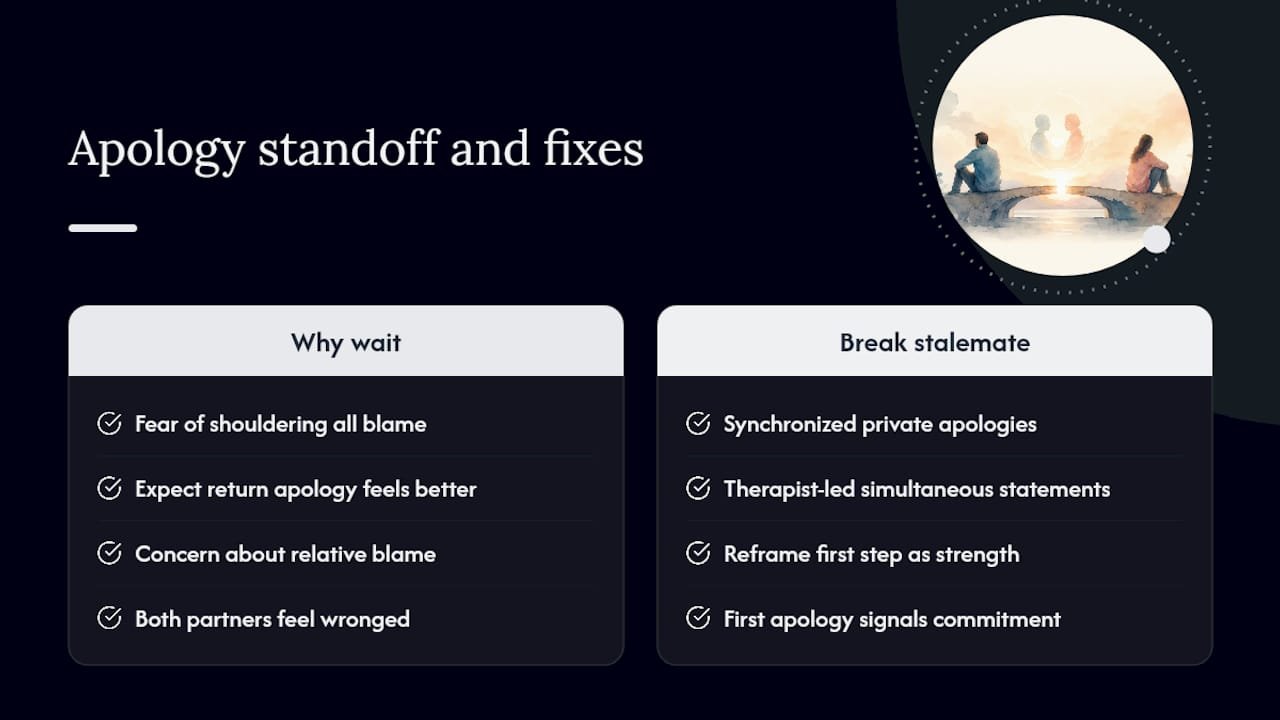
Neither of you wants to apologize first because doing so feels like accepting all the blame, even when you both know the other person also cheated. This isn’t a character flaw. It’s a documented pattern researchers call the apologizer’s dilemma, and understanding the mechanics behind it makes it much easier to break.
Research from multiple pre-registered studies found that people are less likely to apologize for their own part in two-sided conflicts, largely because they expect a return apology to feel better than simply being forgiven. That expectation creates a standoff: both people wait, hoping the other moves first, and the research documenting this pattern shows it holds up consistently across different conflict types.
Waiting for the other person to apologize first often isn’t about righteousness. It’s a quiet fear of shouldering all the relative blame if your apology lands first and theirs never comes.
A Chicago Booth Review summary of this research frames the core issue as relative blame concern: people don’t just care about being forgiven, they care about how the blame gets distributed between the two parties. In a mutual infidelity situation, that concern is amplified, since both partners have very real, very personal reasons to feel wronged.
Practical coordination moves break the stalemate. A synchronized apology, where both partners write their statements privately and exchange them at the same moment, removes the fear of going first alone. A mediated version, where a therapist facilitates simultaneous accountability statements in session, works well when trust is too shaky to try this unsupervised. Therapist-recommended strategies for this exact situation frame taking the first step not as weakness but as relational strength, a framing that tends to shift how partners approach the moment.
Clinically, going first often signals more commitment to repair than caution does, since the partner who apologizes first is demonstrating exactly the vulnerability the relationship needs to move forward.
An Editorial Note on Realistic Hope
Couples in mutual infidelity situations often arrive expecting either total collapse or a clean, fast resolution, and neither expectation matches what recovery actually looks like. The realistic version sits in between: slower than either partner wants, uneven across weeks, and ultimately different from the relationship you had before, not a restoration of it.
Structured programs and therapist support matter more here than in standard one-sided affair recovery, precisely because there’s no clear script for two people who each need to apologize and forgive at the same time. Without some kind of external structure, whether that’s a workbook, a program, or a clinician, couples tend to default to whichever partner is more articulate or more wounded in a given week, which skews the process unfairly.
Consider a couple where both partners had brief affairs within the same six-month period, discovered independently rather than through confrontation. Their early sessions were dominated by comparing severity: an emotional affair versus a physical one, a one-time lapse versus a monthslong pattern. The turning point came when their therapist redirected them away from ranking the affairs and toward a shared question: what did each of you need that you weren’t getting, and are you both willing to build that together now? That reframe didn’t erase what happened. It gave them something to build toward instead of something to keep measuring.
Recovery here isn’t about who suffered more. It’s about whether two people can hold their own accountability steady long enough for trust to regrow on both sides at once.
How Aftertheaffair Resources Support Each Stage
Most guidance on this topic assumes a single unfaithful partner, which leaves couples doing mutual repair without a script that matches their actual situation. Aftertheaffair built its resources around the recovery stages this article covers, with tools designed for exactly the dual-accountability work two-sided betrayal requires.

The 7 Steps-Infidelity Recovery Checklist maps directly onto the stabilization and early accountability phases covered above, giving you a concrete sequence instead of guessing what comes next after the first hard conversation. For the joint conversations themselves, the Partner Accountability Conversation Guide supplies the scripts and meeting structure this article outlines, already written out so neither of you has to improvise mid-argument. And if private processing is where you’re stuck, The Clarity Accelerator: A 21-Day Guided Evidence Journal walks you through the individual reflection work day by day, with prompts built for exactly the shame-and-guilt terrain that individual work requires.
Couples working through this together can start with the checklist for a clear entry point; therapists and coaches supporting clients through mutual betrayal may find the professional guide for clinicians a useful companion resource for structuring sessions.
Sources
Couples wanting a clinical overview of infidelity recovery should start with Mayo Clinic’s guidance on mending a marriage after an affair, which lays out accountability, counseling, and trust-restoration steps in plain language.
For understanding the apology stalemate specifically, the original preprint on apologizing in two-sided conflicts is the primary research, while the Chicago Booth Review summary offers a more accessible breakdown for readers who want the findings without the full study. Therapists and coaches may prefer the research-heavy version; couples generally find the Booth Review summary easier to apply directly.
Couples navigating the emotional complexity of both having cheated may also find value in this counseling-oriented discussion of mutual infidelity, which covers grieving the old relationship as part of moving forward.
For structured next steps, Aftertheaffair’s Book 1, Navigating Infidelity offers an accessible starting point for the first months after discovery, and the full program landing page is available if you’re not sure which resource fits your situation yet.
This article is general information, not a substitute for advice from a qualified doctor. Consult a qualified healthcare professional about your own circumstances before acting on anything here.
- Apologizing in two-sided conflicts — preprint
- What prevents us from saying sorry — Chicago Booth Review
- Infidelity: Mending your marriage after an affair — Mayo Clinic
- When both partners are hurting: saying sorry first — Heartfelt Counseling
FAQ
What are the six stages of healing after infidelity?
Recovery typically moves through stabilization, individual reflection, joint accountability, trust rebuilding, reassessment, and long-term growth, though couples rarely move through these in a straight line, and mutual infidelity often means both partners cycle through the early stages more than once.
Is it true that a marriage is never the same after infidelity?
The relationship does change permanently, but “different” doesn’t mean worse; many couples describe the post-recovery relationship as more honest and more resilient than the one they had before, particularly when both partners commit to real accountability rather than just avoiding a repeat.
What does accountability look like after infidelity?
Real accountability names the specific behavior that caused harm, takes responsibility without shifting blame onto the other partner’s actions, and includes a concrete, verifiable plan for change, not just an apology and a promise to do better.
How do you heal from infidelity trauma in a marriage?
Healing combines stopping ongoing harm immediately, individual processing of shame and anger, structured joint conversations with clear rules, and professional support such as trauma-informed couples therapy or a guided program like Aftertheaffair’s recovery checklist when the work stalls without outside structure.
Why is it so hard to apologize first when both partners cheated?
People often wait to apologize when a conflict feels two-sided because they fear accepting more than their fair share of blame unless the other person apologizes too, a pattern researchers documented across multiple studies on two-sided conflict; coordinated or therapist-mediated apologies help break that standoff.
Recommended
- Relationship Growth After Infidelity – After the Affair Series
- How to Guide Clients After Infidelity for Healing – After the Affair Series
- Online Affair Recovery for Couples – After the Affair Series