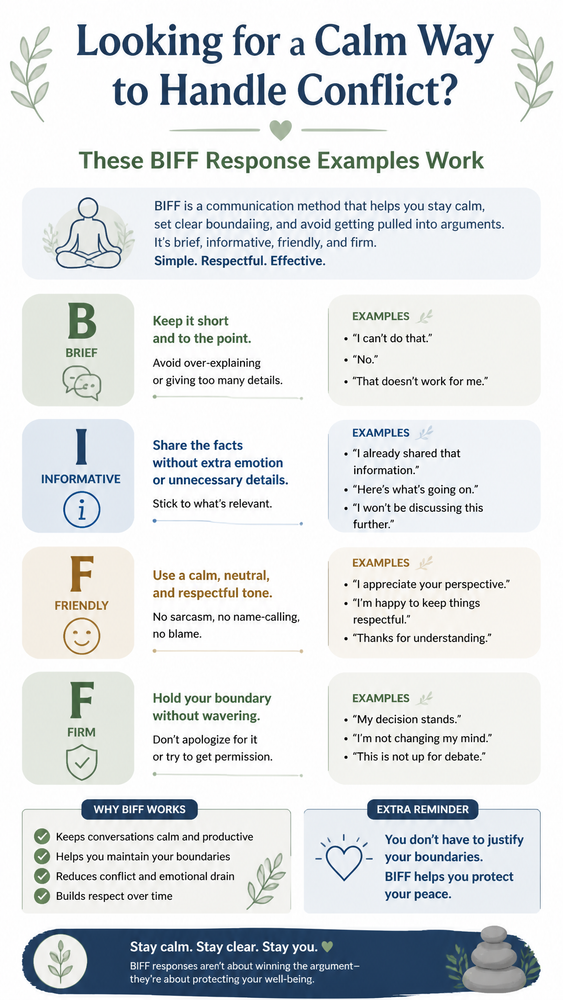
BIFF stands for Brief, Informative, Friendly, and Firm, a four-line filter for answering hostile texts, emails, and posts without feeding the fight. The rule is simple: reply only when facts need correcting, a deadline is on the table, safety is involved, or a wider audience will otherwise take misinformation as truth. Everything else can go unanswered. Below are copy-ready scripts for the situations where a reply actually matters. These are essential BIFF response examples for family, co-parenting, or work scenarios.
- What Does BIFF Communication Mean?
- BIFF Response Examples for Family, Co-Parenting, Work, and Public Accusations
- How to Draft a BIFF Response Step by Step
- Practice Tips and Common BIFF Mistakes
- Why BIFF Works: Evidence and Support
- What Most Advice on BIFF Gets Wrong
- Practice BIFF Scripts With Aftertheaffair’s Recovery Resources
- FAQ
TL;DR:
- Respond only to factual errors, deadlines, safety concerns, or when messages could be misused, avoiding unnecessary replies to hostile messages.
- Keep responses brief, typically three to five sentences, with a friendly opening, clear facts, a limited request or firm closure, and a neutral sign-off.
- Always run the Three A’s check—no advice, no admonishments, no apologies—before sending to prevent escalation or turning a calm reply into a new argument.
- Delay replying at least 24 hours if the message is non-urgent and review your draft aloud to catch defensive language or unnecessary justification.
- Use scripted templates for recurring situations and avoid over-explaining, trying to prove your point, or apologizing out of habit to maintain calm, firm communication.
What Does BIFF Communication Mean?
BIFF was developed to stop the back-and-forth that hostile emails and texts tend to provoke, and each letter does a specific job:
- Brief: Say only what’s needed, usually three to five sentences, so there’s nothing extra for the other person to grab onto and argue with.
- Informative: State facts, not feelings or judgments about the other person’s behavior.
- Friendly: Open with something neutral or warm, because tone is contagious and a calm opener often pulls the other person’s next message down a notch.
- Firm: Close the loop. No invitation for round two.
Most hostile messages carry no real consequence if ignored, and replying often just hands the sender more attention and more fuel. Reply only when incorrect facts might get recorded or repeated to people who matter: a boss, a court, a co-parent’s lawyer, a group of colleagues. Before you draft anything, run a Three A’s check: no Advice, no Admonishments, no Apologies. That single filter catches most of what turns a calm reply into a second argument.
BIFF Response Examples for Family, Co-Parenting, Work, and Public Accusations
Each script below follows the same shape: neutral opener, one or two facts, a limited request or clean close, and a friendly sign-off. Adjust names and specifics, but keep the structure intact.
Angry family text. “Thanks for letting me know you’re upset. I hear you’d like more notice about visits. Going forward I’ll text you the weekend before so we can plan around it. Talk soon.” This works because it skips the guilt-trip entirely and answers with a concrete fix instead of a defense.
Co-parenting handoff conflict. “Got your message about pickup time. Friday works better for me at 5:30 given the school schedule; let me know if that’s fine on your end. Hope the week goes smoothly.” Naming a specific time closes the argument before it starts, since there’s nothing vague left to dispute.
Guilt-tripping ex. “I understand you see it differently. I’ll have the kids ready by 6pm Saturday as planned. Have a good weekend.” Note the firm ending: no justification, no reopening old history, just the plan restated and the door closed.
Work accusation copied to others. “Thanks for flagging this. For clarity, the report was submitted on March 3, ahead of the March 5 deadline; happy to resend the confirmation email if useful. Best.” Because this reply lives in a thread others can see, the priority is the fact, not persuading the sender you’re right.
Public accusation or group post. “Appreciate people weighing in. For accuracy: the schedule change was approved by the board on January 12, and the minutes are posted in the shared folder. Happy to answer specific questions there.” When an audience is watching, a factual correction placed on the record matters more than winning the sender over, since the point is to stop the wrong version from hardening into what people remember.
Pro Tip: Save your best line from each context in a notes app. When a hostile message lands at 11pm and you’re tired and angry, you edit a template instead of drafting from scratch.
Correct facts only when they’ll be seen by someone other than the sender, an HR file, a group thread, a court record. If it’s a private vent with no audience and no deadline, silence is often the stronger BIFF.
Reading this won’t change tomorrow’s message
You Know the Tactic Now. Do You Know What You’ll Actually Do When It Lands?
Understanding grey rock is not the same as doing it at 9pm when your phone buzzes. Most parents can explain the theory perfectly and still bite the bait every single time. The gap between the two is exactly what the free self-check measures.
Get Your Ex Out of Your Head \→5 scenarios \· scored result \· 4 minutes \· free
How to Draft a BIFF Response Step by Step
A workable BIFF template runs three to five sentences: (1) a neutral or friendly opener, (2) one or two facts stated plainly, (3) a limited request or a firm close, (4) a neutral sign-off. Nothing more.
Before sending, run the Three A’s self-audit:
- No Advice. Cut “you should have called first” and replace it with the fact: “the call happened at 3pm.”
- No Admonishments. Cut “that wasn’t fair of you” and just state what happens next.
- No Apologies. Skip “sorry, but” openers; they invite the other person to argue the apology itself.
Coaching questions from the Columbia Ombuds guidance work as a final pass: is it brief, is it informative, is it friendly, is it firm, and does any line sneak in advice, an admonishment, or an apology? Read the draft aloud once before sending. If a sentence sounds like it’s trying to win an argument, cut it.
Practice Tips and Common BIFF Mistakes
Most BIFF failures aren’t about ignorance of the method, they’re about drafting while angry. Build these habits instead:
- Delay 24 hours on anything non-urgent before you write a word.
- Read the draft aloud. If it sounds defensive, it will land as defensive.
- Keep three template lines saved for recurring situations (a late pickup, a missed deadline, a factual correction) so you’re editing, not composing, under stress.
- Have someone else read it first when the stakes are high, a coach, friend, or therapist catches the line you can’t see because you’re inside the conflict.
The three mistakes that sink a BIFF every time: over-explaining (adding a sixth sentence justifying yourself), trying to win (slipping in one line meant to prove the other person wrong), and apologizing out of habit rather than necessity. Cut all three and most drafts get shorter and calmer at the same time.
Why BIFF Works: Evidence and Support
BIFF’s structure isn’t guesswork. The Three A’s self-audit from Columbia Ombuds exists because removing advice, admonishments, and apologies often matters more than anything you add, and the High Conflict Institute’s guidance backs the one-paragraph rule and the reply-only-when-necessary principle used throughout this piece.
Aftertheaffair.uk builds on that same practical footing, with structured scripts and step-by-step recovery resources for people navigating exactly this kind of high-conflict written contact:
- Scripted, trauma-aware communication tools built for betrayal and co-parenting conflict
- A resource library spanning survival, decision-making, transformation, and growth stages
- Guided protocols for boundary-setting alongside communication scripts
One limit worth naming plainly: BIFF is a communication technique, not therapy. If messages involve threats, abuse, or you’re dealing with ongoing psychological harm, a licensed therapist or, where safety is at risk, the appropriate authorities are the right next step, not a script.
Understanding the pattern is not the same as breaking it
You Can Explain Why This Happened. Can You Explain Why You’re Still Stuck In It?
Most people in affair recovery can narrate their entire situation with total clarity, the timeline, the triggers, the whole story, and still find themselves back in the same spiral by evening. Insight was never the missing piece. This free assessment shows you exactly where the gap actually is.
Take the Free Affair Recovery Clarity Check \→A few honest questions \· a scored result \· 4 minutes \· free
What Most Advice on BIFF Gets Wrong
Most guides treat BIFF as a formula you memorize once and apply forever. That’s backwards. The hard part isn’t knowing the four letters, it’s catching your own defensive instinct in the middle of an adrenaline spike, which is exactly when people abandon the structure and fire off the reply that feels satisfying instead of the one that’s actually firm.
The conventional advice also underweights the “should I even reply” question. Most people jump straight to drafting when the better move is often silence, especially with a parent, sibling, or ex who thrives on getting a reaction. Reserve BIFF for the moments that carry real weight: a fact on record, a co-parenting decision, a message copied to your employer.
If you take one thing from this, make it the Three A’s audit rather than the acronym itself. Advice, admonishments, and apologies are the three habits that quietly turn a clean reply into round two of an argument, and they’re the easiest thing to catch on a second read. Practice removing just those three, and the rest of BIFF tends to fall into place on its own. Pair that discipline with a written boundary you’re prepared to hold, and most high-conflict threads lose their charge within a few exchanges.
— S.J.Howe

Practice BIFF Scripts With Aftertheaffair’s Recovery Resources
Reading examples is one thing; having a script ready when your hands are shaking is another. Aftertheaffair’s 7-step infidelity recovery checklist gives you structured exercises to rehearse exactly this kind of reply before you need it in a live conversation with an ex, a family member, or a co-parent.
Unlike a generic communication guide, this checklist is built specifically around the emotional terrain of betrayal recovery, where hostile messages often come loaded with history no ordinary conflict script accounts for. If you’re navigating repeated co-parenting friction, the parallel parenting guide pairs well with your BIFF practice for keeping routines steady. None of this replaces urgent mental health care. If you’re in crisis or facing threats, reach out to a licensed professional first. For the day-to-day work of drafting calmer replies and rebuilding your footing, start with the recovery checklist and build your own script bank from there.
FAQ
What Is the BIFF Method With a Narcissistic Parent?
The same four-part structure applies: keep the reply brief and factual, open with something neutral, skip any apology or justification, and close firmly without inviting further debate. With a narcissistic parent, the firm close matters most, since restating your position once and stopping there denies the extra engagement that keeps the conflict going.
What Does BIFF Communication Mean?
BIFF stands for Brief, Informative, Friendly, and Firm, a structure for replying to hostile messages with short, factual statements instead of emotional counterarguments. The goal is to state facts, stay neutral in tone, and close the exchange rather than extend it.
When Should I Not Reply to a Hostile Message?
Skip a reply when nothing factual is at stake and no one beyond the sender will see the message. Save your BIFF for situations involving deadlines, safety, or an audience that might otherwise treat false claims as fact.
How Long Should a BIFF Response Be?
Most effective BIFF replies run three to five sentences, roughly one short paragraph. Anything longer usually means advice, justification, or an apology has crept back in.
Can BIFF Replace Therapy for Conflict With an Ex?
No. BIFF is a communication technique for managing written exchanges, not a substitute for professional support. If conflict involves abuse, threats, or ongoing distress, a licensed therapist is the appropriate next step.
Recommended
- Post-Infidelity Co-Parenting
- The Parallel Parenting Justification Script
- Parallel Parenting & High-Conflict Exes
Willpower was never the problem
You’ve Said No Contact Before. What Made It Fail Last Time?
It usually isn’t willpower. It’s a loophole nobody accounted for, a second number, a mutual friend, a platform nobody thought to block. This free audit maps all 47 known workarounds so the boundary holds on its own, without relying on you to be strong enough every single time.
Get the Free Loophole Elimination Matrix \→47-point audit \· instant download \· free