- What Is Parallel Parenting In High-Conflict Situations
- Essential Differences: Parallel Parenting Vs. Co-Parenting
- Core Strategies For Healthy Parallel Parenting
- Communication Boundaries And Conflict Management
- Protecting Children’s Wellbeing After Infidelity
- Find Support and Clarity for High-Conflict Parallel Parenting
- Frequently Asked Questions
- Recommended
Trying to co-parent after infidelity with High-Conflict Exes can feel like reopening old wounds each time you interact with your former partner. Emotional triggers often turn simple exchanges into heated arguments, making calm collaboration impossible. In these high-conflict situations, parallel parenting offers a structured approach that prioritizes your children’s wellbeing by allowing both parents to remain involved with clear boundaries and minimal direct contact. This method helps you regain emotional stability while protecting your kids from adult conflict.
Key Takeaways
| Point | Details |
|---|---|
| Parallel Parenting Reduces Conflict | This method minimizes direct communication, allowing each parent to operate independently and protect emotional well-being. |
| Emphasizes Written Communication | Using texting or parenting apps ensures transparency and reduces emotional escalations during interactions. |
| Focus on Child-Centric Boundaries | Each parent upholds separate household rules while prioritizing the children’s needs, fostering a stable environment. |
| Prevention of Parental Conflict Impact | Maintaining clear communication boundaries protects children from adult conflicts, supporting their emotional security. |
What Is Parallel Parenting In High-Conflict Situations
Parallel parenting is a structured approach where separated parents operate independently while remaining involved in their children’s lives, especially when dealing with High-Conflict Exes. Unlike traditional co-parenting, this method minimizes direct contact and communication between you and your ex, reducing opportunities for conflict to damage your kids.
When infidelity has fractured your relationship, the emotional wounds run deep. Attempting to coordinate every decision together often triggers defensiveness, blame, and heated disagreements. Parallel parenting sidesteps this trap entirely by allowing each parent to make decisions within their own household without needing the other’s approval.
Parallel parenting strategies operate on a simple principle: your children have two separate homes with two separate sets of rules, and that’s okay. What works in one house doesn’t need to match the other. Your ex’s rules about screen time, bedtime, or chores stay in their household; yours stay in yours.
Key features of this approach include:
- Minimal communication: You interact only about urgent, child-related matters—medical emergencies, school events, legal requirements.
- Written-only exchanges: Emails, parenting apps, or text messages replace face-to-face conversations, creating a paper trail and reducing emotional escalation.
- Independent decision-making: Routine choices about homework help, friends, or weekend activities stay within each parent’s domain.
- Third-party mediation: A judge, counselor, or parenting coordinator handles scheduling disputes and major disagreements.
- Child-focused boundaries: Every interaction centers on the children’s needs, never on rehashing relationship grievances.
The critical difference from co-parenting: parallel parenting allows parents to raise children separately with minimal direct collaboration. You’re not partners trying to present a united front. You’re two independent caregivers who both love your kids but operate in separate spheres.
This matters for your recovery. After infidelity, forced collaboration reopens wounds repeatedly. Every school project, every doctor’s appointment, every schedule conflict becomes a trigger. Parallel parenting removes those constant collisions, letting you heal while your children maintain healthy relationships with both parents.
The structure isn’t cold or punitive—it’s protective. For everyone.
Parallel parenting transforms high-conflict situations from constant negotiation into manageable, parallel lives, protecting both your emotional recovery and your children’s wellbeing.
Pro tip: Document everything in writing from day one—use a dedicated parenting app or email thread so you have clear records of agreements and can avoid misunderstandings that trigger conflict.
Essential Differences: Parallel Parenting Vs. Co-Parenting
Parallel parenting and co-parenting sound similar, but they operate on fundamentally different assumptions about your ability to work together. Understanding the distinction matters because choosing the wrong model for your situation creates additional stress rather than reducing it.
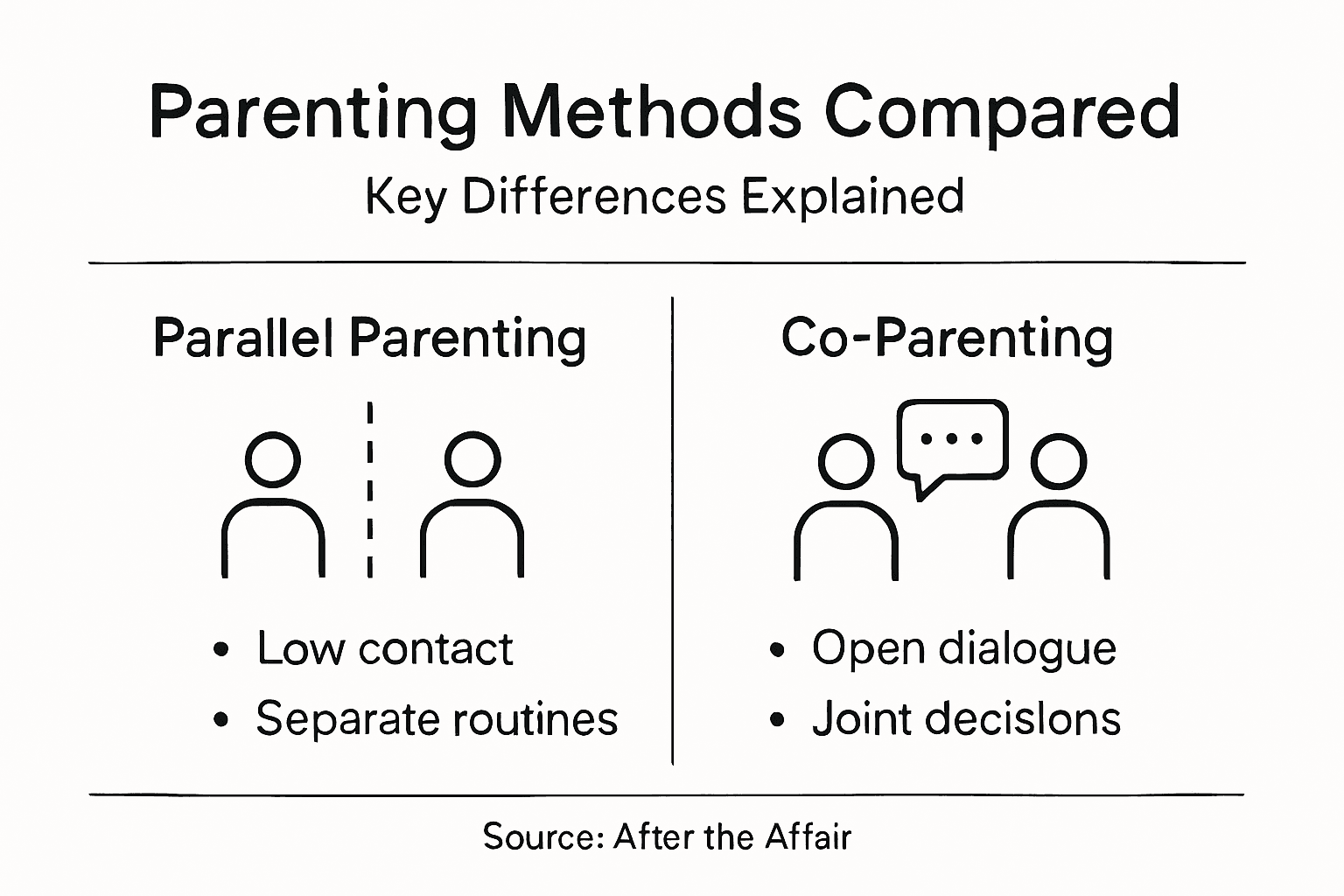
Co-parenting assumes you and your ex can communicate effectively, make joint decisions, and present a unified front to your children. You attend school events together, coordinate rules across households, and regularly discuss parenting choices. This works beautifully when both parents can set aside personal conflict for the children’s sake.
Parallel parenting assumes you cannot do those things—and that’s okay. Instead of forcing collaboration, parallel parenting reduces direct interaction between you and your ex while maintaining each parent’s independent involvement. You make decisions separately during your parenting time without needing the other’s approval.
Here’s how they differ in practice:
Here is a side-by-side comparison of parallel parenting and co-parenting models:
| Aspect | Parallel Parenting | Co-Parenting |
|---|---|---|
| Approach to Decision-Making | Decisions made independently | Decisions made jointly |
| Interaction | Minimal, structured contact | Frequent, direct communication |
| Flexibility of Household Rules | Each home sets independent rules | Aim for consistent rules across homes |
| Collaboration Requirement | Low; mostly logistical | High; collaborative at all levels |
| Suitability After High Conflict | Ideal for high-conflict situations | Best when both can communicate respectfully |
- Communication level: Co-parenting requires frequent, detailed conversations. Parallel parenting limits contact to essential child-related matters only.
- Decision-making: Co-parenting means joint choices on major and minor issues. Parallel parenting reserves joint decisions for significant matters like education and medical care.
- Rule consistency: Co-parenting strives for identical household rules. Parallel parenting allows different rules in each home, reducing conflict triggers.
- Event attendance: Co-parenting involves attending events together. Parallel parenting keeps you separate at functions.
- Conflict level: Co-parenting requires managing disagreements collaboratively. Parallel parenting minimizes situations where disagreements arise.
After infidelity, parallel parenting is tailored for high-conflict cases where cooperative communication feels impossible. You’re not refusing to parent responsibly—you’re acknowledging that forced collaboration reopens emotional wounds repeatedly.
Co-parenting demands emotional maturity that may take years to develop after betrayal. Parallel parenting lets you parent well right now, without needing to heal together first.
The right model isn’t the “better” one—it’s the one that matches your current capacity and protects your children’s stability.
Pro tip: Start with parallel parenting even if you think you might co-parent later; it’s easier to add collaboration once emotions settle than to reduce contact after attempting forced cooperation.
Core Strategies For Healthy Parallel Parenting
Healthy parallel parenting requires deliberate structure and emotional discipline. You’re not managing a failed relationship—you’re building a functional system that protects your children while protecting your own recovery.
The foundation starts with clear boundaries. Define what stays in your domain and what requires coordination. Medical emergencies, school enrollment, and major life decisions warrant joint input. Weekend bedtimes, clothing choices, and screen time during your parenting time stay yours alone.
Communication discipline prevents small disagreements from becoming fires. Minimizing direct communication to focus solely on necessary child-related information means every message serves a purpose. No venting about the affair. No rehashing past grievances. No passive-aggressive remarks disguised as parenting advice.
Implement these operational strategies:
- Use written-only exchanges: Text, email, or parenting apps create transparency and reduce emotional escalation during conversations.
- Establish response timeframes: Set expectations (48 hours for non-urgent matters, immediate for emergencies) so neither parent feels ignored.
- Define decision-making authority: Who decides extracurricular activities during their parenting time? Who handles medical appointments on their schedule?
- Create scheduling consistency: Predictable handoff times and locations reduce friction and surprise conflicts.
- Document agreements: Write down what you’ve agreed to—custody schedules, expense splits, communication protocols—so memory lapses don’t trigger disputes.
Healthy parallel parenting involves managing disagreements constructively by focusing on the child’s best interests rather than parental conflicts. When disagreement happens—and it will—ask yourself: “Does this decision directly impact my child’s safety or wellbeing?” If not, let it go. Your ex’s rules aren’t your problem during their parenting time.
Emotional separation matters as much as physical separation. You’re co-parents in name only. Stop expecting your ex to parent like you would. Accept their differences and focus only on outcomes: Is your child fed, safe, and loved? Yes? Then the job is working.
The goal isn’t perfect alignment—it’s parallel lives that don’t collide, with children thriving in both homes despite different approaches.
Pro tip: Choose one reliable communication tool and stick to it religiously; switching between text, email, and calls creates confusion and reopens old arguments about what was actually agreed.
Communication Boundaries And Conflict Management
After infidelity, every message to your ex carries emotional baggage. Setting communication boundaries isn’t about being cold—it’s about protecting your recovery and your children from adult conflict.
Boundary setting starts with clarity. Decide exactly what topics require communication and what doesn’t. Your ex’s personal life, your feelings about the affair, complaints about their new partner—these stay off limits. Your child’s medical appointments, school performance, and custody logistics stay on.
The medium matters as much as the message. Using indirect methods like texts or third-party apps reduces emotional or legal conflict because written records create accountability. A heated phone call becomes a “he said, she said” dispute. A documented text message is fact.
Establish these communication boundaries:
- Response timeframe: 24-48 hours for routine matters, immediate for emergencies only.
- Topic restriction: Child logistics only. No personal updates, no venting, no relationship commentary.
- Communication channels: One method—typically email or a parenting app. Not phone calls. Not texts mixed with emails. One consistent trail.
- Message tone: Professional, brief, factual. “Soccer practice Tuesday 4pm” not “I’m arranging soccer since you never do anything for the kids.”
- No dialogue: State information or requests. Don’t invite debate on settled decisions.
Conflict management requires accepting that disagreement will happen. The goal isn’t eliminating conflict—it’s preventing it from escalating into warfare. When your ex makes a decision you dislike during their parenting time, you have two choices: let it go or involve a mediator.
There’s rarely a middle ground. Attempting to negotiate directly reopens the wound repeatedly. Avoiding personal attacks or emotional exchanges means not responding to provocative messages. Not explaining yourself when they question your parenting. Not defending your choices during their time.
When disagreement feels unmanageable, a parenting coordinator or mediator steps in—a trained third party who makes decisions or facilitates agreement without the emotional charge you both bring.
Boundaries don’t prevent conflict—they prevent conflict from becoming your daily reality and your child’s burden.
Pro tip: Create a message template for routine communications and use it every time; repetitive structure removes emotion and makes compliance easier for both parents.
Protecting Children’s Wellbeing After Infidelity
Your children didn’t choose this situation. They’re absorbing the fallout from your relationship rupture, and their emotional safety depends on how you manage parallel parenting.
The core truth: children thrive when they feel secure. That security comes from stability, not from knowing details about the affair. It comes from predictable routines, consistent rules, and parents who don’t weaponize them against each other.
Interparental conflict can significantly harm children’s emotional and behavioral well-being, causing long-term issues that extend far beyond the separation itself. Your parallel parenting structure directly protects against this by removing them from the crossfire.
Protect children’s wellbeing through these specific practices:
This summary of common challenges for children in parental separation and how parallel parenting can address them may be helpful:

| Challenge for Children | Parallel Parenting Solution | Expected Benefit |
|---|---|---|
| Exposure to parent conflict | Reduces direct parent interactions | Less anxiety, safer environment |
| Conflicting parenting expectations | Clear boundaries for each home | More predictable routines |
| Forced loyalty to one parent | Neutral, non-confrontational exchanges | Fewer loyalty pressures |
| Confusing communication | Structured, written messaging only | Children not used as messengers |
- Keep them out of communication: Never use kids as messengers between households. Never ask them what happened at your ex’s house. Never vent about the other parent.
- Maintain stable routines: Predictable bedtimes, meal schedules, and weekend activities signal safety. Children need to know what comes next.
- Don’t badmouth their other parent: No matter how angry you are, your child loves this person. Speaking harshly damages their sense of identity and loyalty.
- Shield them from legal/financial details: Children don’t need to know about custody disputes, support payments, or asset division. That’s adult business.
- Recognize behavioral changes: Withdrawal, aggression, academic decline, or anxiety signals distress. Don’t ignore these signs—get professional support.
Your own emotional regulation matters enormously. Stable parenting routines and supportive relationships improve psychological outcomes00022-X/fulltext) for children affected by family disruption. When you manage your grief and anger privately, your children can focus on being kids instead of emotional caretakers.
Parallel parenting creates the distance needed for you to heal separately. As you heal, your children benefit from a calmer, more present parent—even if you’re in separate homes.
Consider age-appropriate counseling for your children. A therapist can provide neutral space for them to process feelings without loyalty conflicts.
Children don’t need parents who stay together—they need parents who model emotional responsibility and protect them from adult conflict.
Pro tip: Establish a “no-ask” rule about the other household; when children volunteer information naturally, listen without judgment, but never interrogate.
Find Support and Clarity for High-Conflict Parallel Parenting
Navigating parallel parenting after infidelity presents unique challenges that no one should face alone. If managing communication boundaries, protecting your children, and restoring your emotional stability feel overwhelming, you are not without resources. This approach calls for clear structure and emotional discipline to reduce conflict and enable healing for both you and your family.
Discover tailored guidance and evidence-informed strategies designed for situations exactly like yours at After the Affair Resource Library. Our comprehensive support helps you build healthy boundaries, understand emotional triggers, and empower your recovery journey while prioritizing your children’s wellbeing. Act now to take control of this difficult chapter and create stable, nurturing environments across separate homes.
Explore how to move forward with confidence by visiting parallel parenting solutions and embrace healing that lasts.
Frequently Asked Questions
What is parallel parenting?
Parallel parenting is a structured approach where separated parents operate independently, allowing each parent to make decisions within their own household while minimizing direct contact to reduce conflict.
How does parallel parenting differ from co-parenting?
Parallel parenting assumes that parents cannot effectively communicate or collaborate due to high conflict, whereas co-parenting requires frequent communication and joint decision-making.
What strategies can help with successful parallel parenting?
Successful parallel parenting involves using written communication, establishing clear boundaries for decision-making, maintaining predictable schedules, and keeping children out of adult conflicts.
How can I protect my children’s wellbeing during parallel parenting?
To protect your children’s wellbeing, maintain stable routines, avoid speaking negatively about the other parent, keep them out of adult disagreements, and seek professional support if you notice signs of distress.
Recommended
- Parallel Parenting Plan – After the Affair Series
- Parallel Parenting after infidelity – After the Affair Series
- Healthy Co-Parenting – After the Affair Series
- Post-Infidelity Co-Parenting – After the Affair Series