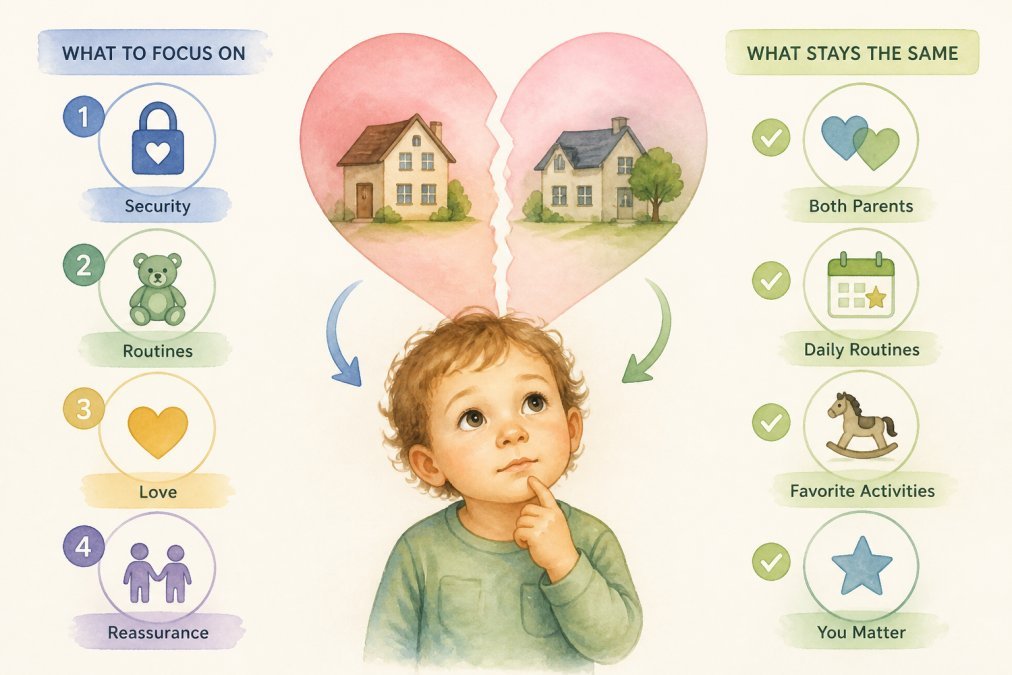
Last Updated: September 2, 2026
- When and How to Tell Your Child About Divorce
- Explaining Divorce to a 3-Year-Old in Simple Terms
- Divorce Scripts for Toddlers You Can Use Right Now
- Validating Your Child's Feelings and Emotional Responses
- Signs of Emotional Distress in Preschoolers During Divorce
- How to Maintain Routine During Separation
- Addressing Separation Anxiety and Fear of Abandonment
- Using Play Therapy and Creative Expression at Home
- Frequently Asked Questions
When and How to Tell Your Child About Divorce
Telling your child about divorce is one of the hardest conversations you’ll have as a parent. The timing, the words you choose, and who’s in the room all matter. Getting this right sets the emotional tone for everything that follows.
Timing the conversation
Tell your child when the decision is final and both parents are ready to present a united front. Avoid telling your child during conflict, stress, or right before bedtime, school, or an important event. Choose a calm afternoon or early evening when there’s time to answer questions. For toddlers and preschoolers, tell them as close to the actual separation as possible, a few days before one parent moves out is usually right.
Who should be present
Both parents should be present if at all possible. This sends a critical message: both of you are still their parents, and you’re making this decision together. If one parent refuses or there are safety concerns, the primary caregiver can have this conversation alone. Never let your child hear about the divorce from a third party.
Explaining Divorce to a 3-Year-Old in Simple Terms
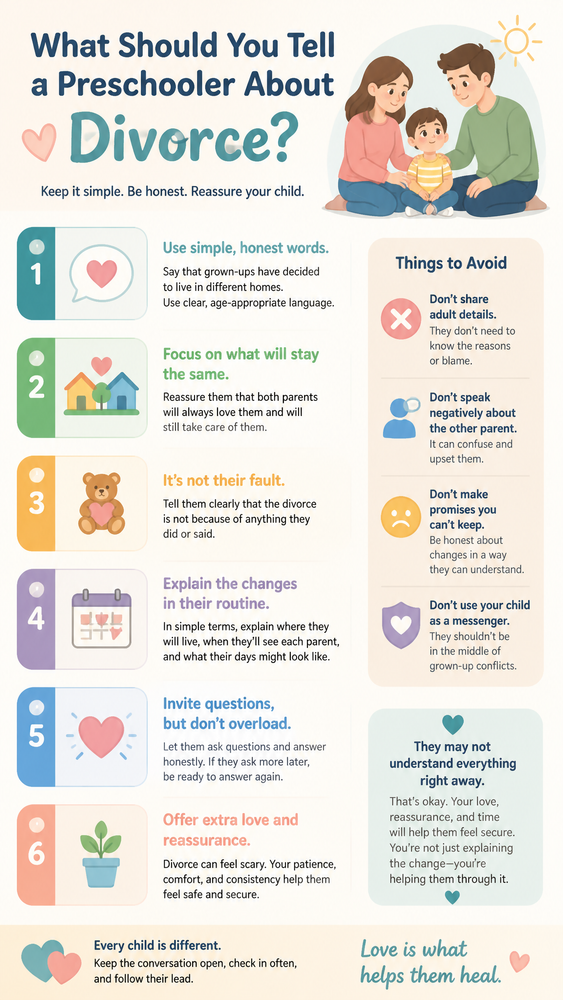
A 3-year-old doesn’t understand legal concepts or marital conflict. They understand concrete things: where they sleep, who picks them up, whether the people they love will still be there.
Using concrete language
Use words tied to physical reality: “Mommy and Daddy are going to live in two different houses now. You’re going to spend time at Mommy’s house and time at Daddy’s house. We both love you so much, and that’s never going to change.” Repeat this simple explanation multiple times over the next few days and weeks. Talk about “sleeping at Dad’s” or “playing at Mom’s house” rather than custody arrangements. Show them both homes if possible and let them see where they’ll sleep.
What to avoid saying
Don’t say “Daddy’s leaving” or “Mommy’s leaving”, a young child hears this as abandonment. Never blame the other parent, even indirectly. Avoid saying “We don’t love each other anymore,” as your child might wonder if you could stop loving them too. Don’t promise things you can’t guarantee, and don’t use language that makes your child feel responsible for the divorce.
Divorce Scripts for Toddlers You Can Use Right Now
Having exact words to use can reduce your anxiety and help you stay calm during the conversation.
Sample scripts for different age groups
For a 2-3 year-old:
“Mommy and Daddy have something important to tell you. We love you so, so much. We’re going to live in two different houses now. You’re going to spend time at Mommy’s house and time at Daddy’s house. We both love you. That will never, ever change.”
For a 3-4 year-old:
“Mommy and Daddy have made a big decision. We’re not going to live together in the same house anymore. But we’re both still your mommy and daddy. You’re going to have a bedroom at my house and a bedroom at Daddy’s house. We both love you so much. Nothing is your fault. This is a grown-up decision.”
For a 4-5 year-old:
“We want to talk to you about something important. Mommy and Daddy have decided we’re not going to be married anymore. We’re going to live in different houses. But we both love you very much, and we’re both going to be your mommy and daddy. You’re going to spend time at both houses. Do you have any questions?”

Scripts for answering the ‘why’ questions
“Why are you getting divorced?”
“Mommy and Daddy love you very much, but we’re not happy living together as husband and wife anymore. Sometimes grown-ups decide they’re better off living separately. But we’re still your mommy and daddy, and we both love you.”
“Is it because of me?”
“No, sweetie. This is not your fault. This is a grown-up decision. You didn’t do anything wrong. Mommy and Daddy both love you so much. Nothing you did caused this.”
“Where will I live?”
“You’re going to live with Mommy and spend time at Daddy’s house” (or vice versa). Be specific about days and times if your child is old enough to understand them.
“Will you still love me?”
“Yes. Forever and ever. Mommy loves you and Daddy loves you. That will never change. Even though we’re not going to live together, we’re both still your mommy and daddy.”
Validating Your Child’s Feelings and Emotional Responses
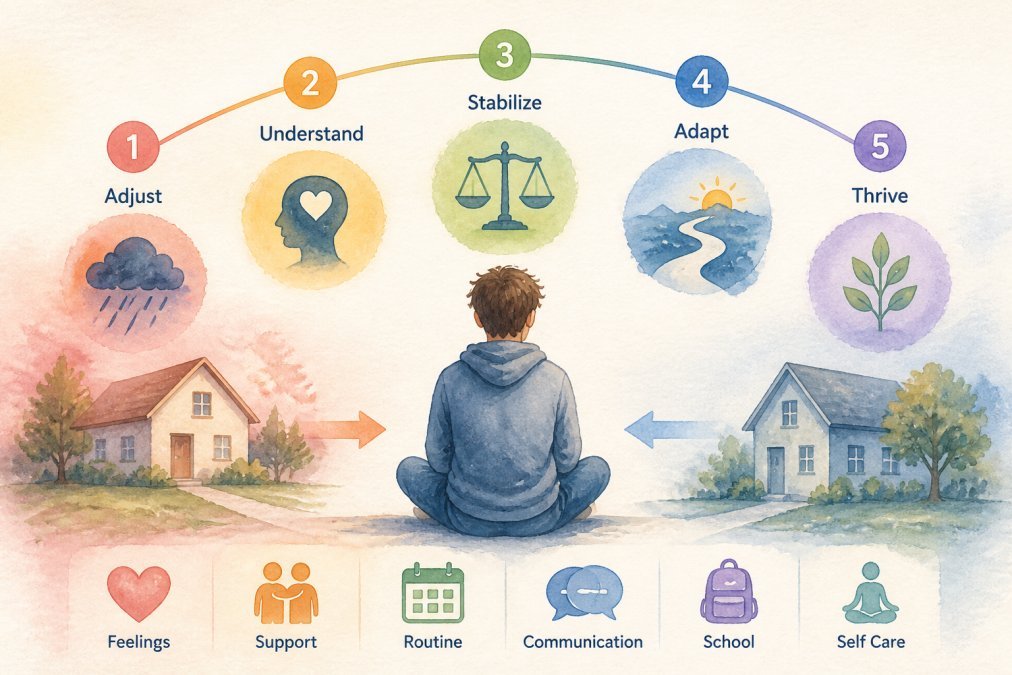
After you tell your child about the divorce, their emotional response might surprise you. Some children cry immediately. Others seem fine and then have a meltdown three days later. All of these responses are normal.
When your child cries, resist the urge to say “It’s okay.” Instead: “I see you’re sad. That makes sense. Mommy and Daddy getting divorced is a big change. It’s okay to feel sad about it.” If your child seems angry, don’t take it personally, anger is often how young children express fear and powerlessness. Let your child know it’s okay to have mixed feelings. Don’t expect your child to process this in one conversation; they’ll need to talk about it multiple times and gradually adjust to the new reality. manage toddler separation anxiety.
Signs of Emotional Distress in Preschoolers During Divorce
Preschoolers can’t tell you they’re struggling with anxiety or grief the way older children can. Instead, they show distress through behavior.
Behavioral changes and regression
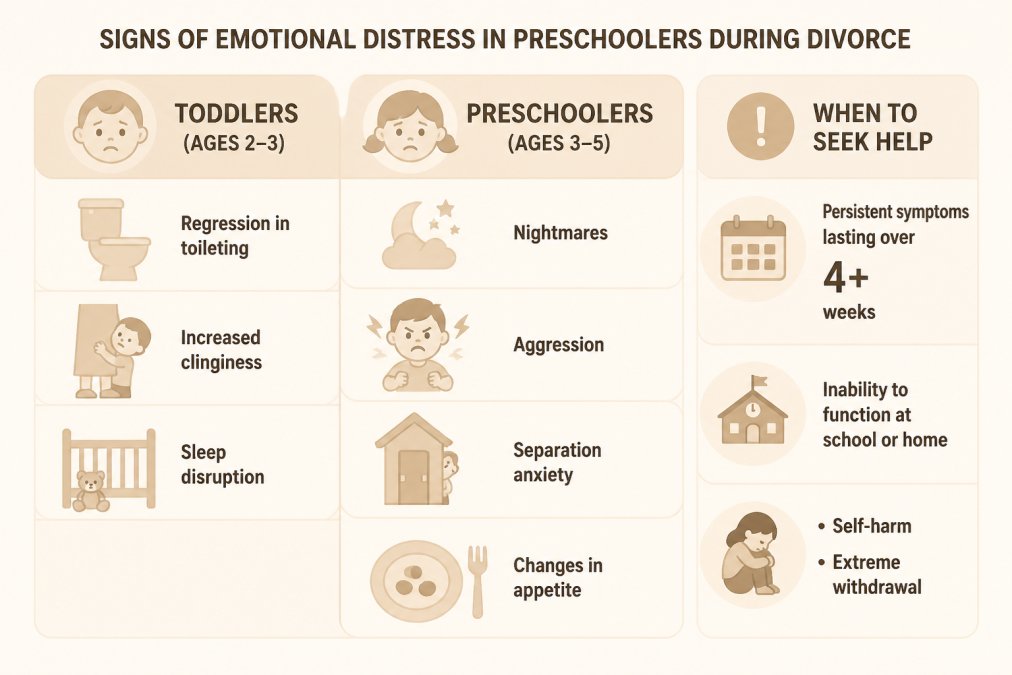
Regression is one of the most common responses to divorce in young children. A potty-trained 4-year-old might start having accidents (peer-reviewed research). A child who sleeps through the night might wake up crying. Sleep disruptions, increased clinginess at transitions, eating changes, and aggression are all normal signs of stress (apa.org). Withdrawal is equally concerning, a child who stops playing or seems flat and emotionless might be depressed.
When to seek professional support
Most children show some behavioral changes after learning about divorce. These typically improve within a few weeks as new routines settle in. Consider a therapist if your child’s distress lasts more than 4 weeks, if they’re unable to function at school or home, or if they express hopelessness (peer-reviewed research). A child psychologist or play therapist who specializes in divorce can help your child process the change in a way that feels safe.
How to Maintain Routine During Separation
Routine is your most powerful tool for helping your child feel secure during divorce. When everything else is changing, consistent routines provide stability and predictability.
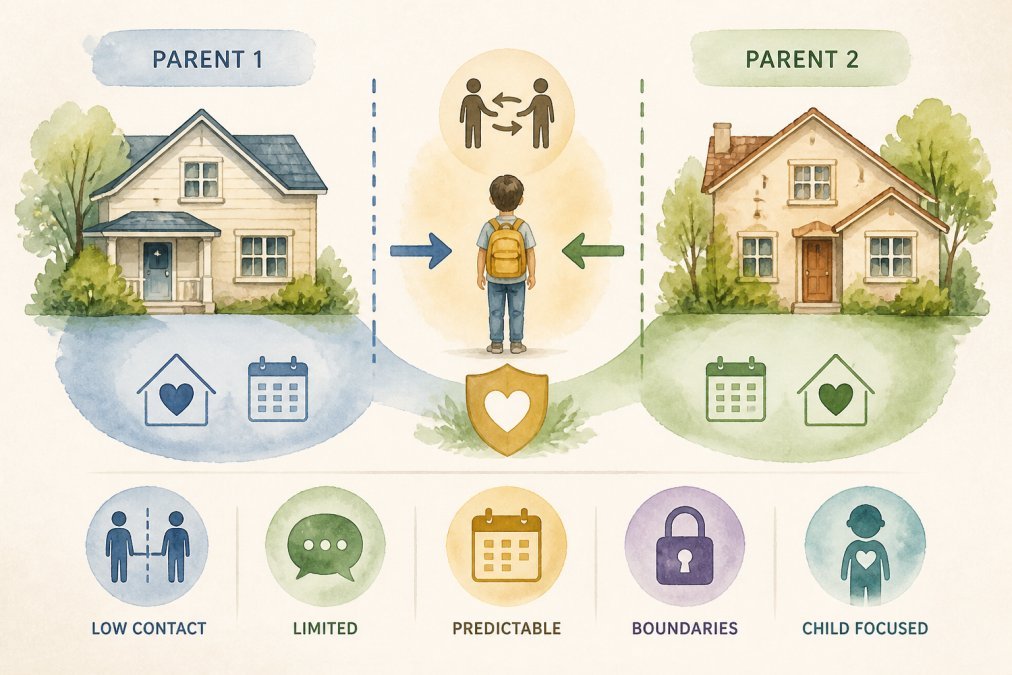
Creating consistency between two homes
The ideal situation is identical routines in both homes, same bedtime, same breakfast, same morning routine. Before separation happens, sit down with your co-parent and agree on non-negotiables: bedtime (within 30 minutes), mealtimes, screen time limits, nap schedules.
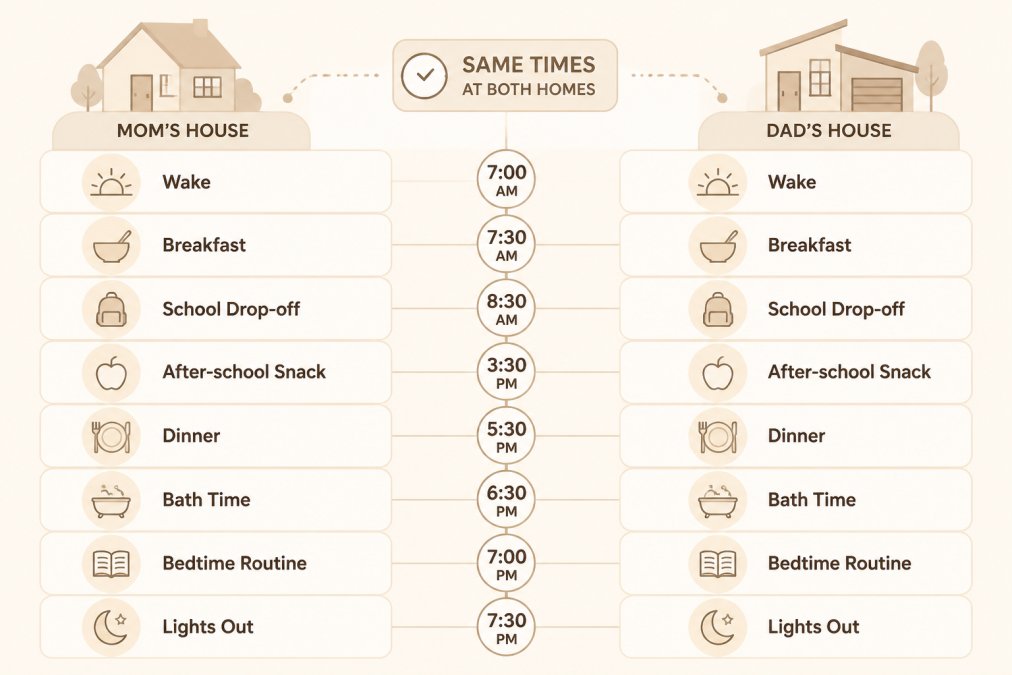
Your child should have familiar items in both homes: a favorite stuffed animal, blanket, or toy. Bedtime is the most critical routine. A consistent bedtime ritual, bath, story, cuddles, signals to your child’s nervous system that they’re safe and cared for.
Bedtime routines and transitions
Create a transition ritual for when your child moves between homes. This might be a special handoff, a goodbye ritual, or a favorite song you sing together. Some families use a “transition object”, a photo book, a special toy, or a comfort item that travels with the child. At bedtime, reinforce the routine: “After bath, we read a story. Then we cuddle. Then lights out. This is what happens every night at Mommy’s house and at Daddy’s house.”
Understanding the pattern is not the same as breaking it
You Can Explain Why This Happened. Can You Explain Why You’re Still Stuck In It?
Most people in affair recovery can narrate their entire situation with total clarity, the timeline, the triggers, the whole story, and still find themselves back in the same spiral by evening. Insight was never the missing piece. This free assessment shows you exactly where the gap actually is.
Take the Free Affair Recovery Clarity Check ->A few honest questions, a scored result, 4 minutes free
Addressing Separation Anxiety and Fear of Abandonment
Separation anxiety is one of the most painful aspects of divorce for young children. Your child might cling to you, cry when you leave, or seem terrified that you won’t come back.
The key is reassurance paired with consistency. When you say you’ll be back, you have to be back at that exact time, every single time. Use concrete language about when you’ll see them again: “I’m going to work now. You’re going to stay with Daddy. After lunch and nap time, I’ll pick you up. We’ll have snack together.”
Create a goodbye ritual that’s quick and confident. A quick hug, a kiss, and “I’ll see you after nap” is better than a long, emotional goodbye. Don’t sneak away, always say goodbye, even if it’s hard.
Using Play Therapy and Creative Expression at Home
Play is how young children process emotions and make sense of their world. During divorce, play becomes a therapeutic tool.
Provide open-ended play materials: blocks, dolls, toy houses, toy families. Let your child build, arrange, and rearrange without direction. Some children use play to act out the divorce, a doll family might separate, with one parent moving to a new house. This is healthy processing.
Art is another powerful tool. Provide paper, markers, paint, and let your child draw. Ask open-ended questions: “Tell me about your picture” rather than “Why did you draw it that way?” Music, movement, and books about divorce help normalize the experience. Most importantly, follow your child’s lead.
At After the Affair Series, we understand that divorce affects the entire family system, not just the adults involved. Our structured toolkit provides specific frameworks for co-parenting communication, managing high-conflict interactions, and protecting your children’s emotional wellbeing during this transition. The scripts and strategies we offer are designed for parents navigating both the immediate crisis of separation and the long-term reality of co-parenting with an ex-partner. Take our free 23-point assessment to identify your specific challenges and get personalized guidance for your situation.
Divorce is one of the most destabilizing events in a young child’s life, but how you handle the conversation and the transition can significantly shape their resilience. Your child needs to hear, clearly and repeatedly, that both parents still love them, that the divorce is not their fault, and that their life will have structure and safety even though it’s changing. After the Affair Series provides the exact scripts and frameworks you need to have these conversations with confidence and to maintain the consistency your child needs during this difficult time. Start with our free assessment and get immediate access to age-specific guidance for your situation.
Frequently Asked Questions
How can I explain divorce to my 4-year-old without overwhelming them?
Use simple, concrete language focused on what changes and what stays the same. Say: ‘Mommy and Daddy love you very much, but we’ve decided not to be married anymore. You’ll spend time with both of us.’ Keep the explanation brief, preschoolers have limited attention spans. Avoid reasons involving adult conflict. Reassure them that both parents will remain in their life. Be prepared to repeat this conversation multiple times as they process the news.
What are signs of emotional distress in preschoolers during divorce?
Common signs include behavioral regression (bedwetting, thumb-sucking), increased clinginess, difficulty sleeping, acting out, withdrawal, or changes in appetite. Some children become unusually quiet or aggressive. Separation anxiety often intensifies. These responses are normal developmental reactions to major family transitions. If signs persist beyond a few weeks, worsen significantly, or include concerning behaviors like self-harm, consult a child psychologist. Play therapy at home can help children express feelings they can’t verbalize.
How do I maintain routines when my child transitions between two homes?
Consistency is critical for emotional security. Coordinate with your co-parent to keep bedtimes, meal times, and daily activities as similar as possible in both homes. Create a visual schedule your child can see. Pack familiar comfort items (stuffed animal, favorite blanket) for transitions. Maintain the same bedtime routine in both places. Predictability reduces separation anxiety and helps children feel secure despite the family structure change. Even small consistencies matter, same bath time, same story, same goodbye ritual.
What should I avoid saying when telling my child about divorce?
Never blame the other parent, use adult language about infidelity or betrayal, or ask your child to choose sides. Avoid saying ‘your mom/dad left us’ or ‘this is because of…’ explanations. Don’t promise the divorce won’t happen or that you’ll reconcile unless that’s genuinely possible. Never use your child as a messenger or confidant about adult problems. Avoid making the child feel responsible for keeping the family together. Keep the focus on concrete facts: where they’ll live, when they’ll see each parent, and that both parents love them unconditionally.
Reading this won’t change tomorrow’s message
You Know the Tactic Now. Do You Know What You’ll Actually Do When It Lands?
Understanding grey rock is not the same as doing it at 9pm when your phone buzzes. Most parents can explain the theory perfectly and still bite the bait every single time. The gap between the two is exactly what the free self-check measures.
Get Your Ex Out of Your Head ->5 scenarios, scored result, 4 minutes free