Table of Contents
- What Is Parallel Parenting and When Do Courts Approve It?
- Parallel Parenting vs Co-Parenting: Key Differences for High-Conflict Custody
- How to Get a Court to Approve Your Parallel Parenting Plan
- Parallel Parenting Rules and Boundaries That Hold Up in Court
- Using Court Ordered Communication Apps to Enforce Your Agreement
- A Parallel Parenting Plan Template That Meets Legal Standards
- What to Do If Your Ex Violates the Court-Ordered Plan
- The Bottom Line on Court Approval for Parallel Parenting
- Frequently Asked Questions
Last Updated: September 5, 2026
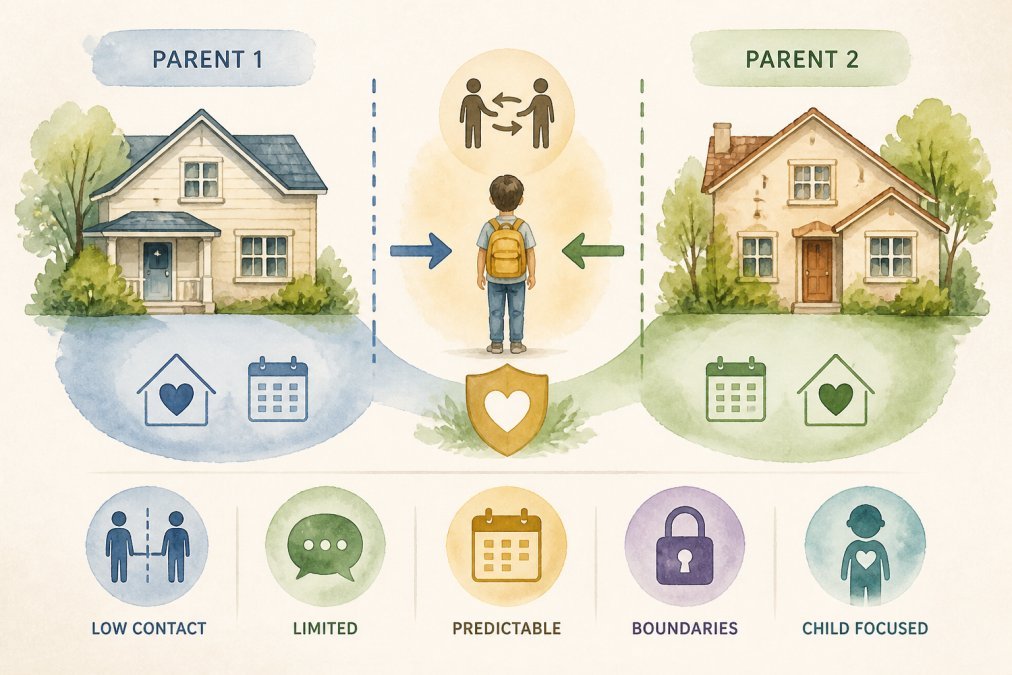
Yes, parallel parenting is court approved in most jurisdictions when it serves the best interests of the child, though it is rarely written into a custody order by that exact name. Parallel parenting is a structured custody arrangement where divorced or separated parents operate largely independently, minimizing direct communication and decision-making conflict. Instead of collaborating on day-to-day choices, each parent follows a detailed, pre-defined plan during their custodial time.
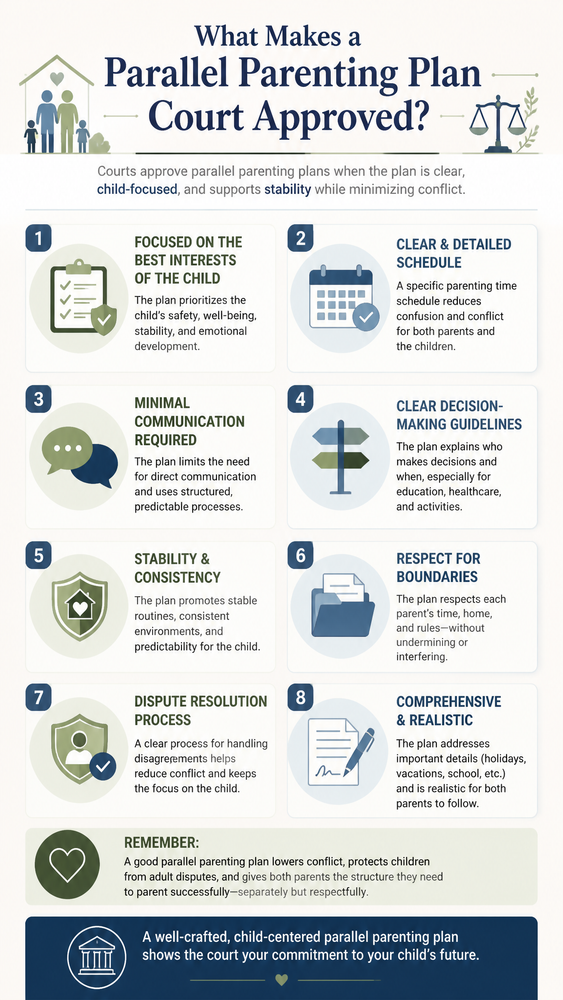
Family courts across the United States routinely approve parallel parenting plans because they reduce the friction that harms children in high-conflict custody situations. A judge’s primary standard is always the best interests of the child, and a plan that eliminates recurring parental conflict typically meets that bar. The courts care less about the label you use and more about whether the agreement is specific, enforceable, and protective of the child’s routine.
The key distinction for court approval is that you present a concrete, written agreement, not a vague intention to “stay out of each other’s way.” Courts want to see structured protocols, clear possession schedules, and a dispute resolution mechanism that does not require the parents to speak directly.
Parallel Parenting vs Co-Parenting: Key Differences for High-Conflict Custody
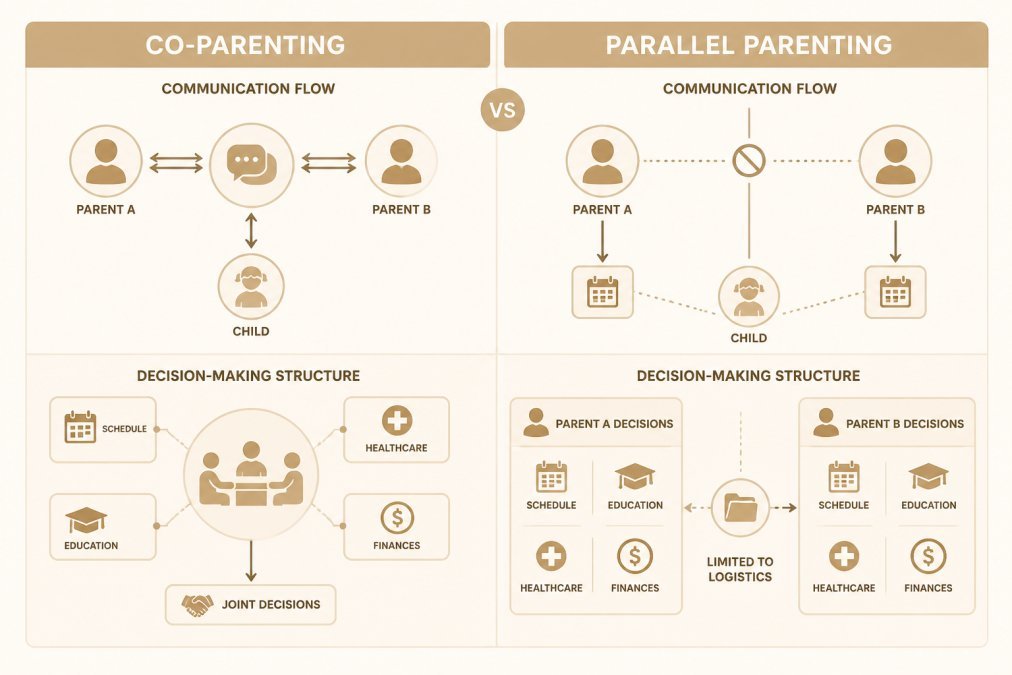
The central difference between parallel parenting and co-parenting comes down to communication frequency and decision-making authority. Co-parenting requires ongoing collaboration, shared problem-solving, and frequent communication between parents about the child’s welfare. Parallel parenting, by contrast, divides authority so each parent makes decisions independently during their own parenting time, guided by non-negotiable terms set in advance.
For high-conflict custody situations, parallel parenting is often the safer choice. When communication between ex-partners triggers arguments, hostility, or parental alienation, forcing collaboration only damages the children caught in the middle. Parallel parenting removes the expectation of friendship or teamwork and replaces it with a business-like structure where the parenting plan itself governs most decisions.
In co-parenting, parents jointly decide on education, healthcare, and extracurricular activities. In parallel parenting, the plan assigns decision-making authority by domain: one parent handles medical appointments during their custody time, the other manages school communications, and the plan specifies which major choices require joint input versus which fall to the custodial parent.
Parallel parenting offers less flexibility than collaborative co-parenting, but when the alternative is constant litigation or exposing children to hostile exchanges, the rigid guidelines protect everyone. Courts frequently approve these arrangements precisely because they reduce conflict and shield children from custody disputes.
How to Get a Court to Approve Your Parallel Parenting Plan
Getting court approval for a parallel parenting plan requires presenting it as a formal, legal document that addresses the court’s core concern: the best interests of the child. Courts do not approve arrangements that look like parents avoiding each other; they approve plans that demonstrably reduce conflict and provide stability for the children.
The process typically starts with drafting a comprehensive plan and filing it with the family court through your attorney or mediation. Many courts now expect high-conflict parents to submit these agreements because they have seen the damage ongoing litigation causes children. Your plan should include a detailed possession schedule, communication protocols, and a dispute resolution mechanism that does not require direct contact.
A common mistake is submitting a plan that leaves too much open to interpretation. Courts reject vague agreements because they know ambiguity leads back to litigation. Every section of your plan must answer: who, what, when, and how. If the plan says “both parents will communicate about school events,” specify the communication method, the response window, and what happens if one parent fails to respond.
Most courts approve a plan when both parents agree or when evidence shows traditional co-parenting has failed. Documentation of hostile exchanges, refusal to communicate, or parental alienation concerns strengthens your case. Include communication logs showing a pattern of conflict to demonstrate why parallel parenting is necessary.
Do not attempt to bypass the court system entirely with an informal verbal agreement. An unwritten parallel parenting arrangement has no enforcement mechanism, and if your ex violates it, you have no legal recourse. Always formalize the agreement as a court order.

Parallel Parenting Rules and Boundaries That Hold Up in Court
The rules and boundaries in your parallel parenting plan must be specific enough to be enforceable and reasonable enough that a judge will sign them. Courts reject plans that are punitive, overly restrictive, or that infringe on the other parent’s custodial rights. The goal is conflict reduction, not punishment.
Effective rules typically cover four areas. Communication rules specify which topics require discussion, which methods are acceptable, and expected response times, often restricting contact to email or court-ordered apps except for genuine emergencies. Decision-making rules assign authority by domain and list which major decisions require joint approval. Scheduling rules establish a consistent possession schedule with minimal deviation. Conduct rules prohibit disparaging the other parent and set transition expectations.
A plan that holds up in court uses neutral language, defines terms like “emergency” and “major decision” explicitly, and includes a clause stating both parents will follow the plan even when they disagree. It also addresses practical details: who provides clothing at exchanges, how school holidays are divided, and what happens when a child is sick during the other parent’s time.
The most enforceable plans treat the agreement like a business contract, removing emotional language and focusing on logistics. Ask whether a third party could administer the rules without knowing either parent; if yes, your boundaries will likely survive court scrutiny.
The strongest parallel parenting rules are administrative, not emotional. Write every boundary as if a neutral third party will enforce it, because that is exactly what happens when a dispute reaches the court.
Using Court Ordered Communication Apps to Enforce Your Agreement
Court ordered communication apps have transformed how parallel parenting plans are enforced in high-conflict custody cases. These platforms provide a documented, neutral channel for all parent communication, creating an automatic record that courts can review if disputes arise. Many family courts now explicitly require their use in high-conflict cases.
These apps contain all communication within a single, timestamped platform. Features typically include message boards, expense tracking, schedule sharing, and a tone monitor that flags hostile language. Because every exchange is logged, parents think twice before sending inflammatory messages, and courts have clear evidence of violations. court-approved monitoring devices.
When your plan specifies that all communication occurs through the app, any attempt to bypass it becomes a documented violation. If your ex sends hostile messages directly to your phone, you have a record that contradicts the court order. If they refuse to respond to schedule requests, the app shows the unanswered message with its timestamp.
Guidance on parenting coordination and communication tools from the American Bar Association notes that structured communication platforms reduce the ambiguity that fuels custody litigation. When selecting an app, look for one that your local family court recognizes or that produces exportable records you can present as evidence. The app should support the specific features your plan requires: shared calendars for the possession schedule, expense logs for child-related costs, and a messaging system that both parents actually use.
Set up the communication app before your court hearing and include the platform name in your proposed plan. Judges respond favorably to parents who have already implemented conflict-reducing infrastructure rather than merely promising to use it later.
Noticing the pattern is not the same as proving it
You Can Feel the Pattern. Can You Prove It to a Judge?
A diary of what happened reads as emotional venting. A structured, timestamped record reads as evidence. Most parents lose that distinction until it costs them. The free checklist shows you exactly what to document today, before the evidence window closes.
Get the Free Red Flag Checklist ->3 categories, 5 minutes, free
A Parallel Parenting Plan Template That Meets Legal Standards
A parallel parenting plan template must be detailed, neutral, and comprehensive to meet legal standards for court approval. While every family’s situation differs, the following structure covers the essential sections that family court judges expect to see in a parallel parenting agreement.
| Plan Section | What It Covers | Why Courts Require It |
|---|---|---|
| Possession Schedule | Physical custody calendar, holidays, vacations | Establishes predictable routine for the child |
| Decision-Making Authority | Who decides what, when, and how | Prevents deadlock on major issues |
| Communication Protocols | Methods, timing, and topic restrictions | Reduces hostile contact |
| Dispute Resolution | Process for disagreements without direct negotiation | Keeps conflicts out of litigation |
| Conduct Clauses | Prohibited behaviors, respect rules | Protects child from parental conflict |
| Modification Process | How to change the plan | Provides flexibility within structure |
The possession schedule should specify weekdays, weekends, holidays, school breaks, and vacation time in alternating-year or fixed patterns. Decision-making authority should list major domains, education, healthcare, religious upbringing, extracurricular activities, assigning primary authority or requiring joint consent for each. Communication protocols should name the approved platform, define emergencies, and set response time expectations.
Dispute resolution typically involves a tiered approach: attempt resolution through the app, escalate to a parenting coordinator or mediator, and only then return to court. Conduct clauses should prohibit disparaging comments, require both parents to support the child’s relationship with the other parent, and establish rules for introducing new partners.
State-by-state parenting plan resources and forms Many state court websites publish model parenting plan forms that you can adapt for parallel parenting. While these templates vary by jurisdiction, they signal to the court that your agreement follows the expected legal structure. Have an attorney review your final document before filing, as state-specific variations in family law can affect what courts will approve.
What to Do If Your Ex Violates the Court-Ordered Plan
When your ex violates the plan, your response should be measured, documented, and legal. The first step is to document the violation through the approved communication channel, noting the specific provision breached and the impact on your child. Do not escalate or argue; state the facts and reference the plan.
The second step depends on the severity and frequency of the violations. Minor infractions, like a late pickup, may warrant a polite reminder through the app. Repeated or serious violations, such as withholding parenting time or making unilateral major decisions, require formal action. Send a written notice through the communication platform outlining the violation and requesting compliance within a specific timeframe.
If violations continue, you can file a motion for contempt asking the judge to enforce the existing agreement, or request modification if the violations reveal the current structure is unworkable. In cases involving safety concerns or parental alienation, you may seek emergency relief or a change in custody arrangements.
Documentation is your strongest tool. Every message, every missed exchange, every violated boundary should be recorded in the communication app. Understanding custody order enforcement and modification Courts rely on evidence, not allegations, and a complete communication log showing a pattern of violations carries significant weight. Before taking legal action, consider whether a parenting coordinator or mediator can resolve the issue more quickly and affordably than returning to litigation.
Never take enforcement into your own hands by withholding parenting time or refusing exchanges. Retaliatory violations weaken your position in court and can be used against you. Always pursue enforcement through the legal process.
Reading this won’t change tomorrow’s message
You Know the Tactic Now. Do You Know What You’ll Actually Do When It Lands?
Understanding grey rock is not the same as doing it at 9pm when your phone buzzes. Most parents can explain the theory perfectly and still bite the bait every single time. The gap between the two is exactly what the free self-check measures.
Get Your Ex Out of Your Head ->5 scenarios, scored result, 4 minutes free
The Bottom Line on Court Approval for Parallel Parenting
Parallel parenting is a legitimate, court-approved framework for high-conflict custody situations, provided your agreement is specific, enforceable, and clearly serves your child’s best interests. Courts approve these plans because they reduce the conflict that harms children and prevent the endless litigation that drains families emotionally and financially.
A well-drafted plan that addresses communication, decision-making, scheduling, and dispute resolution demonstrates that you have thought through the practical realities of raising a child across two households. It shows you prioritize your child’s stability over personal conflicts.
If you are navigating a high-conflict separation, After the Affair Series provides specific frameworks and actionable scripts for these situations. Our approach teaches structured communication methods that protect your children’s emotional wellbeing while maintaining firm boundaries with a hostile ex.
Start with the free 23-point assessment to identify where your current co-parenting structure is vulnerable. Then apply the principles in this guide to build an agreement that courts will approve. You can reduce conflict and give your children the stable, predictable environment they deserve.
Frequently Asked Questions
Do judges like parallel parenting?
Judges approve parallel parenting when it serves the best interests of the child, particularly in high-conflict custody situations. Courts prefer any arrangement that reduces exposure to parental conflict. A judge is more likely to approve a plan that includes specific communication protocols, a clear possession schedule, and non-negotiable terms. Demonstrating that you have a structured plan to minimize direct contact can show the court you are prioritizing your child’s emotional well-being over personal disputes.
What are the downsides of parallel parenting?
The main downsides include a lack of flexibility and the potential for children to feel caught between two separate parental worlds. You will not attend school events together or make joint decisions in real time. For some children, the rigid structure can feel confusing. However, for children exposed to ongoing parental conflict, this structure often provides more stability than a traditional co-parenting arrangement where arguments are frequent. The goal is conflict reduction, not a close family unit.
Does parallel parenting require a court order?
No, a court order is not required to start parallel parenting. Parents can agree to this arrangement informally. However, getting the plan incorporated into a court order is a protective measure. It makes the terms legally binding and gives you access to enforcement mechanisms if your ex violates the agreement. A formal court order also clarifies legal designation and custodial rights, which prevents future disputes about who has authority over specific decisions.
How do I propose a parallel parenting plan to the court?
You propose a plan by filing a motion with the family court that handles your custody case. Your proposal should include a detailed parenting plan that outlines the possession schedule, communication boundaries, and decision-making responsibilities. You must demonstrate how the plan serves the best interests of the child, focusing on shielding them from conflict. Including a provision for a court ordered communication app can strengthen your case, as it shows a commitment to structured, documented interactions.
Getting court approval for parallel parenting is achievable when you present a detailed, conflict-reducing plan that puts your children first. The After the Affair Series toolkit offers 50+ age-appropriate scripts for talking to your children about separation, structured communication tools like the Gray Rock Method for managing hostile interactions, and clear frameworks for high-conflict situations. Take the free 23-point assessment and get the clarity you need to move forward with confidence.