Last Updated: September 6, 2026
- Betrayal Blindness: A Survival Mechanism You Didn't Choose
- The Psychology Behind Why You Ignore Betrayal
- Betrayal Trauma Symptoms You Might Be Overlooking
- How Betrayal Blindness Protects Your Nervous System
- The Awakening Phase: When the Fog Starts to Lift
- How to Heal from Betrayal Trauma: Steps to Reclaim Clarity
- Nervous System Regulation After Infidelity: A Daily Practice
- Conclusion: Moving from Survival to Choice
- Frequently Asked Questions
Betrayal Blindness: A Survival Mechanism You Didn’t Choose
Betrayal blindness is the unconscious failure to recognize or remember betrayal, even when the evidence is right in front of you. It is a psychological defense that keeps you attached to someone your survival may depend on. In this guide from After the Affair Series, we break down why your mind chooses this blindness, how to recognize it, and the steps to reclaim your clarity.
If you have discovered infidelity and feel frozen, confused, or numb, betrayal blindness explains why. The mind is protecting you from a pain it believes you cannot survive, but this protection keeps you bound to a relationship that is harming you.
The Psychology Behind Why You Ignore Betrayal
Most people assume they would leave immediately if their partner cheated. The reality is more complex: the brain prioritizes attachment and safety over truth, especially when the betrayer is also your primary attachment figure.
Cognitive dissonance arises because the mind cannot hold two opposing truths: “I love and need this person” and “This person is hurting me.” To resolve this tension, the brain erases or minimizes the second truth.
The Role of Attachment and Dependence
Attachment style plays a central role in how intensely betrayal blindness manifests. If you have an anxious or dependent attachment pattern, the stakes of losing your partner feel existential. The threat of emotional abandonment activates a primal fear response, making the cost of seeing the truth feel higher than the cost of staying blind. Research into attachment theory and its impact on adult relationships confirms that early relational trauma shapes how we respond to interpersonal betrayal later in life.
The dependency does not have to be financial. Emotional dependency, shared identity, or fear of being alone can keep the blindness active.
Betrayal Trauma Symptoms You Might Be Overlooking
Betrayal trauma symptoms rarely announce themselves as denial. Instead, they show up as patterns you rationalize, habits you hide, and feelings you cannot name.
Cognitive Symptoms: Your Mind Rewrites the Story
The most common cognitive symptom is memory fragmentation, remembering the fight but not what triggered it, recalling the text message but not the exact wording. This is your brain compartmentalizing information that threatens your attachment bond.
A second cognitive pattern is persistent rationalization, explaining away inconsistencies with elaborate theories. This loop is exhausting. You may also experience intrusive doubting, questioning your own memory even when you have evidence.
Emotional Symptoms: The Rollercoaster You Cannot Control
Emotionally, betrayal blindness produces numbing punctuated by sudden surges, feeling flat for days, then a wave of panic or rage triggered by something small. This dysregulation is the nervous system’s way of leaking suppressed stress.
Shame is the dominant emotion in betrayal blindness. Guilt says “I did something wrong”; shame says “I am wrong.” Individuals often feel profound shame about their own blindness, they cannot understand how they missed the signs. You may also feel relief when your partner offers affection, even if you suspect it is manipulative, because attachment relief temporarily outweighs the cost of betrayal.
Understanding the pattern is not the same as breaking it
You Can Explain Why This Happened. Can You Explain Why You’re Still Stuck In It?
Most people in affair recovery can narrate their entire situation with total clarity, the timeline, the triggers, the whole story, and still find themselves back in the same spiral by evening. Insight was never the missing piece. This free assessment shows you exactly where the gap actually is.
Take the Free Affair Recovery Clarity Check ->A few honest questions, a scored result, 4 minutes free
Behavioral Symptoms: What You Do (and Stop Doing)
Behaviorally, the most telling symptom is hypervigilance disguised as care, checking their phone while they sleep, monitoring their location, asking probing questions. You tell yourself you are being attentive, but your body is in constant threat detection.
The opposite pattern is avoidance, stopping questions, editing your behavior to avoid triggering defensiveness, walking on eggshells. This self-censorship signals that your nervous system has learned honesty is dangerous.
A third behavioral cluster involves changes in daily functioning, losing interest in activities, isolating from friends, or changes in appetite and sleep. Many report a decline in work performance because maintaining the blindness leaves little capacity for anything else.
Relational Symptoms: The Pattern Repeats
Betrayal blindness does not stay contained to one relationship. You may be more suspicious in new friendships, quicker to assume the worst in colleagues, or drawn to relationships that replicate the original dynamic.
You may also find yourself over-functioning in relationships, taking responsibility for everyone else’s emotions and suppressing your own needs to keep the peace. This is common in those who grew up in unpredictable environments.
If you recognize five or more of these symptoms in yourself, it is likely that your nervous system has registered the betrayal even if your conscious mind has not fully accepted it. This is not a sign that you are broken; it is a sign that your protective mechanisms are working exactly as designed, and that they are no longer serving you.
The Difference Between Betrayal Blindness and Co-Dependency
A common question is whether betrayal blindness is simply co-dependency. While they overlap, they are distinct. Co-dependency is a relational pattern where self-worth depends on caring for others; betrayal blindness is a specific trauma response to a betrayal event. When both are present, they reinforce each other.
The key distinction is awareness. Co-dependency can operate with full conscious awareness, you know you are over-giving but cannot stop. Betrayal blindness operates below awareness. This is why external feedback, from a therapist, a trusted friend, or a structured assessment, is essential.
When to Seek Professional Support
If you are experiencing suicidal thoughts, self-harm urges, or an inability to function, seek immediate support from a licensed mental health professional. If you are in immediate danger, call 988 to reach the Suicide and Crisis Lifeline (988lifeline.org). Betrayal blindness is treatable, but the awakening phase can be destabilizing.
How Betrayal Blindness Protects Your Nervous System
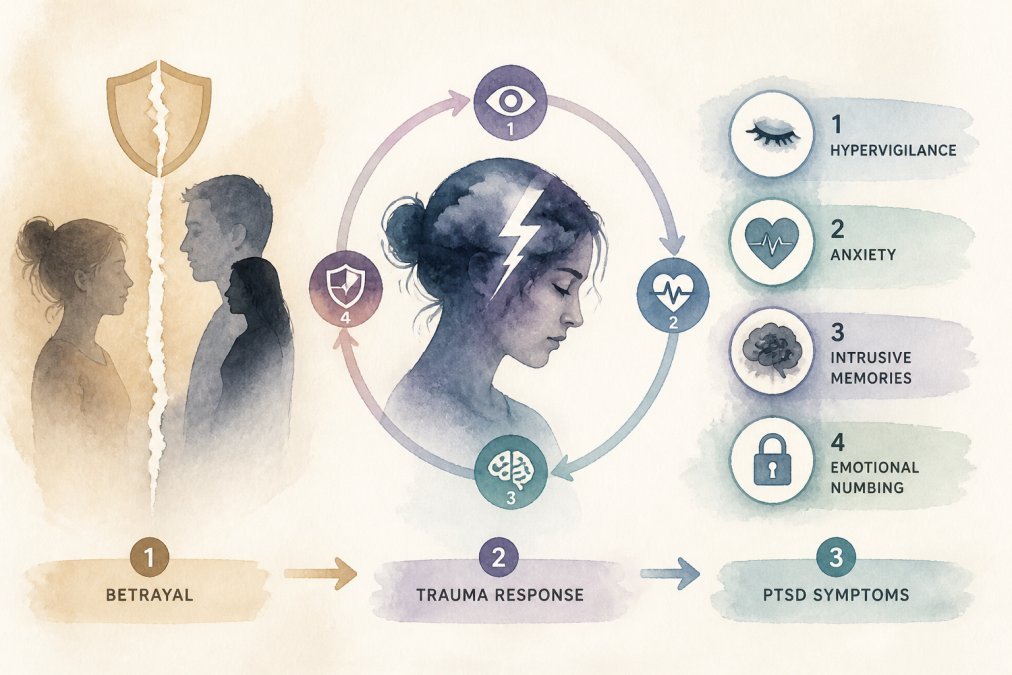
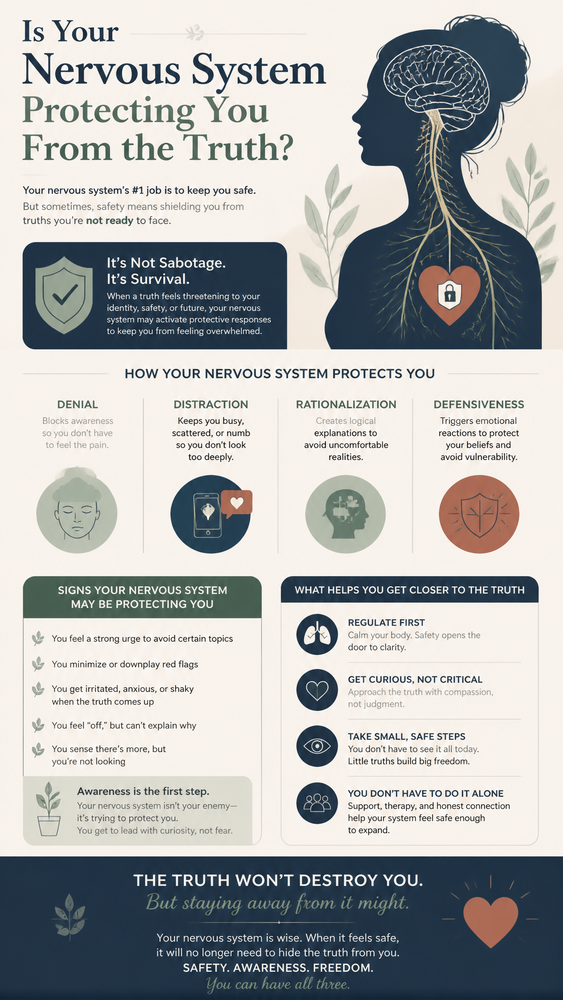
Betrayal blindness is a trauma response designed to regulate your nervous system in the short term. When abandonment is threatened, your body prioritizes immediate anxiety reduction over long-term clarity.
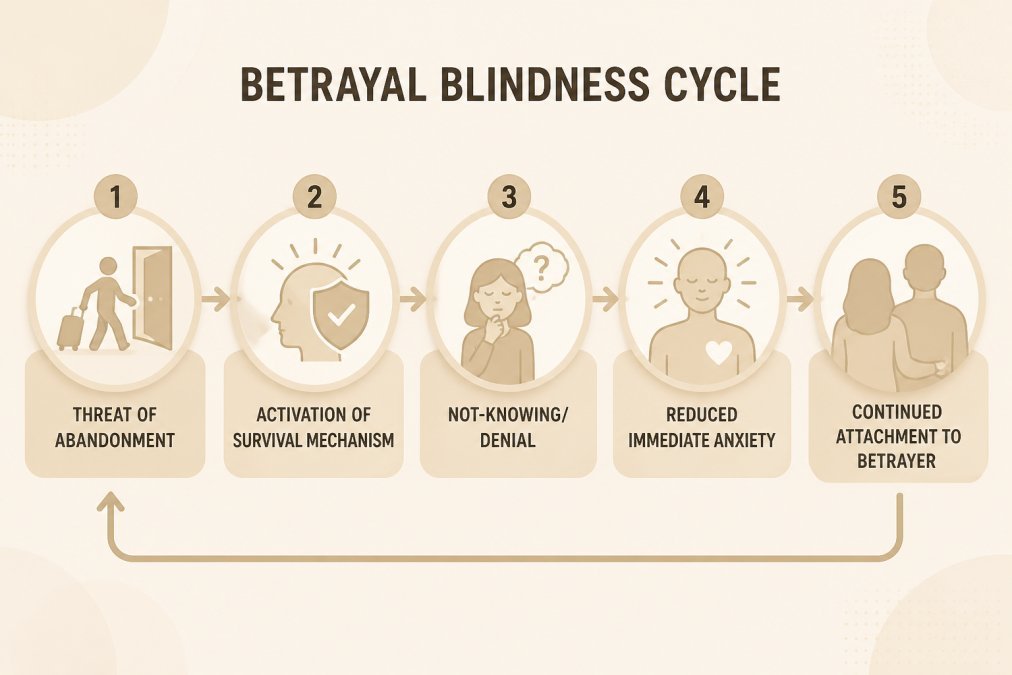
This cycle is a costly adaptation. The problem is that this protection becomes permanent, a temporary shield becomes a permanent wall between you and reality. Gaslighting reinforces this wall, because constant denial trains your brain to distrust its own perceptions.
The danger of staying in betrayal blindness is that it does not just delay healing; it extends the abuse. The longer your nervous system stays in this protective state, the more entrenched the trauma becomes, making the eventual awakening more destabilizing.
The Awakening Phase: When the Fog Starts to Lift
The awakening phase is when betrayal blindness begins to crack. It often starts with a small inconsistency you cannot explain away, or a moment of clarity where you see the pattern of abuse for what it is. This phase is disorienting, the defense that kept you safe is collapsing.
During this phase, many experience waves of intense grief, rage, and exhaustion, cycling between knowing the truth and doubting yourself again. The brain does not surrender its protective mechanisms easily. Navigating this phase requires patience and structure.
How to Heal from Betrayal Trauma: Steps to Reclaim Clarity
Healing from betrayal trauma is not about forgetting; it is about rebuilding your capacity to trust your own judgment. The process is not linear. What follows is a structured protocol addressing the cognitive, emotional, and somatic layers of betrayal blindness.
Phase 1: Stabilization (Weeks 1-4)
The first priority is not understanding the betrayal, it is stabilizing your nervous system. Attempting to process the full scope before stabilization will likely trigger re-traumatization. Your goal is to reduce acute symptoms and establish basic safety.
What to do:
Name the reality without details. Say to yourself: “Something happened that broke my trust. I do not need to understand it fully right now.” This moves the event from vague unease into conscious awareness.
Stop information-seeking. Do not check their phone, re-read messages, or interrogate your partner. Each new piece of information re-activates the trauma response.
Establish a daily regulation practice. The somatic exercises below are the foundation of healing. Practice them at the same time each day.
Create physical distance if possible. If you live with the betrayer, establish separate sleeping arrangements. If not, create temporal boundaries, designated times when you will not interact.
What to avoid:
- Do not make major life decisions during this phase. Your judgment is compromised by the stress response.
- Do not confront your partner about the betrayal. Confrontation during the acute phase often leads to gaslighting, which reinforces the blindness.
- Do not isolate. You need external perspective, even if you do not feel ready to share details.

Phase 2: Somatic Processing (Weeks 4-12)
Once your nervous system has stabilized enough that you are not in constant fight-or-flight, you can begin processing the betrayal through your body. The trauma is stored in your nervous system, and talk therapy alone is often insufficient. Somatic exercises help discharge stored stress.
Somatic Exercise 1: Orienting
When you feel a wave of anxiety or a trauma flashback, your nervous system believes the threat is present now. Orienting brings your brain into the present moment. Slowly name five objects you can see, five sounds you can hear, and five physical sensations you can feel. Repeat until your heart rate settles.
Somatic Exercise 2: Extended Exhale Breathing
Place one hand on your chest and one on your belly. Breathe in for four counts, hold for four counts, and exhale for six counts. The longer exhale activates the parasympathetic nervous system. Practice for two minutes, three times daily, not just when anxious. Consistency matters more than intensity.
Somatic Exercise 3: Titration
Titration is the practice of touching a difficult memory briefly and then returning to safety. Think of the betrayal for ten seconds, then switch to a grounding exercise, feeling your feet on the floor, noticing your breath. This teaches your nervous system that you can approach the memory without being overwhelmed. Most trauma therapists recommend working with a professional, as doing it incorrectly can retraumatize.
Phase 3: Cognitive Rebuilding (Months 2-6)
The third phase involves rebuilding the cognitive frameworks that the betrayal shattered, processing the narrative, understanding the patterns, and rebuilding trust in your own judgment.
Rebuilding trust in your own judgment:
The deepest wound from betrayal is not the loss of your partner; it is the loss of trust in yourself. You question how you missed the signs. Rebuilding this trust requires small, deliberate actions, making and keeping tiny promises to yourself, such as going for a walk at a specific time or journaling each morning. Each kept promise tells your brain you are reliable.
A common mistake is trying to rebuild trust in your judgment by replaying the past to find the moment you “should have known.” This keeps you stuck in shame. Instead, focus on what you know now and what you will do with that knowledge going forward.
Understanding the gaslighting dynamic:
If your partner gaslit you, denied what you saw, minimized your feelings, or blamed you, you need to understand how this manipulation reinforced your blindness. Gaslighting attacks your epistemic trust: your confidence that your perceptions are accurate. Rebuilding that trust requires external validation from people who confirm your reality.
Phase 4: Integration and Choice (Months 6-12)
The final phase is integration, making conscious choices about the relationship, your boundaries, and your future. This is about deciding what you want now that you can see clearly.
Questions to guide this phase:
- Is this relationship safe enough to rebuild? (Note: rebuilding requires the betrayer to take full responsibility, stop the betrayal behavior, and engage in their own healing work.)
- What boundaries do I need to protect my nervous system?
- What do I need from a partner to feel safe, and is this person capable of providing it?
This phase is also where you grieve, not just the betrayal, but the relationship you thought you had, the future you imagined, and the parts of yourself you lost. Grief is not a problem to solve; it is a process to move through.
Willpower was never the problem
You’ve Said No Contact Before. What Made It Fail Last Time?
It usually isn’t willpower. It’s a loophole nobody accounted for, a second number, a mutual friend, a platform nobody thought to block. This free audit maps all 47 known workarounds so the boundary holds on its own, without relying on you to be strong enough every single time.
Get the Free Loophole Elimination Matrix ->47-point audit, instant download, free
The Unique Challenge of the Awakening Phase
Most articles on betrayal blindness stop at “recognize the signs” and “seek therapy.” What they miss is that the awakening phase, when the blindness breaks, is the highest-risk period for mental health crises. This is why the stabilization phase above is not optional; it is the bridge that carries you through the awakening.
If you are in the awakening phase now, the most important thing to know is this: the intense emotions you are feeling, rage, grief, disbelief, shame, are not signs that you are falling apart. They are signs that your nervous system is finally processing what it has been holding. The fog lifts in waves, not all at once.
A Structured Path Forward
Healing from betrayal trauma requires structure, especially when your internal compass has been damaged. Working with a therapist trained in betrayal trauma or somatic experiencing can be beneficial. Support groups provide external validation that counters gaslighting. Structured resources, like the free 23-point assessment offered by After the Affair Series, help you identify where you are and what support you need next. The path exists; your job is to take the next step.
Nervous System Regulation After Infidelity: A Daily Practice
Nervous system regulation after infidelity is not a one-time event; it is a daily practice of returning your body to safety. The betrayal has left your threat detection system on high alert. Start each morning with a check-in: rate your anxiety from one to ten, notice where you hold tension, and spend two minutes breathing into that area.
Throughout the day, build in micro-pauses. Before you check your phone, before you re-read the hurtful messages, take three conscious breaths. This interrupts the cycle of hyper-vigilance and gives your prefrontal cortex a chance to engage. According to guidance on trauma-informed care and nervous system recovery, regulation is best built through predictable, repeated practices that signal safety to the body.
The table below summarizes the key shifts required to move from survival to choice:
| Phase | What Happens | What You Need | Daily Action |
|---|---|---|---|
| Betrayal Blindness | Denial and not-knowing | External validation | Name the reality |
| Awakening | Intense grief and clarity | Structured support | Somatic grounding |
| Healing | Rebuilding self-trust | Safe relationships | Keep small promises |
| Regulation | Nervous system recalibration | Predictable routines | Daily breath practice |
Conclusion: Moving from Survival to Choice
The challenge of healing from betrayal is that your nervous system will keep pulling you back toward the familiar, even when the familiar is harmful. Breaking free requires you to consciously override that survival mechanism and choose clarity over comfort. This is not linear, and there will be days when the fog rolls back in.
At After the Affair Series, we provide structured frameworks and actionable scripts to help you navigate high-conflict moments with confidence. Our tools are designed for the exact situations you are facing. Start with the free 23-point assessment and begin moving from survival to choice.
Frequently Asked Questions
What is the difference between betrayal blindness and denial?
Denial is a conscious or semi-conscious choice to refuse to accept a fact. Betrayal blindness is an unconscious survival mechanism. Your brain actively filters out evidence of betrayal to protect your attachment to the person you depend on. It is not a decision you make; it is a response wired for survival. This distinction matters because it shifts the focus from self-blame to understanding how your brain is trying to protect you, which is the first step toward healing.
What are the first signs that you are experiencing betrayal blindness?
Early signs include making excuses for suspicious behavior, feeling a sense of dread or unease that you quickly dismiss, and experiencing cognitive dissonance. You might find yourself saying ‘It’s not that bad’ or ‘I’m probably overthinking it.’ You may also feel hyper-vigilant around your partner but quickly shut down any questioning thoughts. Physical symptoms like fatigue, headaches, or a racing heart can also surface as your body registers the threat your conscious mind is ignoring.
Does betrayal blindness ever go away on its own?
Betrayal blindness can fade when the cost of not knowing becomes higher than the cost of knowing. This often happens when you gain emotional or financial independence, or when a new betrayal becomes undeniable. However, simply waiting for it to lift is not a reliable path to healing. The underlying nervous system dysregulation and betrayal trauma symptoms remain. Active work, like somatic exercises and therapy, helps your brain and body process the event so you can move forward with clarity.
How does gaslighting reinforce betrayal blindness?
Gaslighting directly feeds betrayal blindness. When your partner denies reality, blames you, or twists events, it amplifies your cognitive dissonance. Your brain, already trying to protect you, receives confirmation that your perceptions are wrong. This deepens the ‘not-knowing’ state and makes it harder to trust your own judgment. Over time, you learn to override your instincts to avoid the painful conflict, which strengthens the blindness and keeps you in the relationship.
Noticing the pattern is not the same as proving it
You Can Feel the Pattern. Can You Prove It to a Judge?
A diary of what happened reads as emotional venting. A structured, timestamped record reads as evidence. Most parents lose that distinction until it costs them. The free checklist shows you exactly what to document today, before the evidence window closes.
Get the Free Red Flag Checklist ->3 categories, 5 minutes, free