TL;DR:
- Betrayal trauma can cause PTSD-like symptoms that require evidence-based therapy.
- EMDR, CPT, and PE are proven treatments, with choice based on individual symptoms and comfort.
- Consistent therapy engagement and completion are crucial for healing, regardless of the specific modality.
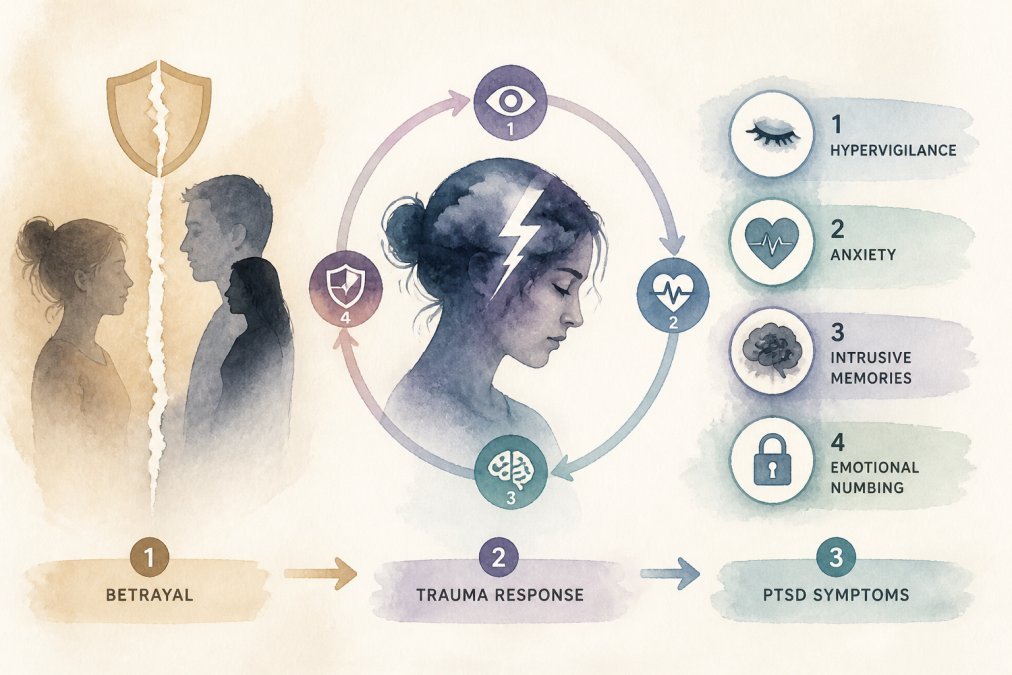
Betrayal by a partner doesn’t just break your heart. It can rewire your nervous system. Many people who discover infidelity find themselves caught in a loop of intrusive memories, sleepless nights, and a hypervigilance that makes even ordinary moments feel unsafe. You’re not overreacting. PTSD-like symptoms appear in 30 to 60 percent of betrayed partners, which means what you’re feeling is a recognized trauma response. This guide walks you through the evidence-based therapy options that actually work, and how to choose the right one for your specific situation so you can start moving toward real, lasting healing.
Table of Contents
- Understanding trauma symptoms after infidelity
- Overview of therapy types for trauma recovery
- How to choose the right therapy for your trauma
- Addressing special considerations: Complex trauma and relational repair
- What really matters: Therapy type or the journey you take?
- Get support and continue your healing journey
- Frequently asked questions
Key Takeaways
| Point | Details |
|---|---|
| Trauma symptoms are common | Up to 60% of those betrayed by infidelity experience trauma responses similar to PTSD. |
| Evidence-based therapies work | Prolonged Exposure, CPT, and EMDR therapies are all proven to help heal betrayal-related trauma. |
| Personal fit matters most | Choose a therapy you feel comfortable with and complete, not one that promises quick fixes. |
| Complex trauma needs nuance | If you have a history of complex or repeated trauma, specialized support may be necessary. |
| Resources can guide your next step | Checklists and trusted guides help you move forward confidently after infidelity. |
Understanding trauma symptoms after infidelity
When most people think of trauma, they picture accidents, combat, or disasters. Infidelity rarely makes that list, yet the psychological impact can be just as severe. Understanding what’s happening inside you is the first step toward finding the right help.
After discovering a partner’s affair, the brain responds the way it responds to any major threat. The stress response floods your body, and your mind tries to make sense of something that fundamentally doesn’t make sense. This is why symptoms can feel so physical, so relentless, and so confusing.
Common trauma symptoms after betrayal include:
- Intrusive thoughts or flashbacks about the affair
- Difficulty sleeping or staying asleep
- Emotional numbness or sudden emotional outbursts
- Hypervigilance (constantly checking your partner’s phone, location, or behavior)
- Avoidance of people, places, or conversations that trigger memories
- Physical symptoms like nausea, chest tightness, or fatigue
- A shattered sense of identity or trust in your own judgment
Research confirms that 30 to 60 percent of betrayed partners meet the clinical criteria for PTSD. This is not weakness. This is biology. Your brain flagged a devastating threat and got stuck in protective mode.
“Infidelity-related trauma is real trauma. The symptoms are clinically indistinguishable from PTSD caused by other major life events, and they deserve the same level of evidence-based care.”
The encouraging news is that standard trauma therapies respond effectively to infidelity-related PTSD symptoms. You don’t need a niche or experimental approach. You need proven tools applied with care. Learning about processing emotional trauma after betrayal can help you understand how your nervous system is responding. Equally, addressing betrayal trauma with specific, structured steps gives you a framework to work from rather than just enduring the pain.
The goal of trauma therapy in this context is not to make you forget what happened. It’s to help your brain file the memory safely, reduce its grip on your daily life, and help you rebuild a sense of safety and self-worth.
Overview of therapy types for trauma recovery
Once you recognize your symptoms, the natural next step is to consider therapy options that directly target the effects of betrayal trauma. Four approaches have the strongest evidence behind them.
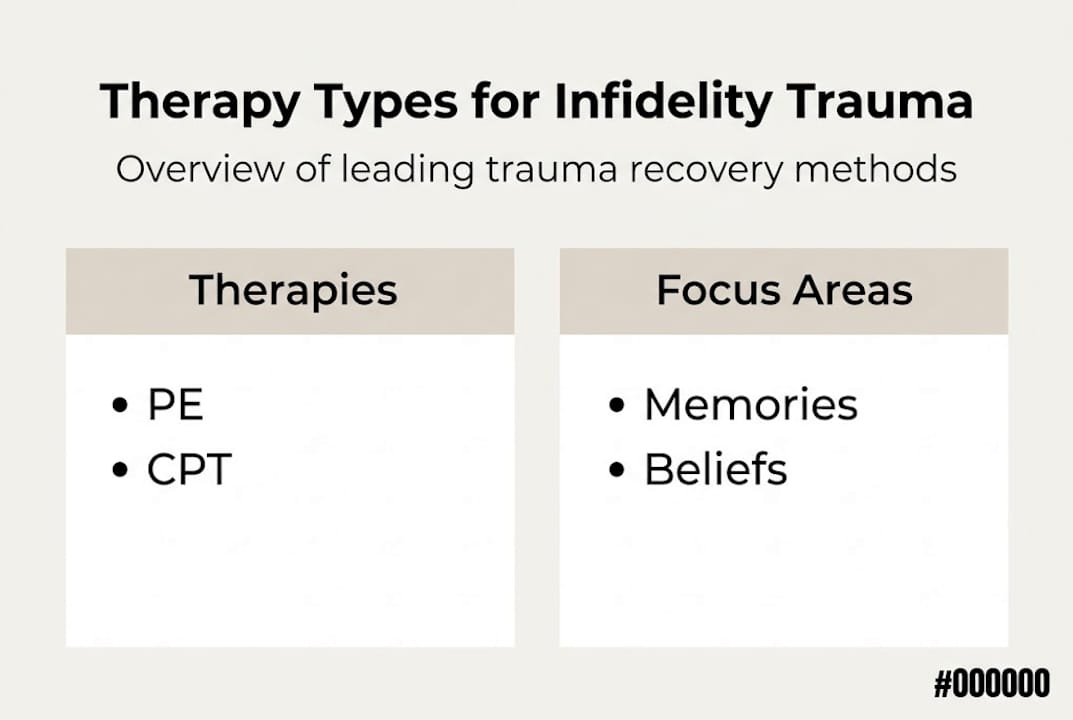
Prolonged Exposure (PE) involves gradually confronting trauma-related memories and situations you’ve been avoiding. In practice, this means talking through the traumatic memory in detail with your therapist, repeatedly, until its emotional charge diminishes. It typically runs 8 to 15 sessions.
Cognitive Processing Therapy (CPT) focuses on the thoughts and beliefs the trauma created. After infidelity, these often sound like: “I should have known,” “I can never trust anyone,” or “Something is wrong with me.” CPT helps you identify and reframe these distorted beliefs. It usually runs 12 sessions.
Eye Movement Desensitization and Reprocessing (EMDR) uses bilateral stimulation (usually eye movements) while you briefly recall traumatic memories. It’s faster for some people and doesn’t require extended verbal retelling. EMDR typically runs 6 to 12 sessions.
Trauma-Focused Cognitive Behavioral Therapy (TF-CBT) combines cognitive restructuring with behavioral strategies and is especially useful when trauma intersects with depression or anxiety.
APA and VA guidelines recommend PE, CPT, and EMDR as first-line trauma therapies. All three are covered by most insurance plans and widely available through licensed therapists.
| Therapy | Core method | Format | Duration | Best for |
|---|---|---|---|---|
| PE | Exposure to memories | Individual | 8 to 15 sessions | Avoidance-dominant symptoms |
| CPT | Thought restructuring | Individual | 12 sessions | Negative self-beliefs |
| EMDR | Bilateral stimulation | Individual | 6 to 12 sessions | Intrusive memories/flashbacks |
| TF-CBT | Combined CBT approach | Individual | 12 to 20 sessions | Co-occurring anxiety/depression |
Exploring the benefits of therapy after infidelity can help you understand why structured professional support makes such a measurable difference compared to trying to work through betrayal alone.
How to choose the right therapy for your trauma
With a lay of the land on therapy types, how do you actually go about deciding which is the best fit for your specific experience? The short answer: there is no universally superior option. PE, CPT, and EMDR are empirically equivalent in real-world use, meaning none consistently outperforms the others across all people.
What matters most is fit. Here’s a practical way to approach the decision:
- Identify your dominant symptoms. If intrusive flashbacks are your biggest problem, EMDR or PE may offer the fastest relief. If you’re drowning in shame-based thoughts like “this happened because I wasn’t enough,” CPT directly targets those beliefs.
- Consider your comfort with retelling. PE requires detailed verbal recounting of the traumatic memory. If that feels impossible right now, EMDR may be a gentler starting point since it doesn’t require the same level of verbal processing.
- Assess therapist credentials. Look for a licensed therapist with specific training in trauma. Ask directly: “Are you certified in EMDR?” or “Have you completed formal training in CPT or PE?” A general therapist without trauma specialization will not deliver the same outcomes.
- Account for logistics. Availability, cost, location, and whether online sessions work for you all matter. A therapy you can actually attend consistently beats a theoretically superior one you’ll cancel.
Pro Tip: When screening therapists, ask how many clients with infidelity-related trauma they’ve worked with, and what their typical outcomes look like. A confident, specific answer is a good sign.
| Therapy | Completion rate | Remission likelihood | Typical duration | Best suited for |
|---|---|---|---|---|
| PE | High | Strong | 8 to 15 sessions | Avoidance, emotional numbing |
| CPT | High | Strong | 12 sessions | Shame, self-blame |
| EMDR | Moderate to high | Strong | 6 to 12 sessions | Flashbacks, intrusive memories |
| TF-CBT | Moderate | Moderate to strong | 12 to 20 sessions | Complex symptom profiles |
Reviewing betrayal recovery steps alongside therapy gives you a broader roadmap, and pairing therapy with emotional healing tips helps you support your progress between sessions.

Addressing special considerations: Complex trauma and relational repair
While most people benefit from trauma-focused therapies, some situations call for extra care or additional layers of support. Not every betrayal trauma fits a clean, single-event pattern.
If you grew up in a home where trust was routinely broken, or if you’ve experienced multiple affairs over the course of a relationship, your trauma may be layered. This is called complex trauma, and it can complicate standard therapy protocols. Evidence shows that complex or childhood-rooted trauma tends to produce lower effect sizes in standard trauma therapies, meaning recovery may take longer and benefit from additional approaches.
Special therapy considerations for complex cases:
- Schema therapy to address deep-rooted beliefs formed in childhood
- Psychodynamic therapy to explore patterns across relationships
- Somatic approaches to address physical manifestations of trauma
- Extended or phased trauma therapy rather than standard protocol lengths
- Trauma-informed group therapy for peer support and normalization
Couples therapy is another layer many people consider. It’s important to understand its role clearly. Couples therapy is an adjunctive tool, not a primary trauma treatment. It can help rebuild relational trust and communication, but only after the betrayed partner has received sufficient individual trauma care. Rushing into couples work before your own nervous system has stabilized can actually increase symptoms.
Pro Tip: A good rule of thumb is to begin individual trauma therapy first, then consider couples work once you’re no longer in acute crisis. The individual vs. couples therapy decision is one where timing genuinely matters. A well-credentialed professional can help you navigate this, and understanding the role of therapists in infidelity recovery gives you realistic expectations for what to ask from them.
Be cautious about unproven options like coaching-only programs, unregulated retreats, or experimental treatments. They can feel appealing when pain is acute, but none carry the clinical evidence base that PE, CPT, and EMDR do.
What really matters: Therapy type or the journey you take?
Here’s what most therapy comparison articles won’t tell you: the choice between EMDR, CPT, and PE matters far less than whether you actually complete the therapy you start. Therapy completion is one of the strongest predictors of remission, yet many people stop early when sessions get uncomfortable, or chase a new modality hoping for an easier path.
After betrayal, it’s tempting to stay in the research phase, reading about therapies, comparing options, and waiting until you feel ready. But that search can become its own form of avoidance. The most important variable in your recovery isn’t the therapy label. It’s the consistency of your engagement with a qualified therapist you trust.
We’ve seen people make profound recoveries with all three first-line therapies. The common thread was never the method. It was showing up, doing the work, tolerating the discomfort of sitting with the memories long enough to process them, and trusting the relationship with their therapist enough to be honest. If you’re committed to relationship growth after infidelity, that commitment has to begin inside the therapy room first.
Get support and continue your healing journey
If reading this has brought clarity, the next step is putting that clarity into motion. You don’t have to navigate this alone, and you don’t have to start from scratch every time the grief resurfaces.
At After the Affair, we’ve developed structured, compassionate resources specifically for people in your position. Whether you’re in the early weeks of shock or months into a painful recovery, the infidelity recovery checklist gives you a concrete, step-by-step framework to follow. The navigating infidelity guide covers the critical first months in practical detail. And when you’re ready to look further ahead, the relationship growth guide shows you what genuine recovery and rebuilding can actually look like. Healing is not linear, but it is possible.
Frequently asked questions
Is EMDR more effective than CPT or PE for infidelity-related trauma?
No. All three therapies are equally effective as first-line treatments, and the best choice depends on your specific symptoms, comfort level, and available therapist expertise.
How long does trauma-focused therapy for infidelity usually take?
Most people see meaningful progress within 8 to 15 sessions, with lasting outcomes documented at six to twelve months post-treatment, depending on trauma complexity.
Do I need couples therapy or individual therapy first after betrayal?
Individual trauma-focused therapy comes first. Couples therapy is recommended as a later step once the betrayed partner has stabilized enough to engage in relational work productively.
Are medications or alternative therapies effective for trauma recovery?
All major clinical guidelines prioritize psychotherapy over pharmacotherapy for trauma. Medication can support symptoms like sleep disruption, but it does not address the root trauma the way evidence-based therapy does.
Recommended
- Individual or Couples Therapy After Infidelity? – After the Affair Series
- Role of Therapists – Rebuilding Trust – After the Affair Series
- Infidelity Trauma – How It Impacts Recovery – After the Affair Series