Last Updated: October 26, 2026
Quick Summary
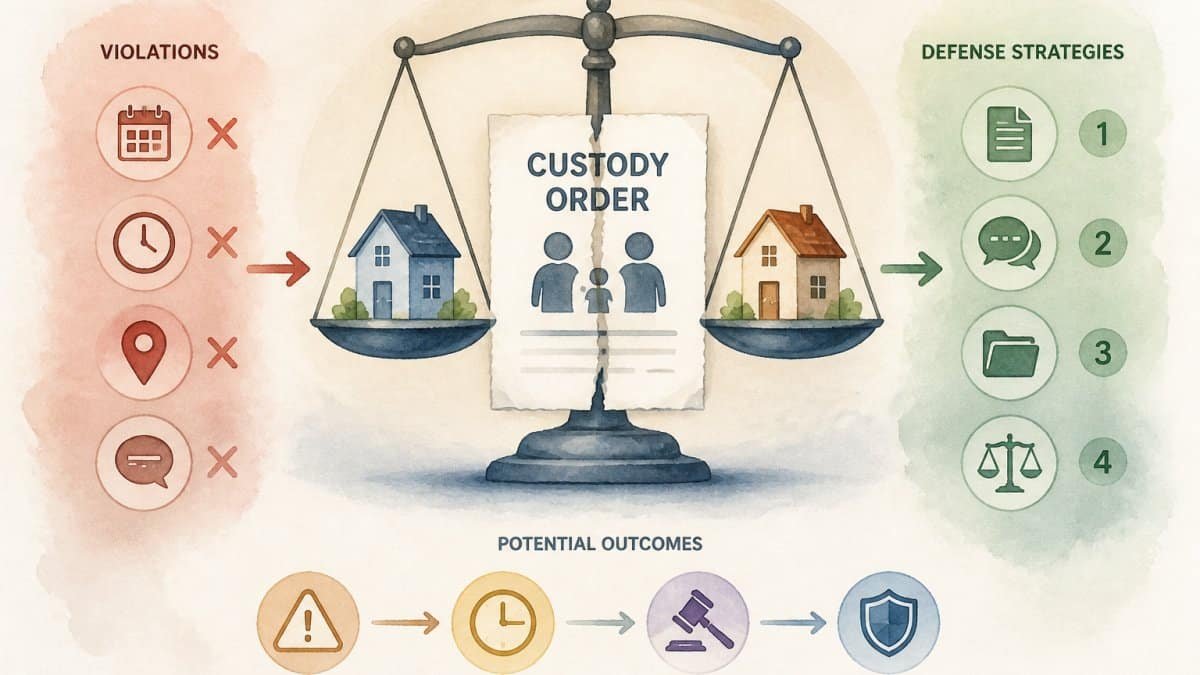
You can defend against a custody order violation by attacking one of the four elements the other parent must prove, most often willfulness. Ambiguity, consent, impossibility, and honest mistake are the defenses that hold up, because a custody order violation must be a clear, provable, willful breach of a written term.
- Civil contempt requires proof by a preponderance of the evidence, while criminal contempt generally requires proof beyond a reasonable doubt.
- If a reasonable person could read an order term two ways, that ambiguity itself is a defense.
- A genuine emergency defense must be documented, immediate, and reported to the court, not a unilateral decision.
- After being served with a contempt motion, file a written, often notarized response before the deadline or risk a default ruling.
- Talk to a family-law attorney before the hearing if the motion asks for jail time or criminal contempt.
Table of Contents
What Counts as a Custody Order Violation (and What Doesn’t)
A custody order violation happens when a parent breaks a specific, written term of a court-ordered custody arrangement. Not every frustrating exchange rises to that level. The hardest part is telling a real custody order violation apart from ordinary friction.
Violation vs. Disagreement or Misunderstanding
A disagreement is a dispute over something the order never addressed; a misunderstanding is a mix-up about timing, pickup spots, or who said what. A violation means a parent acted against a written term, and courts look for a clear, provable breach before imposing penalties.
Common gray areas include:
- A one-time late pickup caused by traffic
- A schedule swap both parents discussed but never confirmed in writing
- A missed call during a window the order left vague
Common Examples Courts Treat as Violations
- Denial of parenting time. Refusing to hand over the child during the other parent’s scheduled time.
- Withholding a child. Keeping the child past the return time without agreement.
- Failure to return a child. Not showing up for the exchange at all.
- Blocking communication. Ignoring court-ordered contact between the child and the other parent.
- Breaking notice rules. Failing to give required notice before a move or travel.
If you are weighing whether a schedule change crossed a line, how to handle custody schedule changes explains when a change is legitimate and when it becomes a violation.
Building Evidence for a Custody Order Violation Case
Build a record:
- Keep a dated log. Note each incident, the exact order term involved, and what happened.
- Save messages. Screenshots of texts, emails, and app messages with timestamps. Co-parenting communication apps vs manual scripts explains which method holds up better as court documentation.
- Use a calendar. Mark scheduled time versus actual time, with notes.
- Collect witness accounts. Names of people present at exchanges.
- Store everything in one place. A single folder beats scattered notes.
If the dispute grew out of an affair, managing custody disputes after an affair offers a structured way to document and communicate through the conflict.
Defense Against Contempt of Court for Custody Violation
A defense against contempt of court for custody violation starts with one move: read the order before you respond. Most custody enforcement actions are civil contempt, which has specific elements the moving parent must prove, and those elements show where to aim your defense.
What the Other Parent Has to Prove
- A valid, enforceable order existed. The order must be in writing, signed by the judge, and specific enough to be followed.
- The order was clear and unambiguous. Vague terms generally cannot support contempt. If a reasonable person could read the term two ways, the ambiguity itself is a defense.
- The other parent knew about the order. Usually shown through service, signatures, or prior court appearances.
- You violated the order willfully. This is the element most defenses attack. A mistake, an honest misunderstanding, or an inability to comply is not willful disobedience.
Ask the court clerk whether your state treats custody violations as civil contempt, criminal contempt, or both. The labels matter: criminal contempt carries a higher burden (proof beyond a reasonable doubt) and can lead to jail, while civil contempt is coercive and usually resolved by compliance or make-up time.
::: Establishing the underlying authority of a custody order often requires clarifying biological relationships, a process that becomes particularly complex during legal paternity disputes.
Civil vs. Criminal Contempt: Why the Distinction Matters
| Feature | Civil Contempt | Criminal Contempt |
|---|---|---|
| Purpose | Coerce compliance with the order | Punish past disobedience |
| Burden of proof | Preponderance of the evidence | Beyond a reasonable doubt (in most courts) |
| Who benefits | The moving parent / the child | The court’s authority |
| Typical outcome | Make-up parenting time, compliance order, attorney fees | Fines, jail, community service |
| Can you purge it? | Yes, by complying | Usually no |
Defenses That Hold Up in Family Court
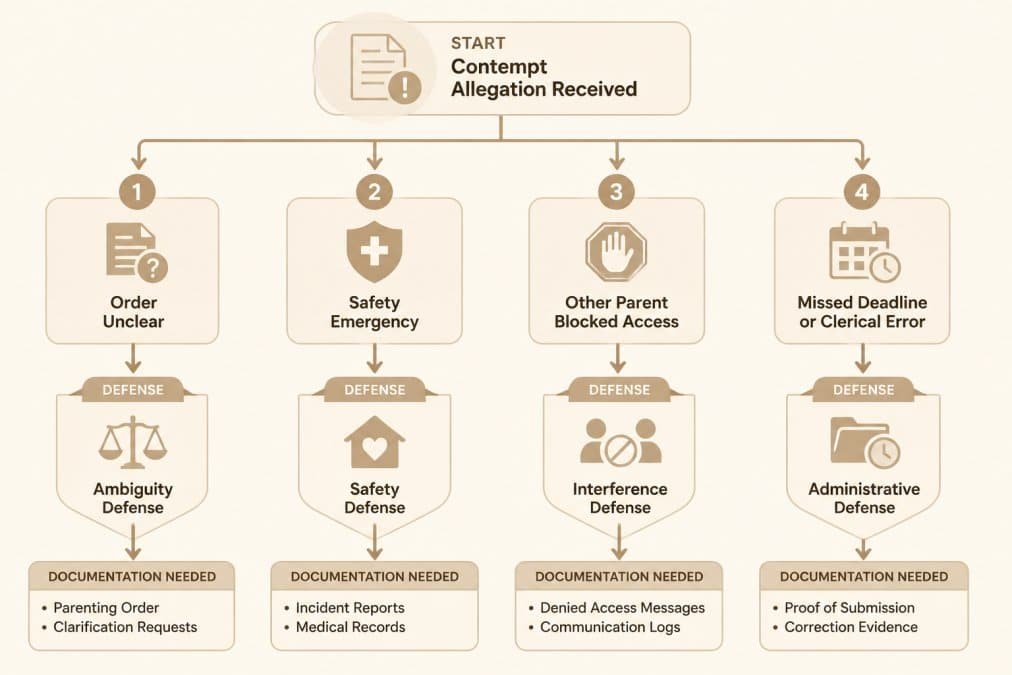
- The order was ambiguous (element 2). You followed a reasonable reading of unclear language. Bring the order and highlight the disputed term.
- The other parent consented (element 4). Texts, emails, or app messages showing they agreed to the change negate willfulness.
- You had a safety concern (element 4). You acted to protect the child from harm. This is the narrowest defense, see the emergency section below, but it can defeat willfulness if documented.
- The other parent blocked access (element 4). You could not comply because they interfered, such as refusing to meet at the exchange point. Impossibility is a defense.
- It was a one-time error (element 4). A clerical or scheduling mistake, corrected quickly, is not willful. Show the correction and your documented effort to follow the order.
- You were never properly served or notified (element 3). If you did not know about the order or a modification, you cannot willfully violate it.
- The order had already been modified or superseded (element 1). A later order, stipulation, or temporary order can replace the term the other parent is citing.
The Burden-Shifting Sequence
- The moving parent presents their case. They must put on evidence of the four elements. If they fail, the motion should be denied.
- You present your defense. You do not have to prove innocence; you have to raise a credible defense to at least one element. Ambiguity, consent, impossibility, and lack of willfulness are the workhorses.
- The court decides and, if contempt is found, considers remedies, make-up parenting time, a compliance order, sanctions, attorney fees, or custody modification if the pattern is serious.
What to Bring to the Hearing
- A certified copy of the current order and any modifications
- A dated log of every relevant incident, tied to the specific order term
- Screenshots of messages with timestamps
- Your calendar showing scheduled vs. actual time
- Names and contact information for witnesses at exchanges
- Proof of any safety concern (police reports, CPS records, medical records)
- A short written timeline you can hand to the judge
When to Get a Lawyer
Talk to a family-law attorney before the hearing if any of these apply:
- The motion asks for jail time or criminal contempt
- The other parent is represented by counsel
- The order is ambiguous and needs interpretation
- You are considering an emergency withholding defense
- There is a parallel CPS investigation or protective order
Emergency Defense for Withholding a Child
An emergency defense for withholding a child applies when you kept the child to protect their safety. It is the narrowest defense in family law. A genuine emergency defense is documented, immediate, and reported to the court, not a unilateral decision to keep the child because you are worried.
The Legal Standard Courts Apply
- Was the risk immediate and specific? General worry or a new partner the other parent dislikes is not enough. The concern must be concrete, abuse, neglect, impairment, or an unsafe person present during parenting time.
- Was withholding the least restrictive response? Could you have called law enforcement, child protective services, or filed an emergency motion instead?
- Did you notify the court and the other parent promptly? A parent who disappears for weeks and then claims safety usually loses the defense. One who calls CPS, files an emergency motion within days, and keeps the other parent informed in writing is in a much stronger position.
Examples That Can Support an Emergency Defense
- Evidence of physical or sexual abuse, or a credible disclosure by the child
- A parent driving while impaired with the child in the car
- An unsafe person present during parenting time, for example, someone subject to a protective order
- A medical emergency the other parent refuses to address
- A credible threat of abduction, especially with travel plans or passport issues
What to Do in the Moment
- Call law enforcement or child protective services if the child is in immediate danger. Get a report or intake number and write it down.
- Write down what happened, with dates and times. Include who was present, what was said, and what you observed.
- Notify the other parent in writing through a documented channel, text, email, or a co-parenting app. State the safety concern and that you are seeking court guidance. Do not disappear.
- File the proper court paperwork as soon as possible. Many jurisdictions have an emergency or ex parte motion process. Ask the clerk for the forms, the filing fee, and whether a fee waiver is available.
- Keep the child’s routine stable and do not speak badly about the other parent to the child. Courts notice.
The strongest emergency defense is one where you can show the court: “I acted immediately, I documented it, I reported it, and I asked the court to decide, I did not substitute my own judgment for the order.” That is the difference between a defense and a violation.
The Risk of Self-Help
- A contempt motion filed by the other parent
- An order requiring you to return the child immediately
- Make-up parenting time for the missed visits
- Monetary sanctions and attorney fees
- A modification of custody that reduces your time
After the Emergency: Next Steps
If the court finds the safety concern genuine, it may adjust custody, order supervised parenting time, or require the other parent to complete services. If not, you may face the consequences listed above. Either way, the record you built in the first 48 hours is what the judge will rely on.

Responding to a Custody Contempt Motion
Responding to a custody contempt motion means filing a written answer with the proper court before the deadline. Do not ignore it. A missed deadline can lead to a default ruling against you.
What to Do After You’re Served
Follow these steps in order:
- Note the deadline. The paperwork states when your response is due.
- Read the motion closely. Identify each alleged violation.
- Gather your evidence. Match documents to each claim.
- Draft a verified response. Many courts require a sworn, notarized answer.
- File with the court clerk. Keep copies of everything.
- Talk to a family-law attorney. A local lawyer knows your court’s rules and deadlines.
Talking to the Other Parent Without Making It Worse
With a hostile co-parent, consider keeping messages factual and focused on the schedule.
A structured script keeps you calm and consistent. BIFF response examples for co-parenting give you one-paragraph replies that stay brief, informative, friendly, and firm, even with a difficult ex.
Preparing Your Response and Next Steps
If you are facing a high-conflict parent, how to prepare for custody court with a narcissist lays out strategies for presenting objective evidence and staying steady under pressure.
At After the Affair Series, our structured frameworks and scripts help parents manage hostile interactions, protect their children’s wellbeing, and respond to conflict with clarity instead of panic.
Frequently Asked Questions
What are common defenses to a custody order violation claim?
Keep records of relevant events and consult an attorney about your situation.
Can an emergency justify withholding a child from the other parent?
Whether an emergency justifies withholding a child depends on the circumstances and applicable law. Consult a family-law attorney about your situation.
What evidence helps in a custody order violation case?
Keep relevant records, such as the schedule, messages, and dated notes about what happened. Consult an attorney about what evidence may be relevant to your situation.
What happens if you are served with a custody contempt motion?
Read the filing and consult a family-law attorney about the response deadline and how to address the allegations. Gather relevant records and prepare a factual account of what happened.