Quick Summary
Protecting a child from a narcissistic parent means shifting from reaction to structure: name the behavior rather than the person, keep your reactions flat, document incidents, never use the child as a messenger, and protect predictable routines. Keep communication short, factual, and focused on logistics, and give children truth they can hold rather than a verdict about the other parent.
- Name the behavior, not the person: say that comment was unkind, not your father is a narcissist.
- Document incidents with dates, quotes, and context in case custody issues arise.
- All logistics go adult to adult; never use the child as a messenger.
- Parallel parenting uses one written channel, response windows, neutral handoffs, and no arguing phone calls.
- If a child discloses abuse, do not investigate yourself or promise secrecy; contact child protective services.
Last Updated: October 27, 2026
Table of Contents
What Narcissistic Parental Influence Actually Does to Children
Protecting children from narcissistic parental influence starts with understanding the situation. For concrete strategies to stop your narcissistic ex from manipulating your kids, see How Do I Stop My Narcissistic Ex from Manipulating Our Kids. A child may feel that their feelings are negotiable.
Manipulation Tactics You Will Recognize
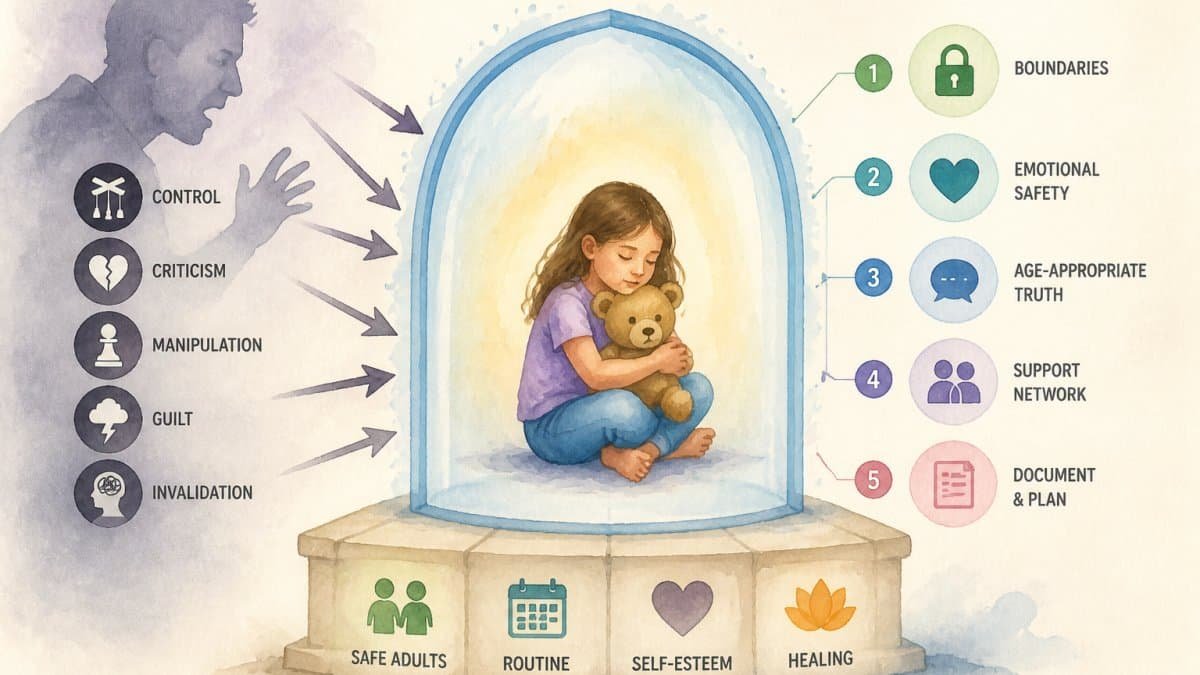
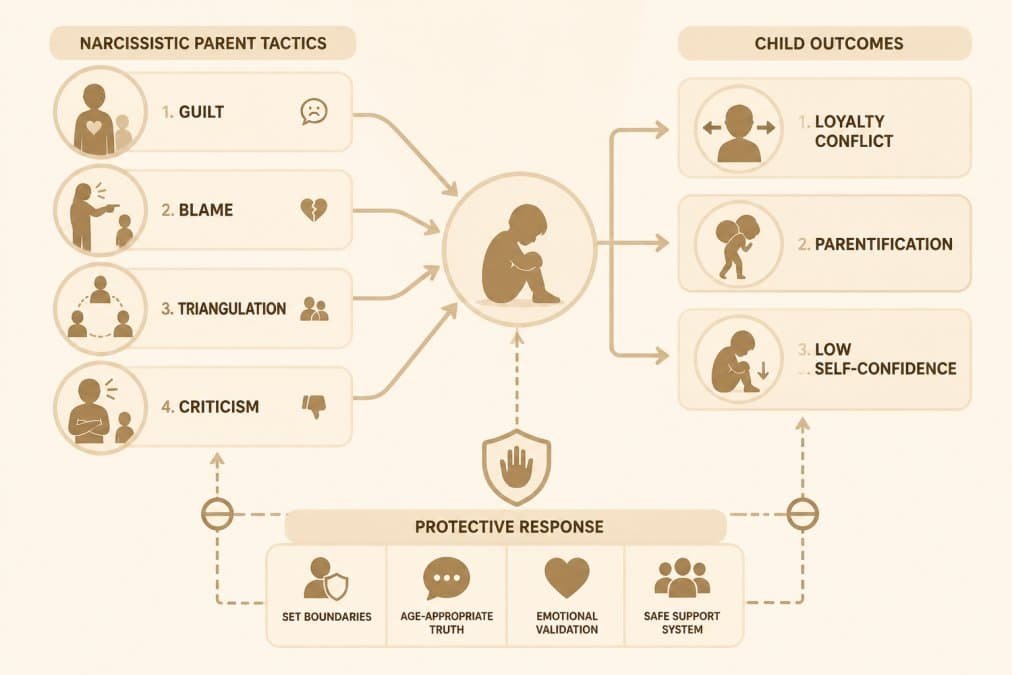
Guilt, blame, and control may appear in difficult family interactions. A parent may:
- Frame every boundary as a personal betrayal
- Blame the child for adult problems
- Criticize one moment and idealize the next
- Use triangulation to pit family members against each other
Parentification and the Adult Role a Child Never Asked For
Parentification is when a child becomes the caretaker, mediator, or emotional support for a parent.
Protecting a Child From Emotional Manipulation: The Ground Rules
Protecting a child from emotional manipulation can involve shifting from reaction to structure. Here are some ground rules:
- Name the behavior, not the person. “That comment was unkind” beats “your father is a narcissist.”
- Keep reactions flat. Big reactions feed the cycle. Calm responses starve it.
- Document incidents. Dates, quotes, and context create a record if custody issues arise.
- Never use the child as a messenger. All logistics go adult to adult.
- Protect routines. Predictable schedules give kids a sense of control.
For more strategies on shielding kids from conflict, see our guide on protecting children from divorce conflict.
These ground rules shift the focus from reacting to the other parent to building structure around the child.
| Ground rule | What to do |
|---|---|
| Name the behavior, not the person | Say “that comment was unkind,” not “your father is a narcissist” |
| Keep reactions flat | Calm responses starve the cycle that big reactions feed |
| Document incidents | Record dates, quotes, and context in case custody issues arise |
| Never use the child as a messenger | All logistics go adult to adult |
| Protect routines | Predictable schedules give kids a sense of control |
Scripts for Communicating With a Narcissistic Co-Parent
Scripts for communicating with a co-parent can provide starting points for neutral exchanges:
- “I’ll stick to the schedule we agreed on.”
- “That’s a topic for the parenting plan, not a text thread.”
- “I hear you. I’m not going to debate this today.”
- “Please send all schedule changes in writing.”
- “I’m ending this conversation now. We can revisit logistics tomorrow.”
Keep messages short, factual, and focused on essential logistics.
Our scripts for co-parenting with a narcissist give you 50+ ready-to-use responses, including boundary language and documentation tips, so you are not writing these lines from scratch at 11 p.m.
Age-Appropriate Ways to Talk With Your Child
What you say depends on the child’s age, and the guiding principle is the same at every stage: give the child truth they can hold, not a verdict about the other parent. The scripts below are starting points, not lines to recite verbatim. For age-specific scripts for explaining parenting changes to kids, including toddlers, school-age kids, and teens, see our full guide.
Toddlers and preschoolers (roughly ages 2-5). Keep it about safety, love, and what happens next. Use short, present-tense sentences and pair words with routine.
- “You are safe. I love you.”
- “Tonight you’re with me. Tomorrow you’re with Daddy. I’ll always come back for you.”
- “It’s okay to feel sad, and I’m right here.”
- What to avoid: “Daddy was mean,” “Mommy made me angry,” or any question that asks the child to choose a side.
School-age kids (roughly ages 6-11). Name the feeling, not the villain. Separate the child’s behavior from the adult’s behavior, and explicitly remove guilt.
- “It’s okay to feel upset after visits. Those feelings make sense.”
- “What happened between the grown-ups is not your fault, and it is not your job to fix.”
- “You don’t have to choose sides. You’re allowed to love both of your parents.”
- “If something someone says to you feels wrong, you can tell me, and we’ll figure it out together.”
- What to avoid: details about court, custody, or the other parent’s diagnosis.
Teens (roughly ages 12-18). Answer real questions directly, respect their perspective, and avoid recruiting them as a confidant or investigator.
- “You’re old enough that I’ll be straight with you: the adults don’t agree on some things, and that’s for us to handle, not you.”
- “You can ask me anything. I may not be able to answer every question, but I won’t lie to you.”
- “If you ever feel unsafe or uncomfortable, you can call me. No questions, no lecture.”
- “I’m not going to ask you to report on what happens at the other house. That’s not your job.”
- What to avoid: using the teen as a messenger, asking them to spy, or sharing adult details about finances or legal strategy.
Write your two or three go-to lines on a note in your phone before a handoff or a hard conversation. Having the words ready keeps you from improvising in a heated moment.
Parallel Parenting Strategies That Limit Contact and Conflict
Parallel parenting strategies involve each parent running their own household with minimal overlap. Learn more about parallel parenting with a narcissist to limit conflict, set boundaries, and protect your child. Contact may focus on essentials such as schedules, health, and school.
A common approach is to:
- Use one written channel for all communication
- Set response windows instead of instant replies
- Skip phone calls that turn into arguments
- Hand off kids at neutral locations
The point is distance with structure, not distance with chaos.
Signs of Parental Alienation in Children and What to Do
Watch for:
- A child who suddenly refuses contact with no clear reason
- Negative comments about you repeated back verbatim
- Guilt when the child shows you affection
If you have concerns, do not grill the child. Stay calm, keep your time together consistent, and document what you observe.

When to Bring In a Child Therapist, School, or Family-Law Professional
Some situations need more than scripts. If you have concerns about a child’s safety or mental health, consider seeking professional help.
Thresholds for Urgent Intervention
Treat the following as thresholds for urgent intervention, not as topics for a text thread:
- Immediate danger. If a child is in physical danger, has been threatened, or is being withheld in violation of a court order, contact emergency services (911) and follow the instructions in your existing custody order. Do not negotiate through the other parent in the moment.
- Disclosure of abuse. If a child discloses physical or sexual abuse, do not investigate it yourself and do not promise secrecy. Contact your local child protective services agency or a child-advocacy center, and follow their guidance on next steps. A pediatrician can also connect you with the right reporting channel.
- Self-harm or suicidal statements. Any talk of self-harm, hopelessness, or wanting to disappear warrants same-day contact with a pediatrician, a crisis line, or an emergency department. The 988 Suicide & Crisis Lifeline is available by call or text in the United States (What to Expect).
- Domestic-abuse concerns. If you or your child are experiencing coercion, threats, or control, a domestic-abuse service can help with safety planning, including how to document incidents and what to do at exchanges. The National Domestic Violence Hotline is a starting point.
- Repeated violations of a custody order. If the other parent repeatedly ignores the parenting plan, talk with a family-law attorney before you respond in kind. Retaliating can hurt your position.
Do not confront the other parent about a disclosure, and do not ask the child to repeat the story to multiple adults. A single, calm report to the right professional protects the child’s credibility and reduces the chance the child feels blamed.
Coordinating With School, Pediatrician, and Therapist
You can share a short, factual update with teachers and clinicians if you have concerns.
- School. Ask the counselor or principal to flag changes in attendance, mood, or behavior, and to tell you if the other parent requests records or tries to change pickup arrangements. Keep the request in writing.
- Pediatrician. Mention any changes in sleep, appetite, school performance, or anxiety at well-child visits.
- Therapist. Ask the therapist how they handle communication with both parents and whether they will coordinate with the school.
If you notice changes in your child’s behavior between households, consider mentioning them to a professional.
Documenting Concerning Behavior
You can keep a simple log with the date, time, what was said or done, who was present, and any visible effect on the child. Save texts and emails in their original form, and note missed exchanges or late pickups. These documented patterns of behavior provide the necessary evidence should you eventually need to pursue the formal process of appointing a legal guardian to ensure your child’s long-term stability.
A family-law attorney can explain what your custody order allows and what counts as evidence in your jurisdiction. The American Academy of Pediatrics guidance on supporting children through family stress is a useful starting point for parents weighing a therapy referral.
If you are unsure whether a situation is a communication problem or a safety problem, consider consulting a professional.
Building Your Family’s Protection Plan With After the Affair Series
Protecting children from narcissistic parental influence is not one conversation. It is a plan you build and repeat. After the Affair Series provides clear frameworks for high-conflict situations, age-appropriate scripts for children, and structured communication tools like the Gray Rock Method.
Start with the free 23-point assessment, which includes scored results. Then build from there.
The takeaway is simple. You cannot control another person. You can choose the words you use and the structure you build.
Frequently Asked Questions
How can I protect my child from a narcissistic parent without badmouthing the other parent?
Keep comments focused on behavior rather than the person. Say ‘That sounded harsh’ instead of naming a diagnosis. You can offer your child a simple exit line like ‘I need a minute’ when a conversation turns critical. You can document incidents in a dated log. Keep routines predictable at your home.
What are the signs of parental alienation in children?
If you notice a sudden shift in how your child talks about you, language that sounds borrowed from the other parent, rejection without a specific reason, or guilt about showing you affection, consider discussing your concerns with a child therapist or family-law attorney.
Can parallel parenting strategies work if my ex refuses to communicate reasonably?
Parallel parenting is one approach to consider when communication is difficult. You can use one written channel for essential logistics, keep responses short and neutral, and set a reply window for yourself.
What if my child repeats hurtful things the other parent said about me?
Do not argue with the content or ask your child to take sides. You could say: ‘That sounds like it was upsetting to hear.’ You can write down what was repeated and the date.