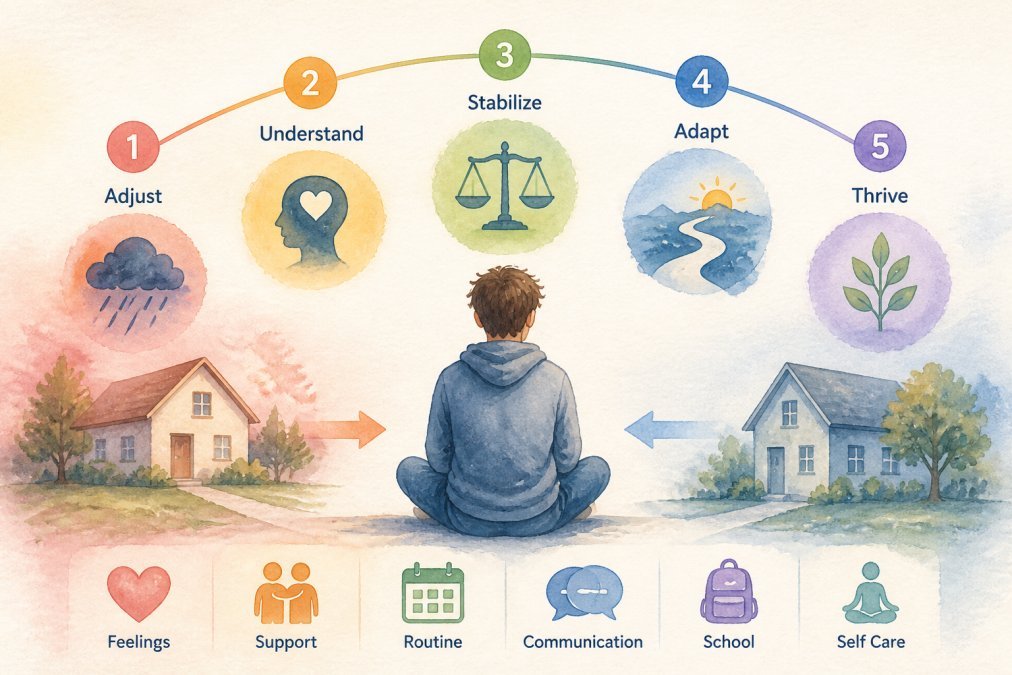
A short set of therapist-informed moves will reliably reduce escalation and improve connection when practiced consistently. Here are the eight skills to start with today, followed by scripts, a conflict protocol, and clear signs that professional help is the right next step.
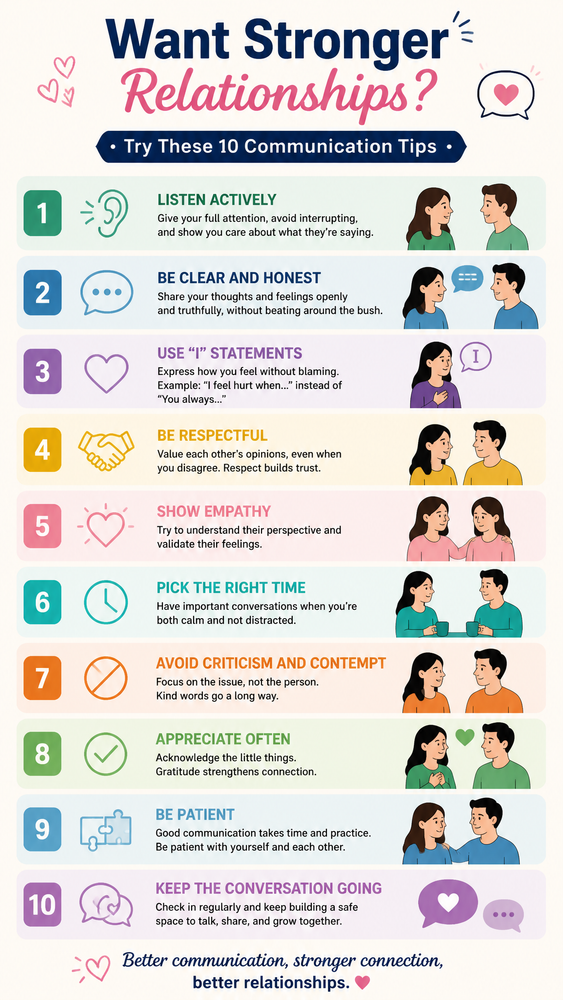
The essential healthy communication tips:
- Listen to reflect, not to respond — paraphrase what you heard before adding your own view
- Use “I” statements — “I feel hurt when…” instead of “You always…”
- Set timing and use time-outs — agree on a signal and a return window before conflict peaks
- Plan your message — know your core point before you open your mouth
- Align your nonverbals — tone, posture, and eye contact should match your words
- Regulate before you respond — breathe first, talk second
- Set clear boundaries — name what you need, not just what you don’t want
- Rehearse short scripts — practice in low-stakes moments so the words come naturally under pressure
GoodTherapy clinicians note that assuming a partner’s good intent lowers defensive barriers and creates space for vulnerability. Harvard Professional Development lists clarity and preparation as foundational practices for anyone who wants their message to land.
Pro Tip: Agree on a neutral time-out signal with your partner before you need it — a raised hand, a specific word — so either person can call a pause without it reading as rejection or stonewalling.
- Key Takeaways
- What do healthy communication tips actually look like in practice?
- How do you resolve conflict without making it worse?
- How do you know when you’re too triggered to talk?
- What exercises actually build communication skills?
- When should you get professional help?
- What most communication advice gets wrong
- Structured support when communication breaks down after betrayal
- FAQ
Key Takeaways
Healthy communication is a trainable skill: regulate first, reflect before responding, and repair quickly when ruptures happen.
| Point | Details |
|---|---|
| Regulate before you speak | Physiological flooding blocks effective communication; use box breathing or grounding before engaging. |
| Use “I” statements and reflect | Name your own feelings, paraphrase what you heard, and ask one open question before responding. |
| Pre-agree a time-out protocol | A named signal plus a committed return window prevents abandonment panic during conflict pauses. |
| Repair matters more than winning | Consistent small repair attempts build more resilience than avoiding conflict altogether. |
| Aftertheaffair for betrayal recovery | When communication breaks down after infidelity, Aftertheaffair’s staged guides and scripted tools provide structured, trauma-informed support. |
What do healthy communication tips actually look like in practice?
Each tip above has a therapist rationale behind it and a short script you can rehearse. The table below maps each one to why it works and what to say.
| Tip | Why it reduces harm | Quick script to try |
|---|---|---|
| Reflect/paraphrase | Confirms understanding before reacting | “What I’m hearing is ___. Did I get that right?” |
| “I” statements | Removes blame; invites dialogue | “I feel ___ when ___ because ___.” |
| Strategic time-out | Prevents flooding; signals intent to return | “I need 30 minutes. I’ll come back at 8 PM.” |
| Plan your message | Reduces repetition and confusion | “The one thing I need you to understand is ___.” |
| Nonverbal alignment | Prevents mixed messages | Soften your voice, face the person, unclench your jaw |
| Regulate first | Keeps prefrontal cortex online | Three slow breaths before speaking |
| Boundary-setting | Names needs clearly | “I’m okay with ___, but I need ___ to feel safe.” |
| Script rehearsal | Builds muscle memory | Practice the line aloud once before the conversation |
Active listening: the skill most people skip
Research from the University of Waterloo recommends a four-step sequence: stop your internal commentary, observe nonverbal cues, paraphrase what you heard, then ask an open question. That last step is where most people stall. A reflective script sounds like this: “It sounds like you felt dismissed when I left early. Is that what happened?” Notice it ends with a question, not a verdict.
Open questions (“What did that feel like for you?” rather than “Were you upset?”) keep the other person talking and signal genuine curiosity. Closed questions shut conversations down fast.
“I” statements and apology language
The structure is simple: I feel [emotion] when [specific behavior] because [impact on me]. Avoid “I feel like you…” — that’s a “you” statement in disguise. For apology and repair, ownership matters more than eloquence. GoodTherapy’s clinicians point to explicit ownership as central to effective repair: “I was wrong to say that. I understand why it hurt you.” No qualifiers, no “but.”
Nonverbal alignment
Tone carries more emotional weight than word choice in most face-to-face conversations. A quick self-check: Is your voice tight? Are your arms crossed? Are you making eye contact or staring at your phone? FranklinCovey’s communication guidance notes that mismatched verbal and nonverbal messages create confusion even when the words themselves are reasonable. Slow your speech, soften your posture, and face the person directly.
Pro Tip: Rehearse one script per week in a low-stakes moment — with a friend, in front of a mirror, or even in the car. The words come out smoother when the situation is charged.
How do you resolve conflict without making it worse?
HelpGuide’s relationship communication research makes a useful point: conflict quality matters more than frequency. Couples who handle disagreements constructively report higher satisfaction and stronger repair capacity than those who avoid conflict entirely. The protocol below gives you a repeatable sequence.
The four-step conflict protocol
- Name the emotion, not the accusation. “I’m feeling anxious about this” opens a door. “You’re being unreasonable” slams it.
- Request a pause if you’re flooded. Use your pre-agreed signal. Say: “I want to work through this. Can we take 30 minutes and come back at 7 PM?” Commit to the return time.
- Reflect before proposing. When you reconvene, start by reflecting what the other person said before the pause: “Before I share my side, I want to make sure I understood yours.”
- Identify the need and propose one small solution. “What I need is to feel heard on this. Could we each take five minutes to speak without interruption?”
A short example of the protocol in action:
Person A: “I’m feeling shut out and I don’t want to fight. Can we pause for an hour?”
Person B: “Yes. Back at 8?”
Person A: “Yes. And when we come back, I just want to understand your side first.”
That’s it. Three lines, no escalation.
Apology and repair after a rupture
A repair attempt doesn’t require a long speech. “I said something hurtful. I’m sorry. What do you need from me right now?” is enough to re-open the door. Rebuilding trust after betrayal often starts with exactly this kind of small, consistent repair rather than a single dramatic gesture.
Handling defensiveness
When someone gets defensive, arguing harder rarely helps. Try: “I’m not attacking you. I’m trying to tell you how I feel.” Then pause. Defensiveness usually drops when the other person stops feeling accused.

Safety callout: If a conversation involves threats, physical intimidation, or persistent coercion, stop the protocol and seek immediate help. The National Domestic Violence Hotline (1-800-799-7233) is available 24/7.
Pro Tip: Assuming good intent before a hard conversation shifts your entire posture. Ask yourself: “Is it possible they’re not trying to hurt me?” That question alone can lower your cortisol before you say a word.
How do you know when you’re too triggered to talk?
PositivePsychology’s synthesis of communication skill research frames regulation as teachable: mindful pauses and breathing techniques reduce reactivity and keep conversations productive. The first step is recognizing when you’ve crossed the threshold.
Signs your nervous system has taken over:
- Racing or pounding heart
- Tunnel vision or difficulty tracking what the other person is saying
- Strong urge to retaliate or go silent
- Shallow, fast breathing
- Feeling like you have to resolve it right now
When you notice two or more of these, the conversation will not go well. That’s not a character flaw; it’s physiology.
Three fast regulation tools
Box breathing: Inhale for four counts, hold for four, exhale for four, hold for four. Two rounds is enough to slow your heart rate.
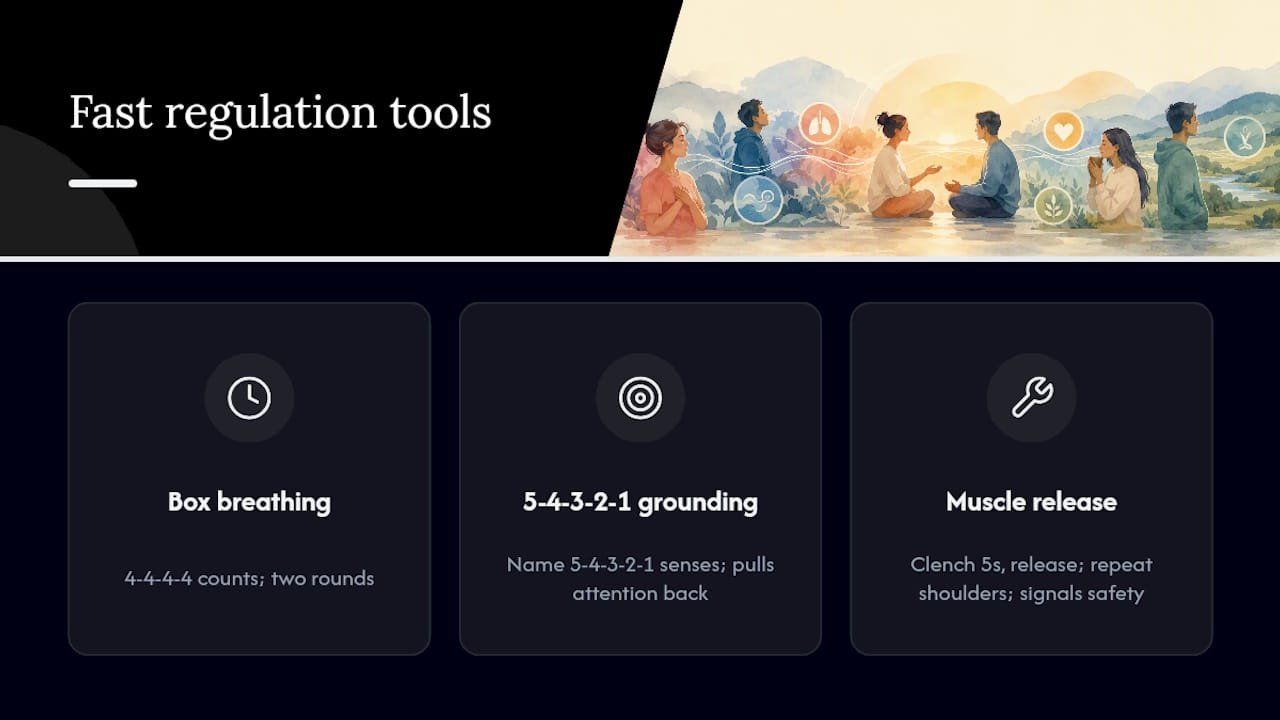
5-4-3-2-1 grounding: Name five things you can see, four you can touch, three you can hear, two you can smell, one you can taste. It pulls attention out of the threat loop and back into the room.
Progressive muscle release: Clench both fists tightly for five seconds, then release completely. Repeat with your shoulders. The physical release signals safety to your nervous system.
Timing rules that prevent unnecessary damage
- Never start a high-stakes conversation when either person is hungry, exhausted, or already stressed about something else.
- Agree in advance on a time-out length. Verywell Mind’s clinician-recommended protocol suggests a specific return window — 60 minutes works for most people — because an open-ended pause triggers abandonment anxiety.
- The person who calls the time-out is responsible for returning. That commitment is what makes the pause feel safe rather than like avoidance.
For emotion regulation strategies tailored specifically to betrayal recovery, this guide on emotion management after an affair covers the same physiological principles with context for high-conflict post-betrayal situations.
Pro Tip: Write your time-out signal and return window on a sticky note and put it somewhere both of you will see it. Pre-agreed beats improvised every time.
What exercises actually build communication skills?
PositivePsychology confirms that short, repeated practice produces measurable improvement in listening and emotional regulation. You don’t need long sessions; you need consistent ones.
Three practice exercises
10-minute role-play: Pick a low-stakes topic you’ve disagreed on recently. One person speaks for two minutes using only “I” statements. The other reflects back what they heard before responding. Switch. Debrief for two minutes on what felt awkward.
Daily reflective check-in: Each evening, answer three questions privately or together: What did I communicate well today? Where did I react instead of respond? What’s one thing I want to say differently tomorrow?
Weekly relationship inventory: Once a week, each partner names one thing that went well and one thing they’d like more of. Keep it to two minutes each. The goal is pattern awareness, not problem-solving.
Micro-habits to build into daily life
- Pause for three seconds before answering any emotionally loaded question
- End conversations with a check-back: “Are we good? Is there anything else you need from me?”
- When you catch yourself interrupting, say “Sorry, finish your thought” and mean it
- Before a high-stakes conversation, write down your core point in one sentence
For couples rebuilding after betrayal, trust-building exercises offer structured drills that layer communication practice into the repair process.
| Exercise | Time needed | What it builds |
|---|---|---|
| “I” statement role-play | 10 minutes | Emotional ownership, reduced blame |
| Daily reflective check-in | 5 minutes | Self-awareness, pattern recognition |
| Weekly relationship inventory | 10 minutes | Shared understanding, proactive repair |
| Check-back habit | 30 seconds | Closure, mutual reassurance |
When preparing for a particularly high-stakes conversation, the same principles that apply to talking effectively with a doctor apply here: write your main point down first, anticipate the other person’s concerns, and keep your opening statement brief.
When should you get professional help?
Self-help tools work well for most communication friction. They are not enough when the underlying issue is trauma, persistent coercion, or a pattern that keeps repeating despite genuine effort.
Red flags that point toward professional support:
- Physical violence or threats of violence at any point
- One person consistently controls, isolates, or coerces the other
- Repeated destructive cycles that reset within days despite resolution attempts
- Inability to regulate emotions even outside of conflict
- Communication breakdown tied to serious betrayal, such as infidelity or emotional infidelity
- One or both partners feel unsafe expressing needs
How to choose the right professional
For general communication and conflict skills, a licensed marriage and family therapist (LMFT) or licensed professional counselor (LPC) with couples training is a solid starting point. For betrayal trauma specifically, look for clinicians trained in EMDR, Emotionally Focused Therapy (EFT), or trauma-informed couples work. At intake, ask: “What’s your approach to betrayal trauma?” and “How do you handle high-conflict sessions?” The answers tell you quickly whether the fit is right.
Safety callout: If you are in immediate danger, call 911. For ongoing domestic abuse, the National Domestic Violence Hotline (1-800-799-7233) offers 24/7 support, safety planning, and referrals.
Pro Tip: A therapist who specializes in betrayal trauma will have a different toolkit than a general couples counselor. The distinction matters — ask directly before booking.
What most communication advice gets wrong
The standard advice — “just listen more,” “use ‘I’ statements,” “take a breath” — is not wrong. It’s incomplete. Most guides treat communication as a skill problem when, for a significant portion of people reading this, it’s a safety and regulation problem first.
You cannot listen actively when your nervous system is in threat mode. You cannot choose your words carefully when your brain is flooded with cortisol. The sequence matters: regulate, then communicate. Every script in this article is useless if you try to deploy it while you’re still in fight-or-flight.
The second thing most guides miss is repair. Conflict is not the enemy of connection; unrepaired conflict is. A relationship that fights and repairs is often more resilient than one that avoids friction entirely. The couples who stay together long-term are not the ones who never argue. They’re the ones who know how to come back.
And for anyone whose communication difficulties are rooted in betrayal, the standard toolkit has real limits. Infidelity and betrayal trauma rewire how you interpret your partner’s words, tone, and silences. A neutral comment can land as a threat. A pause can feel like abandonment. That’s not a communication skill gap; it’s a trauma response, and it needs to be named as such before the scripts will stick.
Structured support when communication breaks down after betrayal
If the communication difficulties you’re facing are tied to infidelity or betrayal trauma, general tips will only take you so far. Aftertheaffair offers structured, evidence-informed resources built specifically for this situation: staged recovery guides, scripted conversation frameworks, and practical tools designed for the moments when standard advice stops working.

A good place to start is the 7-step infidelity recovery checklist, a practical, low-friction tool that maps the recovery process and gives you a clear sequence to follow. For readers ready to go deeper, the Relationship Growth After Infidelity guide walks through rebuilding trust and communication from the ground up, with scripts and exercises at each stage. Both resources are designed to complement professional therapy, not replace it.
Sources
- 21 Tips for Healthy Communication in Relationships — GoodTherapy
- Effective Communication: Improving Your Interpersonal Skills — HelpGuide
- Positivepsychology
- 8 Ways You Can Improve Your Communication Skills — Harvard Professional Development
This article provides general information only and is not a substitute for professional advice. If you are experiencing relationship distress, domestic abuse, or trauma symptoms, please consult a licensed mental health professional or contact the appropriate emergency services.
FAQ
What is the most important healthy communication tip?
Regulate your nervous system before you speak. No script or technique works reliably when you’re flooded; slowing your breathing first keeps your prefrontal cortex engaged and your words more accurate.
How do “I” statements improve communication?
“I” statements remove blame from the message by focusing on your own experience rather than the other person’s behavior, which reduces defensiveness and makes it easier for the other person to hear you.
How long should a communication time-out last?
Verywell Mind’s clinician-recommended protocol suggests a specific return window of around 60 minutes. Open-ended pauses tend to trigger abandonment anxiety; a committed return time keeps resolution possible.
When do communication problems need professional help?
Seek professional support when conflict involves threats, physical intimidation, or coercion, when destructive patterns repeat despite genuine effort, or when communication breakdown is tied to betrayal trauma. A licensed therapist trained in EMDR or Emotionally Focused Therapy is a strong starting point.
Can Aftertheaffair help with communication after infidelity?
Yes. Aftertheaffair offers staged recovery guides, scripted conversation frameworks, and practical tools designed specifically for betrayal-related communication challenges, including the 7-step infidelity recovery checklist and the Relationship Growth After Infidelity resource.
Recommended
- The Grey Rock Communication Scripts – After the Affair Series
- Communication Transition Mistakes – After the Affair Series
- Co-parenting Communication Tools – After the Affair Series
- How to communicate after affair: rebuild trust in 2026 – After the Affair Series