Last Updated: August 13, 2026
- Understanding Betrayal Trauma Symptoms
- How Betrayal Trauma Affects Your Nervous System
- Grounding Techniques for Emotional Flashbacks
- Journaling Prompts for Betrayal Trauma Recovery
- Betrayal Trauma Recovery Timeline: What to Expect
- Managing Triggers and Setting Digital Boundaries
- When to Seek Professional Help
Understanding Betrayal Trauma Symptoms
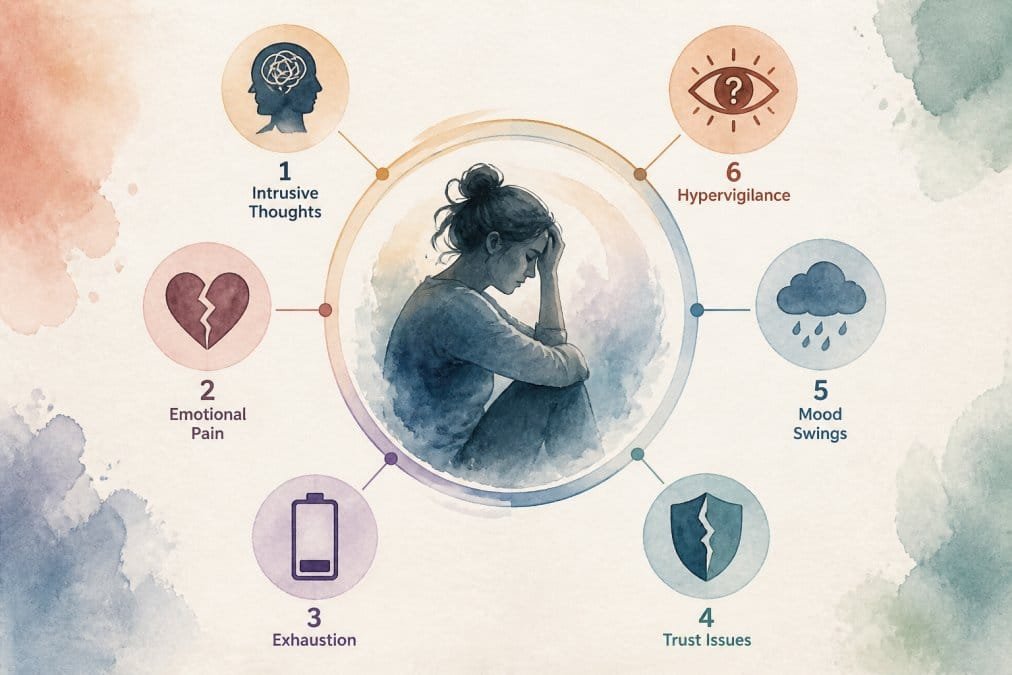
Betrayal trauma symptoms emerge when someone you trusted deeply violates that trust through infidelity, deception, or broken promises. These are neurobiological responses affecting your body, mind, and how you process reality. Unlike general trauma from strangers or random events, betrayal trauma carries the added weight of violated intimacy. Your nervous system registers not just danger, but that the source of danger was someone you relied on for safety.

Many people experiencing these symptoms interpret them as personal failures. The answer is that nothing is wrong with you. Your brain and body are doing exactly what they’re designed to do when betrayed.
Physical signs of betrayal trauma
Your body holds betrayal trauma in measurable ways. Sleep disruption, appetite changes, tension headaches, muscle tightness, chest heaviness, and difficulty breathing are common. Gastrointestinal issues frequently accompany betrayal trauma because your gut is directly wired to your emotional brain. When your nervous system perceives threat, digestion deprioritizes. You might also notice changes in immune function, getting sick more easily or existing conditions flaring up.
If physical symptoms persist or worsen, particularly chest pain, severe headaches, or thoughts of self-harm, contact a healthcare provider immediately. These warrant professional evaluation regardless of your emotional state.
Emotional and psychological responses
The emotional landscape of betrayal trauma is often contradictory. You might swing between rage and numbness within hours. Hypervigilance becomes your constant companion as you scan for threats and reanalyze past conversations for hidden meanings.
Many people experience cognitive dissonance, the painful gap between what you believed about your partner and the reality you now face. Betrayal blindness, a recognized psychological response, means you may have missed red flags before the betrayal was revealed. This isn’t your fault; it’s how attachment works. We’re biologically wired to trust those close to us.
Emotional numbness or dissociation is also common. You might feel like you’re watching your life from outside your body. This protective response helps you survive acute crisis, but when it persists, it creates disconnection from yourself and others.
Betrayal trauma responses, intrusive thoughts, hypervigilance, emotional numbness, rage, are neurobiological, not character flaws. Your nervous system is responding exactly as it should to a genuine threat to your safety and trust.
How Betrayal Trauma Affects Your Nervous System
Your nervous system has two primary branches: the sympathetic (fight-flight-freeze) and parasympathetic (rest-digest). Betrayal activates the sympathetic branch intensely and keeps it activated long after the initial discovery. Your amygdala becomes hyperactive, constantly scanning for threat signals, while your prefrontal cortex, which handles rational thinking, becomes less active. This is why you can’t simply “think your way out” of betrayal trauma.
Your body releases cortisol and adrenaline in response to perceived threat. In acute betrayal, this makes sense, you need energy and alertness to process what happened. But when your nervous system stays activated for weeks or months, the constant elevation of stress hormones depletes your physical and emotional reserves.
The polyvagal theory explains how betrayal affects your vagal nerve, the major pathway connecting your brain to your body. When you feel unsafe, your vagal response can shift into a freeze state, which feels like shutdown or dissociation. This is a more primitive protective response that conserves energy when escape seems impossible.
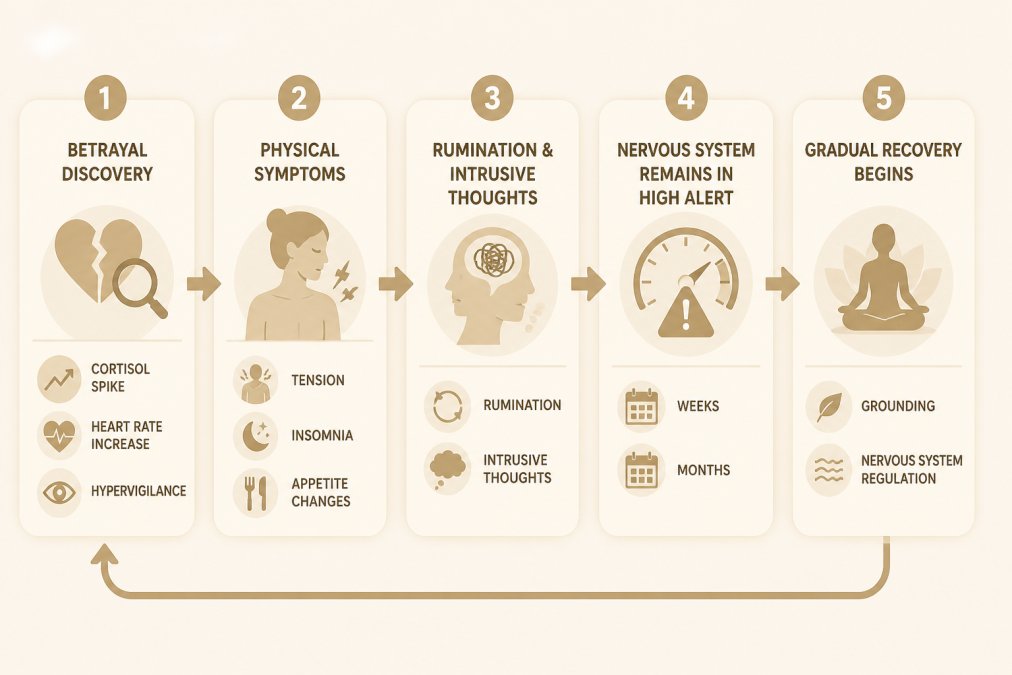
Understanding this neurobiology is crucial when dealing with betrayal trauma symptoms alone. You’re not broken or weak. Your nervous system is doing its job, perhaps too well, staying activated long after the immediate crisis has passed.
Grounding Techniques for Emotional Flashbacks
Emotional flashbacks occur when a trigger suddenly transports you back into the acute pain of betrayal. Your body reacts as if the betrayal is happening right now. Grounding techniques interrupt this cycle by anchoring you to the present moment.
The 5-4-3-2-1 technique is one of the most accessible grounding methods. Name five things you can see around you, four things you can physically feel, three things you can hear, two things you can smell, one thing you can taste. This sensory inventory pulls your attention out of the trauma narrative and into present-moment reality.
Box breathing is another powerful tool. Breathe in for a count of four, hold for four, exhale for four, hold for four. Repeat for two to three minutes. The rhythm signals safety to your vagal nerve, stabilizing your heart rate and signaling that the immediate threat has passed.
Somatic exercises for immediate relief
Somatic work recognizes that trauma lives in the body. Shaking or tremoring is a natural release mechanism. Stand with your feet shoulder-width apart and gently bounce, allowing your legs and body to shake naturally. This literally shakes trauma out of your nervous system. Many people feel significant relief after two to three minutes.
Progressive muscle relaxation involves tensing each muscle group for five seconds, then releasing. Start with your toes and work upward through your calves, thighs, abdomen, chest, arms, shoulders, neck, and face. This teaches your body the difference between tension and relaxation.
Cold water exposure is surprisingly effective. Splash cold water on your face or hold your hands under cold running water for 30 seconds. This activates the mammalian dive reflex, which slows your heart rate and signals safety to your nervous system.
Bilateral stimulation, alternately tapping your knees or feet, helps process traumatic memories. Tap your right knee, then left knee, alternating for two to three minutes while recalling a difficult memory. The bilateral input helps your brain integrate the memory rather than remaining stuck in it.
When grounding techniques feel ineffective, your nervous system is too activated. Start with the most intense somatic exercise (shaking, cold water, vigorous movement) before attempting subtle techniques like breathing or visualization.

Journaling Prompts for Betrayal Trauma Recovery
Journaling transforms the internal chaos of betrayal trauma into externalized thoughts you can examine and eventually release. Unlike rumination, which circles endlessly, intentional journaling creates structure and movement through your grief.
Prompts for processing intrusive thoughts:
- “The thought that keeps replaying is… What would I tell a friend who had this thought?”
- “If this thought were a person, what would it be trying to protect me from?”
Prompts for emotional expression:
- “Right now, I feel… and that feeling wants me to…”
- “If I allowed myself to grieve fully, without holding back, I would…”
Prompts for rebuilding trust in yourself:
- “Times I’ve survived difficulty before: [list]. This shows me I’m…”
- “One small way I can honor my own needs today is…”
Prompts for meaning-making:
- “What this betrayal has taught me about myself, others, and relationships…”
- “What I need to believe about myself to move forward…”
Consistency matters more than perfection. Even five minutes of journaling daily creates more progress than sporadic deep dives. Your journal is a private space where you can be completely honest.
Betrayal Trauma Recovery Timeline: What to Expect
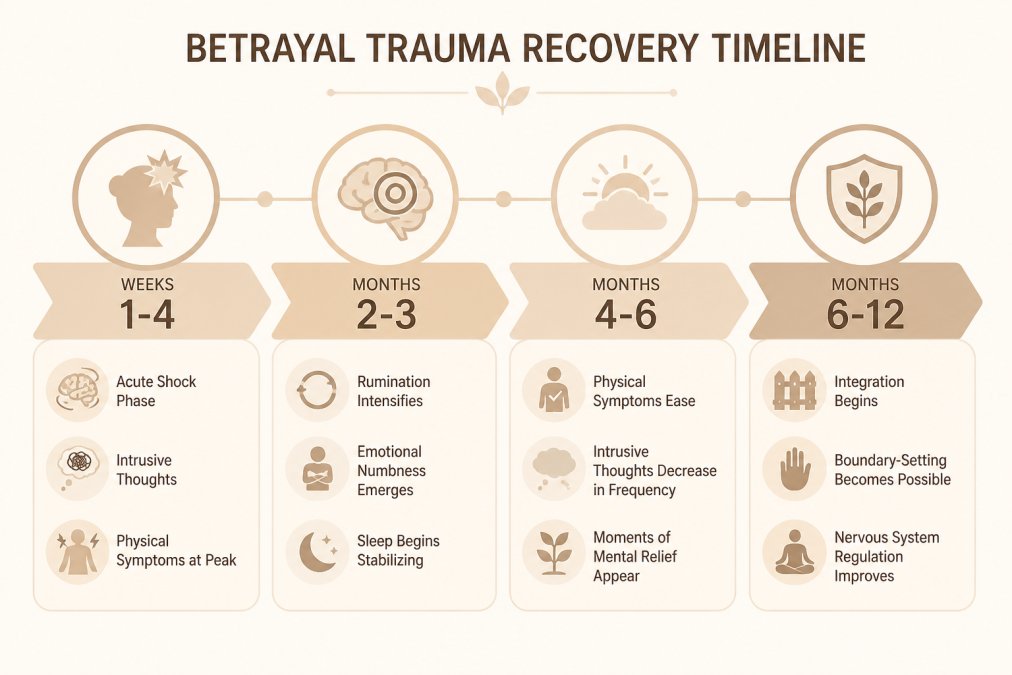
Recovery from betrayal trauma isn’t linear, but understanding the general phases helps you recognize progress. This timeline reflects common patterns, though individual experiences vary.
Weeks 1-4: Acute Shock Phase
Your nervous system is in crisis mode. Intrusive thoughts dominate. You oscillate between disbelief and overwhelming emotion. Physical symptoms are often at their worst. Your brain is processing the reality of what happened and reorganizing your worldview.
Months 2-3: Rumination and Emotional Numbness
The acute crisis subsides slightly, but rumination intensifies. You replay conversations and construct endless “what if” scenarios. Simultaneously, you might experience emotional numbness, a protective response when the full weight of the betrayal feels too heavy.
Months 4-6: Gradual Stabilization
Physical symptoms begin to ease. Sleep improves incrementally. The frequency and intensity of intrusive thoughts decrease. You start having moments, sometimes hours, where you’re not thinking about the betrayal.
Months 6-12: Integration and Boundary-Setting
You’re beginning to integrate the betrayal into your life story without it defining your entire identity. You can think about what happened without immediate emotional flooding. This is when many people find clarity to make decisions about their relationship or co-parenting situation.
Year 2 and Beyond: Ongoing Integration
You’re no longer in active recovery; you’re living with integration. Triggers may still arise, but they’re less overwhelming and shorter-lived. You can recognize them as reminders of past trauma rather than present danger.
If you’re not seeing improvement in physical symptoms, intrusive thoughts, or emotional dysregulation after three months, professional support becomes important. This doesn’t mean you’ve failed; it means your nervous system needs additional resources to regulate.
Managing Triggers and Setting Digital Boundaries
Triggers are sensory experiences that reactivate your trauma response. A song, location, time of day, or word can suddenly transport you back into acute pain. Identifying your specific triggers is the first step. Keep a brief log of when you experience emotional flashbacks and what preceded them. After a week or two, patterns emerge.
Once identified, triggers can be managed through avoidance (temporary), preparation (knowing a trigger is coming and grounding in advance), or desensitization (gradually reducing the emotional charge over time with proper support).
Social media and digital safety strategies
Social media intensifies betrayal trauma because it creates constant, involuntary contact with the person who hurt you. Seeing their photos, updates, or interactions can trigger acute distress and reset your recovery progress.
Immediate steps:
- Unfollow or mute the person who betrayed you on all platforms. You can remain connected if necessary for co-parenting or legal reasons, but muting removes their content from your feed.
- Adjust privacy settings so they cannot see your posts, stories, or activity status.
- Block notifications from mutual connections who might tag them in content you’ll see.
- Consider deactivating social media temporarily if scrolling has become compulsive or triggering.
Ongoing digital boundaries:
- Establish a rule about checking the person’s profile. Most people find that “never” is easier than “just once.”
- If you share children, use a dedicated co-parenting app or email for communication rather than text or social media.
- Be selective about which friends you follow. If someone regularly posts content involving the person who betrayed you, consider muting them temporarily.
- Set specific times to check social media rather than constant scrolling.
Digital boundaries aren’t about avoiding reality; they’re about creating space for your nervous system to regulate without constant reminders of the betrayal.
If you share custody of children with the person who betrayed you, use a co-parenting communication app that separates parenting logistics from personal relationship issues. This reduces triggering personal contact while maintaining necessary coordination around your children’s needs.
When to Seek Professional Help
Self-guided recovery is possible, and many people make significant progress using grounding techniques, journaling, and time. However, professional support becomes essential in specific circumstances.
Seek therapy if you’re experiencing persistent suicidal thoughts, self-harm urges, or severe dissociation that interferes with daily functioning. If intrusive thoughts have become so intense that you cannot work, parent, or maintain basic self-care, professional intervention is necessary. If you’re engaging in compulsive behaviors, repeatedly checking the person’s social media, obsessively seeking reassurance, or substance use, these signal that your nervous system needs clinical support.
Trauma-informed therapy approaches like EMDR, somatic experiencing, or trauma-focused cognitive behavioral therapy are particularly effective for betrayal trauma. These modalities specifically address how trauma lives in the nervous system and body.
If you’re navigating co-parenting with someone who betrayed you, family therapy or mediated communication can provide structure and protection for both you and your children.
According to the American Psychological Association’s guidelines on trauma treatment, professional intervention is recommended when trauma symptoms persist beyond three months or significantly impair functioning. This isn’t a failure; it’s recognizing that some nervous systems need specialized support to regulate after severe betrayal.
After the Affair Series provides structured frameworks for managing high-conflict situations and co-parenting challenges, but these tools work best alongside professional mental health support, not as a replacement for it. A therapist can help you process the emotional dimensions of betrayal while After the Affair Series provides practical communication strategies for managing ongoing contact or co-parenting.
Research from the National Institute of Mental Health on trauma recovery indicates that early intervention leads to better outcomes.
Dealing with betrayal trauma symptoms alone is possible, but it doesn’t have to stay that way. The strategies in this guide, grounding techniques, journaling, nervous system regulation, and digital boundaries, give you immediate tools to stabilize your nervous system and begin recovery. However, if you’re navigating co-parenting with someone who betrayed you or managing ongoing contact in a high-conflict situation, structured support becomes crucial. After the Affair Series combines trauma-informed guidance with practical communication frameworks designed specifically for the complex situations that follow betrayal. Your recovery matters, and you deserve both compassion and concrete tools to get there.