TL;DR:
- Trust after betrayal is a gradual process built through transparency, accountability, and consistent behavior.
- Emotional reactions like anxiety, doubt, and grief are normal aspects of trauma and healing.
- Rebuilding trust requires redefining relationship terms and restoring self-trust, not just forgiveness.
- Understanding and rebuilding trust after betrayal
- Key Takeaways
- How betrayal impacts trust: Emotional and psychological dynamics
- What is trust after betrayal? Definitions and new realities
- Evidence-based pathways to rebuilding trust
- Navigating setbacks and growth after betrayal
- Why real trust recovery is about more than forgiveness
- Next steps: Rebuild trust with guidance and resources
- Frequently asked questions
Understanding and rebuilding trust after betrayal
Trust doesn’t disappear in a single moment after infidelity. That’s a counterintuitive idea, but it’s an important one. Most people experience trust after betrayal as a complete erasure, a kind of emotional freefall where everything they believed suddenly feels false. Yet research tells a different story. A systematic review of trust repair identifies five specific factors that drive genuine rebuilding: proactive transparency, active monitoring, remorse and accountability, shared activities, and clear communication of betrayal reasons. Trust exists on a spectrum, and understanding that spectrum is the first step toward healing.
Key Takeaways
| Point | Details |
|---|---|
| Trust changes after betrayal | Trust is rebuilt with new boundaries and understanding, not returned to its old form. |
| Five factors drive repair | Transparency, monitoring, accountability, shared activities, and clear communication are crucial for trust recovery. |
| Healing is a process | Expect setbacks and uneven progress while working toward authentic growth and trust. |
| Forgiveness and trust differ | Forgiveness makes trust possible but does not guarantee it will return. |
How betrayal impacts trust: Emotional and psychological dynamics
When a partner betrays you, they don’t just break a promise. They shatter something deeper: your sense of emotional safety and your ability to predict the world around you. Trust, at its core, is the expectation that the people close to you will behave in predictable, caring ways. When that expectation is violated, your nervous system treats it as a genuine threat. That’s not weakness. That’s biology.
The emotional responses that follow betrayal are not signs of instability. They are normal, documented reactions to a relational trauma. You may recognize some of these in yourself:
- Shock and disbelief: The mind protects itself by initially refusing to process what happened.
- Anger: Raw, sometimes unpredictable, and often directed at multiple people, including yourself.
- Anxiety and hypervigilance: Constant scanning for new threats, checking phones, replaying conversations.
- Self-doubt: Questioning your judgment, your perception, your attractiveness, your worth.
- Grief: Mourning the relationship you thought you had, the future you planned, and the version of your partner you believed in.
These reactions don’t arrive neatly in stages. They overlap, recede, and return without warning. This is not a flaw in your recovery. It’s how trauma actually works.
“Betrayal trauma disrupts not only the relationship, but the betrayed person’s internal sense of reality and self. The damage is both relational and identity-based.”
One of the most damaging misconceptions people carry into recovery is the belief that trust can never return after infidelity. This belief often hardens into certainty during the sharpest moments of pain. But trust repair research shows that meaningful rebuilding is possible, provided specific conditions are met. The injury is real, but it is not permanent by default.
Another layer that often goes unaddressed is how broken trust affects self-worth and attachment patterns. Betrayal doesn’t only change how you see your partner. It changes how you see yourself. Many people begin to question whether they were “enough,” whether they somehow caused the affair, or whether they’ll ever be able to trust anyone again. These shifts in attachment, the way you connect with and depend on others emotionally, can persist long after the immediate crisis fades if they aren’t actively addressed.
Signs of broken trust also show up in behavior in ways people don’t always recognize. Difficulty concentrating, sleep disruption, emotional numbness, and social withdrawal are all connected to the relational injury. Understanding these as normal responses, rather than personal failures, is a critical first step. You can read more about the rebuilding trust timeline to understand what a realistic recovery arc looks like and how long different stages typically last.
With an understanding of why trust feels shattered after betrayal, let’s explore what trust repair actually looks like based on recent research.
What is trust after betrayal? Definitions and new realities
Now that we know how betrayal disrupts trust emotionally, it’s vital to clarify what “trust” means in your life going forward.
In healthy relationships, trust is usually defined as a confident reliance on a person’s honesty, reliability, and good intentions. Before betrayal, most people experience what you might call blind trust: an assumption of safety that doesn’t require verification. You trust because nothing has given you reason not to. This kind of trust feels effortless, but it’s also fragile precisely because it’s never been tested.
After betrayal, blind trust is gone. This is painful, but it’s also a fact. What replaces it, if both people choose to work toward it, is something fundamentally different: earned trust. Earned trust is built through consistent, verifiable behavior over time. It requires transparency, follow-through, and patience. It is not a restoration of the old dynamic. It is the construction of a new one.
Here is a useful way to see that distinction:
| Feature | Pre-betrayal blind trust | Post-betrayal earned trust |
|---|---|---|
| Basis | Assumption and hope | Consistent, observed behavior |
| Verification | Rarely needed | Ongoing and expected |
| Emotional tone | Effortless and assumed | Conscious and chosen |
| Vulnerability | Unexamined | Acknowledged and accepted |
| Durability | Untested | Stronger when built correctly |
According to trust repair research, one of the five key factors in rebuilding is active monitoring, which is the process of verification and behavioral observation over time. Many people feel ashamed of needing to “check up” on a partner after betrayal, as though it signals weakness or insecurity. In reality, it’s a documented part of healthy trust repair. Needing evidence is not paranoia. It’s wisdom.
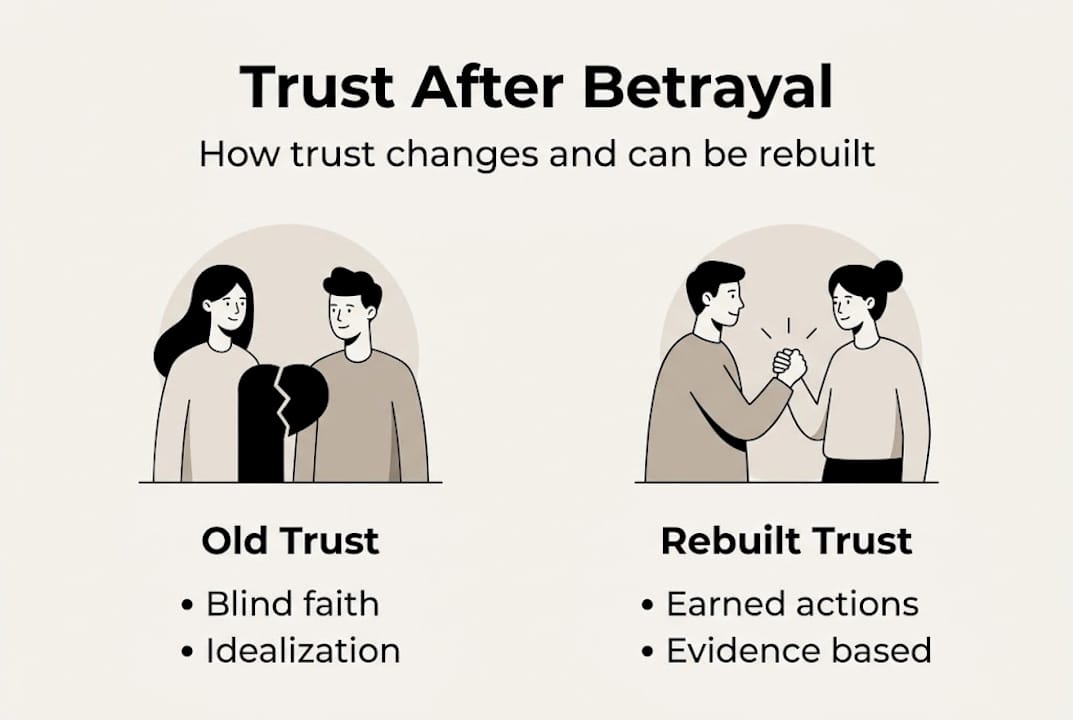
The shift from idealization to informed confidence is another critical milestone. Idealization is what we do before betrayal, projecting our hopes onto a partner and minimizing red flags. Informed confidence is different. It’s the ability to trust based on what you can actually see, rather than what you wish were true. Reaching that place takes time, honest communication, and often, professional support. You can explore how relationship growth after infidelity is possible when this shift is actively pursued.
Pro Tip: One practical way to track rebuilt trust is to identify concrete progress markers, specific behaviors that show up consistently over at least 90 days. These might include your partner proactively sharing their location, following through on commitments without reminders, or initiating honest conversations about difficult topics. Each instance of follow-through is a deposit into the trust account.
With realistic expectations for trust after betrayal, these evidence-backed strategies can offer actionable steps for your healing journey.
Evidence-based pathways to rebuilding trust
Research on trust repair after infidelity identifies five core factors that make the most significant difference. These aren’t vague concepts. They’re specific, actionable behaviors that both individuals and couples can practice, track, and build on over time.
| Trust repair factor | What it means in practice |
|---|---|
| Proactive transparency | Sharing information before being asked, reducing the burden on the betrayed partner |
| Active monitoring | Allowing the betrayed partner to verify through access to accounts, location, etc. |
| Remorse and accountability | Expressing genuine regret and taking responsibility without defensiveness |
| Shared activities | Rebuilding positive connection and intimacy through time spent together |
| Clear communication of betrayal reasons | Explaining honestly why the betrayal happened, without blaming the betrayed partner |
Here’s how you can apply each of the five trust repair factors to your situation:
- Proactive transparency: Instead of waiting to be asked, the unfaithful partner starts sharing daily plans, whereabouts, and relevant communications without prompting. This shifts the emotional labor away from the betrayed partner and demonstrates genuine commitment.
- Active monitoring: Shared calendars, open access to devices, and regular check-ins are all practical tools. The betrayed partner’s need for verification should be treated as reasonable and temporary, not as punishment.
- Remorse and accountability: This isn’t a single apology. It’s an ongoing willingness to acknowledge the harm caused, to tolerate the betrayed partner’s pain without becoming defensive, and to show through behavior that the remorse is genuine.
- Shared activities: Reconnecting through meaningful experiences, whether cooking a meal together, taking a weekly walk, or revisiting shared interests, builds new positive associations alongside the healing work.
- Clear communication of betrayal reasons: This is perhaps the hardest factor. The betrayed partner typically needs to understand what led to the affair. Honest, compassionate explanation, framed without blaming the betrayed person, is essential. Without this, the imagination often creates something far worse than reality.
For practical support in applying these strategies, trust-building exercises provide structured activities designed specifically for this stage of recovery. If you’re working with a professional, understanding the role of therapists in trust recovery can help you get more from each session.
Pro Tip: Focus on process rather than outcomes in the early months. Ask not “Do I trust them yet?” but “Are they behaving in trustworthy ways consistently?” The emotional feeling of trust tends to follow behavioral evidence, not precede it. Give it time to catch up.
As you put repair strategies into practice, remember that the road to trust is rarely linear. Here’s how to navigate highs, lows, and true growth.
Navigating setbacks and growth after betrayal
Even when both partners are doing everything right, the path back to trust is not a straight line. This is one of the most important things to understand going into recovery. If you expect linear progress, every setback will feel like failure. If you expect an uneven road, setbacks become information rather than disaster.
Common experiences during trust recovery include:
- Triggers: A song, a location, a name on a phone screen can activate the full emotional experience of the betrayal all over again. Triggers are not signs that healing isn’t happening. They’re normal features of trauma processing.
- Doubt spirals: Days when the progress feels unreal and the fear of being hurt again becomes overwhelming. These are especially common at anniversaries, during stress, or after minor conflict.
- Communication breakdown: Even couples committed to repair will have moments of defensive shutting down, misunderstanding, or painful honesty that temporarily increases conflict.
- Physical symptoms: Anxiety, fatigue, insomnia, and appetite changes often resurface at key recovery milestones. This is the body processing what the mind is working through.
“Healing is not the absence of pain. It is the gradual increase in the capacity to hold pain without being destroyed by it.”
Sign of genuine progress are often subtler than people expect. You might notice that the window between a trigger and your recovery from it is getting shorter. You might notice you can think about the betrayal without it consuming your entire day. You might find moments of genuine connection with your partner that don’t feel shadowed by suspicion. These are real milestones, even if they don’t feel dramatic.
In fact, some setbacks signal growth rather than regression. When a previously silent partner begins to express their anger, or when someone who has been protecting their betraying partner starts naming what hurt them, those are signs the healing is deepening. The timeline for trust rebuilding is different for every couple, but most research suggests meaningful progress takes at least 12 to 18 months of consistent effort.
Self-compassion is not optional in this process. Research consistently shows that people who practice self-compassion, treating themselves with the same kindness they’d offer a friend in pain, recover more effectively from relational trauma. If you’re struggling to find that compassion for yourself, marriage healing strategies offer structured support for both partners navigating this difficult terrain together.

Why real trust recovery is about more than forgiveness
Most mainstream conversations about healing from infidelity focus heavily on forgiveness. And while forgiveness matters, treating it as the destination is a mistake that slows genuine recovery for many people.
Here’s what often gets missed: forgiveness is about releasing the grip of resentment for your own wellbeing. It is not a transfer of trust. You can fully forgive someone and still not trust them, and that is not a contradiction. These are two separate internal processes, and conflating them creates confusion, guilt, and stalled healing.
What actually drives lasting trust recovery is something most guides skip over: rebuilding self-trust. After betrayal, many people no longer trust their own perceptions, instincts, or judgments. Restoring confidence in your own reading of a situation is foundational. Without it, even a genuinely reformed partner can’t fully reach you because you no longer trust what you’re seeing.
Next steps: Rebuild trust with guidance and resources
The second overlooked factor is the need to rebuild trust on new terms, not restore it to old ones. The relationship that existed before the betrayal had dynamics, gaps, and patterns that contributed to the environment in which the affair occurred. Trying to return to exactly that relationship means rebuilding on an unstable foundation. Sustainable trust requires a genuinely redefined relationship, with new agreements, clearer boundaries, and a shared understanding of what went wrong and why. Relationship growth after betrayal becomes possible when both people commit to building something different, not just repairing something broken.
If this article has helped you see trust recovery as something structured, manageable, and evidence-backed rather than an overwhelming unknown, you’re already moving in the right direction.
At After the Affair, we’ve built a library of resources specifically designed for this stage of recovery, including detailed guides, checklists, and books that walk you through every phase of healing. Whether you’re deciding whether to stay, learning to trust yourself again, or working through the practical steps of repairing your relationship, our structured resources meet you where you are. Explore our full range of recovery tools and take the next concrete step toward a future that genuinely feels safe and honest again.
Frequently asked questions
Can trust ever be fully restored after betrayal?
Trust can be rebuilt, but it typically takes a different, more conscious form than the blind trust that existed before. Research on trust repair confirms this kind of earned trust is achievable with sustained effort from both partners.
What are the most important steps for repairing trust?
The five evidence-based factors are proactive transparency, active monitoring, genuine remorse and accountability, shared activities, and honest communication about the reasons behind the betrayal. Applying all five consistently over time yields the strongest outcomes.
How long does it take to rebuild trust after infidelity?
Every couple’s timeline is unique, but most research and clinical experience point to at least 12 to 24 months of consistent effort before trust feels genuinely stable. Patience with this process is not complacency; it’s realism.
Is it normal to feel anxiety and fear even during trust repair?
Absolutely. Emotional fluctuations, including fear, doubt, and periods of intense grief, are a documented part of the recovery process. Experiencing setbacks does not mean progress has stopped.
Does forgiveness mean trust is fully restored?
No. Forgiveness and trust are distinct processes. Forgiveness is about releasing resentment for your own healing; trust is rebuilt through consistent, observable behavior over time. One can happen without the other.
Recommended
- Relationship Healing Process – After the Affair Series
- Rebuilding Trust Timeline – After the Affair Series
- Step-by-step betrayal recovery: healing trust in 2026 – After the Affair Series
- Relationship Growth After Infidelity – After the Affair Series