TL;DR:
- Emotional infidelity involves secretly redirecting emotional energy and intimacy away from a partner, causing deep trust issues. It often accumulates through behaviors like hiding conversations and emotional withdrawal, which can be more damaging than physical affairs. Healing requires honest acknowledgment, boundary clarification, and often professional support to rebuild trust and intimacy.
Most people assume cheating requires physical contact. That assumption leaves a massive blind spot. Emotional infidelity is the kind of betrayal that happens in plain sight, in text threads you’re not supposed to see, in conversations that go deeper than anything being shared at home. It doesn’t leave physical evidence, yet the damage it causes to trust, intimacy, and self-worth can be just as devastating as a physical affair. This article breaks down what is emotional infidelity, how to recognize the signs, why it hurts so deeply, and what real healing looks like.
- Key takeaways
- What is emotional infidelity, and how is it different from an emotional affair?
- Common signs of emotional infidelity
- The real impact of emotional infidelity on relationships
- Navigating the gray areas of emotional infidelity
- How to address and heal from emotional infidelity
- My take on why emotional infidelity is chronically underestimated
- FAQ
Key takeaways
| Point | Details |
|---|---|
| Emotional infidelity defined | It involves redirecting intimate emotional energy away from your partner with secrecy or prioritization, not just a specific affair. |
| Secrecy is the core sign | Hiding conversations, deleting texts, and emotional withdrawal are the hallmark behaviors that distinguish emotional cheating. |
| It can hurt more than physical cheating | Betrayed partners often feel replaced and inadequate, with deep erosion of trust and intimacy. |
| Boundaries are subjective | What counts as emotional infidelity depends on couple-specific norms and individual attachment styles. |
| Healing is possible but slow | Recovery requires honesty, accountability, clear boundaries, and often professional therapeutic support. |
What is emotional infidelity, and how is it different from an emotional affair?
These two terms often get used interchangeably, but the distinction matters and can change how you understand what happened in your relationship.
Emotional infidelity is a broader pattern of betrayal. It describes the act of redirecting intimate emotional energy, including vulnerability, deep confiding, and romantic attention, away from the primary partner and toward someone else, with secrecy or deliberate prioritization involved. You don’t need a specific ongoing relationship for it to qualify. Confiding your fears to a coworker instead of your spouse, while hiding those conversations, falls under this definition.
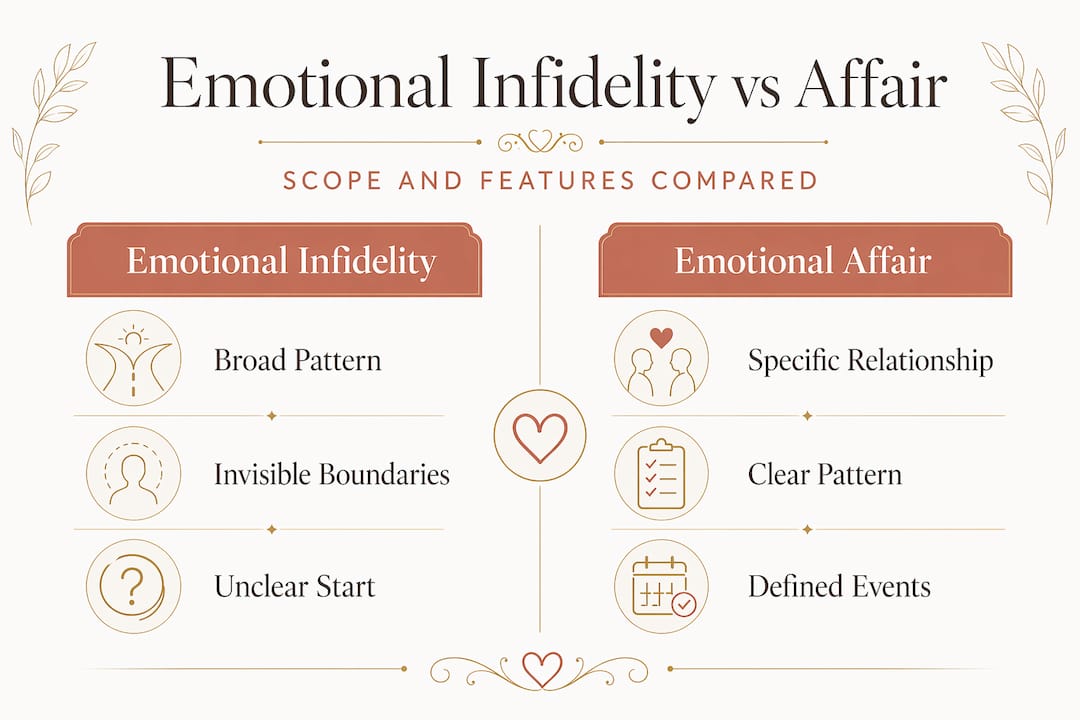
An emotional affair, by contrast, is a specific and sustained relationship. It has a beginning, a pattern, and usually a growing sense of emotional exclusivity with the outside person. Think of it as one particular expression of emotional infidelity rather than a synonym.
Understanding what is emotional infidelity is crucial for recognizing unhealthy patterns in relationships.
Why does the distinction matter? Because it shapes how you respond. A single boundary-crossing conversation is very different from a months-long emotional partnership conducted in secret. Both can wound a relationship, but they call for different conversations and different levels of repair.
| Feature | Emotional infidelity | Emotional affair |
|---|---|---|
| Scope | Broader pattern of boundary violations | Specific, ongoing relationship |
| Duration | Can be brief or sustained | Typically sustained over time |
| Exclusivity | Not always | Often emotionally exclusive |
| Secrecy | Central element | Central element |
| Romantic potential | Sometimes | Usually present |
Pro Tip: If you’re unsure whether something crosses a line, ask yourself this: Would I share this conversation openly with my partner? If the answer is no, that’s worth examining, regardless of whether anything physical occurred.
Common signs of emotional infidelity
Recognizing emotional infidelity in real life is harder than it sounds, because there is no single defining moment. It tends to accumulate. Still, certain behavioral patterns are reliable indicators.
Secrecy is the hallmark behavioral element of emotional infidelity. It shows up in specific, observable ways:
- Hiding a phone, angling it away, or deleting message threads
- Becoming irritable or defensive when asked simple questions about the other person
- Describing the outside relationship as “just a friendship” while going to unusual lengths to protect it
- Creating opportunities to be alone with or communicate with the person
- Withdrawing emotionally at home while being warm and engaged elsewhere
- Sharing personal or relational problems with the outside person before or instead of the partner
- Emotional distance and a noticeable drop in intimacy, conversation depth, or affection at home
One of the more disorienting signs for the betrayed partner is the feeling of being replaced without being able to name exactly why. The person is physically present but emotionally absent. Conversations feel surface-level. Physical affection decreases. And when the betrayed partner raises concerns, they’re often told they’re imagining things.
Research consistently describes this experience as an invisible betrayal. Emotional cheating is less about physical proof and more about boundary erosion and emotional distance, which is precisely what makes it so difficult to confront. You can feel it clearly, but proving it in concrete terms is a different matter entirely.
The real impact of emotional infidelity on relationships
The emotional toll of this kind of betrayal surprises many people, including sometimes the person who caused it.
Emotional cheating can be as damaging, or more so, than physical infidelity, creating feelings of replacement and inadequacy in the betrayed partner. When you discover that your partner has been sharing their innermost thoughts, fears, and desires with someone else, the wound is specific. It isn’t just that they were attracted to someone. It’s that they chose someone else for the emotional role you thought you held.
“The most painful part isn’t always what happened. It’s realizing that someone else knew things about your partner that you didn’t. That kind of intimacy shared outside the relationship cuts at the foundation of what a committed partnership is supposed to be.”
This experience often triggers anxiety, hypervigilance, and a trauma response that mirrors what happens after physical affairs. The betrayed partner may find themselves reviewing the psychological impact of infidelity, trying to understand why the discovery feels so destabilizing even without a physical component.
Trust erodes in a particular way with emotional infidelity. Because the betrayal was invisible for so long, the betrayed partner often starts questioning their own perception. Did I miss the signs? Was I not enough? These questions are natural but damaging, and they tend to linger well beyond the initial discovery.
Another complication: the person who engaged in emotional infidelity often genuinely does not see it as cheating. They rationalize it as friendship, as harmless venting, as something that never went anywhere. This gap in perception adds another layer of pain for the person who felt the full weight of the betrayal.
Navigating the gray areas of emotional infidelity
One of the most frustrating aspects of emotional infidelity is that it doesn’t come with universally agreed-upon rules. What feels deeply violating in one relationship might be unremarkable in another.
Definitions of emotional infidelity are subjective. Boundaries vary by couple, and perception is shaped by individual attachment styles, relationship history, and what each person needs to feel secure. A person with an anxious attachment style may experience their partner’s close friendship with a coworker as a profound threat, while someone with a more avoidant style might not register the same behavior as problematic at all. Neither reaction is wrong. They reflect different relational frameworks.
Attachment styles and personality traits strongly influence how emotional infidelity is interpreted and experienced, which is why two people can describe the same situation in completely different terms.
Here is where many couples get stuck when they try to address it:
- Focusing on intent over impact. The person who strayed insists, “I didn’t mean for it to become anything.” People often mistakenly focus on intent rather than the actual process: the secrecy, the emotional reliance, the boundary crossings that accumulated over time.
- Disagreeing about whether it qualifies. Without a shared understanding of what emotional fidelity means in your relationship, one partner can sincerely not believe they did anything wrong.
- Minimizing because nothing physical occurred. This is one of the most common and most harmful rationalizations. The absence of physical contact does not determine the severity of the betrayal.
- Getting stuck in the discovery conversation. Rehashing who said what and when, rather than moving toward what the betrayal meant and what needs to change.
Pro Tip: Defining emotional fidelity explicitly, before any crisis, is one of the most protective conversations a couple can have. What does loyalty mean to each of you? What level of emotional intimacy with others feels safe? These conversations feel awkward until they become urgently necessary.
How to address and heal from emotional infidelity
Healing from emotional infidelity is possible. It is not fast, and it cannot be forced. But with the right approach, many couples come out with a clearer, more honest relationship than they had before.
Recovery depends on slow understanding, boundary clarification, emotional steadiness, and honest communication rather than quick fixes or immediate forgiveness. Here is what that looks like in practice:
- Acknowledge what happened fully. The person who engaged in emotional infidelity needs to name the behavior clearly, without minimizing it. “It was just a friendship” is not an acknowledgment. “I shared things with someone else that I should have shared with you, and I kept it secret” is.
- Create space for the betrayed partner’s grief. There will be anger, sadness, confusion, and waves of hurt. These responses need room, not rushing.
- Clarify emotional boundaries going forward. What does each partner need to feel secure? This is not about controlling behavior. It is about building a shared framework for what emotional fidelity looks like in your relationship specifically.
- Consider individual or couples therapy. A therapist who understands infidelity recovery can help both partners move through the process without getting trapped in cycles of blame and defense.
- Work through the underlying relationship dynamics. Emotional affairs rarely emerge from nowhere. Understanding what emotional needs were going unmet, and why, is part of genuine repair.
- Use a structured recovery process. A 7-step recovery checklist can help both partners track their progress and avoid common missteps in the healing process.
Reconciliation and repair are not the same thing. Repair means doing the work to understand what happened and why. Reconciliation means choosing to rebuild the relationship together. Both take time, and repair must come first.
My take on why emotional infidelity is chronically underestimated
From everything I’ve seen in this work, emotional infidelity is almost always underestimated by the person who caused it and overexplained by the person who experienced it.
I’ve encountered this pattern repeatedly: the betrayed partner describes feeling replaced, invisible, and emotionally abandoned for months before they could even name what was happening. Meanwhile, the person who had the emotional connection insists they were just talking. Just friends. Nothing happened.
What strikes me most is this: the damage doesn’t come from a single conversation. It builds through a thousand small redirections. The laugh shared with someone else at the end of a hard day. The worry confided to an outside person before the partner even hears about it. The slow accumulation of emotional energy flowing somewhere other than home.
In clinical terms, the key question is what function that outside connection served. Emotional intimacy provided secretly often functions like a second partnership, even when nothing was ever intended. That’s not a moral judgment. It’s an honest assessment of what was happening relationally.
I also believe the “nothing physical happened” defense does more damage than people realize. It invalidates the betrayed partner’s very real experience and stalls the honest conversation that healing requires. The hardest truth I’ve sat with, in this work, is that emotional recovery takes longer when one partner doesn’t fully accept what happened. Acknowledgment isn’t a step you can skip.
— S.J.Howe
Resources to support your healing from emotional infidelity
If what you’ve read here resonates, you are not alone, and you don’t have to figure out the next steps by yourself.
At Aftertheaffair, the resources available are grounded in real clinical experience and designed for exactly this kind of betrayal. Whether you’ve just discovered an emotional affair, are trying to understand what happened months ago, or are wondering whether your relationship can recover, there are structured, compassionate guides for each stage. Start with the infidelity recovery checklist to get a clear picture of where you are and what comes next. If you’re further along and ready to think about what comes after healing, the guidance on relationship growth after infidelity offers practical frameworks for rebuilding trust and genuine intimacy.
FAQ
What is the definition of emotional infidelity?
Emotional infidelity is the act of redirecting intimate emotional energy, including vulnerability, deep confiding, and romantic attention, away from a primary partner and toward someone else, with secrecy or prioritization involved. It is broader than a specific emotional affair and can include patterns of behavior rather than a single relationship.
How is emotional infidelity different from physical infidelity?
Emotional infidelity involves emotional intimacy and connection rather than physical contact, but research shows it can be equally or more damaging. The betrayed partner often feels replaced at the deepest level of the relationship, which can be harder to process than physical betrayal.
What are the most common signs of emotional cheating?
The most consistent signs include hiding phone conversations, deleting texts, emotional withdrawal from the primary partner, confiding personal problems to someone outside the relationship first, and becoming defensive when asked about the outside connection.
Can emotional infidelity be forgiven?
Yes, emotional infidelity can be forgiven, but recovery requires full acknowledgment from the person who caused the harm, honest communication, clear boundary-setting, and often professional therapeutic support. Forgiveness is a process, not a single decision.
Does intent matter in emotional infidelity?
Intent matters less than impact. Therapists consistently point out that people often focus on “I didn’t mean for it to become anything,” when the more important question is what actually happened: the secrecy, the emotional reliance, and the impact on the primary relationship.
Recommended
- Effective tips for emotional healing after infidelity
- Emotional Affair Trauma- ‘Just a Friend’ – After the Affair Series
- Why Infidelity Hurts? – After the Affair Series
- Emotional Recovery After Infidelity: 5 Real-Life Examples