TL;DR:
- Infidelity is often rooted in individual emotional struggles and unmet needs, not solely relationship issues.
- Most cheaters experience multiple overlapping motives, including anger, low self-esteem, and desire for variety.
- What are the psychological and emotional reasons people cheat?
- How do internal conflicts and life stages drive cheating behavior?
- What relationship dynamics and situational factors accompany infidelity?
- What are the common misconceptions about infidelity?
- Key takeaways
- What I’ve learned about why people really cheat
- FAQ
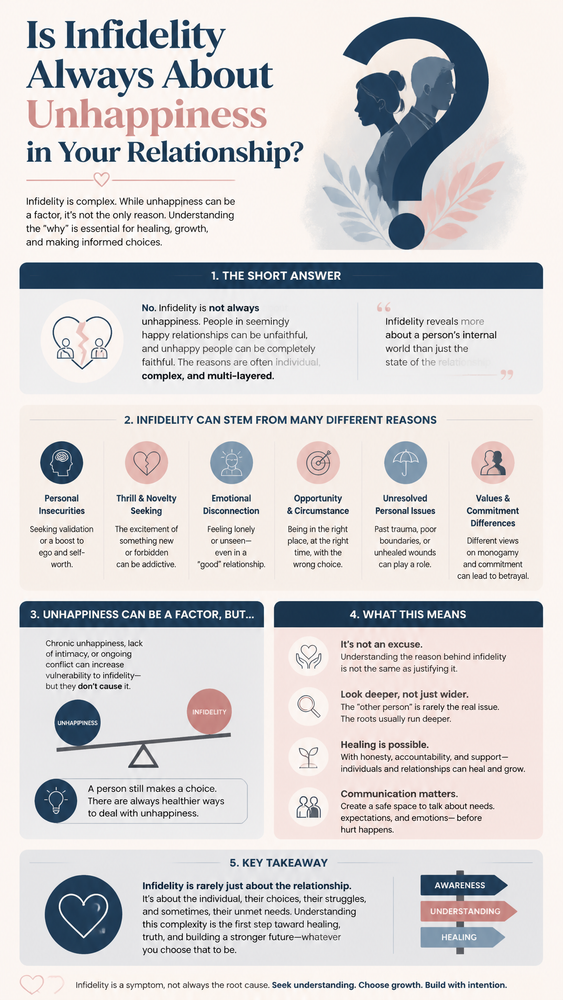
Infidelity is defined as a conscious choice to breach the agreed boundaries of a committed relationship, and upwards of 40% of married couples experience it at some point. That figure means cheating is far more common than most people assume. Understanding why people cheat requires looking past the obvious explanations. Research consistently shows that the psychology of infidelity is rooted in individual emotional struggles, unmet internal needs, and situational pressures, not simply in a bad relationship or an attractive opportunity. The causes of cheating are rarely about one thing. They are layered, personal, and often surprising.
What are the psychological and emotional reasons people cheat?
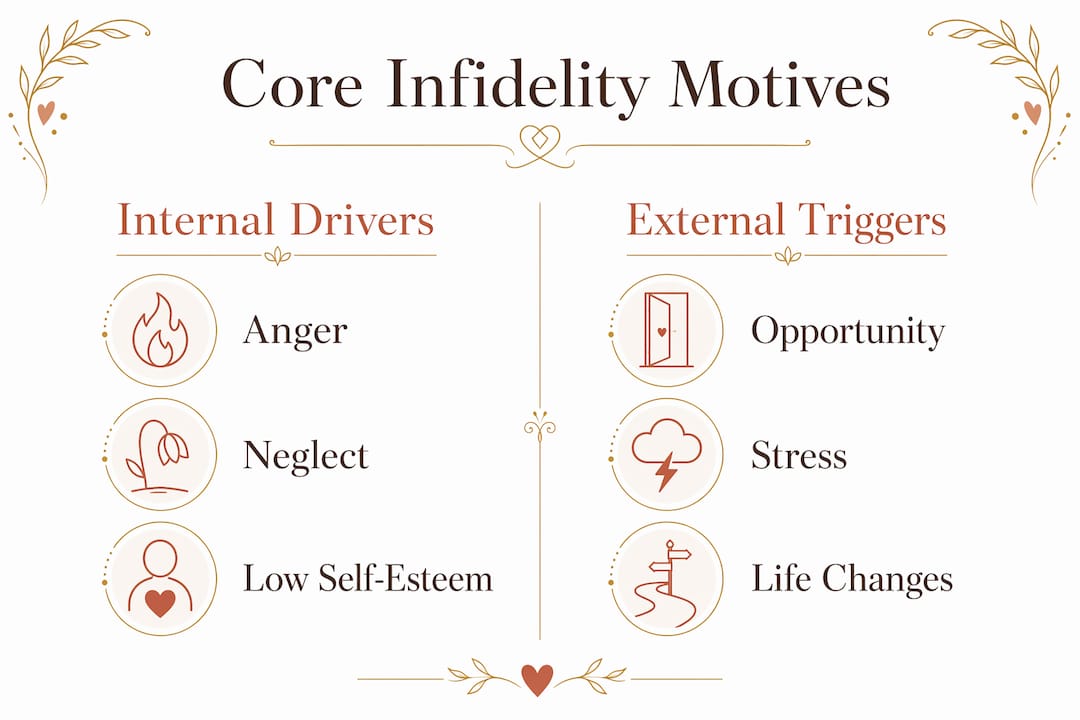
A study of 495 individuals identified eight primary motivational categories behind infidelity: anger, low self-esteem, lack of love, low commitment, need for variety, neglect, sexual desire, and situational factors. These categories rarely operate alone. Most people who cheat are driven by two or three overlapping motives at once.
Here is what each category looks like in practice:
- Anger: A partner feels wronged and uses an affair as retaliation, often without fully acknowledging that motive to themselves.
- Low self-esteem: Someone seeks outside validation to fill a confidence gap their relationship cannot fix.
- Lack of love: Emotional disconnection has grown to the point where the relationship feels like a formality.
- Low commitment: The person never fully invested in the relationship and treats fidelity as optional.
- Need for variety: Novelty-seeking behavior drives the decision, regardless of relationship quality.
- Neglect: A partner feels invisible or unappreciated and looks elsewhere for attention.
- Sexual desire: Physical attraction to someone outside the relationship becomes the primary driver.
- Situational factors: Opportunity, alcohol, travel, or grief lower normal inhibitions and judgment.
Attachment styles also shape these motivations in important ways. Anxiously attached people tend to cheat while seeking deeper intimacy they feel is missing. Dismissively attached people often cheat as a way of asserting independence or avoiding vulnerability. The same behavior, infidelity, can mean completely different things depending on a person’s attachment history.
Pro Tip: If you are trying to understand why a partner cheated, ask which of the eight categories resonates most with what you know about them. That narrows the conversation from “how could you” to “what was actually driving this.”
| Motive category | Internal or external driver | Common pattern |
|---|---|---|
| Anger / low self-esteem | Internal | Seeks validation or revenge outside the relationship |
| Lack of love / low commitment | Relational | Emotional disconnection precedes the affair |
| Need for variety / sexual desire | Internal | Novelty-seeking regardless of relationship satisfaction |
| Neglect / situational | External | Opportunity and unmet needs combine at a vulnerable moment |
How do internal conflicts and life stages drive cheating behavior?
Infidelity often reflects the cheating partner’s internal struggle rather than the worth of their partner or the quality of the relationship. Sex therapists who specialize in affairs describe this pattern repeatedly. The affair is a symptom of something unresolved inside the person, not a verdict on the relationship.
Midlife is one of the most documented periods for infidelity. Men and women in their 40s and 50s sometimes pursue affairs as a way of reconnecting with a younger version of themselves. The affair is not really about the other person. It is about recapturing a sense of identity, freedom, or possibility that feels lost. This is why affairs during midlife crises often end quickly once the existential question has been answered in another way.
“Cheating often represents a search for self-validation rather than a direct reflection of partner inadequacy.” — Health.com
Unresolved childhood trauma is a significant risk factor for infidelity if it goes unaddressed. Adults who experienced emotional neglect, abandonment, or abuse in childhood often develop patterns of emotional dysregulation that surface in intimate relationships. They may seek outside connections to manage internal distress rather than turning toward their partner.
Mental illness and addiction also raise infidelity risk by lowering inhibitions. Bipolar disorder during a manic episode, for example, can produce impulsive sexual behavior that the person would not engage in otherwise. Substance abuse creates similar conditions. These are not excuses. They are clinical realities that explain why some people cheat in ways that seem completely out of character.
Pro Tip: If you suspect internal psychological issues played a role in a partner’s infidelity, therapy types for infidelity trauma can help both of you understand the underlying drivers without excusing the behavior.
What relationship dynamics and situational factors accompany infidelity?
Relationship problems create vulnerability. They do not create inevitability. Neglect, poor communication, and unmet sexual needs raise the risk of infidelity, but they do not cause it. That distinction matters enormously for the person who was cheated on. A struggling relationship does not make cheating the logical next step. It makes it a more available temptation that the cheating partner still chose to act on.
The most common relational contributors to infidelity look like this:
- Emotional neglect: One partner feels consistently unseen, unheard, or unimportant.
- Sexual dissatisfaction: Mismatched desire levels or avoidance of physical intimacy creates distance.
- Poor communication: Conflict avoidance means problems accumulate without resolution.
- Boredom: Long-term relationships can lose novelty, and some people respond to that by seeking stimulation outside.
Situational factors add another layer. Grief, job loss, relocation, and high-stress periods all reduce a person’s emotional resources and judgment. Opportunity also matters more than most people admit. Affairs frequently begin in workplaces, at conferences, or during travel, where normal social boundaries are less enforced.
Many people struggle to define what counts as cheating, which leads to accidental boundary crossings that still cause real betrayal. One partner may consider an intense emotional friendship with a coworker harmless. The other may experience it as a full breach of trust. Experts consistently recommend that couples establish explicit agreements about boundaries before a gray area becomes a crisis.
| Relationship vulnerability | Situational trigger | Combined risk |
|---|---|---|
| Emotional neglect | Opportunity at work or travel | High |
| Sexual dissatisfaction | Alcohol or grief-related lowered inhibition | High |
| Poor communication | Prolonged stress or life transition | Moderate |
| Boredom | Novelty-seeking personality | Moderate |
What are the common misconceptions about infidelity?
The biggest myth about cheating is that it only happens in unhappy relationships. Infidelity can occur in perfectly happy relationships due to thrill-seeking and personal dissatisfaction that has nothing to do with the partnership itself. This is one of the hardest truths for betrayed partners to process. It removes the comfort of a clear explanation.
Several other misconceptions distort how people understand the reasons for infidelity:
- Cheating always means the relationship is over. Many couples rebuild successfully after an affair. Discovery does not determine outcome.
- Cheating is always about physical attraction. Emotional affairs, where no physical contact occurs, cause equal or greater damage to trust and are increasingly common.
- The betrayed partner must have done something wrong. Infidelity is a choice even when relationship vulnerabilities exist. The cheating partner’s decision belongs to them alone.
- Only unhappy or unloved people cheat. Top reasons people cite for cheating include variety-seeking and personal dissatisfaction, both of which can exist alongside genuine love for a partner.
- Emotional infidelity is less serious than physical infidelity. Research and clinical experience both show that emotional betrayal often cuts deeper because it involves sustained deception and intimacy.
Understanding these misconceptions does not excuse cheating behavior. It does make the picture more accurate, which is the first requirement for anyone trying to decide what to do next.
Key takeaways
Infidelity is driven primarily by individual psychological factors, including attachment style, internal conflict, and personal dissatisfaction, rather than by relationship failure alone.
| Point | Details |
|---|---|
| Eight core motives exist | Research identifies anger, neglect, low self-esteem, variety-seeking, and situational factors as the primary drivers. |
| Internal struggles dominate | Cheating most often reflects the cheater’s unresolved personal issues, not a partner’s inadequacy. |
| Relationship problems raise risk | Neglect and poor communication create vulnerability but do not make infidelity inevitable. |
| Misconceptions cause harm | Believing cheating only happens in bad relationships prevents accurate understanding and healing. |
| Attachment style shapes motive | Anxious and dismissive attachment patterns produce different infidelity behaviors and require different recovery approaches. |
What I’ve learned about why people really cheat
After working with individuals and couples navigating infidelity, the pattern I see most consistently is this: the person who cheated rarely has a clean, single reason. They have a cluster of unresolved things, a personal void, a life stage crisis, an attachment wound, and a moment of opportunity. The affair is where all of those things collide.
What I find most clinically useful is the distinction between vulnerability and choice. A relationship can be struggling, a person can be lonely, and the opportunity can be right there. None of that removes the decision point. Cheating is still a choice made at that intersection. Holding both truths at once, that circumstances contributed and that the person still chose, is genuinely hard. But it is the only honest place to stand.
I also want to say something about timing. Addressing why the affair happened too soon after discovery is often counterproductive. The betrayed partner is in acute trauma. Their nervous system is not in a state to process nuanced explanations. The “why” conversation has its place, but it belongs weeks or months into recovery, not in the first raw days.
What I have seen work is starting with therapist-guided affair recovery before trying to explain the affair intellectually. Stabilize first. Understand later. That sequence makes the understanding actually land.
— S.J.Howe
Ready to move forward after infidelity?
Understanding the reasons behind cheating is the first step. Knowing what to do with that understanding is the harder part.
Aftertheaffair offers structured, evidence-informed resources built specifically for people in your position. Whether you are trying to decide whether to stay or leave, or you have already committed to rebuilding, the 7-step infidelity recovery checklist gives you a clear path through the most disorienting period. For those working through the emotional aftermath with a partner, the couples healing workflow provides a structured five-step process grounded in therapeutic practice. You do not have to figure this out alone.
FAQ
Why do people cheat even in happy relationships?
Infidelity can occur in perfectly happy relationships because cheating is often driven by internal factors like thrill-seeking, low self-esteem, or personal dissatisfaction rather than relationship quality. A happy partnership does not automatically protect against a partner’s unresolved psychological needs.
What is the most common emotional reason for cheating?
Feeling neglected or emotionally disconnected is one of the most frequently cited emotional reasons for infidelity. Research also identifies low self-esteem and the need for external validation as core internal drivers.
Does cheating always mean the relationship is over?
Cheating does not automatically end a relationship. Many couples rebuild trust and connection after an affair, particularly when both partners commit to structured recovery and honest communication about what drove the infidelity.
How do attachment styles affect why partners cheat?
Attachment styles shape infidelity motivations in distinct ways. Anxiously attached individuals often cheat while seeking deeper intimacy, while dismissively attached individuals may use affairs to assert emotional independence or avoid closeness.
Is emotional infidelity as damaging as physical cheating?
Emotional infidelity, where no physical contact occurs but deep intimacy and deception are present, is often reported as equally or more damaging than physical cheating. The sustained nature of the deception and the emotional bond formed with another person are what cause the deepest harm.
Recommended
- Why Infidelity Hurts? – After the Affair Series
- 7 Types of Infidelity-Healing & Recovery – After the Affair Series
- Why Do Cheaters Stay? The Truth About What Your Spouse Really Wants – After the Affair Series
- Betrayal Trauma Symptoms – After the Affair Series